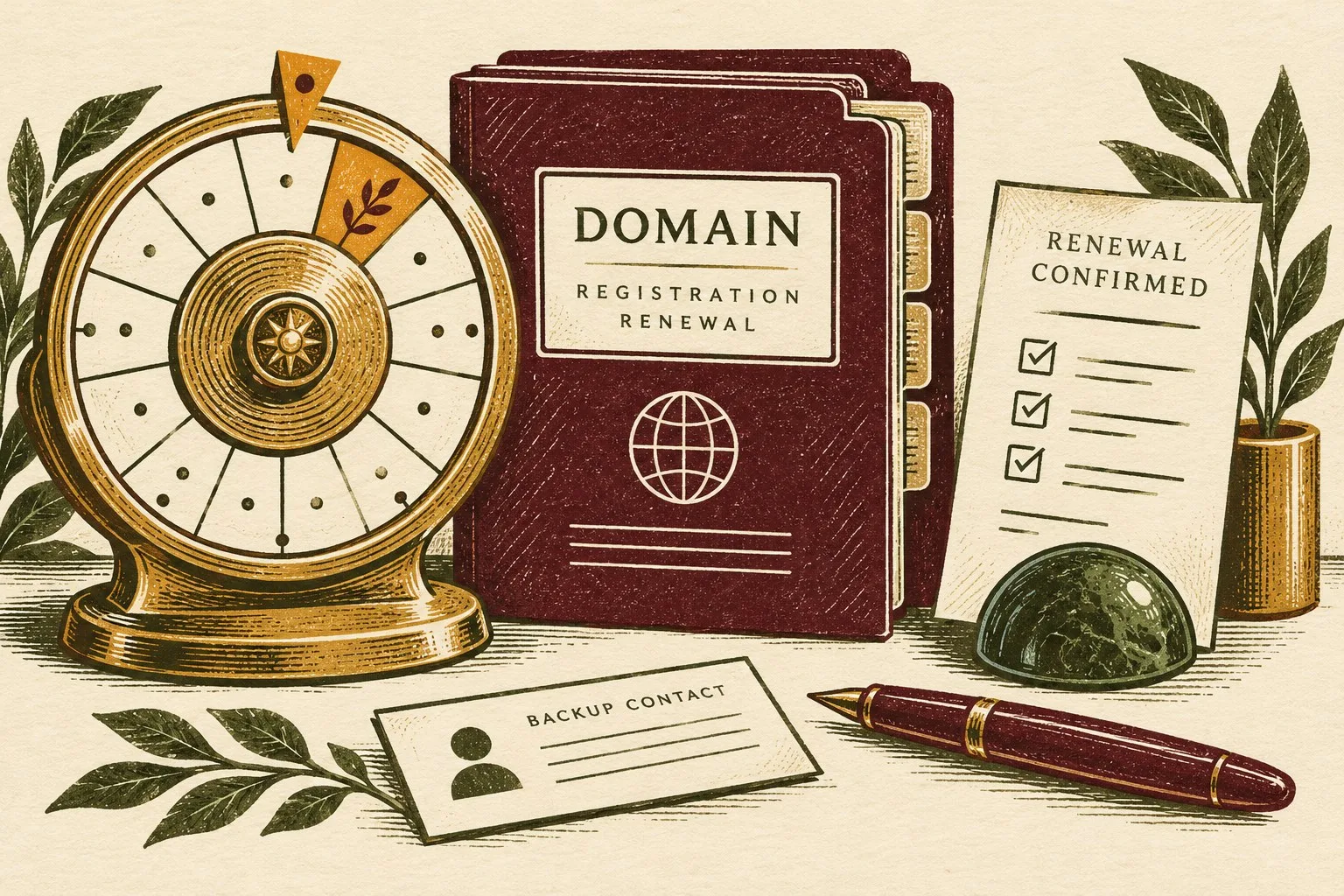
A domain renewal is a business continuity task. The domain may support a website, staff email, customer accounts and several background integrations. Missing its renewal can affect all of those services, even when the website hosting bill has been paid.
The safest approach combines reliable account details, a named renewal owner and evidence that the registration has actually been extended. Reminder emails and an enabled auto-renew setting are useful controls, but neither is a substitute for checking the result.
Build a complete domain register
List the main website domain, alternative spellings, campaign domains, defensive registrations and domains used only for email or technical services. For each, record the business purpose, registrar, registrant, current expiry date, billing owner and authorised recovery route. Store credentials in the business's secure account system, not in the register itself.
Check the information against the authorised registrar account. A spreadsheet last updated during a rebrand may no longer represent the live registration. Domain extensions can follow different renewal and expiry rules, so record the extension as well as the familiar name. Flag domains whose owner, support route or billing arrangement is uncertain.
Give the renewal an accountable owner
Assign someone to monitor renewal notices, maintain payment details and confirm completion. Give that role an appropriate backup when the person is away. If an agency manages renewals, agree the evidence it will provide and the escalation process when an invoice or notice is missed.
Use a monitored account contact that remains available if the administrator leaves. Consider how you would receive recovery communications if email on the affected domain stopped working. Account recovery arrangements should be established and tested through the provider's supported process while the account is healthy.
Check auto-renew settings and payment dependencies
Confirm which domains have auto-renew enabled, when the provider attempts payment and which payment method applies. Review card expiry, spending limits, account balances and invoice approval requirements. An enabled toggle does not guarantee successful collection. Providers can have different rules for how failed payments are retried or escalated.
Separate a renewal invoice from a completed domain renewal. Payment may require processing or an additional account action, while an advance invoice can be issued before the registration is extended. After payment, verify the provider's renewal confirmation and updated registration term. Resolve any mismatch before the existing expiry becomes urgent.
Use reminders as a second control
Maintain your own review dates ahead of expiry and check that registrar notices reach the intended contact. Review spam filtering and shared-inbox ownership where necessary. Do not rely on a reminder appearing in a single employee's personal inbox.
For many generic domain extensions, registrar renewal reminders are required around expiry under the applicable registration framework. The exact timing and process depend on the domain and provider. Country-code arrangements can differ. Build a workable internal calendar rather than assuming one extension's notice timetable applies to every domain in the business.
Understand expiry, restoration and deletion
Ask the registrar what happens if the domain expires: whether service is interrupted, how renewal can be completed, whether restoration is available and what costs apply. A grace period is a recovery possibility under particular rules, not permission to ignore the expiry date. Do not assume a domain will remain recoverable for a fixed period without checking the current applicable process.
Be especially careful with domains connected to email, identity verification or account recovery. Losing such a domain can disrupt access elsewhere. Record critical dependencies before deciding that an apparently unused registration can lapse. A domain with little website traffic can still support important private business operations.
Respond to an unexpected expiry
- Confirm the exact domain and current state through the authorised account.
- Contact the managing registrar using the established support route.
- Check the available renewal or restoration action and its conditions.
- Preserve evidence of payments, notices and account communications.
- After recovery, verify the registration term, DNS, website and email.
- Review the failed control and update ownership or monitoring.
If the domain is no longer registered to the business, do not assume an ordinary renewal payment will recover it. Establish its current status and the appropriate resolution route. Avoid responding to unsolicited recovery offers that ask for credentials or urgent payments without verification.
Treat non-renewal as a deliberate business decision
Before allowing a domain to lapse, identify its redirects, mailboxes, campaign links, printed references and account recovery uses. Move or retire those dependencies first. Obtain an authorised decision and retain a record of why the domain is no longer needed. A cancellation checkbox can affect more than the visible website.
Check defensive domains against current brand requirements. Renewing every historical registration indefinitely may be unnecessary, but dropping a recognisable former name can create customer confusion. Make the decision alongside the business's brand and customer communication plan.
Keep evidence after renewal
Update the register with the confirmed expiry, completion date and next review point. Recheck account contacts and recovery arrangements when staff, business ownership or providers change. If your registrar announces a procedural change, review how it affects notices and renewal operations rather than relying on an old checklist.
Giraffe Hosting can be your starting point for hosting and domain requirements. When renewals relate to a rebrand or website move, connect them with Giraffe Digital's branding service and the wider website plan. The required result is continued control of the domain and its dependencies, with a renewal outcome that has been verified.