
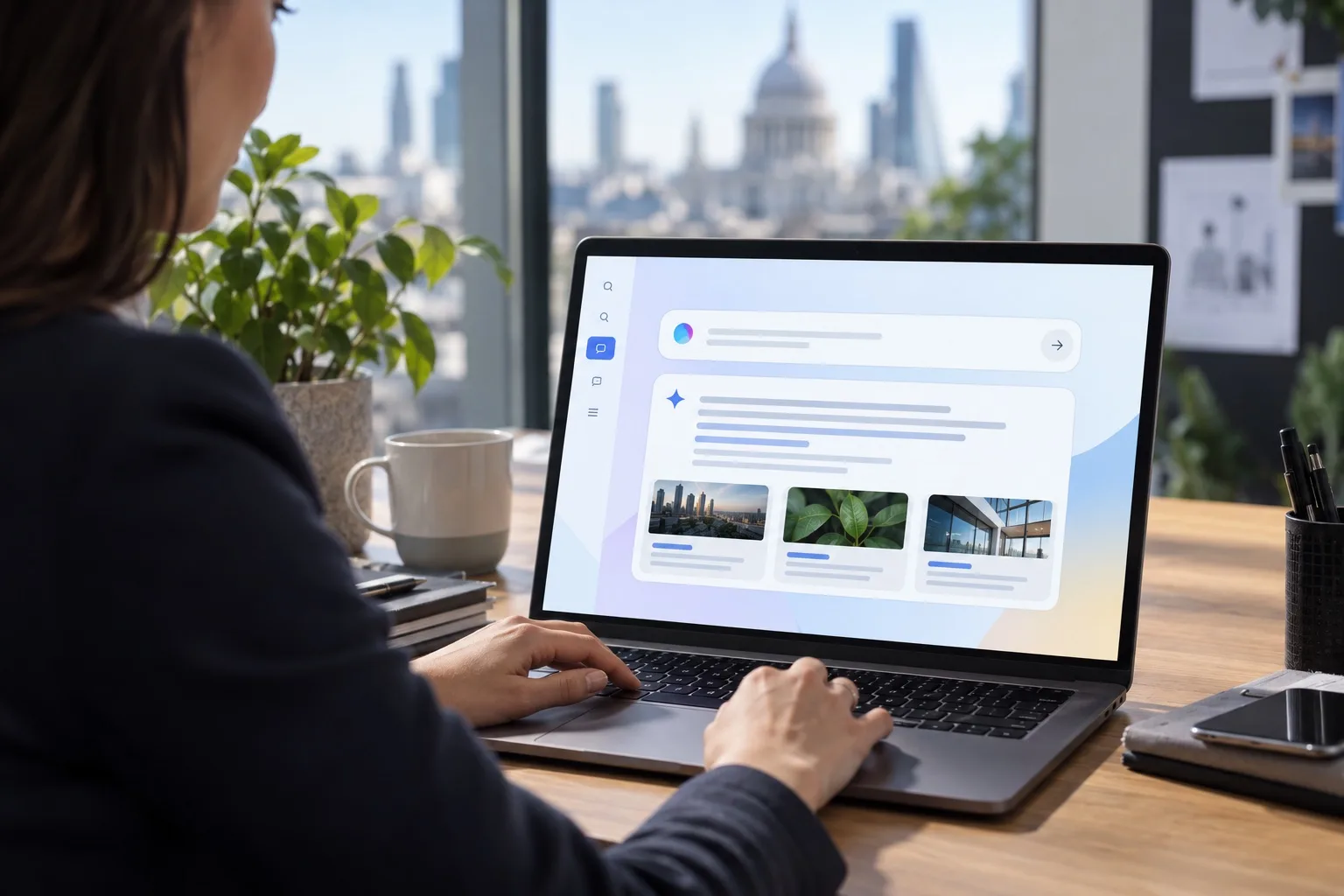
Google AI Mode is reshaping the way people move from a question to a decision. For UK business owners, the change is not only about rankings. It is about whether your brand is visible when search results are summarised, compared, cited and explored through longer, more conversational queries.
Search behaviour in 2026 looks less like a list of ten blue links and more like a guided journey. A potential customer might ask Google for advice, refine the question, compare options, check local credibility, read reviews, look for examples and only then visit a website. Some of that journey now happens inside AI-generated search experiences before a user clicks anywhere.
This does not make websites, SEO or brand building less important. It makes them more connected. If Google is going to summarise, cite or recommend information, it needs clear, trustworthy source material to work with. Your website, content, reputation and overall digital presence all contribute to whether your business is understood, surfaced and trusted.
What Google AI Mode means for search in 2026
Google AI Mode expands the role of search from answering keywords to handling more complex intent. Instead of typing short phrases such as website designer Portsmouth or best accountant near me, people are increasingly asking fuller questions, such as which website design company is best for a growing trade business that needs more local enquiries? or what should I check before choosing an SEO agency for a small UK business?
These longer queries give Google more context. They also allow AI-generated answers to draw together multiple points, including definitions, comparisons, warnings, next steps and links to supporting pages. In many cases, the searcher may see an answer that includes cited sources, product or service suggestions, local signals, reviews and follow-up prompts.
For businesses, the key shift is that visibility is no longer measured only by a traditional ranking position. You may also need to consider whether your pages are being cited, whether your brand is mentioned in AI answers, whether Google can understand your services and whether your wider online presence supports the claims on your website.
The search journey is becoming longer, even when it feels faster
AI answers can make search feel quicker because users receive an immediate summary. However, the decision-making process is often becoming more detailed. People can ask follow-up questions without starting again. They can compare providers, request pros and cons, ask for local options and test whether a recommendation fits their situation.
For example, a business owner may start with a broad question such as how can I get more enquiries from my website?. AI Mode may return an answer covering website structure, local SEO, service pages, conversion rate optimisation, trust signals and analytics. The user might then ask what does this mean for a building company in Hampshire? or which of these should I prioritise if my website is outdated?
That searcher is not simply looking for a page that repeats a keyword. They are looking for an informed, credible route forward. Your content needs to be useful enough to appear in that research journey and clear enough to encourage the next step when the user reaches your site.
Why brand visibility matters inside AI answers
In a traditional search results page, a business could rely heavily on title tags, meta descriptions and ranking positions. These still matter, but AI search experiences place more emphasis on entity understanding. In plain English, Google needs to understand who you are, what you do, where you operate, who you serve and why your information is reliable.
Brand visibility is not only about being well known. It is about consistency and clarity. A local service business can strengthen its visibility by having accurate service descriptions, a consistent business name, a well-maintained Google Business Profile, relevant reviews, strong location information, helpful website content and mentions from credible third-party sources.
If your website says one thing, your listings say another, and your content is thin or outdated, it becomes harder for search systems to interpret your business confidently. If your digital presence is consistent, specific and well structured, you give both users and search engines a clearer picture.
Cited content: why being useful is becoming more valuable
One of the most important questions for SEO in 2026 is whether your content is strong enough to be used as a source. AI-generated answers often rely on pages that provide clear explanations, original detail, structured information and evidence of expertise. Generic content that says the same thing as everyone else is less likely to stand out.
Cited content does not have to be academic or complicated. For many UK businesses, the most valuable pages are those that answer real customer questions with clarity. A solicitor might explain the stages of a conveyancing process. A web design agency might set out what a small business should prepare before a new website project. A heating company might explain common signs that a boiler needs attention, while making clear when a qualified professional should be contacted.
The common thread is usefulness. Content should be specific enough to help someone make progress. It should show experience, avoid vague claims and include details that demonstrate genuine knowledge. If an AI answer summarises your topic, your page should add something worth citing.
How longer queries change your content strategy
Longer search queries reveal the concerns behind a customer’s decision. Instead of optimising only for short keywords, businesses should build content around problems, comparisons, objections and next steps.
Consider the difference between SEO services and how long does SEO take for a local business with a small website?. The second query tells you far more about the user’s mindset. They may be cautious, budget-conscious, time-sensitive or unsure whether SEO is the right channel. A helpful page would explain how SEO builds over time, what can be improved early, what depends on competition and what a business should expect from a credible strategy.
This is where semantic SEO becomes important. Rather than repeating the primary keyword unnaturally, strong pages cover related topics naturally. Relevant topics include AI search, search intent, conversational search, cited sources, brand authority, Google Business Profile, content strategy, local SEO, entity SEO, structured data, E-E-A-T, customer journey and conversion optimisation.
Practical examples for UK businesses
Example 1: A local trades business
A roofing company may previously have focused on ranking for roofer near me and nearby town names. Those pages still matter. However, customers may now ask more detailed questions, such as how do I know if I need a roof repair or a full replacement? or what should I ask a roofer before booking an inspection?
The business could create service pages and advice articles that explain warning signs, common materials, inspection steps, guarantees, safety considerations and local coverage. It should also maintain accurate location information, collect genuine reviews and include photos of real work where appropriate. The aim is to become a clear, trusted source, not just another listing.
Example 2: A professional services firm
An accountancy practice may be found through queries such as what records should a limited company keep in the UK? or do I need an accountant if I use cloud accounting software?. These searches are often early-stage, but they influence trust.
Useful content could explain common responsibilities, decision points and when to seek professional advice. The firm’s website should make its sectors, services and locations clear. Team credentials, review signals, case-style explanations that avoid invented results, and regularly updated advice can all help search systems and users understand the firm’s expertise.
Example 3: An e-commerce brand
An online retailer may see customers using AI search to compare materials, sizing, delivery considerations, sustainability claims and alternatives. Product pages therefore need more than manufacturer-style descriptions. They should include clear specifications, FAQs, comparison information, care guidance, reviews and original imagery where possible.
If AI Mode summarises a product category, brands with richer, clearer information have a better chance of being included in the consideration set. That does not guarantee a click, but it can strengthen recognition and trust before the user reaches the website.
What to update on your website
Businesses should not respond to Google AI Mode by chasing every new feature. The stronger approach is to improve the foundations that make your website easier to understand, cite and trust.
- Clarify your core services: Make each main service easy to identify, with a dedicated page where appropriate.
- Answer real customer questions: Use sales calls, enquiry forms and customer conversations to identify useful topics.
- Improve page structure: Use clear headings, concise paragraphs, descriptive titles and logical internal links.
- Strengthen local relevance: Include accurate location information, service areas and local proof where relevant.
- Show expertise: Add author details, credentials, process explanations, examples of work and transparent advice.
- Keep information current: Review content regularly so guidance, terminology and service details remain accurate.
- Use structured data where suitable: Schema markup can help search engines interpret your organisation, services, FAQs, reviews and articles.
- Improve conversion paths: If a user reaches your site after a detailed AI-assisted journey, make the next step obvious.
How to think about clicks, impressions and measurement
AI search can change the relationship between impressions and clicks. Some users may get enough information from an AI answer and not visit a website immediately. Others may click fewer results, but arrive with stronger intent because they have already compared their options.
This makes measurement more nuanced. Businesses should still monitor organic traffic, rankings and enquiries, but they should also look at brand searches, assisted conversions, engagement quality, visibility across different query types and how often content appears for informational searches.
It is also worth reviewing the questions that bring users to your site. Longer, more specific queries can reveal high-value content opportunities. If people are searching for comparisons, risks, checklists or local advice, those are signals that your content should support a more informed journey.
Common mistakes to avoid
Some businesses are reacting to AI search by producing large volumes of thin AI-written content. This is unlikely to build lasting visibility. Search systems are increasingly focused on quality, originality and helpfulness. Publishing more pages is not the same as becoming more useful.
Another mistake is ignoring brand. If your website content is strong but your business information is inconsistent elsewhere, you weaken trust signals. Likewise, if you focus only on technical SEO and neglect the clarity of your offer, users may still leave without enquiring.
It is also risky to write only for search engines. AI Mode may summarise content, but people still make the final decision. Your website needs to sound credible, human and commercially clear. The best content supports both discovery and conversion.
A sensible action plan for Google AI Mode
- Audit your current visibility: Search for your services using natural, question-led queries and review what appears.
- Map your customer journey: Identify what people ask before they are ready to buy, book or enquire.
- Refresh priority pages: Improve your main service, location and product pages before creating large amounts of new content.
- Create source-worthy content: Publish articles, FAQs and resources that answer specific questions with genuine expertise.
- Build brand consistency: Check your business details, profiles, reviews, social channels and third-party mentions.
- Review technical foundations: Ensure your site is fast, mobile-friendly, crawlable, secure and logically structured.
- Measure quality, not just volume: Track enquiries, call quality, contact form relevance and assisted conversion paths.
FAQs about Google AI Mode and business search
Does Google AI Mode replace SEO?
No. It changes how SEO needs to work. Technical SEO, content quality, brand authority, local signals and user experience are still important. The difference is that your content may need to support AI-generated summaries as well as traditional search listings.
Will my website get fewer clicks?
Some informational searches may generate fewer clicks because users receive summaries directly in search. However, users who do click may be more informed and closer to taking action. The aim is to be visible throughout the journey and make your website persuasive when visitors arrive.
How can my business be cited in AI answers?
There is no simple switch that guarantees citations. Focus on creating accurate, well-structured, specific and genuinely helpful content. Support it with clear business information, relevant expertise, strong internal linking and consistent external signals.
Should I write longer content for every page?
Not necessarily. Longer queries do not always require longer pages. They require better answers. Some pages need depth, while others need concise clarity. The right format depends on the user’s intent and the complexity of the decision.
Is local SEO still important?
Yes. Local intent remains highly valuable, especially for service businesses. Accurate location signals, reviews, service areas, local landing pages and a well-managed Google Business Profile can all help customers and search engines understand your relevance.
Clear next steps for UK business owners
Google AI Mode is not a reason to panic. It is a reason to take your website, content and brand presence seriously. The businesses most likely to benefit are those that explain their services clearly, answer customer questions properly, maintain consistent information and build trust before the enquiry stage.
If your website has not been reviewed recently, start with the pages that matter most commercially. Are your services clear? Does your content answer the questions customers actually ask? Can Google understand where you operate and who you help? Are your calls to action easy to follow?
Giraffe Digital helps UK businesses improve website design, SEO, branding and digital strategy with a focus on long-term visibility and better enquiry quality. If you want your business to be easier to find, understand and choose in the age of AI-assisted search, now is the right time to strengthen the foundations.