
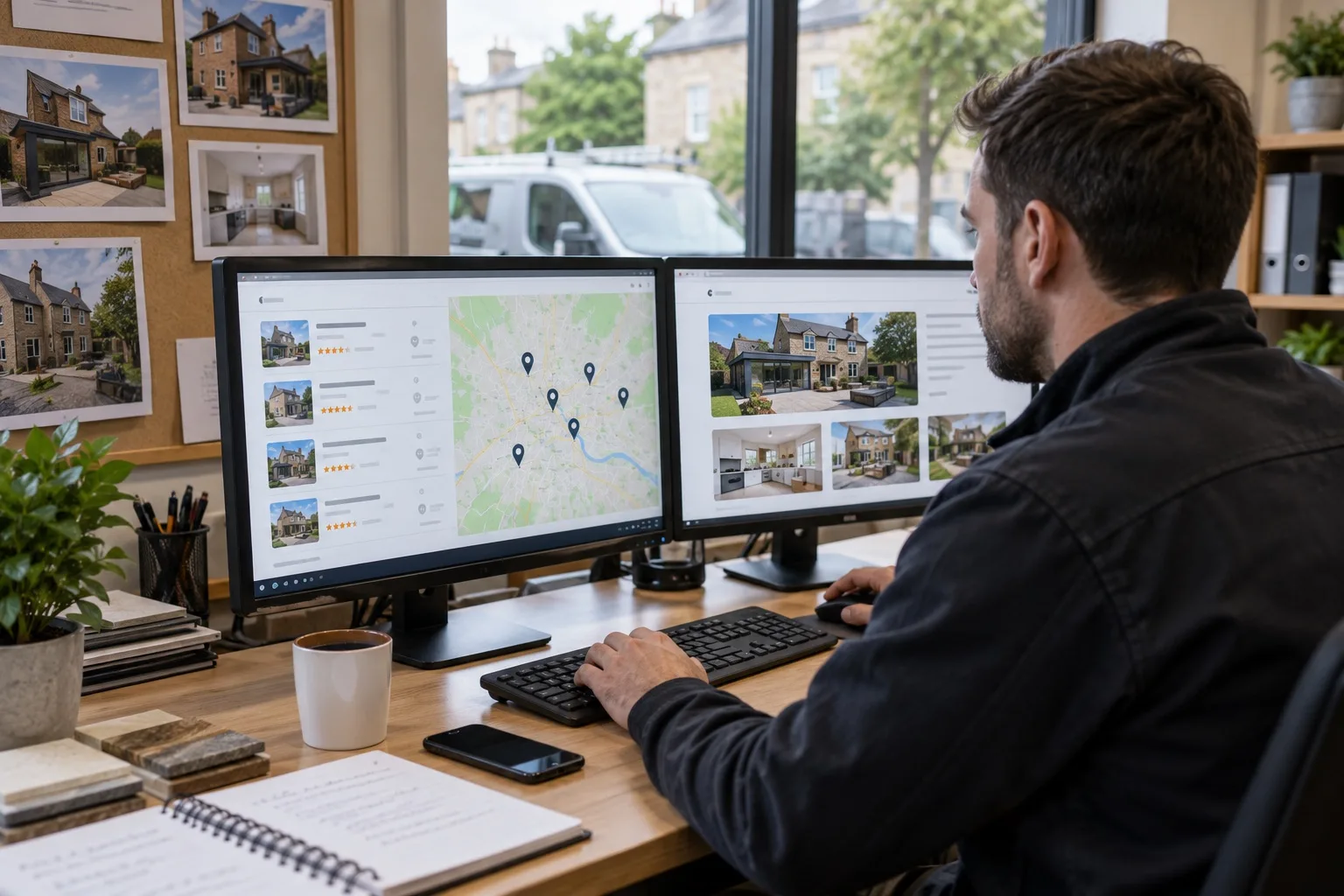
When someone searches for a service in their area, they are usually close to taking action. They may be comparing suppliers, checking who covers their postcode or looking for reassurance before making an enquiry. Strong local landing pages help that visitor move from uncertainty to confidence by showing that your business understands their location, offers the service they need and can be trusted to respond.
For UK businesses in 2026, local SEO is no longer just about adding a town name to a page title. Search engines, map results and AI-assisted search experiences are much better at spotting thin, duplicated or generic local content. The pages that perform best tend to combine genuine local relevance, useful service information, proof, reviews, clear contact options and a well-planned internal linking structure.
What makes a local landing page work
A local landing page is a page focused on a specific service area, town, city, region or branch location. It might target searches such as accountants in Exeter, commercial cleaning in Manchester, web design in Portsmouth or emergency electrician in Croydon. Its purpose is to answer a local searcher’s questions and encourage them to enquire.
The strongest pages do not feel like copied templates with the place name swapped out. They explain what the business offers in that location, why local customers choose it, how the service works, where the business operates and what the visitor should do next. They also connect with the wider website, so visitors can explore services, case studies, FAQs and contact options without reaching a dead end.
If your website already has local pages but enquiries are weak, the issue is often not the existence of the pages. It is the quality, usefulness and trust signals on those pages. Improving them can make a meaningful difference to search visibility, conversion rate and lead quality.
Start with genuine local detail
The most common mistake with local landing pages is using generic copy. A page that says we provide our professional service in Southampton and surrounding areas tells the visitor very little. It may also look very similar to pages targeting Portsmouth, Winchester or Bournemouth, which makes it harder for search engines to understand why each page deserves to rank.
Useful local detail might include the specific neighbourhoods, towns, business districts, roads, venues, industrial estates or landmarks you genuinely serve. It can also include local delivery considerations, parking or access information, regional customer needs, nearby branch details or service availability across a defined catchment area.
For example, a trades business serving Bristol could mention response areas such as Clifton, Bedminster, Redland, St George and Filton, but only if those areas are genuinely covered. A professional services firm in Leeds might explain its experience supporting businesses in the city centre, Headingley, Holbeck, Chapel Allerton and surrounding West Yorkshire towns. A hospitality supplier covering Cornwall could describe seasonal demand, rural delivery routes and support for coastal venues.
The aim is not to stuff in every nearby place name. The aim is to demonstrate real-world relevance. Visitors should recognise that the business understands their area, while search engines can see that the page has a specific local purpose.
Match the page to a clear search intent
Local searches can have different meanings. Someone searching for IT support Glasgow may want a managed support contract, emergency help, a local phone number or reassurance that an engineer can visit their office. Someone searching for wedding photographer Kent may want portfolios, venue experience, availability and reviews. The page needs to match the intent behind the query.
Before rewriting a local page, define the primary enquiry you want it to generate. Is the visitor looking for a quote, a consultation, a booking, a call-out, a brochure, a property valuation or an appointment? The wording, content structure and calls to action should support that objective.
A service-area page should usually answer these questions:
- What service is available in this location?
- Who is the service suitable for?
- Which nearby areas are covered?
- How does the enquiry or booking process work?
- What proof is available that the business is reliable?
- What should the visitor do next?
This focus helps avoid vague pages that rank for nothing and convert poorly. It also gives you a better foundation for wider SEO strategy, content planning and local search optimisation.
Use proof that feels specific and credible
Trust signals are especially important on local landing pages because the visitor may be comparing several nearby businesses at once. They want to know whether you are established, responsive and suitable for their needs. Proof helps reduce risk.
Good proof can include reviews, testimonials, accreditations, local project examples, trade memberships, awards, guarantees, qualifications, media mentions, before-and-after images, portfolio examples or short explanations of relevant experience. The key is to make the proof relevant to the service and location.
A page for office fit-out in Birmingham could include examples of work in the Midlands, descriptions of typical project types and sector experience. A page for family solicitor in Norwich might highlight professional accreditations, client care standards and appointment options. A page for digital marketing in Hampshire could link to broader digital marketing services, explain the team’s approach and show how discovery, strategy and delivery are handled.
Avoid inventing results or making claims you cannot evidence. Strong local pages are persuasive because they are specific, not because they exaggerate.
Make reviews work harder
Reviews are often one of the strongest conversion elements on a local page. In 2026, users are familiar with review snippets, star ratings, map listings and third-party platforms, but they are also more alert to unconvincing or overly polished praise. The best approach is to present reviews clearly, honestly and in context.
Rather than adding a generic review block at the bottom of every page, consider selecting reviews that relate to the service or location. If a customer mentions fast response in a specific town, helpful communication, project quality or aftercare, that review can support the page’s message. If you have multiple branches, make sure reviews are associated with the right location wherever possible.
You can also add a short paragraph explaining how feedback is collected and how your team responds. This reassures visitors that reviews are not decorative; they are part of how the business maintains service quality.
Embed maps and clarify service areas
Maps can help visitors understand where you are based, how close you are and whether you cover their area. For a business with physical premises, an embedded map can support trust and make it easier for visitors to plan a visit. For a service-area business, a map should be used carefully so it does not imply a public office where none exists.
Local landing pages should also make coverage clear in plain English. Instead of saying we cover the South East, explain which counties, towns or postcodes are included and where exceptions may apply. This is particularly useful for businesses with call-out areas, delivery zones, franchise territories or appointment-based services.
Keep your name, address and phone number consistent across your website, Google Business Profile, directories and review platforms. Inconsistent local business information can cause confusion for users and search engines. If you have multiple locations, each branch page should have its own accurate address, contact information, opening hours and local content.
Explain the services without overwhelming the page
A local landing page should not try to replace every service page on your website. It should summarise the relevant services available in that area and link to deeper pages where visitors can find more detail.
For example, a local page for a building contractor might introduce extensions, refurbishments, loft conversions and commercial projects, with internal links to separate service pages. A local page for an agency might introduce website design, SEO, branding and ongoing support, with each service linked to a dedicated page. This helps users move naturally through the site and helps search engines understand the relationship between your location pages and core service pages.
Keep the page focused on what matters to a local buyer. Explain common problems, the process, timescales where appropriate, what information you need from the customer and what makes your approach reliable. Avoid long lists of keywords that do not help the reader.
Strengthen internal links and page structure
Internal links are often overlooked on local landing pages. A page may be published, added to a footer and then forgotten. This limits its ability to attract authority from the rest of the website and can make it harder for visitors to find related information.
Useful internal links could include:
- Links from main service pages to relevant local pages.
- Links from local pages back to detailed service pages.
- Links to case studies, portfolio pages or sector pages.
- Links to the main contact page, quote form or booking page.
- Links between nearby location pages where it genuinely helps users.
- Links from blog articles that mention a local service or regional issue.
The anchor text should be natural and descriptive. Instead of repeatedly using the exact same keyword, vary the wording based on context. Phrases such as SEO support for local businesses, website design in your region or book a consultation with our team can be more helpful than repetitive keyword-heavy links.
If your website has grown over several years, it may be worth reviewing the structure as part of a broader website audit. Local pages often sit outside the main journey, which can weaken both SEO performance and enquiry generation.
Improve calls to action for local enquiries
A visitor should never have to work hard to contact you. Local landing pages need visible, specific and low-friction calls to action. A generic contact us link is better than nothing, but it can usually be improved.
Use wording that reflects the next step the visitor is likely to want. Examples include Request a local quote, Book a call with our team, Check availability in your area, Send us your project details or Arrange a consultation. The right wording depends on your business model and how customers prefer to enquire.
Make sure phone numbers, forms and email links work properly on mobile devices. Many local searches happen on phones, especially for urgent services. Forms should be short enough to complete quickly but detailed enough to qualify the enquiry. If you need more information later, ask for it after the first contact has been made.
Keep the technical foundations clean
Content and trust signals matter, but technical quality still affects local landing page performance. Slow pages, poor mobile layouts, broken links, intrusive pop-ups and confusing navigation can all reduce enquiries.
Check that each local page has a unique title tag, meta description, heading structure and readable URL. Use image alt text where it genuinely describes useful local or service-related imagery. Add relevant structured data where appropriate, such as LocalBusiness, Service or FAQ schema, ensuring it reflects visible page content.
Core Web Vitals, accessibility and mobile usability remain important because they influence how easy the page is to use. A page that looks professional but loads slowly or hides the enquiry form on mobile will lose potential leads. If your local pages were built quickly or copied from an older template, this is a good time to review them as part of your wider website maintenance.
Measure enquiry quality, not just rankings
Ranking higher is useful, but the real aim is better enquiries. Track phone calls, form submissions, booking clicks, map interactions and engaged visits from organic search. Where possible, record which local pages generate the most valuable conversations, not just the highest traffic.
Look for patterns. A page may receive fewer visits than a larger city page but generate stronger enquiries because the content is more specific. Another page may rank well but attract unsuitable leads because the service area, customer type or offer is unclear. These insights help you refine your local landing pages over time.
Regular improvements can include updating reviews, adding new project examples, refreshing service information, improving internal links, testing calls to action and expanding FAQ sections based on real customer questions.
FAQs about local landing pages
How many local landing pages should a business have?
Only create pages for locations you genuinely serve and can write about usefully. Ten strong pages with specific content, proof and clear service information are usually better than fifty thin pages that repeat the same wording.
Can I use the same copy for every town and change the place name?
No. That approach creates low-value pages and gives visitors little reason to trust you. Each page should include unique local detail, relevant services, specific proof and useful information for that area.
Should every local page include a map?
Not always. A map is useful for branches, showrooms, offices and customer-facing premises. For service-area businesses, it may be better to describe the coverage area clearly and avoid implying that customers can visit an address if they cannot.
Do reviews help local SEO?
Reviews can support both visibility and conversions, particularly when they are genuine, recent and relevant. They also help visitors decide whether to contact you, especially when they mention service quality, communication and local experience.
How often should local landing pages be updated?
Review important local pages at least a few times a year, and update them whenever your services, coverage, team, opening hours, reviews or examples change. Stale pages can lose relevance and miss opportunities to answer new customer questions.
Clear next steps
If your local landing pages are not generating the enquiries you expected, start with a focused review. Choose your most important service area page and assess it from the visitor’s point of view. Does it explain the service clearly? Does it prove local relevance? Are reviews visible? Is the next step obvious? Does the page link to useful supporting information?
From there, prioritise improvements that will help real customers first: clearer service descriptions, stronger proof, better internal links, more useful FAQs, improved mobile contact options and accurate local information. Search performance often improves when the page becomes more genuinely helpful.
Giraffe Digital supports UK businesses with website design, SEO, content strategy and digital growth planning. If you would like your local landing pages reviewed or rebuilt to attract better enquiries, speak to our team about a structured approach that connects local search visibility with a stronger user journey.