
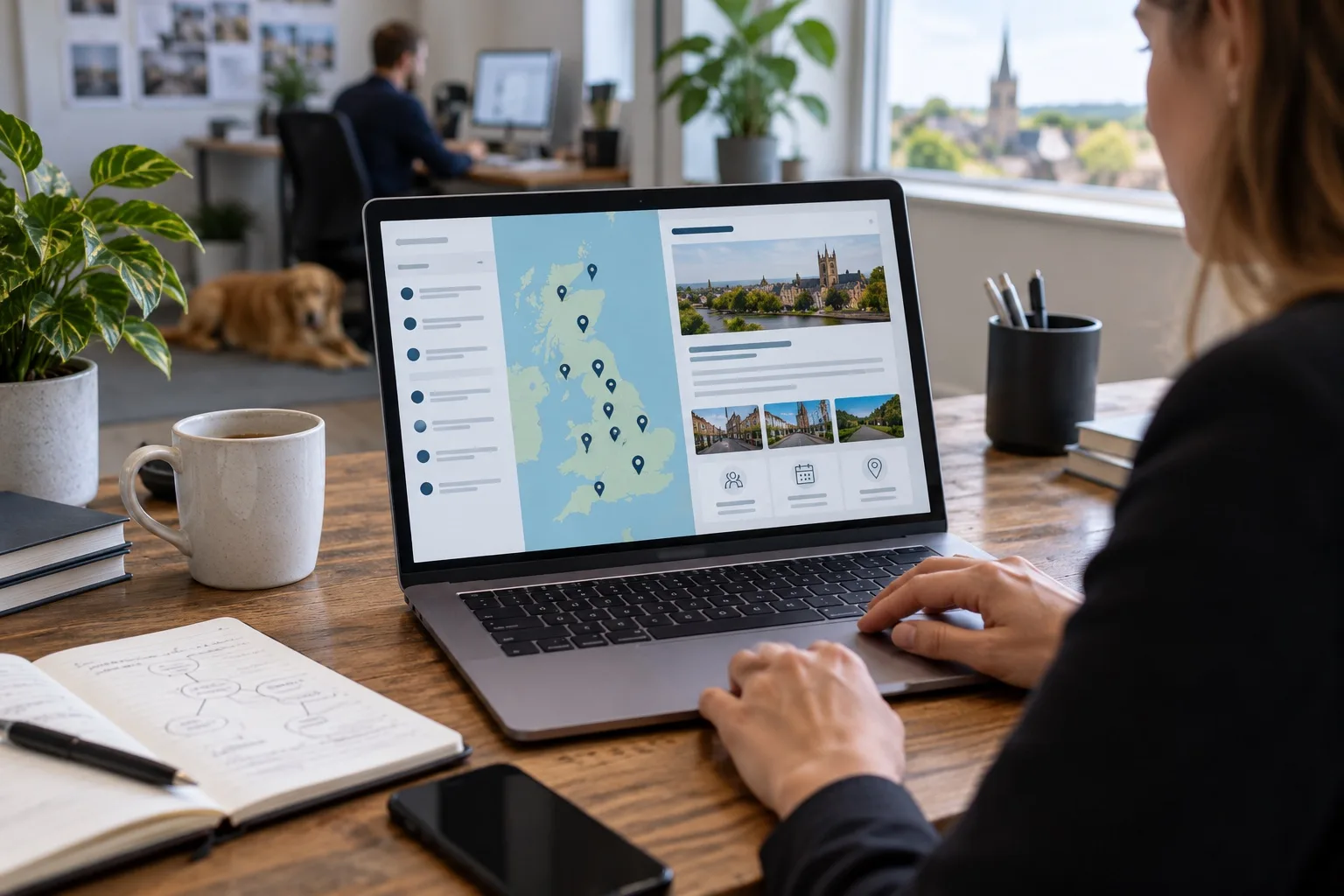
Service area pages are often created with good intentions: a business wants to show that it serves nearby towns, cities, counties or regions. The problem is that many of these pages end up saying almost the same thing, with only the place name changed. For UK business owners in 2026, that approach is increasingly weak. Search engines are better at recognising duplicated, low-value location pages, and visitors are quicker to spot pages that do not answer their local questions.
Useful service area pages still have a role in a strong local SEO strategy. They can help the right customers find the right service in the right place, but only when the page deserves to exist. That means adding genuine local context, practical information, relevant proof, helpful FAQs and clear next steps. The aim is not to create hundreds of near-identical pages. The aim is to build a smaller set of pages that support real decision-making.
What makes a service area page thin
A thin service area page is not simply a short page. It is a page that adds little or no unique value for the visitor. A 500-word page can be helpful if it answers a specific local need. A 1,500-word page can still be thin if it repeats generic wording and fails to explain anything meaningful about the area, the service or the customer’s situation.
Common signs of thin service area pages include:
- Changing only the town, city or county name across multiple pages.
- Using generic phrases such as “we are the leading provider in [location]” without evidence.
- Listing every nearby place purely for search visibility, rather than because the business genuinely serves those areas.
- Offering no local examples, travel considerations, delivery details, service limitations or regional context.
- Repeating the same FAQs across every location page.
- Adding stock imagery that does not relate to the area or the service.
- Creating doorway-style pages that funnel users to the same generic contact form without helping them decide.
For a UK business, this can damage trust as well as search performance. If someone in Guildford, York, Swansea or Aberdeen lands on a page that claims to be local but gives no sign that you understand their area, they may question whether the business is genuinely suitable.
Start with real service intent, not a list of place names
Before writing service area pages, decide which locations deserve their own page. A location should usually have a page only if there is meaningful demand, a genuine service relationship and enough useful information to say about that area.
Ask questions such as:
- Do we actively serve this area and want more enquiries from it?
- Are customers in this area searching differently from customers elsewhere?
- Can we explain anything specific about how we work in this location?
- Do we have relevant proof, examples or operational knowledge connected to the area?
- Would this page help a potential customer make a better decision?
If the answer is no, the location may be better mentioned on a broader regional page instead. For example, a business based in Hampshire might not need separate pages for every village it can reach. A strong “Website Design in Hampshire” page, supported by selected town-specific pages where there is clear demand and relevance, will often be more effective than dozens of weak variants.
Build each page around local usefulness
A strong service area page should explain how your service applies to that location. This does not mean forcing in local landmarks or writing awkward sentences about the high street. It means showing that the page has been written for real people in that place.
Include practical local context
Local context might include typical customer needs in the area, nearby business sectors, regional constraints, travel or delivery considerations, appointment availability, common property types, local competition, seasonal factors or relevant service differences.
For example, a web design agency writing a service area page for a coastal town might discuss the needs of tourism, hospitality and independent retail businesses, while a page for a city centre might focus more on professional services, recruitment, e-commerce or B2B lead generation. The service is still web design, but the commercial context is different.
Show how the service works in that area
Visitors often want to know what working with you will feel like. A useful service area page should explain the practical process in a location-aware way. That might include whether consultations are remote, on-site or hybrid; how discovery sessions are handled; whether you cover surrounding villages; or how quickly your team can respond to local enquiries.
For a website serving trades, property businesses, professional services or a digital agency, this is more helpful than a vague statement such as “we proudly serve businesses in the area”. The page should reduce uncertainty.
Add unique proof without inventing results
Proof is one of the strongest ways to make service area pages more credible, but it needs to be handled carefully. Do not invent case studies, named clients or results. If you have permission to reference a project, testimonial or review, use it accurately. If you do not, you can still provide useful evidence responsibly.
Examples of acceptable proof include:
- General descriptions of relevant project types, such as “recent brochure website projects for independent service businesses across the South East”.
- Anonymous examples where confidentiality is important, such as “a regional accountancy firm” or “a family-run e-commerce retailer”.
- Photos of completed work, team visits, premises, installations or local activity, where appropriate and permitted.
- References to accreditations, memberships, processes or guarantees that genuinely apply.
- Testimonials with permission, marked clearly and not over-edited.
For digital strategy, branding, SEO and website design services, useful proof might include screenshots of design systems, before-and-after navigation improvements, examples of content planning, structured discovery outputs or anonymised search visibility improvements. The important point is to connect the proof to the service and the area without making exaggerated claims.
A good service area page should make the visitor think: “This business understands my location, my type of problem and what I need to do next.”
Avoid duplicated location pages
Duplicated service area pages are usually created through templates. Templates can be useful for structure, but they become a problem when the substance of each page is almost identical. Search engines may choose not to index weak duplicates, and visitors may leave when the content feels automated.
Instead of duplicating the same page structure with small edits, create a content brief for each service area. The brief should identify what is genuinely different or relevant about that location. If there is nothing specific to say, do not create the page yet.
A better structure for service area pages
Use a consistent structure, but vary the content based on real relevance. A strong page might include:
- An opening that confirms the service and area clearly. Explain who the page is for and what problem you solve.
- Local context. Discuss the types of customers, businesses, properties or needs common in the area.
- Service detail. Explain what is included, how the process works and any local considerations.
- Proof or examples. Add relevant, truthful evidence that supports trust.
- FAQs. Answer questions specific to that area, not generic questions repeated across all pages.
- Clear next steps. Tell visitors how to enquire, what to prepare and what happens after they make contact.
This approach keeps pages consistent for users while avoiding repetitive, low-value content.
Write FAQs that reflect local search behaviour
FAQs are often added to service area pages because they are good for SEO. They are useful only when they answer genuine questions. In 2026, search results are increasingly focused on satisfying intent quickly, and weak FAQ blocks that repeat the same basic answers across every page rarely help.
Useful local FAQs might answer questions such as:
- Do you work with businesses outside the main town or city?
- Can meetings take place remotely or in person?
- How do you support multi-location organisations?
- Do you understand the needs of local independent retailers, hospitality businesses or professional firms?
- Can you help with local SEO as well as website design?
- What should a business prepare before requesting a proposal or consultation?
For example, a service area page for “SEO in Bristol” might include a question about supporting businesses that serve both Bristol and surrounding areas such as Bath, Weston-super-Mare or South Gloucestershire. A page for “Website Design in Manchester” might answer questions about designing websites for competitive city-centre service sectors. The questions should feel as though they belong on that page.
Use semantic keywords naturally
Service area pages should not be written around one repeated phrase. The primary keyword matters, but search engines and users both need broader context. Write naturally around related terms that support meaning.
Useful semantic phrases might include:
- local SEO
- location pages
- regional landing pages
- nearby towns and cities
- local search visibility
- customer intent
- service coverage
- local business enquiries
- Google Business Profile
- website content strategy
- conversion-focused content
Use these phrases where they make sense. A page that reads naturally will usually perform better than one that forces “service area pages” into every paragraph. Good SEO writing in 2026 is less about density and more about clarity, relevance and usefulness.
Make the page helpful beyond search
A useful service area page should support conversion as well as ranking. If a visitor lands on the page, they should understand whether you are right for them, what you offer, why you are credible and what to do next.
Include practical details such as:
- The specific services available in that area.
- Who the service is best suited to.
- Any limitations or areas not covered.
- How your process works from enquiry to delivery.
- What information a customer should provide when getting in touch.
- Links to relevant service pages, case studies, resources or contact options.
Internal links are particularly important. A service area page should not sit alone. Link it to the main service page, relevant blog articles, examples of work and nearby area pages where appropriate. This helps visitors continue their journey and helps search engines understand the relationship between your services and locations.
Examples of useful improvements
Here are a few practical ways to improve thin service area pages without starting from scratch.
Example 1: Replace generic claims with specific relevance
Weak wording: “We provide high-quality SEO services in Leeds for businesses of all sizes.”
Stronger wording: “We support Leeds businesses that need clearer search visibility across competitive local and regional markets, from independent professional service firms to e-commerce brands serving customers across West Yorkshire.”
The stronger version gives a clearer sense of who the service is for and why the area matters.
Example 2: Add operational clarity
Weak wording: “Contact our friendly team today to discuss your project.”
Stronger wording: “Most initial consultations are handled by video call, which works well for businesses across the wider Leeds area. For larger discovery projects, we can agree the best format during the enquiry stage.”
This answers a practical question and reduces friction for the visitor.
Example 3: Create local FAQs instead of copying them
Weak FAQ: “Do you offer web design in this area?”
Stronger FAQ: “Can you help a local service business rank in nearby towns as well as the main city?”
The stronger question reflects a real local SEO challenge faced by many UK businesses.
When not to create a service area page
Sometimes the best SEO decision is not to publish another page. If you cannot make a location page genuinely useful, it may be better to strengthen existing content.
You may not need a separate service area page if:
- The area has very low search demand and no strategic importance.
- You only occasionally serve the location and do not actively want more enquiries there.
- The content would be almost identical to another nearby page.
- You cannot provide any local relevance, examples or useful distinctions.
- A broader county, city or regional page would serve visitors better.
This is especially important for businesses that serve wide regions. A consultancy covering the whole of the UK does not automatically need hundreds of location pages. It may be more effective to create strong pages for key cities, sectors or regions, supported by informative service content and a well-optimised Google Business Profile where relevant.
How to review your existing service area pages
If your website already has service area pages, audit them before creating new ones. This will help you find duplication, gaps and opportunities.
Use the following checklist:
- Does each page clearly explain the service and location?
- Is the content substantially different from other area pages?
- Does the page include local context that is genuinely useful?
- Are there relevant examples, proof points or process details?
- Are the FAQs specific to that area or repeated everywhere?
- Does the page link to the main service page and related resources?
- Is there a clear next step for the visitor?
- Does the page attract impressions, clicks or enquiries?
- Would a real customer find the page helpful if search engines did not exist?
Pages that perform poorly and add little value can be rewritten, consolidated or removed. In some cases, several thin pages can become one stronger regional page. In others, a high-potential location page can be expanded with better local relevance and more useful conversion content.
FAQs about service area pages
How many service area pages should a business have?
There is no ideal number. A small local business may need only a handful of strong pages, while a regional organisation may need more. The right number depends on genuine coverage, demand, business priorities and your ability to create useful, distinct content for each location.
Should every town have its own page?
No. Creating a page for every town can lead to duplication and low-quality content. Focus on locations where there is a clear commercial reason, enough search demand and enough relevant detail to make the page worthwhile.
Can service area pages help local SEO?
Yes, service area pages can support local SEO when they are well written, accurate and genuinely useful. They work best as part of a wider strategy that includes strong service pages, local signals, reviews, internal linking, technical SEO and a well-maintained Google Business Profile where appropriate.
What should be different on each location page?
Each page should include distinct local context, service details, examples, FAQs and next steps. The difference should go beyond changing the place name. If two pages could be swapped without the visitor noticing, they are probably too similar.
Should service area pages include maps?
Maps can be useful if they help visitors understand coverage, office location or service boundaries. They should not be added purely for decoration. If you include a map, make sure the surrounding content clearly explains what areas you serve.
Clear next steps for better service area content
If your service area pages feel thin, start by prioritising quality over quantity. Identify the locations that matter most to your business, then build pages that genuinely help people in those areas understand your services. Add local relevance, honest proof, specific FAQs and clear conversion paths. Remove or consolidate pages that exist only for search engines.
For UK business owners, the opportunity is not to create more location pages for the sake of it. The opportunity is to create better pages that support trust, visibility and enquiries. If you need help planning service area pages, improving local SEO content or restructuring duplicated website content, Giraffe Digital can help you build a more focused, useful and search-friendly approach.