Website discovery turns uncertainty about customers and business operations into questions that can be investigated. It should give the team a sound basis for design decisions, including deciding which proposed work is unnecessary.
Start with the problem and current experience
Describe what people are trying to accomplish and how they currently do it. Include existing website visits, telephone conversations, documents, staff actions and follow-up. A website may solve one part of a longer problem.
For example, a customer seeking a repair may need to establish suitability, send photographs, agree access and receive an estimate. A new homepage cannot resolve an unclear handover between the enquiry and the estimate. Map the work supporting the service as well as the visible pages.
Separate evidence from assumptions
Collect sales questions, support records, analytics and examples of incomplete tasks. Record the scope and limitations of each source. A team's belief that customers prefer a particular layout is a hypothesis until it has suitable supporting evidence.
Agree the most consequential unanswered questions. Research should help decide what to do next, rather than merely validate a preferred design. Keep a simple record of the question, method, participants, findings and remaining uncertainty.
Ask about real decisions
Use open, neutral questions grounded in concrete experiences. Ask what the customer was trying to do, which information they sought and what happened next. Avoid suggesting that the proposed redesign would obviously have solved their problem.
Distinguish a participant's remembered account from direct observation. Both can be useful, but they have different limits. Include relevant circumstances such as device, confidence, accessibility needs and the urgency of the task.
Observe representative tasks without giving answers
In moderated usability work, give a realistic goal and observe how the participant attempts it. Do not tell them which menu or button to choose. Record the questions, misunderstandings and obstacles that arise.
For example, ask someone to find out whether a service covers their situation and how to request a quotation. Watch the sequence without coaching the route. If assistance becomes necessary, record it, so the result is not presented as independent completion.
Combine methods to understand the journey
Numerical evidence can show activity, while observation and interviews help explain questions and obstacles. Compare these perspectives without assuming a small research sample describes every customer. Preserve disagreement that needs further investigation.
People may explore options, narrow them and return to exploration through several channels. Avoid forcing every customer into a simple awareness-to-purchase sequence. Organise content around changing information needs and the actual service journey.
Analyse observations before choosing actions
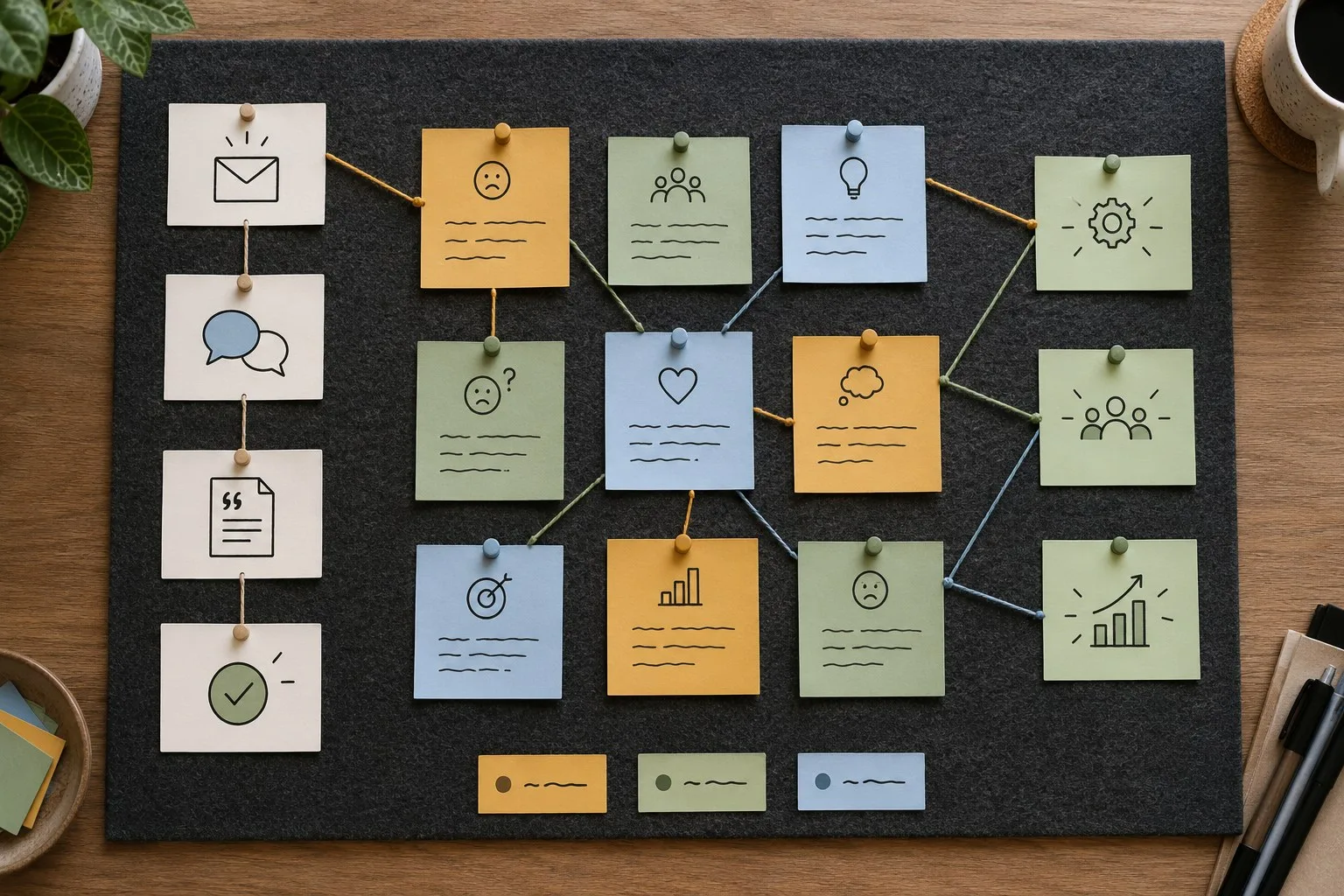
Keep an observation, interpretation and proposed action identifiable. Group related observations, discuss their meaning and check whether the evidence supports the finding. Do not silently convert an isolated comment into a universal design requirement.
Record what was said or observed clearly, subject to appropriate permission and data handling. An experience map should show meaningful stages, touchpoints, channels and dependencies. Its purpose is to reveal unresolved needs and responsibilities, rather than decorate a presentation.
Turn findings into a proportionate brief
Connect each priority to a user need, a business constraint and a way to verify the outcome. Assign an owner and decide what belongs in the first release. Keep assumptions that still need testing visible.
Review findings with the people who handle enquiries and maintain content. A useful discovery handover should explain why a design decision is being made and what evidence could cause it to change. Plan follow-up research around the most consequential uncertainty.
A discovery review checklist
- Identify the whole task and current service journey.
- Separate observed evidence from team assumptions.
- Prioritise neutral research questions.
- Observe realistic tasks without coaching.
- Preserve observations, findings and proposed actions separately.
- Connect the brief to owners and verification criteria.
Our requirements and user stories guide helps turn findings into testable work. The helpful content guide supports the information decisions behind a useful customer journey.