For many UK businesses, a website is no longer a brochure that can be built and forgotten. It is often the first place a potential customer checks before making an enquiry, visiting a shop, joining a mailing list or placing an order. That makes website security a commercial issue as much as a technical one. A secure, well-managed site protects customer confidence, supports your brand, reduces disruption and helps your search marketing work harder.
Security does not have to mean complicated jargon or unnecessary fear. Most problems arise from a small number of familiar weaknesses: poor passwords, neglected software, unsafe forms, weak hosting arrangements and domain names that are not properly controlled. By putting sensible procedures in place, business owners can reduce risk and make better decisions when planning a website design, redevelopment or digital marketing campaign.
Why website security matters to your business
A hacked website can cause several problems at once. It may display unwanted content, send visitors to another site, distribute malicious files or stop working. Even a small brochure site can be targeted, because many attacks are automated and look for common weaknesses rather than well-known brands.
The most obvious cost is lost business. If your site is unavailable when someone searches for your products or services, that enquiry may go elsewhere. If your contact form is abused, genuine messages may be missed among spam. If your site displays suspicious warnings, customers may assume the business is careless, even if the issue is quickly corrected.
There is also a search marketing consequence. Search engines aim to protect their users. If a site is found to contain malware, spam pages or deceptive redirects, search results may show a warning or the site may lose visibility until the issue is resolved. For businesses investing in SEO, content or online advertising, poor security can undermine months of work.
Security also affects brand perception. Professional website design should communicate trust through clear content, suitable imagery, good navigation, and reliable functionality. If that same site has broken forms, odd pop-ups or unauthorised pages appearing in search results, the brand message is weakened. Security is therefore part of good design and digital strategy, not a separate afterthought.
Start with sound hosting and clear responsibilities
Your hosting arrangement is the foundation of your website. A well-designed site can still be vulnerable if it is hosted on a poorly managed server. When choosing hosting, consider support quality, backup arrangements, server maintenance, and whether the package is appropriate for the site's purpose.
A simple brochure website, a busy content-managed site and an online shop do not all have the same requirements. An e-commerce site, for example, needs careful handling of customer data, secure payment processes and reliable uptime. A content-managed site may require regular updates to its publishing software, extensions and templates. A static site may be simpler to maintain, but it still requires secure file access and dependable backups.
Business owners should also be clear about who is responsible for what. Your web designer, developer, hosting provider and internal team may all have different roles. It is useful to agree who applies software updates, who monitors contact form spam, who holds domain account details, who receives renewal notices and who can restore the site if something goes wrong.
Do not assume that security is automatically included forever because a site was built professionally. Websites need maintenance. If your website uses a content management system such as WordPress, Joomla or Drupal, it should be reviewed regularly and kept up to date in a controlled way. Updates should be tested where appropriate, especially if the website has bespoke functionality or important enquiry forms.
Use strong passwords and control access
Weak passwords remain one of the simplest ways for attackers to gain access. A password such as a company name, town, football team, child's name, or common word can often be guessed or discovered. Passwords should be long, unique and not shared between services.
Every person who edits the website should have their own account where possible. This makes it easier to remove access when a member of staff leaves or when an external supplier's work is complete. Shared administrator logins may seem convenient, but they make accountability difficult and increase the chance that a password will be passed around by email.
Access should also match the role. A staff member who only needs to add news articles usually does not need full administrative control over the whole website. Reducing unnecessary privileges limits the damage that can be caused by a mistake or compromised account.
Consider how passwords are stored within the business. A reputable password manager or a carefully controlled internal process is better than sticky notes, spreadsheets sent by email or reusing the same password across hosting, email, social media and website administration. If an email account is compromised and contains login credentials for the company's online services, the problem can spread quickly.
Keep your website software maintained
Many business websites now use content management systems because they allow owners to update pages, publish news, and add images without having to ask a developer for every small change. This flexibility is valuable, but it comes with the responsibility of maintaining the software.
Common areas to review include the core content management system, themes or templates, plug-ins, modules, contact form scripts, image galleries and any third-party code used on the site. Old extensions that are no longer used should be removed rather than left in place. A forgotten plug-in can still be a route into the website.
Before adding a new feature, ask whether it is necessary, well supported and suitable for a business website. A slideshow, booking form, blog commenting tool or social sharing feature may improve usability or marketing, but every additional component should be chosen carefully. Simpler websites are often easier to maintain and quicker for visitors to use.
Maintenance should be planned rather than occasional. A monthly review is a sensible starting point for many small business sites, with more frequent checks for online shops or high-traffic sites. Keep a record of changes so that, if a problem appears after an update, it is easier to trace what happened.
Protect forms, enquiries and customer data
Contact forms, newsletter sign-ups and enquiry forms are valuable because they help visitors take action. They are also common targets for spam and misuse. A good form should collect only the information the business genuinely needs, explain what will happen next and be built in a way that reduces abuse.
For example, a simple enquiry form might ask for a name, email address, telephone number and message. It usually does not require a date of birth or other personal details. The less unnecessary data you collect, the less you have to protect and manage.
Forms should validate entries properly, both in the visitor's browser and on the server. This helps prevent obvious spam and reduces the risk of malicious code being submitted. If your site receives a high volume of automated messages, a carefully implemented verification step may help, provided it does not make the form frustrating for genuine customers.
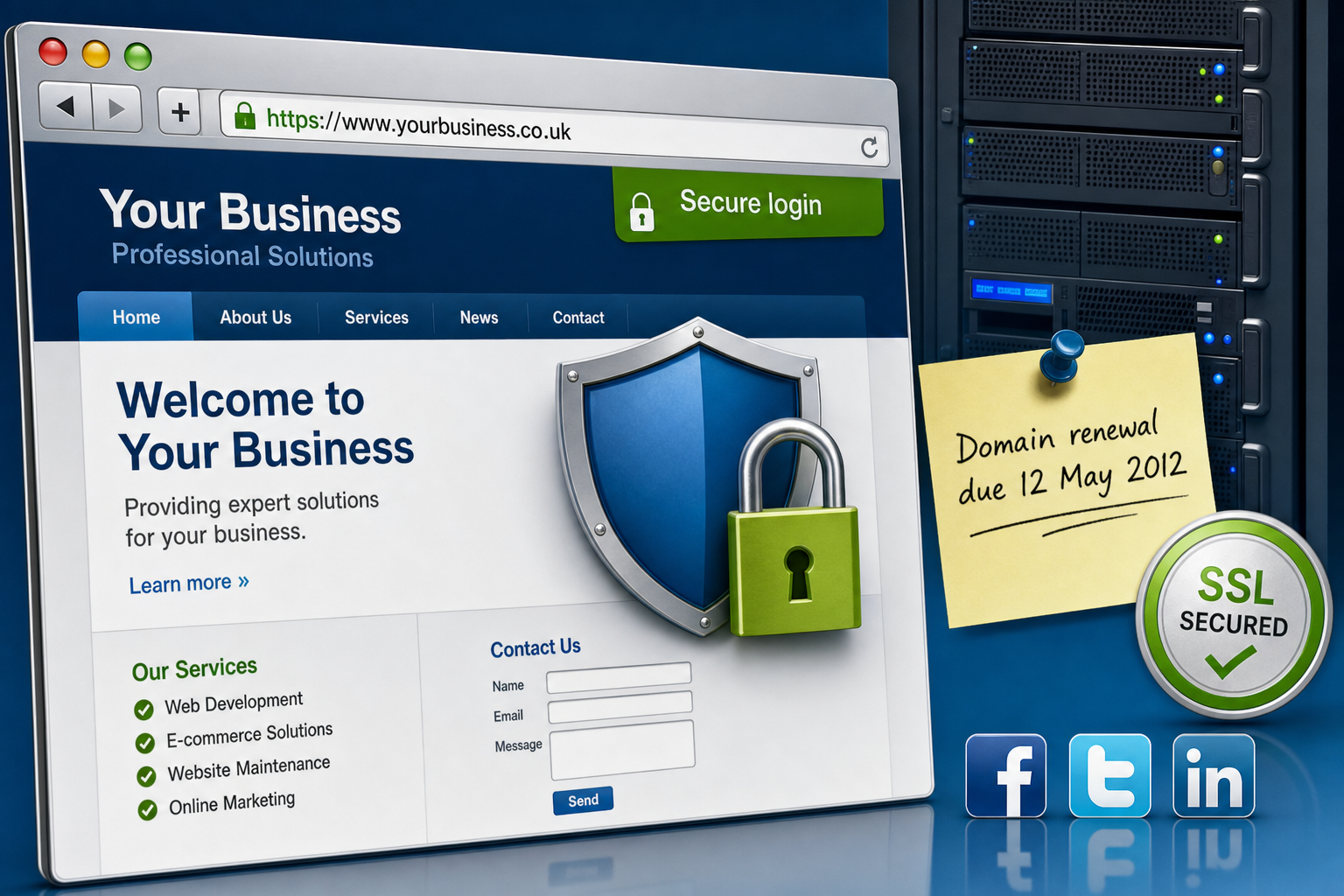
If visitors log in, submit confidential information, or make payments, an SSL certificate should be used on the relevant pages to encrypt data in transit between the visitor's browser and the website. Visitors are increasingly aware of the padlock symbol in the browser, particularly on Checkout and login pages. For e-commerce, secure handling of payment data and compliance with card-processing requirements should be discussed with the payment provider and the web development team.
It is also worth reviewing where enquiry emails go. If all website leads are sent to one person's inbox, what happens during holiday, illness or staff changes? A secure and reliable enquiry process is part of both customer service and website security.
Think carefully about domain registration
Your domain name is a core business asset. Losing control of it can be more disruptive than many owners realise. If the domain expires, points to the wrong website or is transferred without proper approval, customers may not be able to find you and email may stop working.
When registering a domain, make sure the registrant details reflect the correct business ownership. Avoid placing the domain entirely in the name of an individual employee or an external supplier unless there is a clear agreement and the business has access to the account. Keep contact details up to date so that renewal and administrative notices are not sent to an outdated email address.
It is sensible to register the most relevant domain for your business and market. Many UK businesses choose a .co.uk domain and may also secure the matching .com where appropriate. Consider common spelling variations if your brand is often mistyped, but avoid buying large numbers of domains without a clear reason.
Keep a secure record of where the domain is registered, when it renews, who can authorise changes and what name servers it uses. This information is especially important during a website redesign, a change of hosting or a move to a new email provider. Domain changes should be planned carefully because a small mistake can take a website or email offline.
Backups are your safety net
No security measure is perfect. A reliable backup allows a business to recover quickly if a site is damaged, deleted, or compromised. Backups should include both the website files and any database used by the content management system or e-commerce platform.
It is not enough to assume that backups exist. Ask how often they are taken, how long they are kept and how quickly they can be restored. A backup that has never been tested may not be useful when needed. For frequently updated websites, such as blogs, news sections or online shops, backups may need to be more regular than for a small static site.
Backups should not all sit in the same place as the live website. If the server fails or the hosting account is compromised, backups stored only on that same account may be lost as well. A sensible arrangement keeps copies separate and accessible to the people responsible for recovery.
For business continuity, document the recovery process. Who should be contacted first? Who has authority to approve a restore? Where are the latest clean files? Which parts of the site are most important to bring back quickly? Clear answers can save time during a stressful situation.
Security and website design should work together
Good website security should not make a site difficult to use. It should support a clear and trustworthy visitor experience. A well-designed site helps customers understand who you are, what you offer and how to contact you, while also reducing unnecessary risk.
For example, a professional login area should use clear labels, helpful error messages, and secure password handling. A Checkout should reassure visitors without cluttering the page with technical language. A contact form should be short enough to encourage enquiries but robust enough to reduce spam. A news or blog section should be easy for staff to update without giving them access to areas they do not need.
Security can also influence content planning. If your business publishes downloadable files, make sure they are clearly named, checked before upload, and kept in a tidy structure. If staff add images, they should use appropriate file types and avoid uploading unnecessarily large files that slow the site down. A faster, cleaner site benefits visitors and supports search engine optimisation.
During a redesign, security should be part of the brief. Ask your web team about update procedures, form handling, backups, user permissions, search engine-friendly redirects and the handover process. A launch checklist should cover more than visual approval. It should also confirm that old pages redirect correctly, forms work, analytics tracking is in place, password access is controlled, and the domain points to the correct hosting.
Social media, email and your wider online presence
Many businesses are using Facebook, Twitter, LinkedIn and YouTube alongside their websites. These channels can support brand awareness, customer service, and traffic to your site, but they also require sensible security practices.
Use strong, separate passwords for social media accounts and control who has access to them. If an employee or agency helps manage updates, decide how access will be removed when the arrangement changes. A compromised social account can damage trust quickly by posting spam links or misleading messages.
Be careful with shortened links, unexpected direct messages and requests to reconnect accounts. Staff who manage social media should know not to enter passwords into unfamiliar pages. If a promotional campaign directs users from social media to your website, make sure the landing page is secure, on-brand and consistent with the message being shared.
Email marketing should also be handled responsibly. Mailing lists should be permission-based, with clear unsubscribe options and accurate sender details. Sending from a properly configured business domain helps recognition and trust. If your email campaigns link back to your website, those pages should be current, relevant and functioning correctly.
A practical security checklist for business owners
Website security is easier to manage when it is broken into regular tasks. The following checklist is a useful starting point for small and medium-sized businesses:
- Keep website administration passwords strong, unique and controlled.
- Remove old users, unused plug-ins and unnecessary scripts.
- Update content management systems, themes and extensions on a planned basis.
- Use secure file transfer methods rather than sending login details casually by email.
- Check that contact forms work and are protected against obvious spam.
- Use SSL where visitors log in, submit sensitive details or make payments.
- Keep domain ownership details, renewal dates and account access up to date.
- Maintain reliable backups of files and databases, and test the restore process.
- Monitor search results and website traffic for unusual changes.
- Make security part of every website redesign or digital marketing review.
This list will not cover every possible technical risk, but it covers many of the issues that commonly affect business websites. For larger sites, online shops or organisations handling sensitive data, a more detailed security review is advisable.
Security supports trust, visibility and growth
A secure website gives visitors confidence and gives your business a stronger platform for marketing. It helps protect enquiries, online sales, search visibility and brand reputation. It also makes it easier for your web team to improve the site over time, because the foundations are controlled and documented.
Business owners do not need to become technical specialists, but they should ask informed questions. Who maintains the site? How are updates handled? Where are the backups? Who owns the domain? What happens if the site is compromised? Are forms and customer data being handled appropriately? These are practical questions that belong in any serious discussion about website design, SEO or digital strategy.
By treating website security as part of normal business housekeeping, rather than a one-off technical task, you reduce risk and improve the value of your online presence. A website that is secure, well-structured and easy to maintain is better placed to attract customers, support marketing campaigns and represent your organisation professionally.