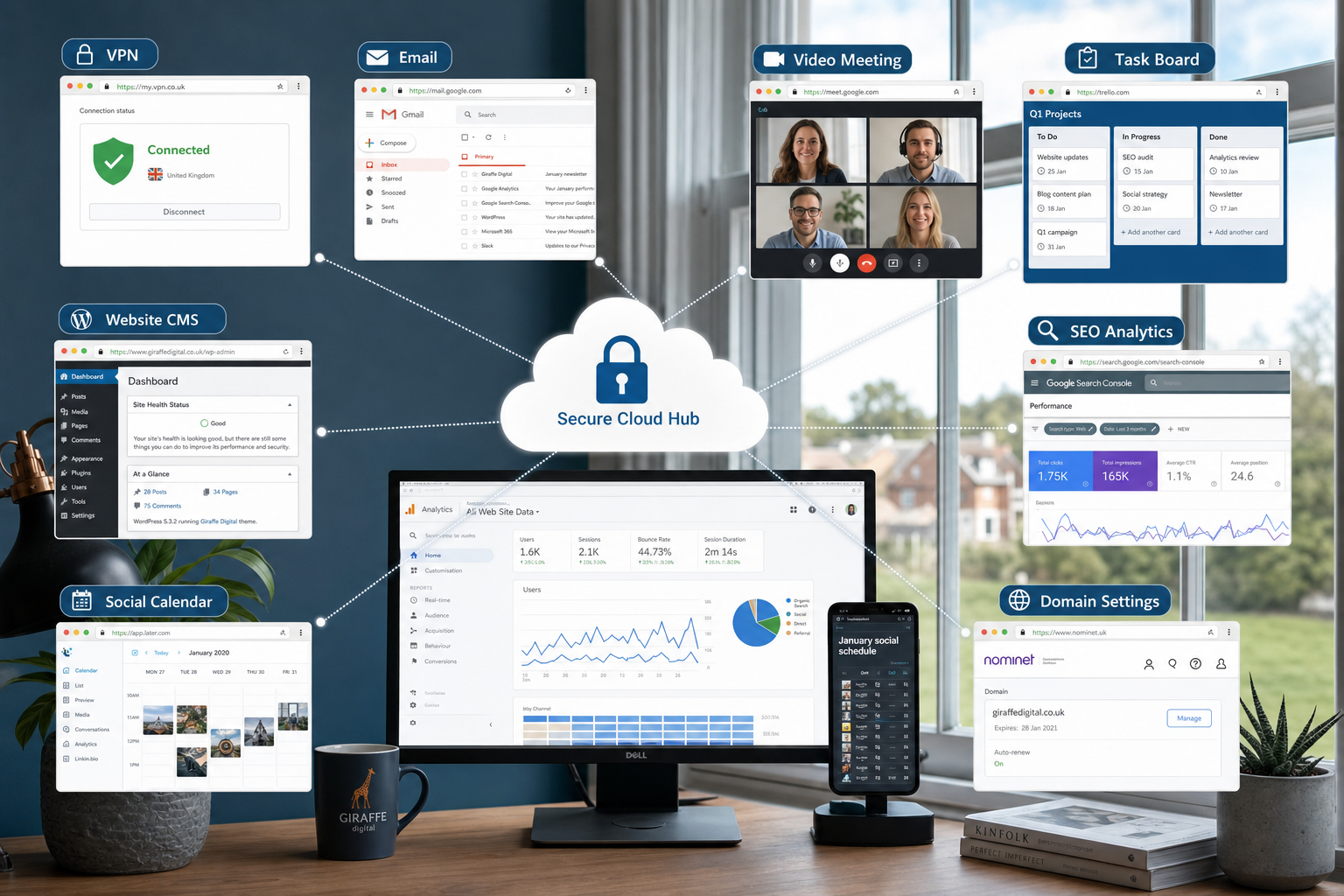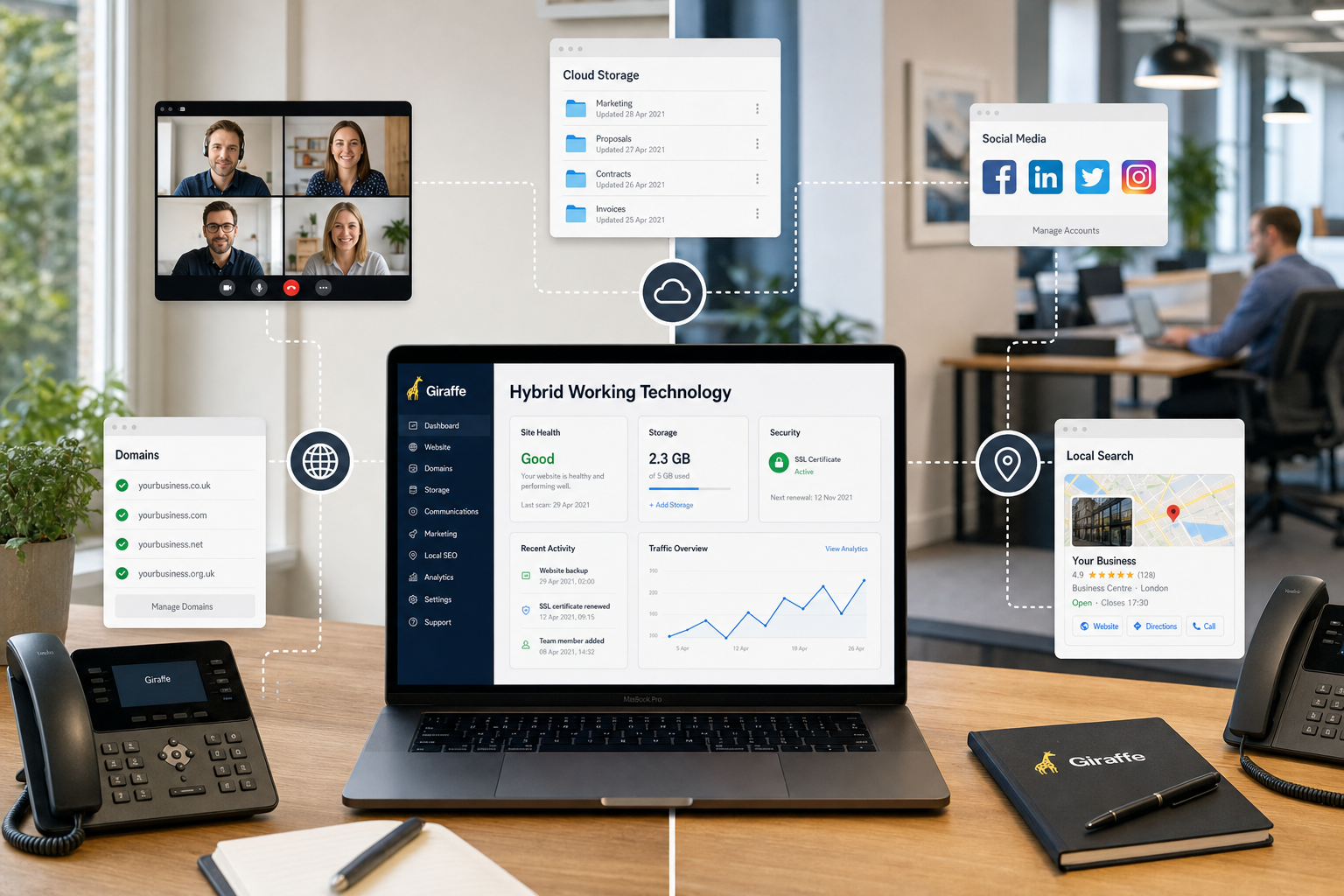
Hybrid working is no longer a temporary workaround for many UK businesses. After months of remote working, business owners are considering how to support staff, customers and suppliers across a more flexible mix of home, office and mobile working. That shift changes the role of technology. It is not simply about giving people a laptop and a video meeting link; it is about building a reliable digital foundation that helps your organisation communicate clearly, serve customers online and stay visible in search.
For small and medium-sized businesses, the most valuable hybrid working technology is practical, secure and joined up. Your website, domain name, email, social media channels, cloud systems and marketing activity should work together so customers can find you, understand your offer and get in touch without friction. Businesses that plan this properly are likely to gain better resilience, more efficient processes and stronger customer confidence.
Hybrid working technology is a business decision, not just an IT decision
Hybrid working affects how people communicate, how decisions are made, how customers are supported and how your brand is experienced. That means technology choices should be led by business needs, not by whichever tool happens to be convenient.
Start by mapping the everyday tasks your team needs to complete. For example, a sales team may need access to customer records, proposal documents, video calls and shared calendars. An operations team may need stock information, project updates and secure file storage. A customer service team may need phone routing, live chat, email templates and a clear process for handing work between colleagues.
Once those workflows are clear, it becomes easier to choose the right systems. Cloud-based document storage can reduce the need for email attachments. A shared project management platform can give managers visibility without constant meetings. A secure VoIP phone system can help customers reach the right person whether staff are in the office or working from home. The aim is not to add more technology for its own sake, but to remove uncertainty and make the business easier to run.
Good hybrid working technology should also support your customers. If your team is working across different locations, your website and digital channels become even more important as a central point of truth. Opening hours, service updates, contact routes, booking forms, delivery details and frequently asked questions should be easy to find and kept up to date.
Building a dependable technology foundation
Hybrid working depends on reliable access. If staff cannot reach the tools, documents and data they need, productivity will suffer and customers may notice delays. A dependable foundation should include connectivity, devices, cloud systems, security and support.
Connectivity and devices
Home broadband, office networks and mobile connections now form part of the same working environment. Businesses should agree minimum expectations for connection quality where possible and provide guidance on safe home working practices. Staff should know how to connect securely, how to report issues and what to do if their usual connection fails.
Devices also need to be managed sensibly. Company-owned laptops and mobiles make it easier to apply updates, antivirus protection and access controls. Where personal devices are used, there should be clear rules about what can be accessed, how data is stored and how work accounts are protected. Consistency matters because hybrid working often exposes weaknesses that were less obvious when everyone worked from one office.
Cloud systems and collaboration
Cloud-based email, calendars, shared files and collaboration platforms are central to hybrid working. They allow teams to access the latest information from different locations and reduce dependence on a single office server. However, cloud adoption should be planned. Folder structures, permissions, naming conventions and version control need attention; otherwise, a business can quickly replace filing cabinets with a confusing collection of shared drives.
Video meetings are useful, but they should not be the default answer to every communication problem. Short written updates, shared task boards and clear decision logs can often save time. Encourage teams to choose the right channel for the job: instant messages for quick checks, email for formal updates, project tools for task ownership and video calls for discussions that benefit from face-to-face conversation.
Security and access control
Security is a major concern for hybrid businesses. Staff may be accessing systems from home networks, shared spaces or mobile connections. Strong passwords, multi-factor authentication, regular software updates and clear access permissions are essential. Sensitive files should only be available to the people who genuinely need them.
Businesses should also review how leavers, temporary staff and external suppliers are managed. Removing access promptly is just as important as granting it. If your business handles customer data, financial information or confidential documents, your hybrid working arrangements should be reviewed alongside your data protection responsibilities.
Your website becomes the central hub for customers
When customers cannot always visit in person or reach the same office contact, your website carries more responsibility. It should explain who you are, what you do, who you help and how people can take the next step. A dated or confusing website can make a business look less prepared, even if the service behind it is excellent.
Website design for hybrid working should focus on clarity and conversion. A visitor should be able to understand your core services within seconds. Contact options should be visible and suitable for the way your business operates. If you offer appointments, consultations, remote demonstrations, quotes or callbacks, make those actions easy to complete.
Useful website improvements include:
- Clear contact routes: phone, email, enquiry forms and booking options should be easy to find.
- Service pages with specific detail: avoid relying on one broad services page if customers search for individual services.
- Trust signals: include case study summaries, accreditations, testimonials where you have permission, and clear business information.
- Mobile-friendly design: many customers will browse from phones, especially when researching quickly.
- Fast-loading pages: compressed images, efficient hosting and tidy code help users and search visibility.
- Helpful content: answer common questions so customers can make informed decisions before contacting you.
For businesses offering remote consultations or hybrid service delivery, it is also helpful to explain the process. Tell visitors whether meetings can take place by phone or video, what information they should prepare and how follow-up will be handled. This reduces uncertainty and helps customers feel comfortable engaging with you online.
Search marketing should reflect changing customer behaviour
Search behaviour has changed as people look for services that are accessible, responsive and digitally capable. A strong search marketing strategy helps your business appear when customers are actively looking for help. In February 2021, the fundamentals remain important: relevant content, sound technical performance, mobile usability, secure browsing and a clear site structure.
Start with keyword research that reflects how customers now describe their needs. A professional services firm might find that people are searching for remote consultations, online advice or local support. A retailer may need to optimise pages for delivery, collection or appointment-based browsing. A business-to-business supplier may need content that reassures customers about continuity, lead times and support.
Local search is particularly important for many UK businesses. Keep your business listings accurate, including opening hours, contact details, service areas and website links. If your office is open by appointment only, or your services are delivered remotely, make that clear. Consistency across your website, listings and social profiles helps customers and search engines understand your business.
Technical SEO also deserves attention. Your site should use secure HTTPS pages, load quickly, work well on mobile devices and be easy for search engines to crawl. Page titles and meta descriptions should be written for real users, not stuffed with keywords. Internal links should guide visitors from general information to more specific service pages.
Content marketing can support hybrid working by addressing customer concerns directly. For example, you might publish guidance on how your remote consultation process works, how customers can prepare for an online appointment, or how your business is maintaining service quality. These articles can support search visibility while also reducing repeated questions for your team.
Social media needs consistency and purpose
Social media has become an important bridge between businesses and customers. It can show that your organisation is active, available and responsive. However, successful social media marketing is not about posting constantly; it is about sharing useful, relevant updates that support your wider business goals.
For many UK businesses, LinkedIn is valuable for professional relationships, recruitment, business updates and thought leadership. Facebook can support local communities, events and customer service conversations. Instagram may be useful for visual brands, retail, hospitality, interiors, design, fitness and lifestyle businesses. Twitter can be effective for timely updates, industry conversations and signposting useful resources.
A hybrid working social media plan might include:
- Updates about service availability, opening arrangements or appointment options.
- Short explanations of how customers can work with you remotely.
- Behind-the-scenes content showing your team, processes or values.
- Links to helpful website guides, FAQs or service pages.
- Customer questions answered in plain English.
- Recruitment or culture posts that reflect flexible working arrangements.
It is also worth agreeing who is responsible for monitoring messages and comments. If staff are working from different places, enquiries can be missed unless ownership is clear. Social media should connect back to your website wherever possible, so interested users can find fuller information and take action.
Domain names, email and brand consistency
Your domain name is a key part of your digital identity. It affects your website address, your email addresses and how customers remember your brand. As hybrid working increases reliance on digital communication, a professional domain becomes even more important.
When choosing or reviewing a domain, aim for something clear, memorable and easy to spell. UK businesses often consider extensions such as .co.uk, .uk or .com, depending on audience, availability and brand plans. If your business serves a specific region, you may also want to consider whether location terms help customers understand what you offer, although long or awkward domains can be harder to remember.
It is sensible to register obvious variations where appropriate, such as common misspellings or closely related extensions, so customers are less likely to land elsewhere by mistake. Keep ownership details, renewal reminders and access credentials organised. Your domain should be registered to the business or an appropriate business owner, not left under an old supplier account that may become difficult to access later.
Professional email addresses using your own domain help reinforce trust. A customer is more likely to feel confident contacting a business with a consistent branded email address than one using a generic personal mailbox. Email authentication and security settings should also be configured correctly to reduce the risk of delivery issues and impersonation.
Connecting digital marketing with day-to-day operations
Hybrid working technology is most effective when it is connected to practical business processes. A website enquiry form should not disappear into an inbox nobody checks. A social media message should have a clear owner. A new lead from search marketing should be followed up quickly and recorded in a suitable system.
Consider how information flows from the first customer interaction through to delivery and follow-up. For example, a visitor may find a service page through Google, complete an enquiry form, receive an email response, book a video consultation and then receive documents through a secure cloud folder. Each step should feel professional and consistent.
This is where digital strategy becomes valuable. Rather than treating website design, SEO, social media, email, hosting and cloud tools as separate tasks, businesses can plan them as one connected customer journey. That makes it easier to measure what is working and identify where improvements are needed.
Useful measurements might include website enquiries, phone calls from key pages, search visibility for priority services, social media referral traffic, email response times and conversion rates from consultations to confirmed work. The right figures will depend on your business, but they should link back to commercial goals rather than vanity metrics alone.
Planning your next steps
For many businesses, the move to hybrid working has happened faster than expected. It is understandable if systems have been added quickly to solve immediate problems. The next step is to review what you have, remove unnecessary complexity and invest in the areas that support long-term growth.
A practical review could begin with these questions:
- Can staff securely access the systems and information they need from approved locations?
- Is our website clear about our services, availability and contact options?
- Are our domain, email and brand assets properly controlled and documented?
- Do our search marketing and social media activities reflect how customers now make decisions?
- Are enquiries captured, followed up and measured consistently?
- Do customers receive the same quality of service whether we are working remotely, in the office or across both?
Hybrid working technology should make your business more resilient, not more complicated. With the right mix of secure systems, a well-designed website, consistent branding and focused digital marketing, UK businesses can support flexible working while improving the customer experience.
If your organisation is reviewing its website, search visibility or digital strategy, now is a good time to think beyond short-term fixes. A joined-up approach can help your technology support your people, strengthen your online presence and give customers confidence in the way you work.