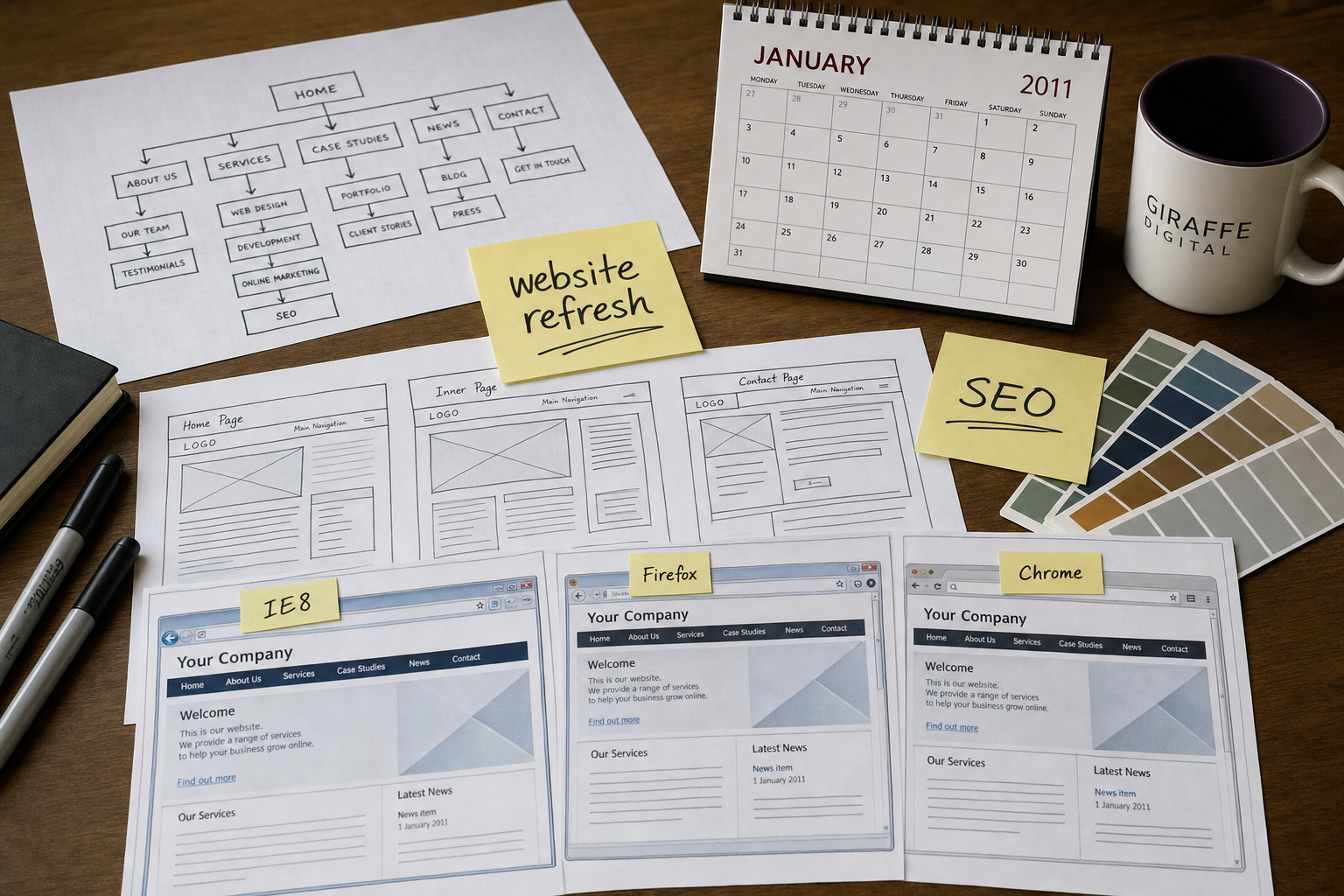
A website refresh can be one of the most useful business improvements to plan before the New Year. For many UK companies, the website is now the first place a potential customer will check before making an enquiry, visiting a shop, booking a meeting or asking for a quotation. If the site looks dated, is difficult to update, performs poorly in search engines or fails to explain what the business actually does, it can quietly cost enquiries every week. The good news is that a refresh does not always mean starting again from scratch. With the right plan, a business can improve design, content, usability, search visibility, and day-to-day management while preserving the value already built into the site.
Why plan a website refresh now
The end of the year is a sensible time to review how well your website is supporting the business. Marketing plans, sales targets and budgets are often being discussed, which makes it easier to connect the website to wider commercial goals rather than treating it as a standalone design project. A refreshed site can help communicate your current services more clearly, support new campaigns, give sales staff a better reference point and make it easier for customers to take the next step.
Many business websites still carry content written several years ago. Staff may have changed, services may have developed, and the language customers use when searching may no longer match the wording on the site. A website refresh is an opportunity to bring everything into line: branding, messaging, page structure, photographs, calls to action and search engine optimisation.
It is also worth consideringvisitors'e expectations. Broadband use is more common, screens are larger and more varied, and customers are increasingly comfortable comparing suppliers online before making contact. At the same time, many people still browse using older versions of popular browsers, so a refresh should be modern without excluding those visitors. The best approach is not to chase every new web technique, but to create a reliable, useful website that presents the business well and encourages action.
Start with a clear business purpose
Before discussing colours, layouts or software, define what the website needs to achieve. A brochure-style website may need to generate telephone enquiries, explain services and establish trust. An online shop will need clear product information, secure Checkout, delivery details, and customer support content. A professional services firm may need to demonstrate its expertise through articles, case studies, team profiles, and clear contact points.
Useful questions include:
- Who are the most important audiences for the website?
- What do visitors need to know before they contact the business?
- Which services or products should be most prominent?
- What actions should a visitor be encouraged to take?
- Which pages currently bring in enquiries, and which are underperforming?
- What information does the sales team regularly explain over the phone or via email?
Answering these questions early keeps the refresh focused. It also helps avoid the common problem of designing a site around internal preferences rather than visitor needs. The most effective business websites make important information easy to find and give visitors the confidence to contact them.
Review the existing website before changing it
A good website refresh begins with an audit. This does not need to be overly complicated, but it should identify what is working, what is missing and what may be holding the site back. Check your website statistics to see which pages are visited most often, which search terms driveterms drive traffic, where visitors leave the site, and whether enquiries can be traced to particular sections.
Look at the site from a customer's perspective. Is it immediately clear what the business does and where it operates? Are the contact details easy to find? Does the site explain why someone should choose you rather than a competitor? Are the photographs, testimonials and examples of work still representative of the business?
Technical checks are equally important. Broken links, missing page titles, slow-loading images, outdated code and confusing navigation can all affect performance. If pages have attracted links from other sites or have established search visibility, they should be handled carefully during the refresh. Removing or renaming important pages without proper redirects can reduce traffic and cause avoidable frustration for visitors.
Improve design without losing clarity
Design plays a major role in how a business is perceived online. A refreshed design can make a company appear more credible, more current and easier to work with. However, good web design is not only about decoration. It should support the content, guide visitors through the site and make key actions obvious.
For a 2011-ready website, consider a clean layout, consistent typography, strong headings, well-edited images and clear calls to action. The home page should quickly communicate who you are, what you offer and what the visitor can do next. Service pages should be structured around customer questions rather than internal jargon. Contact pages should include telephone numbers, email options, enquiry forms and, where relevant, a map and opening hours.
Be cautious with design trends that add movement or complexity without improving the user experience. Large image banners, animations, n and rich media can be effective when used sparingly, but they should not obscure important content or unnecessarily slow the site. Some visitors will still be using older computers or browsers, and business websites need to work reliably for as many genuine customers as possible.
Make content useful, current and persuasive
Content is often the difference between a website that looks pleasant and one that produces enquiries. During a website refresh, review every important page. Remove outdated claims, rewrite vague descriptions and add the practical details that customers need when comparing suppliers.
Strong business website content usually includes:
- Clear service or product explanations written in plain English.
- Benefits that relate to customer problems, not just internal features.
- Evidence of experience, such as project summaries, accreditations or sector knowledge.
- Frequently asked questions that reduce uncertainty before enquiry.
- Prominent contact details and straightforward enquiry prompts.
- Fresh news, advice, or blog content that the business has the capacity to maintain.
A blog or news section can support search visibility and demonstrate expertise, but only if it is kept reasonably active. An abandoned news page with the last update from several years ago can do more harm than good. If regular publishing is unrealistic, consider a smaller resources section with carefully written evergreen advice.
Search engine optimisation during a refresh
Search engine optimisation should be considered from the start of a website refresh, not added at the end. Search engines need to understand what each page is about, and visitors need clear, relevant content when they arrive. A well-planned refresh can improve both.
Begin with keyword research based on the language customers actually use. A business may refer to a service internally by one name, while customers search for another. Page titles, headings, body copy and internal links should reflect relevant phrases naturally. The primary aim is to create useful pages, not to awkwardly repeat keywords.
Important SEO considerations include:
- Unique, descriptive page titles for all key pages.
- Helpful meta descriptions that encourage clicks from search results.
- Clean, readable web addresses where practical.
- Logical navigation and internal links between related pages.
- Fast-loading images that are properly sized and described.
- An XML sitemap to help search engines discover pages.
- Permanent redirects from old page addresses to suitable new ones.
If the website serves a local area, make location information clear. Include the areas you cover where it is useful for customers, and keep business contact details consistent across the website and reputable directory listings. For many local companies, search visibility is closely connected to clear contact information, relevant local content and a trustworthy online presence.
Avoid short-term tricks. Search engines are becoming better at identifying low-quality content, excessive linking schemes and pages created purely for rankings. A sustainable website refresh should make the site more useful, more accessible and easier to understand.
Choose technology that suits the business
The technology behind a website should support the business rather than create unnecessary complexity. Some companies need a simple content-managed site so staff can update pages, add news and upload documents. Others need e-commerce, customer logins, booking forms or integration with internal systems. The right choice depends on the site's purpose, the team's ability to maintain it and the likely direction of the business over the next few years.
A content management system can be a strong option if regular updates are required. It should be easy enough for authorised staff to use, but controlled enough to prevent accidental damage to the design or structure. Ask how pages are created, how images are handled, how users are managed and how backups are taken.
It is also sensible to discuss browser support. A refreshed website should display well in current versions of major browsers and remain usable in older versions that your customers may still rely on. This is particularly important for business-to-business websites, where visitors may be browsing from workplace computers with restricted software updates.
Mobile browsing is worth considering too. More people are using smartphones to check addresses, telephone numbers and basic information while away from their desks. A full mobile strategy may not be necessary for every business, but contact details, maps and key content should not be hidden behind features that fail on smaller devices.
Domain names and web addresses
Domain names are a practical part of planning a website refresh. If your existing domain is established, has been used for several years and is already known by customers, changing it should not be taken lightly. A new domain can be useful after a rebrand, merger or major change of business focus, but it requires careful planning to avoid losing visitors and search visibility.
When registering a new domain, keep it clear, memorable and appropriate for the business. For UK companies, a UK-focused domain can be suitable where the target audience is mainly domestic, while a broader option may be useful for organisations with international ambitions. Avoid confusing spelling, unnecessary hyphens and names that are too similar to other organisations. It is also wise to secure relevant variations where there is a clear business reason, such as protecting a brand name or supporting a planned campaign.
Before committing to a domain, check that it fits the wider brand. Consider how it will sound when read aloud over the phone, how it will appear on printed materials and whether email addresses using that domain will look professional. If a domain change is required, plan redirects from the old addresses to the new ones and update stationery, email signatures, directory listings and marketing materials.
Connect the website with social media marketing
Social media is becoming a useful part of many businesses' marketing plans, but it works best when integrated with a solid website. Profiles on networks such as Twitter, Facebook, LinkedIn and video-sharing sites can help businesses share updates, answer questions, promote events and build relationships. However, social activity should usually lead interested people back to a website that explains the offer clearly and converts attention into enquiries.
During a website refresh, consider where social media fits. Add links to active profiles, not to empty accounts. Make it easy for visitors to share useful articles where appropriate. If the business produces videos, presentations, or guides, create website pages that properly introduce that material rather than relying entirely on external platforms.
Social media also provides useful listening opportunities. Questions asked by customers online can inform blog posts, FAQ pages and service descriptions. If people regularly ask the same question on a social network, that is a strong sign the answer should be visible on the website.
Protect enquiries with a better conversion path
A refreshed website should not only attract visitors; it should help them take action. Many business websites lose enquiries because the next step is unclear. A visitor may like what they see, but if they cannot find a telephone number, cannot understand the enquiry form, or are unsure whether the business serves their area, they may leave.
Each key page should have an appropriate call to action. This might be "Call us to discuss your project", "Request a quotation", "Book a consultation" or "Visit our showroom". The wording should match the buying process. A complex service may need a softer first step, such as an initial conversation, while a simple product may support a more direct enquiry.
Forms should ask only for the information needed at that stage. Long forms can be useful for detailed project briefs, but they can also discourage early enquiries. Offer alternatives where possible, such as a telephone number and a simple email option. If enquiries are valuable, make sure they are delivered reliably and that someone in the business is responsible for responding promptly.
Create a practical refresh plan
A website refresh is easier to manage when broken into clear stages. Start with discovery and planning, then move into structure, content, design, build, testing and launch. Rushing straight into visual design can lead to delays later if the content, navigation, n and technical requirements have not been agreed upon.
A sensible plan may include:
- Audit the current website, statistics, rankings and enquiries.
- Define goals, audiences and priority actions.
- Map the new site structure and decide which pages are needed.
- Prepare or rewrite content before final design decisions are made.
- Develop the visual design around the brand and user journey.
- Build the site using suitable, maintainable technology.
- Test forms, links, browser display, page speed and search engine basics.
- Prepare redirects, analytics tracking and launch checks.
- Review performance after launch and make improvements where needed.
Testing is particularly important. Check the site on different browsers, screen sizes and devices where possible. Ask people outside the project team to use the site and report anything confusing they encounter. Small improvements made before launch can prevent missed enquiries and support a smoother introduction.
Measure success after launch
A website refresh should not end on launch day. Once the site is launched, monitor its performance. Review visitor numbers, enquiry levels, popular pages, search phrases and form completions. Look for pages where visitors leave quickly and consider whether the content, layout or call to action needs improvement.
Search engines may take time to process changes, especially if the site structure has altered. Keep an eye on important pages and ensure redirects are working correctly. If a page previously attracted useful traffic, make sure the new equivalent is easy to find and properly optimised.
It is also helpful to collect feedback from staff and customers. Sales teams often hear whether customers found the site useful. Reception staff may notice when callers ask questions that should be answered online. These observations can guide future updates and help the website continue to improve.
Final thoughts before the New Year
A successful website refresh is not simply a new look. It is a chance to make the website work harder for the business: clearer messaging, stronger design, better search visibility, more useful content and easier enquiry routes. By planning carefully before 2011, UK business owners can enter the year with a website that better reflects their organisation and supports their marketing activity.
The most valuable websites are built around customers' needs and business objectives. If your current site feels dated, is difficult to update or no longer represents what you offer, now is a good time to review it. A thoughtful refresh can protect what already works, correct what does not and give your digital marketing a stronger foundation for the year ahead.