For many UK businesses, the website is now the first meaningful point of contact with a potential customer. Visitors may arrive from search engines, social media updates, email campaigns, online advertising, printed materials or a recommendation from a friend. Wherever they come from, they make quick decisions about whether a business looks credible, careful and worth speaking to. HTTPS security is becoming a more visible part of that judgement.
HTTPS is not just a technical detail for banks and large retailers. It is a practical way to protect information as it travels between a visitor’s browser and your website. It also gives customers a clearer sign that your organisation takes online trust seriously. If you are planning a new wewebsite designreviewing your search marketing or updating your didigital strategyn 2014, HTTPS deserves a place in the conversation from the start.
What HTTPS security actually does
HTTPS stands for Hypertext Transfer Protocol Secure. In simple terms, it is the secure version of the standard web connection used when someone visits a page. It uses SSL or TLS technology to encrypt the information sent between the visitor and the web server.
Without HTTPS, data sent through a website can be easier to intercept on shared networks, public wireless connections or poorly secured systems. That may include contact form enquiries, login details, email addresses, order information or other personal information. HTTPS helps to prevent that information from being read or altered while it is in transit.
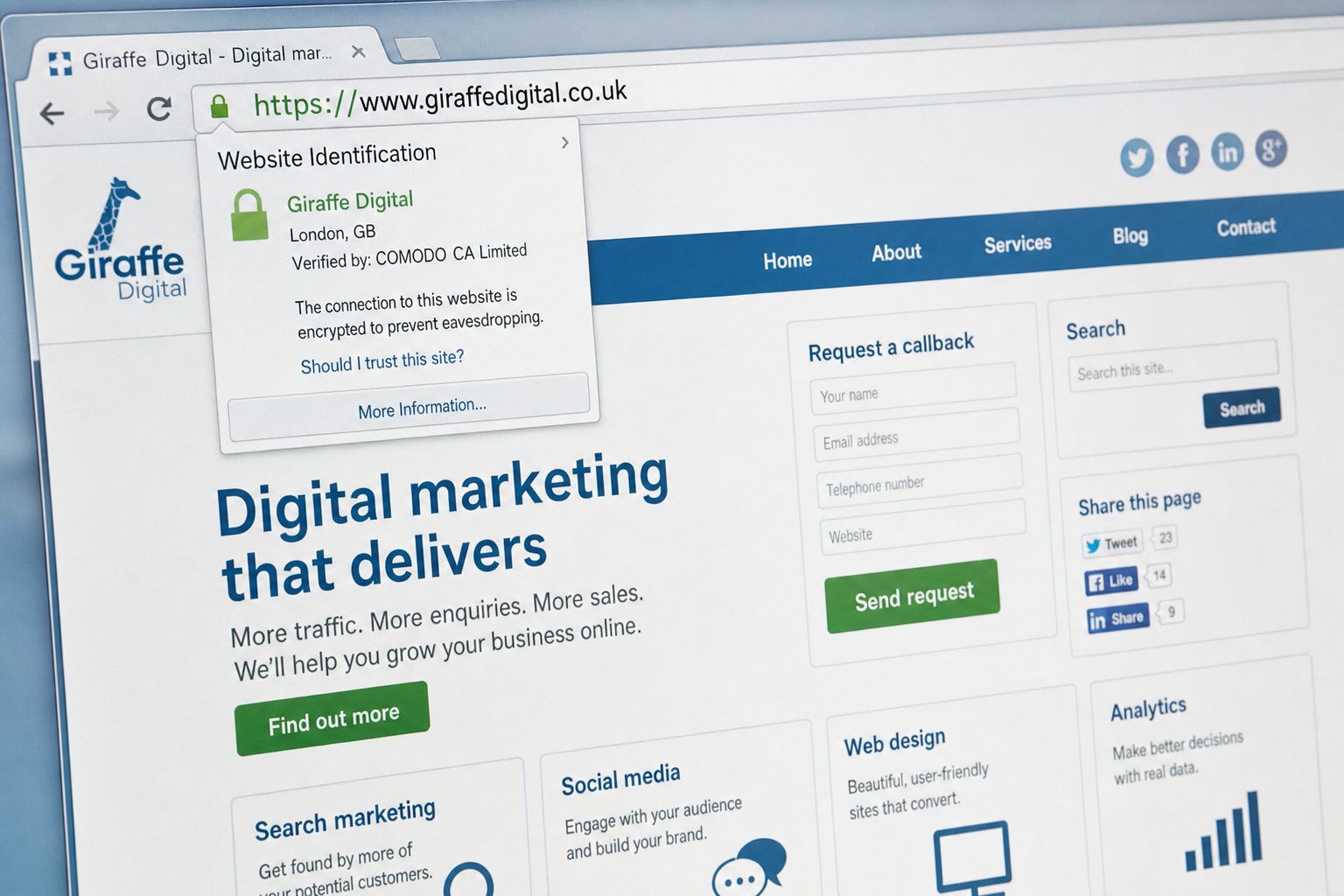
Visitors normally see HTTPS in the address bar, often alongside a padlock symbol. Depending on the browser and the type of certificate used, some sites may also display the organisation name more prominently. These visible signals matter because people are becoming more aware of online risk. Even when customers do not understand the technical detail, many recognise that a secure connection is a positive sign.
Why this matters for business websites
Some business owners still assume that HTTPS security is only essential if they take card payments online. Payment pages absolutely need strong security, but the argument no longer stops there. A lead generation website, professional services site, membership area, booking form or brochure site with a contact form can all handle information that deserves protection.
Consider a local accountancy firm with an enquiry form asking for a name, email address, telephone number and a short message. That message could include sensitive financial information. A recruitment agency might receive CVs or employment history. A private healthcare provider may receive appointment requests. A manufacturer might receive details of a commercial project that is not yet public. In each case, a secure website helps to reduce unnecessary exposure.
HTTPS also supports brand confidence. If your website design is polished but the browser gives no secure signal at the moment a visitor is about to submit a form, that final step can feel weaker than it should. Trust is not created by one design element alone. It is built through clear branding, useful content, professional presentation, straightforward navigation, visible contact information and careful handling of customer data. HTTPS contributes to that overall impression.
Planning HTTPS as part of website design
The best time to think about HTTPS is before a website is built or redesigned. It can be added later, but it is usually cleaner to plan the secure structure at the beginning. This allows your web designer, developer and hosting provider to make decisions that support the whole site rather than treating security as an afterthought.
A good website project should consider which pages need secure connections, how forms will be handled, whether customers will log in, how enquiries are stored and how content management access is protected. It is often sensible to run the whole website over HTTPS rather than only securing a payment or login page. This gives visitors a consistent experience and reduces the risk of secure and non-secure elements being mixed together on the same page.
Mixed content is a common issue when a secure page loads images, scripts or other files over a non-secure connection. Browsers may show warnings, block elements or remove the secure padlock. These warnings can undermine trust quickly. When planning a site, make sure templates, images, style sheets, forms and third-party scripts are reviewed carefully so the secure version works properly across the full customer journey.
Certificates and the level of assurance
To use HTTPS, a website needs an SSL certificate from a certificate authority. The certificate helps prove that the visitor is connecting to the correct website and enables the encrypted connection. There are different levels of validation, and the right choice depends on the nature of the organisation and how much assurance visitors are likely to need.
A basic domain-validated certificate confirms control of the domain name. This can be suitable for many smaller websites where the main requirement is encryption for forms and general browsing. Organisation-validated certificates involve checks on the organisation behind the site, which can be useful where a more formal business identity is important. Extended validation certificates apply more detailed checks and can display stronger visual trust indicators in many browsers.
Whichever route is chosen, it is important that the certificate is correctly installed, renewed on time and configured properly on the server. A certificate warning in the browser is far worse than having no visible security message at all, because it immediately suggests something is wrong. Businesses should also ensure that their hosting environment supports current certificate requirements, including appropriate key lengths and reliable server configuration.
Search marketing considerations in 2014
Search marketing is built on relevance, quality and trust. A secure website is not a substitute for useful content, strong technical structure, well-written page titles, sensible internal linking, earned links, local visibility or a good user experience. However, HTTPS security can still support the broader search marketing picture.
Firstly, secure pages can improve user confidence, which may help more visitors complete enquiries, registrations or purchases after finding you through search. Good search visibility is only valuable when the website converts attention into action. If a visitor hesitates at the point of contact because the site looks less secure than expected, valuable traffic can be wasted.
Secondly, a well-planned HTTPS implementation encourages disciplined website management. Redirects, canonical page versions, analytics tracking, sitemap updates and internal links all need to be considered. This often prompts a useful technical review that can uncover other issues affecting performance in search, such as duplicate pages, inconsistent URLs or outdated content.
Thirdly, secure search behaviour has already changed how some referral and keyword information appears in analytics platforms. Business owners should expect some data to be less detailed than it once was, particularly around individual search terms. This makes it even more important to measure broader outcomes such as enquiries, phone calls, downloads, newsletter sign-ups and sales rather than relying on one narrow report.
Social media, campaigns and customer journeys
Social media marketing is often the start of a customer journey rather than the end. Someone may see an update on Twitter, Facebook or LinkedIn, click through to a landing page, read a guide and then complete an enquiry form. If that journey ends on an unsecured form, the campaign has a weak point.
HTTPS security is particularly relevant for landing pages that collect names, email addresses or competition entries. It is also worth considering for newsletter sign-up pages, downloadable guide forms and event registration pages. People are more willing to share details when the page looks professional, loads correctly and gives clear reassurance that their information is being handled carefully.
From a branding point of view, consistency matters. If your social media profiles present a helpful, reliable and professional business, the website should reinforce that message immediately. A secure connection, clear privacy wording, well-designed forms and transparent contact details all help to make the transition from social media to website feel safe and deliberate.
Domain names and secure site ownership
HTTPS security begins with control. A business should know who owns its domain name, which email address is attached to the registration, when it renews and who has access to the account. If the domain registration is unclear, security projects can become unnecessarily difficult.
When registering or reviewing a domain name, choose a reputable registration provider, keep the registrant details accurate, use a secure email address for account access and avoid leaving ownership in the name of an individual who may later leave the business. For UK businesses, common choices include country-specific and commercial domain extensions, depending on the brand, audience and availability.
It is also wise to register obvious variations where appropriate, particularly if the brand is distinctive. This helps reduce confusion and protects marketing activity. Domain decisions should sit alongside brand planning, website design and search strategy, not be treated as an isolated administrative task.
Practical steps before moving to HTTPS
A move to HTTPS should be planned carefully. Although the technology is well established, a poor implementation can create broken links, browser warnings or tracking issues. Before making changes, it is sensible to review the current website structure and decide whether the whole site or selected sections will be secured.
- Audit the website: list key pages, forms, login areas, payment paths, images, scripts and third-party elements.
- Choose the right certificate: match the level of validation to the organisation, the website’s purpose and customer expectations.
- Check hosting support: confirm that the server can support the certificate and a secure configuration.
- Plan redirects: make sure old HTTP addresses send visitors to the correct HTTPS versions where necessary.
- Update internal links: avoid sending visitors back and forth between secure and non-secure versions unnecessarily.
- Test forms thoroughly: confirm that enquiries are submitted securely and arrive where they should.
- Review analytics: check that tracking continues to work and that goals or enquiry measures are still recorded.
- Monitor after launch: watch for browser warnings, broken images, unexpected redirects and customer feedback.
For a new website, these steps can be built into the normal project plan. For an existing site, it may be worth combining the move with a wider technical review, particularly if the site is due for a redesign, has old code or has grown in a piecemeal way over several years.
Trust is more than a padlock
It is important not to oversell HTTPS as a complete answer to online trust. A secure connection does not prove that a business offers a good service, writes accurate content or treats customers properly. It does not replace clear privacy information, sensible data handling, reliable hosting, secure passwords or regular website maintenance.
However, it is one of the practical foundations of a trustworthy website. Customers expect businesses to take reasonable care with information. When a website asks for details, the business should be able to show that it has thought about security as part of the whole digital experience.
HTTPS should be viewed as part of good website practice: a combination of technical care, clear communication and respect for the visitor’s confidence.
For business owners investing in website design or digital marketing during 2014, the message is straightforward. If your website collects information, supports customer relationships or represents a professional brand, HTTPS security is worth serious consideration. It can protect data in transit, improve confidence, support campaign performance and demonstrate that your organisation is paying attention to the details that matter online.
The businesses that benefit most will be those that plan security properly rather than rushing it at the end of a project. Speak to your web team early, check your domain and hosting arrangements, choose an appropriate certificate and make sure the secure experience is tested across the whole site. A well-secured website is not just safer; it feels more professional, more credible and better prepared for the expectations of modern customers.