Secure websites are no longer a nice extra for larger organisations or online shops. For UK businesses of almost every size, a secure website is now a basic expectation from customers, browsers and search engines. Whether your website takes payments, collects enquiry form submissions, publishes blog content or simply represents your brand, visitors increasingly expect to see a secure connection before they decide to trust you.
For many business owners, website security can still sound highly technical. In practice, the first and most visible step is straightforward: your website should load over HTTPS, with a valid SSL certificate in place. This helps protect information travelling between a visitor’s browser and your website, and it gives people a clear signal that your business takes their privacy seriously.
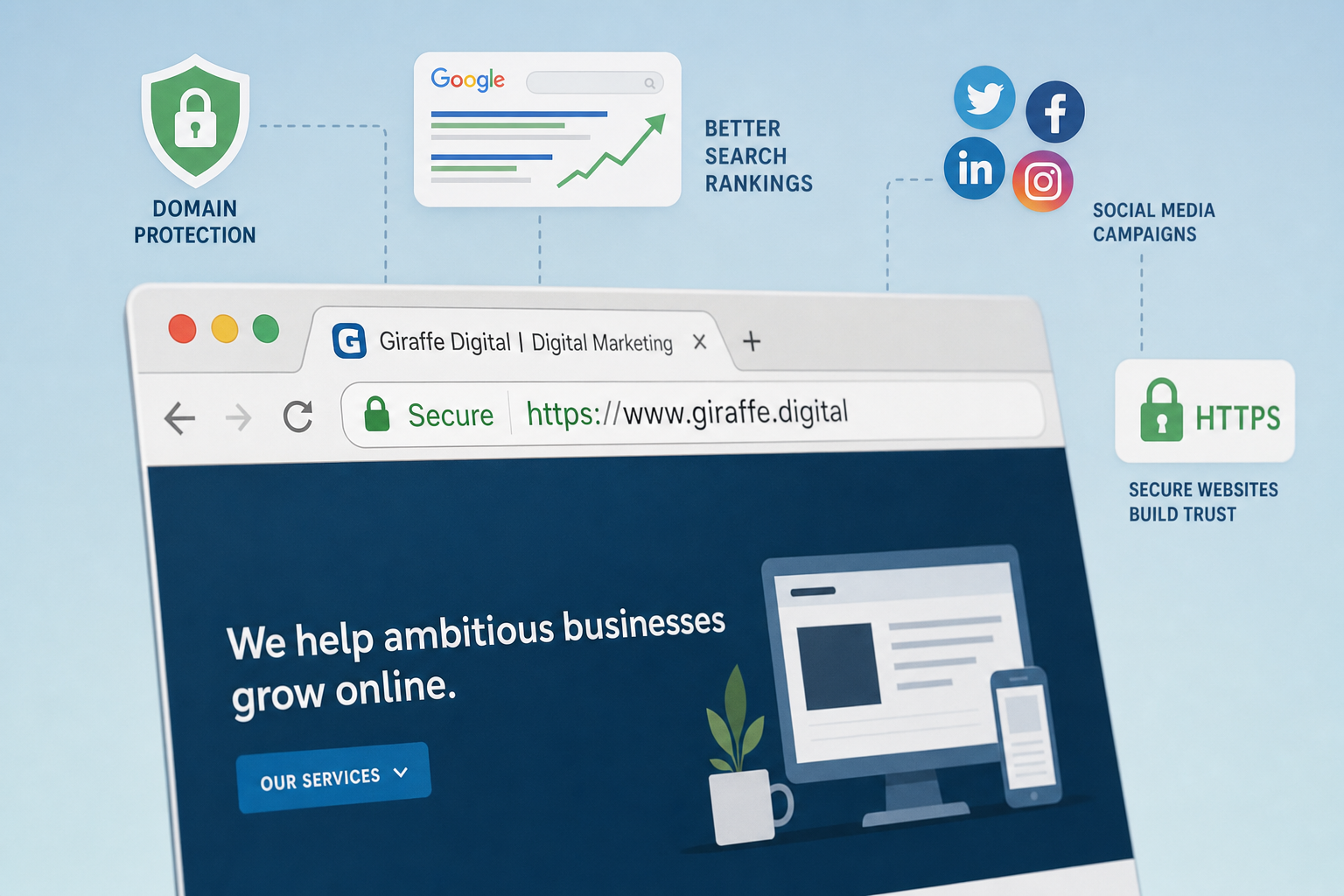
Security is also closely connected to website design, search marketing, social media activity and brand perception. A modern website that looks good but displays a browser warning can quickly lose enquiries. A strong social media campaign that sends users to an insecure landing page can undermine its own results. A domain name that is well chosen but poorly protected can create unnecessary risk. Secure websites should therefore be treated as part of a wider digital strategy, not as an isolated technical task.
What makes a website secure
When people talk about secure websites, they are usually referring to websites that use HTTPS rather than HTTP. HTTPS means that data sent between the user’s browser and the website is encrypted. This encryption is enabled through an SSL certificate, although the underlying technology is often more accurately referred to as SSL/TLS.
For a visitor, the most obvious sign is the padlock shown in the browser address bar. In many browsers, an insecure page may now be labelled in a way that draws attention to the lack of protection. That change matters because users do not need to understand the details of encryption to react negatively to a warning. If a potential customer sees a message suggesting that a site is not secure, they may hesitate before completing a form, signing in, making a purchase or even continuing to browse.
A secure website does not mean that every possible security issue has been solved. It does not replace good hosting, careful website maintenance, strong passwords, sensible access control or regular software updates. However, HTTPS is one of the foundations. It is visible, expected and important for protecting everyday interactions online.
Why secure websites matter for business trust
Trust is one of the biggest commercial reasons to take website security seriously. Before a visitor speaks to your team, visits your premises or reads a proposal, your website is often forming their first impression. A site that looks out of date, loads slowly or appears insecure can create doubt at the very point where you need to build confidence.
This is particularly important for businesses that rely on enquiries. A contact form may only ask for a name, telephone number and email address, but that information still belongs to the user. If your site asks people to share personal details, they should be able to do so through a secure connection. This applies to professional services, trades, charities, education providers, hospitality businesses, health and wellbeing organisations, and many more.
E-commerce websites have an even clearer responsibility. Customers expect secure browsing throughout the shopping experience, not just at the final payment stage. Product pages, basket pages, account areas and checkout pages should all feel consistent and protected. If security appears only at the point of payment, the customer journey may feel disjointed and less trustworthy.
There is also a reputational element. A secure website suggests that the business is paying attention to the details. It shows that the organisation understands how people use the web in 2018 and is willing to invest in a better, safer experience. That reassurance can help support conversion rates, repeat visits and long-term brand confidence.
How HTTPS supports search marketing
Search engines want to recommend useful, trustworthy pages. HTTPS has been used as a ranking signal for several years, and although it is only one factor among many, it is not something to ignore. Good search visibility depends on a combination of relevant content, sound technical structure, quality links, helpful user experience and a website that can be accessed reliably. Security fits naturally into that mix.
If two competing pages are similar in quality, a secure page has an additional advantage over an insecure one. More importantly, HTTPS supports user behaviour after the click. Search marketing is not only about gaining rankings; it is about turning search visitors into readers, enquiries and customers. If someone clicks from a search result and immediately sees a security warning, that visit may be lost.
Secure websites can also help with referral data. When traffic moves between secure and insecure environments, analytics information can become less clear. For business owners who rely on reporting to understand which campaigns are working, accurate data matters. If you are investing in SEO, paid search, social media or email marketing, your website should be technically prepared to measure the results as cleanly as possible.
HTTPS should therefore be included in any sensible SEO checklist. Alongside page titles, meta descriptions, internal linking, mobile-friendly design and high-quality content, security is part of building a website that search engines and users can trust.
Website design and the secure user experience
Security should not be treated as something hidden away from the design process. The best websites combine clear design, persuasive content and reliable technology. If any one of those elements is weak, performance suffers.
For example, a beautifully designed landing page for a campaign may include a short enquiry form, a downloadable guide or a newsletter sign-up. If that page is not secure, users may be less willing to interact with it. Likewise, a professional brochure website can lose credibility if the browser suggests it is not safe. The visual design may say one thing, while the browser interface says another.
Good website design in 2018 should consider security from the start. That means planning for HTTPS across the whole site, not adding it as an afterthought. It also means checking that images, scripts and embedded assets are loaded securely. A common problem after moving a website to HTTPS is mixed content, where the page itself is secure but some resources still load over an insecure connection. This can prevent the padlock from appearing correctly and create confusion for visitors.
Mobile users deserve particular attention. Many people will reach your website from social media, email or local search on a phone. They may be making a quick decision while travelling, comparing suppliers or looking for contact details. A clean, mobile-friendly, secure experience gives them fewer reasons to leave and more reasons to take the next step.
Social media campaigns need secure destinations
Social media marketing often focuses on the post, the advert, the image or the video, but the destination page is just as important. If your social activity is designed to generate enquiries, bookings, downloads or sales, the page you send people to must be credible.
A user who sees an engaging social media post and clicks through is showing interest. That moment should be supported by a secure, fast and relevant page. If the landing page looks disconnected from the campaign, loads slowly or appears insecure, the trust created by the social content can quickly disappear.
Secure websites also help when businesses run seasonal campaigns, competitions, event registrations or lead generation activity. These campaigns often ask users to submit personal information. Even a simple form should be protected. Security is not only about complex transactions; it is about respecting the information people choose to share with you.
From a branding point of view, consistency matters. Your social profiles, website, landing pages and email communications should all feel like part of the same professional organisation. HTTPS contributes to that consistency by ensuring the website does not create avoidable concerns at the point of engagement.
Domain registration and protecting your online identity
Website security is not limited to the certificate on your site. Your domain name is a key business asset, and it should be managed carefully. A domain that is allowed to expire, registered under the wrong details or controlled by someone outside the business can create serious disruption.
When registering or managing a domain, make sure the ownership details are appropriate for the organisation. Keep login details secure, use strong passwords and limit access to people who genuinely need it. It is also sensible to keep renewal reminders in more than one place so that important dates are not missed. If your website, email and marketing activity all depend on the domain, a missed renewal can be far more than a minor inconvenience.
Choose a domain name that is easy to spell, easy to say and suitable for your brand. Avoid unnecessary complexity if it makes the address harder for customers to remember. For UK businesses, it is often worth considering the most relevant UK domain options as well as any wider commercial extensions that make sense for the brand. The right choice will depend on your market, audience and long-term plans.
It is also important to be careful with lookalike domains and brand protection. If your organisation has a distinctive name, consider whether related domains should be secured to reduce confusion. This does not mean registering every possible variation, but it does mean thinking strategically about how customers find you and how your brand may be represented online.
Practical steps for moving to HTTPS
If your website is not yet secure, the move to HTTPS should be planned rather than rushed. The process is usually manageable, but it needs proper checks to avoid broken links, ranking disruption or poor user experience.
- Check your current website status. Visit key pages in a modern browser and look at the address bar. If pages load with HTTP or show warnings, action is needed.
- Choose the right SSL certificate. Different certificate types suit different needs. A simple brochure website may not require the same certificate as a large e-commerce platform or a site with multiple subdomains.
- Install and configure the certificate correctly. The certificate must be properly set up on the hosting environment so that pages load reliably over HTTPS.
- Redirect HTTP pages to HTTPS. Visitors and search engines should be sent to the secure version of each page using appropriate redirects.
- Update internal links and resources. Menus, images, scripts, canonical tags and other internal references should point to secure URLs where possible.
- Check for mixed content. Make sure images, fonts, scripts and embedded content are not still loading insecurely.
- Update analytics and search tools. Website reporting and search monitoring should reflect the secure version of the site.
- Test forms and checkout pages. Any area where users submit information should be checked carefully after the change.
For a small website, the work may be relatively quick. For a larger website with many pages, old content, third-party integrations or e-commerce features, the planning stage is more important. A careful migration helps preserve search performance and ensures that users get the intended experience.
Security, maintenance and long-term digital performance
Once HTTPS is in place, it should be maintained. SSL certificates have expiry dates, and if a certificate expires, visitors may see a warning that prevents them from accessing the site comfortably. Certificate renewals should be monitored as part of routine website maintenance.
Content management systems, themes, plugins and server software also need attention. Many business websites use popular platforms that are regularly updated to improve features and fix vulnerabilities. Ignoring updates for long periods can create unnecessary risk. At the same time, updates should be handled carefully, especially on sites with bespoke functionality, so that improvements do not break important features.
Backups are another key part of the picture. A secure connection helps protect data in transit, but it does not replace the need for reliable backups. If something goes wrong, the ability to restore a recent, clean version of the website can be invaluable.
Security should be seen as an ongoing responsibility rather than a single project. The businesses that get the best results from their websites tend to treat design, content, SEO, hosting, analytics and maintenance as connected parts of the same digital presence. Secure websites sit at the centre of that joined-up approach.
A basic expectation that supports better results
Customers are becoming more aware of how their information is handled online. Browser messages are more visible, search engines value trustworthy experiences, and businesses are placing more emphasis on measurable digital performance. In that environment, secure websites are not simply a technical preference; they are part of the standard expected from a credible organisation.
If your website is being redesigned, HTTPS should be included from the outset. If your current website is performing well but still uses HTTP, it is worth planning a careful migration. If you are investing in SEO, social media marketing, paid campaigns or content, your website needs to provide a secure destination for that traffic.
A secure website helps protect users, supports trust, strengthens your professional image and contributes to a healthier digital strategy. For UK business owners, it is one of the most practical improvements to make before asking people to engage, enquire or buy online.