
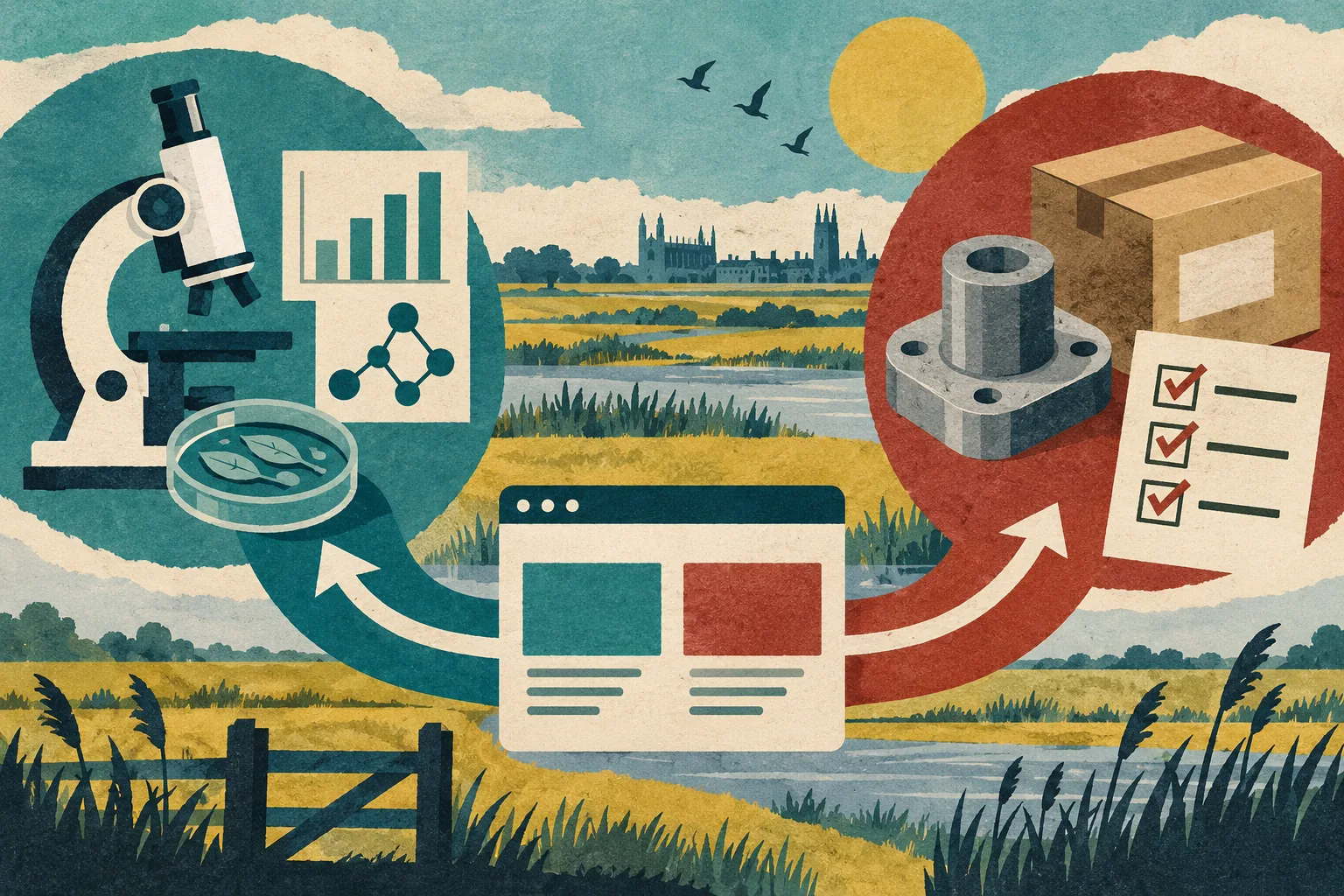
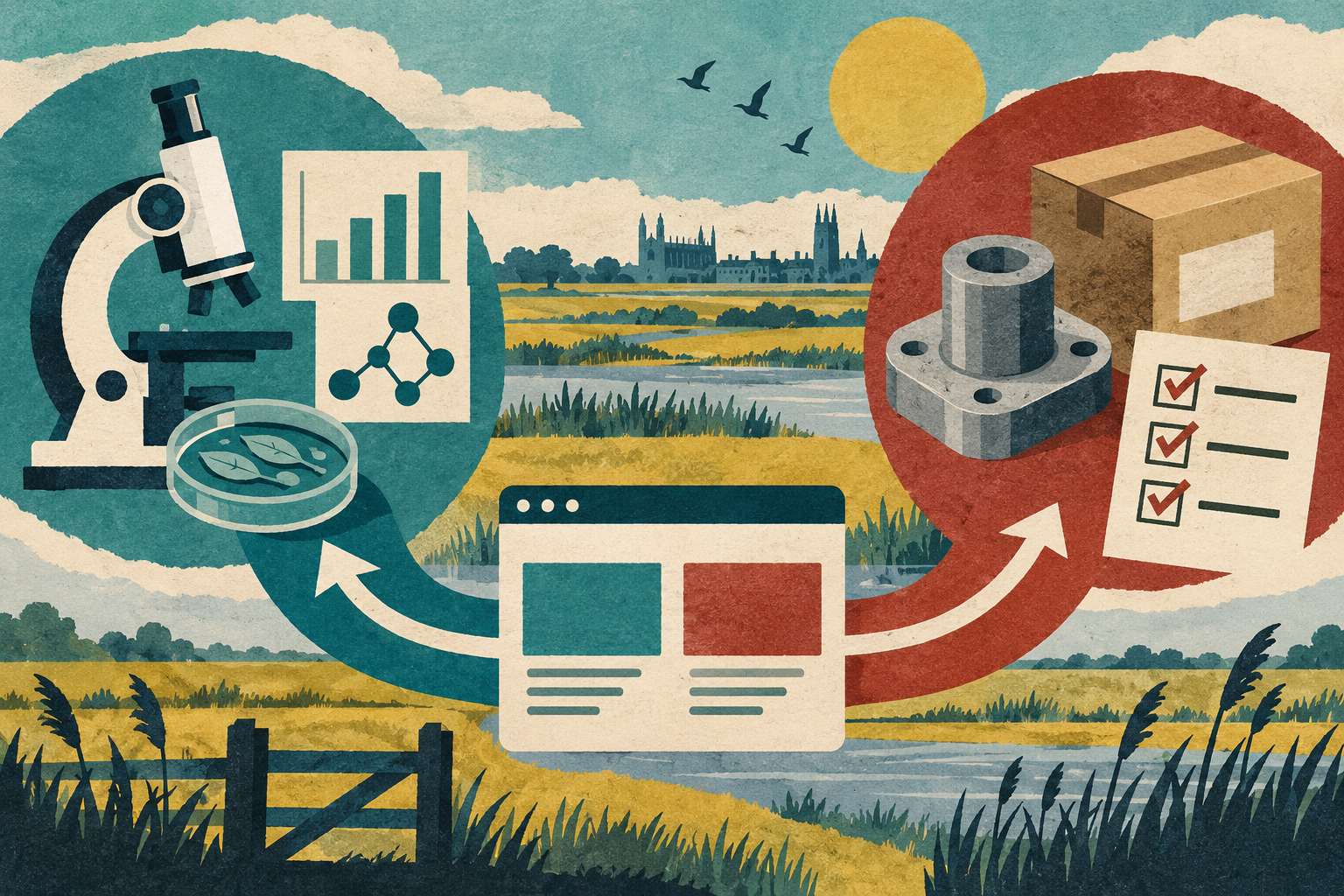
A website can attract the right interest and still send it to the wrong next step. Someone exploring a scientific service needs a different conversation from a buyer checking a product format or a customer asking when they can collect an item. If all three arrive at a general “Tell us more” form, the business has to reconstruct the requirement after contact.
For businesses working across the East of England, Cambridge, Peterborough and Ely provide useful contexts for reviewing this problem. The purpose of the exercise is to give each genuine customer requirement a clear route, then assess its outcome according to the job that route performs. The examples below are illustrative design exercises, not claims about particular businesses or local customer behaviour.
Use the offer to define the route
Cambridge City Council describes a science and technology cluster. For a business with an analytical service, a useful enquiry may begin with the question a prospective client wants to answer. The visitor needs an accurate explanation of the available method and its commercial role before the team can assess a project.
Cambridgeshire County Council recognises a varied economy including manufacturing, science and technology. A supplier serving a business customer in Peterborough may instead need to establish a product reference, supply format or intended application. That is a different information exchange from asking someone to explain a research question. The design recommendation follows the offer, rather than assume every company in a city sells the same thing.
In Ely, the district council describes food, craft and vintage market activity. An independent retailer provides a third useful example: a customer may know what they want but need to check an option or collection arrangement. The next step should clarify the purchase process rather than send them into a project questionnaire intended for a trade or scientific enquiry.
Write down what the business needs to decide next
Give each route a short internal decision statement. For the scientific service, it could be “Can our team assess this question within the available offer?” For the supplier, it could be “Which product or supply conversation fits this requirement?” For the retailer, it could be “Can this item and collection request be confirmed?” These statements help identify what belongs before contact and what the first exchange needs to establish.
Next, list the information already available to the visitor. A scientific introduction might explain the service boundaries and provide approved method detail. A product page might show the relevant variant and specification. A retail description might explain which options are available and whether a collection request needs confirmation. Missing information should become a content task, rather than automatically become another compulsory form field.
Finally, identify the person responsible for the next decision. If a contact is routinely forwarded between departments, review whether the route asks for the right context or uses terminology the customer understands. The problem might concern the internal process as well as the website. A more attractive button will not resolve uncertainty about who assesses the request.
Give each destination a distinct content job
A route does not always require an entirely separate website section. It needs an understandable purpose. A product enquiry option can sit beside useful range information; a service discussion can follow the explanation of the capability. A collection request should connect to current practical arrangements. Where the same information genuinely applies, share it and link clearly instead of duplicating the entire introduction.
This distinction matters when planning SEO content. A search for an application and a search for a known product reference can lead to different depths of information. The destination should answer the requirement it claims to address. Repeating a broad business description under several headings does not help a visitor decide what to do, even if the headings contain different search phrases.
Review the link text as well as the destination. “Ask about this service” has a purpose in context, while a bare list of place names tells the reader little about the help available. A link should continue the decision the person is already making. That is the reason to connect a detailed guide with the relevant service, rather than add links simply because the destinations exist.
Test the route with three realistic briefs
Write a short fictional request for each genuine audience your business serves. Keep the exercise clearly separate from client case studies. Include one uncertainty: the research client has not defined the final output, the supplier customer knows the application but not the reference, or the retail customer needs confirmation of a product option. These situations test whether the journey supports a useful conversation.
Ask a colleague to use the website on a phone. Give them the request but do not tell them which link to choose. Record the route selected, the information they find and the point where they hesitate. The goal is to locate a specific obstacle, such as two options with unclear differences or a form that assumes knowledge the customer does not have.
Review the submitted example with the person who handles enquiries. Could they decide the next step from the information collected? Did the customer have to repeat details already selected? Did the message imply an accepted job or confirmed order before assessment? Change the explanation or fields that caused the problem and repeat the same exercise. This gives the redesign a practical acceptance check.
Measure the route without confusing its purpose
An enquiry submitted is not necessarily a project agreed or a purchase completed. Where your systems provide suitable evidence, keep those stages distinct. The scientific route may be reviewed for assessable project interest, the supply route for relevant product discussions and the retail route for confirmed arrangements. Choose measures that can be recorded consistently and inform a real decision.
Do not combine all contact into a single total and assume the business has improved. An increase in requests outside the offer may reveal unclear scope. More questions about collection could show that practical information is missing. A route with fewer submissions might still produce more relevant discussions. Interpret the evidence alongside the content and the response process, rather than the form total alone.
A route review you can complete with your team
- Name the real customer requirement and the next business decision.
- Identify the content needed before the first exchange.
- Use a clear destination and link label for that purpose.
- Ask only for context that helps the initial assessment.
- Test an uncertain requirement on a phone.
- Assign a response owner and distinguish enquiry from confirmation.
- Review evidence for each route against its own objective.
For help translating the review into practical work, explore website design in Cambridge, SEO in Peterborough and digital strategy in Ely. If several routes belong to one business, our East of England branding support can also help make their naming and relationship easier to recognise.
Frequently asked questions
Practical answers to questions about putting this advice into use.
When should a website offer different customer routes?
Separate routes are useful when visitors need different information or a different first conversation. Define each destination by the customer’s task and the decision it supports, rather than creating several pages that repeat the same offer.
How can we test whether an enquiry route makes sense?
Choose a few realistic customer briefs and follow each route from the landing page to first contact. Check that the content explains the service and that the information collected helps your team prepare a useful reply.