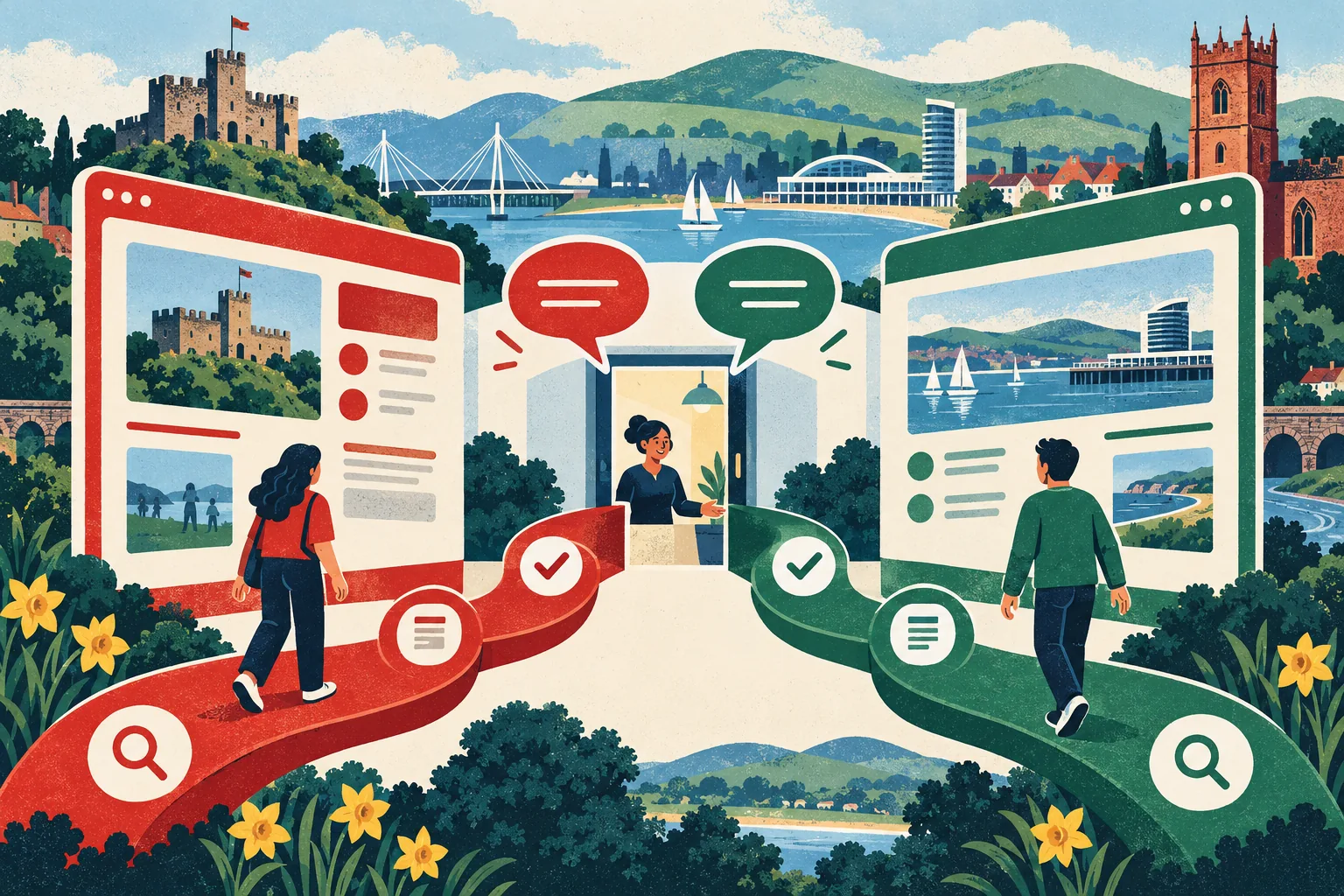
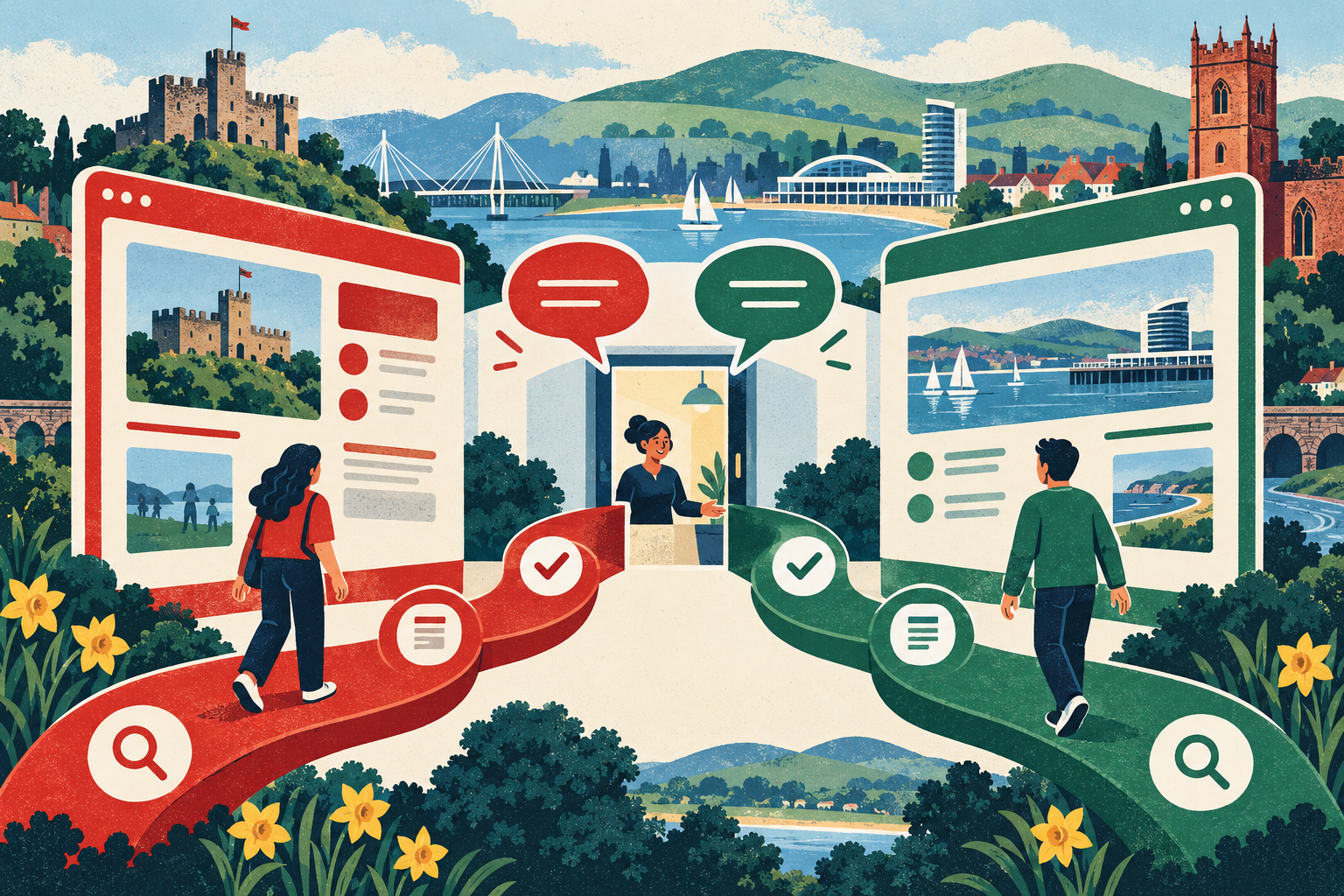
A language choice at the top of a website is only the beginning of a bilingual experience. The service explanation, enquiry form, confirmation message and follow-up information need to work together. A visitor who chooses Welsh should be able to understand what happens next without repeatedly returning to English to complete the task.
Cardiff Council's Bilingual Cardiff work, Swansea Council's 2024 to 2029 language promotion strategy and Wrexham's 2022 to 2027 language strategy provide a local context for planning Welsh and English content. Businesses should begin with their own agreed language offer and the needs of the people using it. This guide focuses on the practical website brief.
Define the journey you are offering
Write down what a customer can do in each language. Include the information they can read, the enquiries they can make and the replies your team can provide. Be specific about any part of the service handled by another organisation or system. The website should describe an offer that the business can actually support.
Use an illustrative Cardiff workshop enquiry as the first test. A Welsh-speaking reader wants to understand the session, ask about a place and receive a useful reply. Write those three decisions on a test card. Then list the service text, enquiry labels and messages that support them. The test should reveal whether the public language offer continues beyond the first description.
For website design in Cardiff, use that list to agree the content fields and interface requirements. Ask the designer to demonstrate the complete journey in both languages before treating a language switch as the finished feature.
Pair equivalent pages deliberately
Make the second test a Swansea collection enquiry. The visitor may recognise the city by its English or Welsh name, but the practical destination must stay the same. Compare the equivalent pages for the collection point, opening arrangement and next action. A change of language should not accidentally change the service the visitor is reading about.
Google's multilingual website guidance recommends separate addresses for language versions and explains how language annotations can identify related pages. It also supports giving visitors a clear way to choose a language. Ask the website team to plan and check the relevant implementation, including links between equivalent pages.
Do not assume that a visitor's location or browser settings tell you which language they want. Keep the choice visible and test what happens when someone enters through a link to an inner page. The language relationship should work beyond the home page.
Brief the translator on the service
Give the person preparing or reviewing the Welsh copy enough context to preserve its meaning. Include the service description, intended audience, agreed terminology and any interface space constraints. Identify phrases whose precise meaning affects a customer's decision, rather than asking for isolated strings with no explanation.
The Welsh Language Commissioner's business design guidance provides a useful starting point for planning bilingual materials. Within your project, agree who can approve the language and how questions about meaning will be resolved. A translation needs to reflect the service you offer, including its boundaries and next steps.
For an illustrative Swansea business reviewing branding in Swansea, this includes tone as well as terminology. The two versions should communicate the same identity and practical offer while allowing natural expression in each language. Identical sentence lengths are not the measure of a successful result.
Include forms and messages in the review
Check the words that appear when something goes wrong or needs clarification. A required-field message, an instruction about a date and a confirmation screen are all part of the customer's experience. They should be reviewed alongside the form, with enough context to show when the message appears.
For the Cardiff workshop test, check whether the form records the customer's enquiry accurately and whether the acknowledgement distinguishes a request from a confirmed place. For the Swansea collection test, compare the location and instructions in the message with the chosen page. Use fictional details and record any difference in meaning between the two journeys.
If an external booking or payment system forms part of the journey, verify its actual language options before describing them on your site. Where the experience changes, explain the transition accurately. The presence of a bilingual website does not establish that every connected system offers the same choices.
Make updates a paired publishing task
A service change needs to reach both versions. Assign an editor to identify the affected pages and a reviewer to approve the revised language. Keep a record of which version is awaiting review. This prevents one version from quietly describing an arrangement the business has changed.
Wrexham Council's 2026 announcement of a Welsh-language cultural festival suggests a useful third test for an event business. Distinguish the language of the website from the language of the experience being described. An English event page can still need to explain that a performance is in Welsh. The equivalent Welsh page should preserve the same event facts and booking status.
For a Wrexham business planning SEO in Wrexham, ask the language reviewer to check that distinction in headings and descriptions. A search visitor needs an accurate expectation of the experience, whichever language they use to read about it.
A bilingual journey brief
Choose one important service and complete the brief with the website team, the person who owns the service and the language reviewer.
- Define the information and customer actions your language offer includes.
- Pair the equivalent service pages and their supporting content.
- Include navigation, form labels, instructions and messages.
- Provide service context and approved terminology for language review.
- Test both complete journeys, including any external transition.
- Assign responsibility for keeping the two versions accurate when the service changes.
Giraffe Digital's digital strategy support in Wales can help turn these requirements into a website and content brief. Across Wales, a planned bilingual experience connects the language choice with the practical task the customer came to complete.
Frequently asked questions
Practical answers to questions about putting this advice into use.
What belongs in a bilingual website brief?
Define the Welsh and English journeys, the pages that need equivalents and the information available in each language. Include navigation, forms, confirmation messages and responsibility for approving translations and future updates.
How do we keep Welsh and English pages consistent?
Treat an update as a paired publishing task. Identify equivalent pages, agree who reviews each language and check the complete customer journey so a change to a service or form is reflected where it is needed.