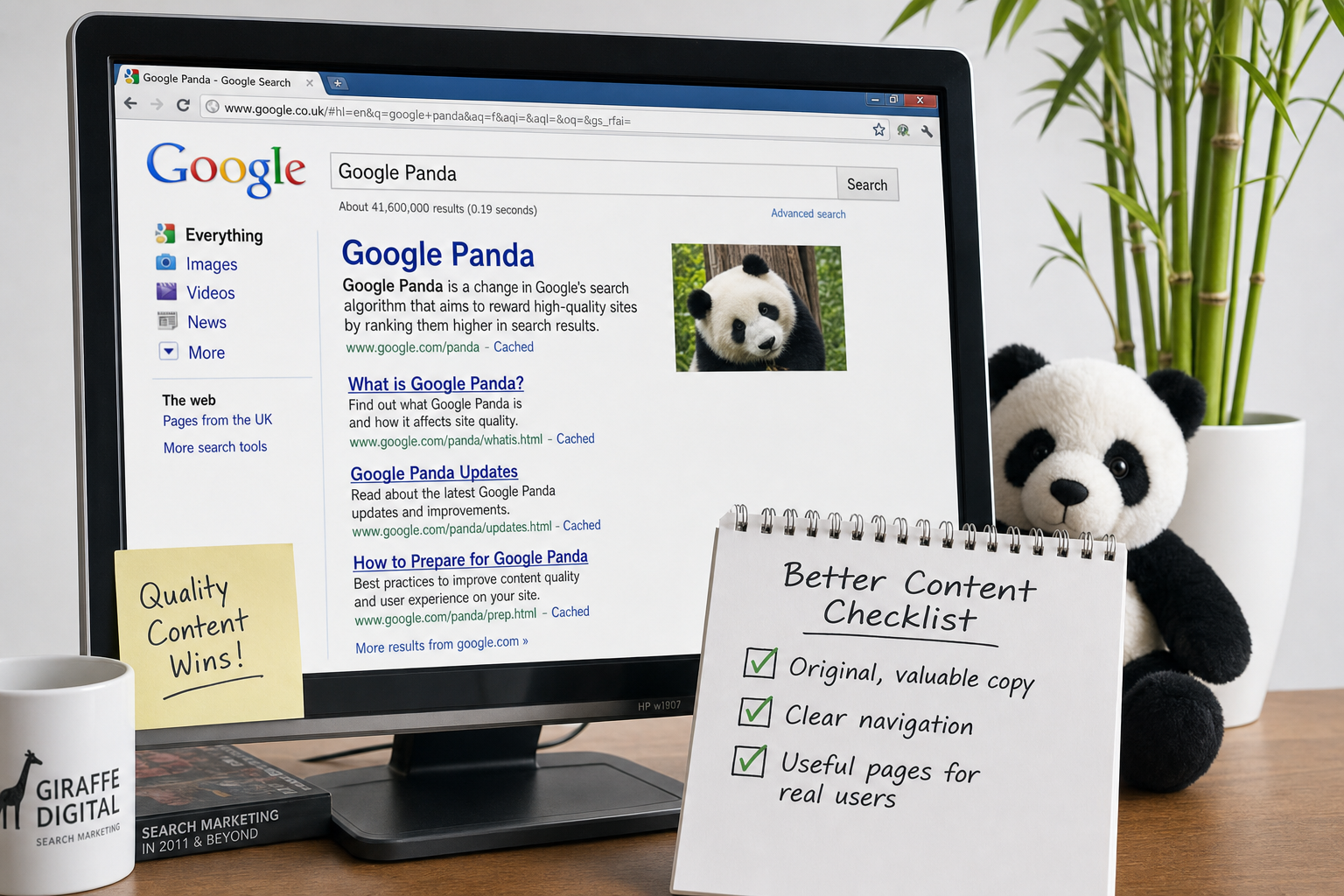
Google Panda is a useful reminder that search marketing should not be treated as a trick or a shortcut. For UK businesses, the safest long-term approach is to build a website that genuinely helps customers: clear information, original pages, simple navigation, trustworthy design and regular improvement. Search engines are becoming better at identifying pages that exist only to attract visits, rather than to answer questions or support a real business. That shift matters whether you run a local service company, an online shop, a professional practice or a growing national brand.
The businesses most likely to benefit are those prepared to invest in their website as a working asset. A good site should explain what you do, who you do it for, where you operate and why someone should trust you. It should also make it easy for visitors to enquire, telephone, visit, buy or return. Google Panda should therefore be seen not only as a search issue but also as a broader prompt to improve content, website design, branding, and digital marketing.
Why Google Panda matters to business owners
For several years, many websites have relied on volume rather than value. They have published large numbers of shallow pages, copied manufacturer descriptions, repeated the same sales copy across multiple towns, or filled pages with adverts while offering little practical information. This may bring some short-term traffic, but it is a weak foundation for a serious business website.
Google Panda reflects the search engine's growing emphasis on quality. The exact workings of any Google system are not published in full, and it would be unwise to chase rumours. The practical message is much clearer: pages that satisfy visitors are more likely to support sustainable search performance than pages written only for algorithms.
That does not mean every page must be lengthy. A contact page can be brief. A product page can be concise. A landing page can focus on a single service. The important question is whether the page does its job properly. If a visitor arrives from a search result, can they quickly understand the subject, see evidence that your business is credible, and decide what to do next?
For business owners, this creates a direct commercial opportunity. Better content can reduce wasted enquiries, improve conversion rates, support sales staff, strengthen your brand and make your website easier to promote through social media, email and offline marketing. Search visibility is important, but it is only one part of the value.
What better website content looks like in 2011
Useful content starts with the customer. Before writing new pages, consider the questions people ask before they contact you. They may want to know whether you serve their area, what is included in a service, how long a process takes, what choices are available, what information they need to provide, or how to compare one option with another.
A strong business website will usually include a clear home page, service or product pages, an about page, contact details, location information where relevant, and supporting articles or guides. These should be written in natural British English, with enough detail to be useful and enough structure to be easy to read.
Good content is also original. If you sell products supplied by a manufacturer, avoid relying entirely on the same descriptions as every other reseller. Add your own buying advice, compatibility notes, delivery information, care guidance or frequently asked questions. If you provide services in several towns, avoid creating dozens of near-identical pages with only the place name changed. A genuinely useful local page might mention the area served, the types of customers you assist there, practical details and relevant examples of the work you undertake, without inventing claims or results.
Content should be reviewed as part of your normal business activity. A page written two years ago may still rank, but it may no longer accurately represent your services. Out-of-date opening hours, outdated staff details, expired offers, and broken contact forms all undermine confidence. Search engines may bring visitors, but the website must earn enquiries.
Signs your website may be vulnerable
Not every website affected by quality changes is deliberately poor. Many business sites become untidy over time because new pages are added without a plan. A practical content audit can reveal problems before they become more serious.
Warning signs include pages with very little text, duplicated wording across multiple sections, articles written around awkward keyword repetition, pages created only for search engines, and navigation that hides important information. Excessive adverts, intrusive banners and cluttered layouts can also make a page feel less trustworthy, especially if the main content is difficult to find.
Another common issue is weak page purpose. If a page is called a guide, it should guide. If it is a service page, it should explain the service. If it is a product page, it should help someone decide whether that product is suitable. Pages that promise one thing in the title and deliver something else are unlikely to satisfy visitors.
Business owners should also check analytics data where available. High bounce rates, short visit times and low enquiry numbers can indicate that visitors are not finding what they expected. These figures should be interpreted carefully, as some pages answer a question quickly but are useful prompts for further investigation.
Website design and content must work together
Better content will not perform well if the design makes it difficult to read or trust. In 2011, many visitors are browsing on a mixture of desktop computers, laptops, tablets and mobile phones. Not every business needs a complex mobile platform, but pages should be built with care so that important information is accessible, legible, and not obscured by unnecessary effects.
Clean navigation is essential. Visitors should not have to guess where to find your services, contact details or location. A sensible menu, clear headings and prominent calls to action make the site easier for both people and search engines to understand. Search engine optimisation is often most effective when it supports good usability rather than fighting it.
Page speed also matters. Heavy images, bloated code and unnecessary scripts can slow a site down, particularly for users on slower connections. Compressing images sensibly, using well-structured HTML and CSS, and choosing reliable hosting can all improve the experience. These are not glamorous tasks, but they contribute to a more professional website.
Trust signals should be visible but not overdone. Include real contact details, a company address where appropriate, professional photography or well-chosen imagery, clear terms for online transactions, and evidence of expertise. Testimonials can help when they are genuine and presented responsibly. Avoid exaggerated claims, copied badges or anything that might make a careful customer hesitate.
Practical steps to improve pages affected by quality concerns
The first step is to list your important pages. Include your home page, main service pages, product categories, popular articles, local pages and any pages that bring enquiries. Then review each page from a potential customer's perspective.
- Clarify the purpose: decide what the page should help the visitor understand or do.
- Remove duplication: combine weak pages into a single stronger page that would serve the visitor better.
- Add useful detail: answer common questions, explain options and provide relevant guidance.
- Improve structure: use clear headings, shorter paragraphs and logical sections.
- Strengthen calls to action: make it obvious how to enquire, order, telephone or request information.
- Check accuracy: update old details, broken links and outdated descriptions.
- Reduce clutter: ensure the main content is easy to find and not overwhelmed by adverts or distractions.
Where pages are very weak, it is often better to rewrite them properly rather than make small cosmetic changes. A well-written service page can become a valuable sales tool, especially when it explains benefits, process, suitability and next steps. A strong guide can attract links, support social sharing and give your sales team something useful to send to prospects.
Do not remove pages purely because they receive little traffic. Some niche pages are valuable because they answer a specific question for a small but important audience. The issue is not whether every page attracts large numbers of visitors, but whether each page has a legitimate purpose and meets a reasonable standard.
Search marketing without shortcuts
Google Panda reinforces the need for sound search marketing. That means writing page titles and descriptions that accurately reflect the page, using headings sensibly, creating descriptive internal links and making sure search engines can crawl the site. XML sitemaps, clean URLs and careful use of redirects can also help a well-built site perform more consistently.
Keyword research remains useful, but it should not dominate the writing. If a phrase is important to your business, use it naturally where it belongs. Do not repeat it in every sentence or force it into headings where it sounds odd. Search engines are becoming more capable of understanding relevance, and visitors are quick to notice copy written for machines rather than people.
Link building should also be approached with care. A good link is usually a sign of a real relationship, a useful resource, or a trusted mention. Local organisations, suppliers, trade associations, chambers of commerce, relevant directories and genuine editorial coverage can all play a role. Avoid schemes that promise large numbers of links with no regard for quality or relevance.
For local businesses, consistent contact details across the web are important. Make sure your business name, address and telephone number are presented accurately on your website and reputable local listings. If you serve a defined area, explain it clearly rather than creating artificial pages for every nearby location.
Social media and content promotion
Social media is not a replacement for a good website, but it can help distribute useful content and build familiarity with your brand. Facebook Pages, Twitter, LinkedIn and YouTube each offer different opportunities, depending on your audience. The key is to share material that has a reason to exist: guides, announcements, photographs of real work where appropriate, event information, industry observations and answers to common questions.
A business blog can support both search and social media when it is maintained properly. It should not be used to publish thin posts to create more pages. Instead, use it for practical advice, seasonal reminders, explanations of changes in your market, interviews, project notes or buying guidance. A modest number of strong articles is better than a large archive of forgettable posts.
When promoting content, write clear updates that explain why someone should click. Do not simply broadcast the same sales message every day. Encourage staff to understand the website's key resources so they can refer customers to helpful pages. Digital marketing works best when it is connected to the way the business actually operates.
Domain registration and brand foundations
Your domain name is part of your brand, so it should be chosen with care. For many UK businesses, a .co.uk domain remains a sensible choice, while a .com can also be valuable where available and appropriate. The best domain is usually short, memorable, easy to spell and closely connected to your business name or main brand.
Avoid choosing a domain solely because it contains a keyword. Exact-match names can look generic and may limit your business as your services expand. Hyphens and unusual spellings can create confusion when someone hears the address over the telephone or sees it on a van, leaflet or business card.
Keep registration details organised. Make sure the domain is registered in the correct business name, renewal dates are monitored, and access details are stored securely. Losing control of a domain can disrupt email, search visibility and customer confidence. If you work with a web designer or agency, agree clearly who manages the domain and how it can be transferred if needed.
It is also sensible to consider related domains that protect your brand, such as common spelling variations or the main UK and international versions where appropriate. These should be redirected properly to the main site rather than used to create duplicate copies of the same website.
Technology choices that support quality
The technology behind a website should make improvement easier, not harder. A suitable content management system can allow staff to update pages, publish articles and correct details without waiting for every small change to become a development project. However, convenience should be balanced with control, security and performance.
Good website build standards matter. Clean markup, accessible text, properly labelled images, logical navigation and readable URLs all help create a better experience. Flash may still have a place for certain creative elements, but important content and navigation should not depend on it. Search engines and many mobile users may struggle with content locked in difficult-to-access formats.
Measurement is also important. Installing analytics and reviewing search query data in Webmaster Tools can help you understand how people find and use the site. The aim is not to stare at reports every day, but to make informed decisions. Which pages bring enquiries? Which subjects attract visitors? Where do people leave? These questions can guide content planning and design improvements.
A better website is a better business tool
The most useful lesson from Google Panda is that quality should be treated as a business decision. A website filled with thin, duplicated or confusing pages may attract some traffic, but it is unlikely to build lasting trust. A website that explains, helps and reassures can support sales, customer service, recruitment, partnerships and brand recognition.
For UK business owners planning a new website or reviewing an existing one, the priority should be simple: create something worth finding. Invest in clear design, original content, reliable technology and honest promotion. Search engines will continue to change, but businesses that focus on serving visitors well will be in a stronger position than those chasing short-term loopholes.
If your website has grown without a clear plan, now is a good time to review it. Identify weak pages, prioritise the most important one, and build a content strategy that reflects your real expertise. Google Panda may be discussed as a search update, but its wider message is about the standard customers expect when they arrive at your website.