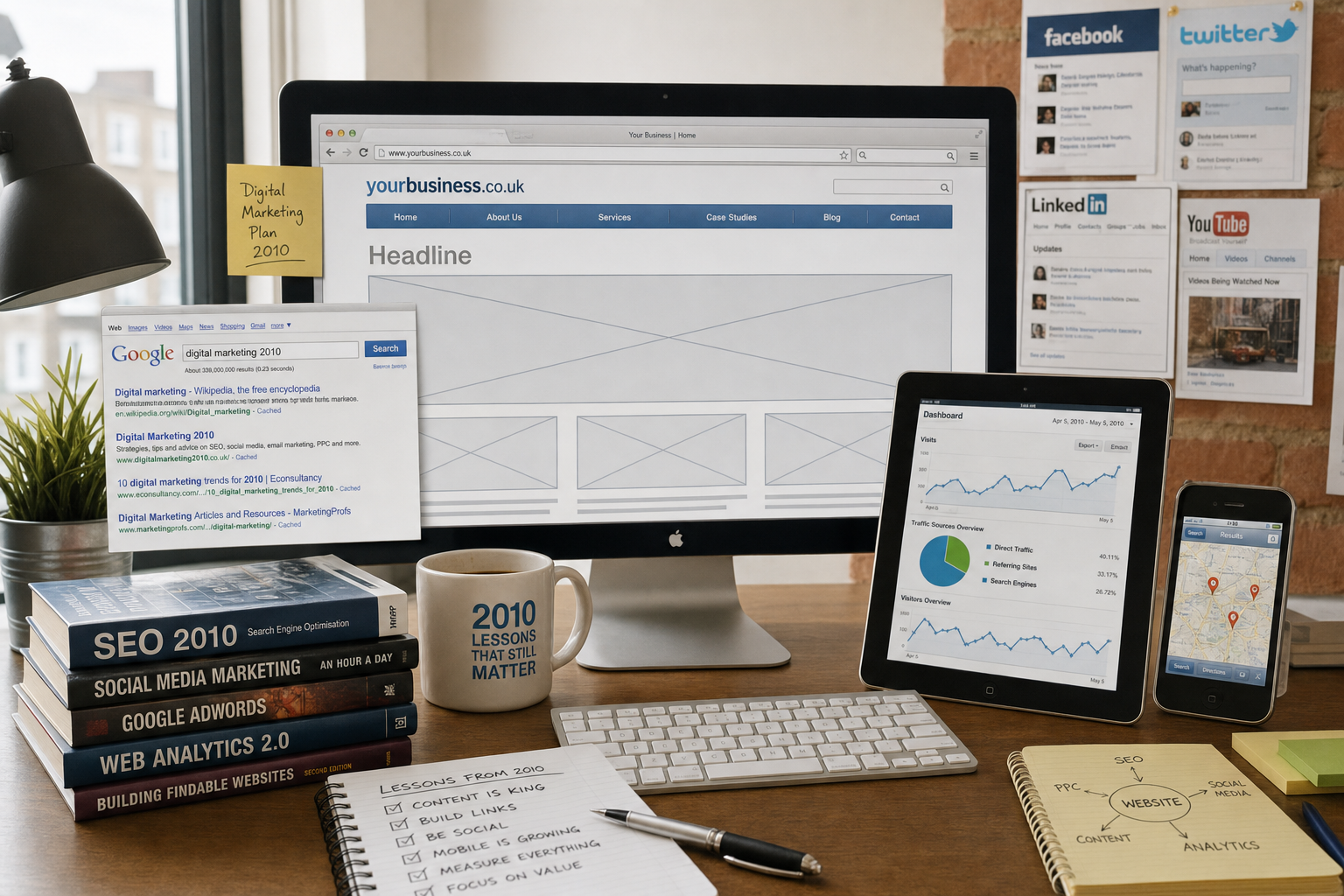
As December 2010 draws to a close, many UK business owners are looking at the web with a mixture of interest, urgency and uncertainty. More customers are using search engines before making enquiries, social networks are becoming a normal part of daily communication, and a company website is no longer simply an online brochure. Digital marketing 2010 is about using the right combination of website design, search visibility, useful content, social media and measurement to support real business goals.
The most important lesson is that digital marketing should not be treated as a collection of fashionable tools. A new website, a Facebook Page, a Twitter account or an email newsletter will only help if each one has a clear purpose. The businesses getting the best value online are those that understand their customers, present a credible brand, make it easy to enquire, and continually improve their activities based on evidence.
Start with a clear business objective
Before choosing technology or planning a campaign, it is worth deciding what the website and wider online presence must achieve. For some firms, the priority is to generate telephone enquiries. For others, it is to sell products, take bookings, encourage newsletter sign-ups, support existing customers or build local awareness.
A clear objective affects every digital decision. If enquiries are the goal, your website should make contact details prominent, explain your services clearly and guide visitors towards a simple form or phone number. If online sales are the goal, product information, stock clarity, delivery details and a trustworthy Checkout become essential. If reputation is the goal, case studies, testimonials, articles and a professional design will matter greatly.
Good digital marketing in 2010 begins with asking practical questions: who are we trying to reach, what problem are they trying to solve, what should they do next, and how will we know whether it worked?
Your website is still the centre of the strategy
Social media may be attracting much of the attention, but a business website remains the centre of a serious online marketing programme. It is the place where you control the message, structure, branding, and conversion path. A social profile can boost visibility, but it should usually lead interested people back to a website that clearly explains the business.
A useful website in 2010 should be clear, fast enough to use comfortably, easy to navigate and compatible with the browsers your audience is likely to use. This means checking how pages appear in common browsers such as Internet Explorer, Firefox, Chrome and Safari. Many visitors will still be using older browser versions, so attractive design must be balanced with reliable access.
Visual design should support trust. A strong logo, consistent colours, readable typography and well-presented photography can all make a difference to how a visitor feels about your organisation. However, design should not get in the way of action. Important pages should have clear headings, concise explanations and obvious next steps.
It is also sensible to consider mobile visitors. Smartphones are becoming more common, and many people now check websites while away from their desks. Not every business needs a separate mobile website immediately, but pages should be tested on smaller screens where possible. Avoid relying entirely on elements that may not work consistently across devices, and make sure important contact details can be found quickly.
Search engine optimisation must be practical, not mysterious
Search engine optimisation is often described in confusing terms, but the foundations are straightforward. A search engine needs to understand what each page is about, and users need to find the page useful when they arrive. The best approach is to create clear, relevant pages for the services, products and locations that matter to your business.
Each important page should have a unique page title, a sensible meta description, a well-written heading and copy that uses natural language. If a company provides office refurbishment in Bristol, for example, it should have a page that genuinely explains that service rather than hiding the phrase in a list of repeated keywords. Search engines are increasingly good at recognising quality, and visitors are quick to leave pages that feel artificial.
Website structure is important too. A clear navigation menu, readable URLs, an XML sitemap and well-organised internal links can help search engines find and understand content. If your site has duplicate pages, printer-friendly versions or multiple routes to the same product, it may be worth asking a web professional about canonical tags and tidy site architecture.
Links from other reputable websites remain valuable, but quality matters more than quantity. Useful ways to earn links include publishing helpful articles, joining relevant trade bodies, being listed in appropriate local or sector directories, issuing worthwhile news, and building genuine relationships with partners or suppliers. Avoid schemes that promise large numbers of links with little relevance. They rarely create lasting business value.
Local search is becoming more important for UK businesses
For many local firms, visibility in local search results can be just as important as traditional organic rankings. People often search for a service plus a town, city or county, and they expect to see accurate addresses, opening hours and contact details. A well-completed local business listing can help customers understand where you are and how to reach you.
Local optimisation should be treated carefully. Your business name, address and telephone number should be consistent across your website and reputable directories. If you serve a defined area, make that clear in your copy. A solicitor in Leeds, a restaurant in Portsmouth or a heating engineer in Surrey should not hide local relevance behind vague national wording.
Encouraging satisfied customers to leave fair, honest reviews where appropriate can also support trust. Reviews should never be fabricated or forced. A small number of genuine comments is far more valuable than a suspicious pattern of praise.
Social media needs a reason to exist
Facebook, Twitter, LinkedIn and YouTube are now part of the marketing conversation for many businesses. Used well, they can help companies share news, answer questions, demonstrate personality and keep in touch with customers. Used poorly, they can become neglected profiles that make the business look inactive.
The first decision is whether your customers are likely to use a particular platform in a way that supports your aims. A business-to-business consultancy may find LinkedIn useful for professional networking and article sharing. A retailer may use Facebook to showcase new products, events or seasonal ranges. A company that offers practical demonstrations may benefit from short YouTube videos explaining how something works.
Consistency is more important than volume. It is better to maintain one or two profiles properly than to open accounts everywhere and abandon them. A simple weekly plan can help: one useful tip, one piece of company news, one link to a helpful article and one response to a common customer question. Social media should sound human and helpful, not like a stream of advertisements.
Businesses should also decide who is responsible for posting and responding. Tone of voice, approval processes and basic etiquette matter. If a customer complains publicly, a calm and constructive response can protect reputation. Ignoring the message, or replying defensively, may do more harm than the original complaint.
Content gives people a reason to visit and return
A website without useful content has little to offer beyond contact details. Articles, guides, frequently asked questions, project notes and product advice can all help visitors make decisions. They also give search engines more relevant pages to index and provide material to share through email newsletters and social media.
Good content answers real questions. A kitchen company might explain the difference between worktop materials. An accountant might write about preparing records before year-end. A training provider might publish a guide to choosing the right course for a team. These pieces do not need to be overly long, but they should be accurate, well-structured and genuinely useful.
Fresh content also signals that a business is active. A news area or blog can work well, but only if it is maintained. If the most recent update is several years old, it may create the wrong impression. A manageable publishing schedule is better than an ambitious one that quickly falls apart.
Domain names and brand protection deserve early attention
A domain name is a small detail that can have a long-term effect on branding, search visibility and customer confidence. A good domain should be easy to say, easy to spell and closely connected to the business name or main activity. For UK organisations, a .co.uk domain will often feel familiar and trustworthy, while a .com may also be useful if the business trades internationally or wants broader protection.
Try to avoid unnecessary complexity. Long strings of words, awkward abbreviations and excessive hyphens can make a domain harder to remember and easier to mistype. If people hear the name over the phone or see it on a van, leaflet or business card, they should be able to enter it without confusion.
It can be sensible to secure closely related domain variations where there is a clear branding reason to do so. This may include common spelling variations or the main UK and international versions of the same name. However, buying large numbers of domains without a plan is rarely useful. The priority should be a strong primary domain, correctly configured email, and a website that builds authority over time.
Measure activity and improve gradually
One of the advantages of digital marketing is that it can be measured. Website analytics can show how many people visit, which pages they view, where they come from and which enquiries are generated. Search advertising platforms can show which phrases lead to clicks. Email marketing tools can report opens and clicks. This information should guide decisions rather than sit untouched.
The figures that matter most depend on the objective. A brochure website may focus on enquiry forms, phone calls and brochure downloads. An e-commerce website may track orders, basket abandonment and repeat purchases. A content-led site may monitor newsletter sign-ups and time spent on key guides.
It is important not to become distracted by vanity measures. A large number of visitors is not useful if none of them is potential customers. A busy social profile is not valuable if it never supports enquiries, loyalty or reputation. Look for evidence that online activity is helping the business move towards its goals.
Paid search can support, but not replace, a strong website
Pay-per-click advertising can be a useful way to gain visibility quickly, particularly for new websites, seasonal offers or competitive search terms. It allows businesses to choose phrases, write adverts and direct visitors to relevant landing pages. However, paid search works best when the website is ready to convert visitors.
Sending paid traffic to a vague homepage is often wasteful. If someone searches for emergency plumbing in Manchester, they should land on a page that clearly explains the service, the area covered, and the quickest way to contact. The advert, keyword and landing page should all match closely.
Paid campaigns also require regular attention. Search terms, advert wording and landing page performance should be reviewed. Poorly targeted phrases can spend budget without producing meaningful enquiries, while well-structured campaigns can reveal which messages and services attract serious interest.
The lasting lesson: integrate the pieces
The strongest digital marketing in 2010 is integrated. Website design, search engine optimisation, social media, content, email and paid advertising should not operate as separate islands. Each channel should support the others and lead customers towards a clear next step.
A useful article can attract search traffic, be shared on Twitter, be mentioned in an email newsletter and support a sales conversation. A well-designed landing page can improve paid search results and help social media visitors understand an offer. A consistent brand style can make the website, email campaigns and printed materials feel connected.
For UK business owners planning improvements, the best starting point is not to chase every new platform. Begin with a professional website, clear messaging, sound search foundations and a realistic content plan. Add social media where it supports the audience. Measure what happens, learn from it, and improve steadily.
Digital marketing is now a practical part of doing business. The organisations that treat it strategically, rather than as an afterthought, will be better placed to attract attention, earn trust and turn online interest into commercial value.