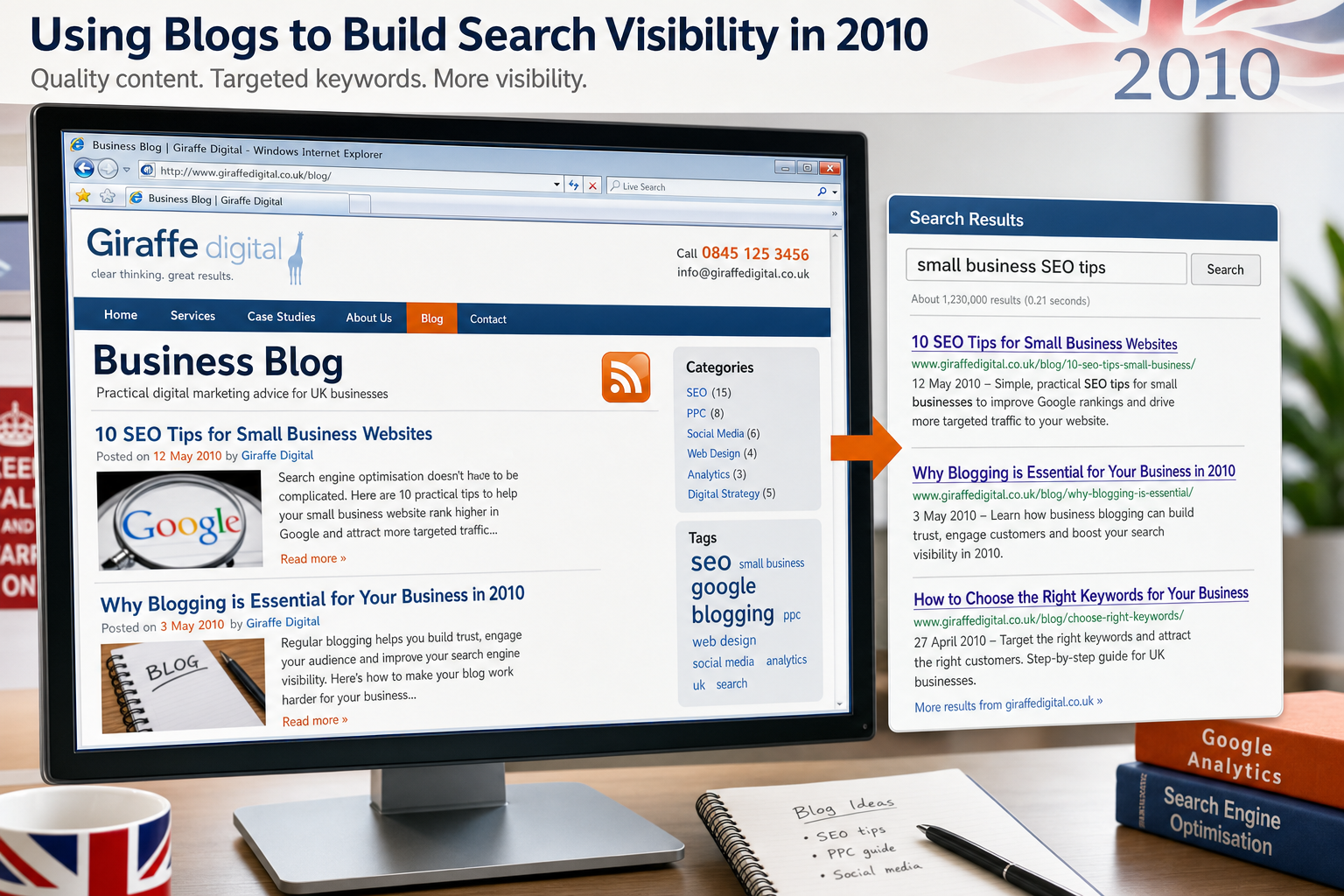
Business blogging is no longer a novelty reserved for journalists, hobbyists or large media organisations. For many UK businesses, a well-planned blog is becoming one of the most practical ways to keep a website active, answer common customer questions and increase visibility in the search engines. When used properly, a blog can support your website design, search engine optimisation, branding, social media marketing, and wider digital strategy.
The value of a blog is not simply that it gives you somewhere to publish company news. Its real strength is that it allows your business to create useful, relevant pages around the subjects your customers are already searching for. A brochure-style website may explain who you are and what you sell, but it often remains fairly static. A blog allows you to add fresh, focused content regularly without rebuilding the whole site.
Why business blogging helps search visibility
Search engines aim to return useful results for the words and phrases people type into them. If your website has only a handful of general pages, it can be difficult to appear for the more specific searches that potential customers make during their research. A blog helps by creating additional pages that cover individual topics in greater detail.
For example, a firm offering office refurbishment might have main website pages for design, fit-out and project management. A blog can then expand on more specific subjects, such as planning an office move, choosing partitioning, reducing disruption during refurbishment or preparing a workplace for new staff. Each useful article creates another opportunity to be found for a relevant search phrase.
This is especially valuable for what search marketers often call the long tail. These are longer, more detailed searches that may attract fewer visits individually but often show clearer intent. A person searching for office refurbishment may still be gathering ideas, while someone looking to plan an office refurbishment without closing the business may be closer to needing professional help.
Fresh content can also encourage search engines to revisit your site more often. This does not mean publishing for its own sake, nor does it mean posting daily if you have nothing useful to say. It means showing that your website is active, maintained and relevant to the market you serve.
Start with customer questions, not company announcements
One of the most common mistakes in business blogging is to treat the blog as a noticeboard for internal updates. There is nothing wrong with sharing important company news, but most prospective customers are not searching for your latest staff appointment or a photograph from an exhibition stand. They are usually searching because they have a question, a problem or a decision to make.
A more effective approach is to make a list of the questions customers ask before they buy. Sales teams, reception staff, account managers and directors often hold a great deal of useful knowledge that never reaches the website. Those questions can become practical blog articles.
Useful subjects might include:
- How to choose between two similar products or services.
- What information should a customer prepare before requesting a quotation?
- Common mistakes to avoid when planning a project.
- How long a typical process takes and what affects the timescale.
- What different industry terms mean in plain English.
- How legislation, warranties or maintenance requirements may affect a purchase.
These kinds of articles help search visibility because they match real search behaviour. They also help build trust. A business that explains matters clearly is more likely to be seen as competent, approachable and confident in its expertise.
Choosing keywords for blog articles
Good business blogging is not about stuffing pages with repeated keywords. Search engines are becoming increasingly capable of identifying low-quality or unnatural content, and visitors are quick to leave a page that reads poorly. The aim is to write clearly about a defined subject, using the language your customers use.
Before writing, choose one main topic for the article. Think about the words a potential customer would type into Google, Bing or Yahoo when looking for information on that subject. Use that phrase naturally in the article heading, opening paragraph and body copy where it makes sense. Related terms and plain-English explanations will usually appear naturally if the article is genuinely useful.
For instance, an accountancy firm might write about choosing an accountant for a small business. The article could mention bookkeeping, tax returns, payroll, limited companies and business advice, but it should remain focused on the main topic. A scattered article trying to target too many phrases rarely performs well and is less helpful to the reader.
It is also worth considering local search phrases if your business serves a particular area. A solicitor, builder, designer or training provider may benefit from articles that refer naturally to the towns, counties or regions they serve. This should be done honestly and sensibly. Adding a long list of locations at the bottom of every post is unlikely to create a good impression.
Make the blog part of your website, not a separate afterthought
From a website design and search perspective, it is usually best for a business blog to sit within the main website rather than on an unrelated free blogging address. Keeping the blog within your own domain helps build the overall authority and depth of your site. It also gives visitors a smoother journey from an article to your service pages, enquiry form or telephone number.
A sensible structure might place the blog at an address such as yourdomain.co.uk/blog or use a clearly labelled news and advice section. The important point is that the blog should feel like part of the same business. It should use the same branding, navigation, contact details and tone of voice as the rest of the website.
If you are planning a new website, discuss the blog early in the design process. Consider how articles will be categorised, how readers will find related content and how calls to action will be included without making the page feel pushy. A good article should first help the visitor, then make it easy for them to take the next step if they want assistance.
Domain names and long-term ownership
If your business is still choosing a domain name, select one that is memorable, professional and appropriate for long-term use. A short, clear domain is often better than one overloaded with keywords. Your domain should support both your brand and your search marketing.
For UK businesses, a .co.uk domain remains a familiar and trusted choice, particularly when serving customers in Britain. Some organisations may also wish to secure related domain variations to protect their brand, but the main website should have one clear primary address. Avoid changing domains without a good reason, as consistency helps customers, printed marketing and search visibility over time.
Keep domain registration details organised and make sure the business has proper access to renewal information. Losing track of domain ownership can create serious problems for a website, email and marketing activity. Domain decisions should be treated as part of the company's wider digital assets, not as a minor technical detail.
Write for people first, then optimise carefully
A strong business blog article should be easy to read. Use a clear heading, a short introduction and sensible subheadings. Break longer information into paragraphs, lists or step-by-step sections. Visitors often scan a page before deciding whether to read it properly, so structure matters.
At the same time, basic optimisation should not be ignored. Each article should have a descriptive page title, a clear web address and a concise meta description where your content management system allows it. The article should link to relevant pages elsewhere on your site, such as a related service page, a case study, or a contact page. Internal links help visitors and can also help search engines understand the relationship between pages.
Avoid copying manufacturers' descriptions, supplier text or articles from elsewhere on the web. Duplicate content offers little value and may make it harder for your site to stand out. Your own explanation, opinion and practical knowledge are what make the article worthwhile.
Images can also support a blog post, provided they are relevant and properly prepared. Use clear file names and alternative text that describes the image. Avoid uploading very large images straight from a camera, as slow pages can frustrate users. Fast, tidy pages are part of good website design as well as good search marketing.
Use blogging to support social media marketing
Social media platforms such as Twitter, Facebook, LinkedIn and YouTube are giving businesses more ways to share expertise and speak directly with customers. A blog provides a useful home for more substantial content, while social media can help distribute that content and start conversations around it.
For example, a short update on Twitter can point followers towards a new guide on your blog. A LinkedIn discussion may highlight a common business question that deserves a fuller article. A YouTube demonstration can be embedded or referenced in a blog post, giving visitors both written explanation and visual support.
The important point is that social media and blogging should not be treated as isolated tasks. A blog gives your social activity something useful to link to, and social channels can help bring the right readers back to your website. This is far more valuable than posting occasional promotional messages with no supporting content.
Plan a realistic publishing routine
Many businesses begin blogging enthusiastically and then stop after a few weeks. This often happens because no one has planned the work properly. A realistic routine is better than an ambitious schedule that cannot be maintained.
For a small or medium-sized business, one well-written article every fortnight or month may be a good starting point. The key is consistency and usefulness. Prepare a list of article ideas in advance, assign responsibility and allow time for review. If several people in the organisation have expertise, consider gathering their knowledge through short interviews and turning it into clear, polished articles.
An editorial plan might include seasonal subjects, common customer questions, industry explanations, project advice and occasional company updates. This helps avoid last-minute writing and keeps the blog balanced. It also ensures the content supports business goals rather than drifting into unrelated commentary.
Measure what your blog is contributing
Business blogging should have a purpose. While not every article will generate an immediate enquiry, your blog should drive measurable activity over time. Website analytics can show which articles attract visits, how people found them and whether readers move on to other pages.
Pay attention to the search phrases that bring visitors to the site, the articles that keep people reading, and the pages that lead to enquiries. This information can guide future content. If several visitors arrive after searching for a specific question, there may be an opportunity to expand on that topic or create a related service page.
It is also useful to monitor comments, email enquiries, and customer conversations. Sometimes the value of a blog is not visible in analytics alone. A prospect may mention that an article helped them understand an issue or gave them confidence to make contact. That is a genuine business benefit.
A practical asset for long-term visibility
Business blogging is not a quick trick for search rankings, and it should not be approached as one. Its strength lies in building a useful body of content that reflects your expertise, answers customer questions and supports the rest of your website. Over time, that content can help attract more relevant search visitors, strengthen your brand and give prospective customers more reasons to trust you.
For UK business owners investing in website design, SEO or digital marketing, a blog should be considered a core part of the plan. It brings together content, search, social media and customer education in a way few other tools can. Start with the questions your customers already ask, publish clear answers, and make the blog a natural part of your website. Done consistently, it can become one of the most valuable sections of your online presence.