Google's May 2026 core update has prompted many UK business owners to look more closely at how their websites are performing in organic search. Some organisations have seen steady gains, others have noticed page-level drops, and many are unsure whether a change is genuinely update-related or simply part of normal search movement. The sensible response is not to panic, rewrite everything or chase quick fixes. It is to review your search visibility, content usefulness, technical foundations and competitor movement with a clear plan.
Core updates are broad changes to Google's ranking systems. They are designed to improve how search results assess relevance, usefulness and quality across many types of websites. That means there is rarely one single issue to repair. For website owners, the May 2026 core update is best treated as a prompt to ask whether your site is still the strongest, clearest and most trustworthy answer for the searches that matter to your customers.
What a core update usually changes
A core update is not the same as a manual penalty, a security warning or a technical indexing fault. It is a recalibration of ranking systems. Pages can move up or down because Google's assessment of the wider search results has changed. Your website may not have done anything wrong, but competitors may now be considered more useful, fresher, better structured or more aligned with the searcher's intent.
For UK businesses, this can affect commercial pages, service pages, local landing pages, blog posts, resource hubs and e-commerce category pages. A page that ranked well because it was long, keyword-rich, or historically strong may lose ground if another page now offers a clearer answer, demonstrates stronger first-hand expertise, or supports the visitor more effectively.
It is also important to separate the impact of updates from unrelated changes. Seasonality, paid media activity, brand demand, tracking issues, website migrations, CMS changes and competitor campaigns can all influence traffic. Before assuming the May 2026 core update is the cause, compare several data points rather than relying on one ranking report.
Start with search visibility, not just traffic
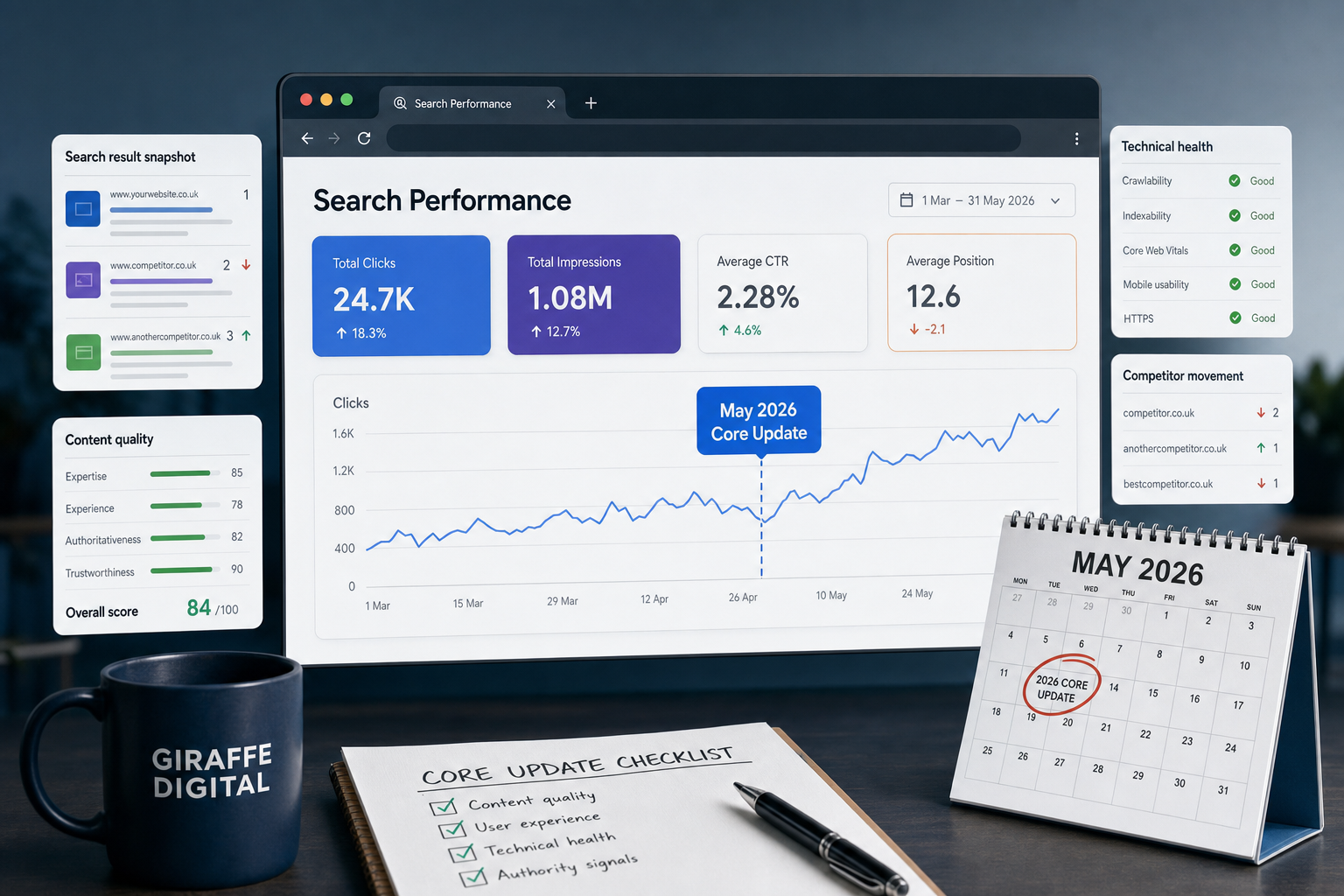
Organic traffic is useful, but it can hide the real pattern. A page may lose traffic because search demand has fallen, not because rankings have collapsed. Another page may gain impressions but fewer clicks because the search results page has changed. Start by reviewing search visibility across impressions, clicks, average position, click-through rate and landing page performance.
Look at a date range that covers the period before, during and after the May 2026 core update. Compare it with the previous period and, where useful, the same period in the previous year. This helps you distinguish movement due to updates from normal business seasonality.
Questions to ask in your visibility review
- Which pages gained or lost the most impressions?
- Which queries have changed position significantly?
- Are losses concentrated around one service, location, product type or informational topic?
- Are rankings down across the whole site, or only across a group of pages?
- Has click-through rate changed even where rankings remain similar?
- Are branded searches stable while non-branded searches have moved?
This analysis gives you a clearer picture of whether you are dealing with a site-wide quality concern, a content mismatch, a competitor issue or a technical problem. For example, if a Manchester-based professional services firm loses visibility for several advice-led blog posts but its core service pages remain stable, the next step is likely to be a content usefulness review rather than a full technical rebuild.
Review content usefulness through the customer' s eyes
The strongest response to a core update is to improve your website's usefulness. That does not mean adding more words to every page. It means making sure each page serves a clear purpose, answers the visitor's likely questions and supports the next step in their decision-making process.
Many business websites have accumulated content over several years. Blog posts overlap, service pages repeat similar claims, FAQs are thin, and older articles may no longer reflect current customer concerns. After the May 2026 core update, these weaknesses may become more apparent as search engines continually reassess which pages deserve attention.
Signs that content may need improvement
- The page targets a broad keyword but gives only surface-level information.
- The introduction is generic and could apply to any competitor.
- Claims are not supported by practical examples, evidence or explanation.
- The page does not make it clear who the service is for.
- Several pages cover the same topic without a clear difference in purpose.
- The content has not been updated to reflect current regulations, tools, buying behaviour or market expectations.
- The page attracts traffic but does not help visitors take a meaningful next step.
Useful content is specific. A web design agency page, for example, should not simply say that good design matters. It should explain how design choices affect enquiries, navigation, accessibility, mobile behaviour, brand perception and conversion. A local SEO page should not only list the benefits of visibility; it should explain how local landing pages, business information consistency, reviews, service relevance and content depth work together.
For service-led businesses, it is often worth mapping content to the buyer journey. Early-stage visitors may need educational articles, comparison pieces and checklists. Mid-stage visitors may need service explanations, proof of process and industry-specific guidance. Ready-to-enquire visitors need clear calls to action, trust signals and concise information about how you work.
Check whether your pages still match search intent
Search intent can shift over time. A keyword that once returned mostly blog posts may now favour comparison pages, product category pages, local results or expert-led resources. If your content type no longer matches what searchers expect, rankings can soften even if the writing itself is good.
Review the current search results for your most important queries. Do not copy competitors; instead, pay attention to the types of pages being rewarded. Are the top results more detailed? Are they more recent? Do they provide tools, tables, expert commentary, original insight or clearer answers? Are they localised for UK users? Do they include stronger supporting pages around the topic?
For example, a business targeting the phrase website redesign checklist may find that searchers now expect a practical, step-by-step resource rather than a short promotional blog. A company targeting SEO for accountants may need a page that addresses sector-specific compliance considerations, local competition, content planning and lead quality rather than a generic SEO service page.
Do not ignore technical issues
Core updates are primarily about quality and relevance, but technical SEO still matters. If Google has become more selective about which pages it shows, technical weaknesses can make it harder for your best content to compete. A technically sound website helps search engines crawl, understand and evaluate your pages properly.
After the May 2026 core update, review the basics carefully. Look for pages that have dropped out of the index, internal links that no longer point to important pages, slow templates, duplicated metadata, broken redirects, canonical tag issues, and inconsistent structured data. Check whether your mobile experience is genuinely usable, not just technically responsive.
Technical areas worth checking
- Indexing: Make sure important pages are indexable and not blocked by noindex tags, robots rules or canonical errors.
- Site structure: Ensure key services, locations and resources are easy to reach through internal links.
- Page experience: Review load speed, layout stability, intrusive elements and mobile usability.
- Content duplication: Identify near-identical service pages, location pages or category pages that may compete with one another.
- Structured data: Use relevant schema accurately where it helps clarify services, articles, FAQs or organisation details.
- Redirects and migrations: Check that recent website changes have not created chains, loops or lost authority.
A technical review is especially important if you have recently redesigned your website, changed CMS, merged pages, altered URLs or launched new templates. Ranking changes that appear to be caused by a core update may actually stem from a technical change made around the same time.
Understand competitor movement
When your rankings change, your competitors are part of the story. A drop is not always a decline in your own quality; it may be that another website has improved. They may have refreshed outdated pages, added detailed resources, strengthened internal linking, improved page speed, gained relevant mentions or created more focused landing pages.
Competitor analysis should be practical rather than obsessive. Choose the websites now ranking above you for commercially important searches and compare the factors that matter. Look at content depth, clarity, topical coverage, evidence of expertise, page layout, internal links, trust signals, freshness and usability. The aim is not to imitate, but to identify the gap between what your page offers and what the search results currently reward.
For instance, if a competitor's local service page includes clear service areas, practical FAQs, examples of typical customer problems, strong internal links and current supporting articles, while your equivalent page is brief and generic, the opportunity is obvious. Improve the page for visitors first, then align it more carefully with the query.
What not to do after the May 2026 core update
It is tempting to react quickly when rankings drop, but rushed changes can make diagnosis harder. Avoid deleting large sections of content without evidence. Do not change every page title at once. Do not rewrite successful pages simply because the site has seen movement elsewhere. And do not rely on automated content expansion as a substitute for genuine expertise.
Also avoid chasing individual ranking factors in isolation. A page is unlikely to recover because you changed one heading, added a keyword a few more times or increased the word count. Sustainable improvement usually comes from a combination of clearer intent, better structure, stronger content, technical hygiene and a more coherent website strategy.
The most effective post-update response is measured, evidence-led and focused on improving the experience for the people you want to reach.
Recovery and improvement plan after the update
If your website has been affected, prioritise work in a structured way. Start with the pages and queries that matter commercially, not every URL on the site. A small number of high-value pages often drive a large share of enquiries, so improving them can have a meaningful impact.
- Benchmark performance: Record current clicks, impressions, rankings, enquiries and conversions for key pages.
- Group affected pages: Separate service pages, blog posts, local pages, product pages and resource content.
- Check intent: Compare each key page with the current search results and identify whether the format still fits.
- Improve usefulness: Add missing detail, remove vague sections, answer real customer questions and make next steps clearer.
- Strengthen internal linking: Connect related content so visitors and search engines can understand your expertise.
- Fix technical blockers: address indexing, speed, mobile usability, redirects, and duplicate content issues.
- Monitor gradually: Track movement over several weeks rather than judging success after a few days.
For many businesses, the best outcome is not simply recovering lost rankings. It is building a website that is more resilient, more useful and more closely aligned with the enquiries you actually want. Core updates often expose strategic weaknesses that were already there: unclear positioning, thin service pages, underdeveloped content hubs or a lack of trust signals.
How this affects website design and digital strategy
The May 2026 core update is not only an SEO issue. It should also influence how businesses approach website design, branding, and digital strategy. A well-designed website should make expertise easy to find, guide visitors through decisions and support organic visibility with a clear structure.
Design choices can either help or hinder search performance. If important content is hidden behind weak navigation, buried in tabs, difficult to read on mobile or disconnected from related pages, the website may not communicate its value effectively. Similarly, a strong brand message can improve users' understanding of your relevance and why they should trust you.
For UK business owners planning a redesign, this is a good moment to bring SEO, content and design together from the start. Page templates, navigation, service architecture, copywriting, calls to action and measurement should all support the same commercial goals. Treating SEO as an add-on after launch often leads to avoidable rework.
FAQs about the May 2026 core update
How long should I wait before making changes
Once the update has finished rolling out and the data has settled, you can begin analysis. Avoid reacting to one or two days of movement. Look for consistent patterns across pages, queries and conversions before making significant changes.
Does a ranking drop mean my website has been penalised
Not usually. A core update is different from a manual action. A drop often means that Google's systems are reassessing relevance and usefulness across the wider search results. Your task is to identify where competitors or alternative content now provide a stronger answer.
Should I remove old blog posts
Only if there is a clear reason, some older posts can be updated, consolidated or redirected into stronger resources. Others may still support long-tail searches or internal linking. Review performance, relevance and quality before deciding.
Can technical SEO fix a core update decline
Technical SEO can help if crawl, indexing, performance or duplication issues are holding the site back. However, most core update responses also need content and strategy work. Technical fixes alone are rarely enough if the page is not useful or does not match intent.
How do I know if competitors have overtaken me
Review the current search results for your priority queries and compare the pages that now rank ahead of you. Look at content quality, freshness, structure, topical authority, user experience and trust signals. This will show whether you need to improve a page, create supporting content or rethink the structure of a topic area.
Clear next steps for UK website owners
If your visibility has changed since the May 2026 core update, take a calm, evidence-led approach. Review the data, identify affected pages, assess search intent, improve usefulness, fix technical issues and study competitor movement. Do not treat the update as a one-off problem to patch. Treat it as a signal to build a stronger digital foundation.
For businesses considering website design, SEO, branding, or a broader digital strategy, the key lesson is simple: your website needs to prove its value clearly. It should answer the questions your customers are asking, demonstrate your organisation's credibility, perform well on modern devices, and connect content to commercial outcomes. The more helpful and coherent your website is, the better placed it will be when search systems continue to evolve.