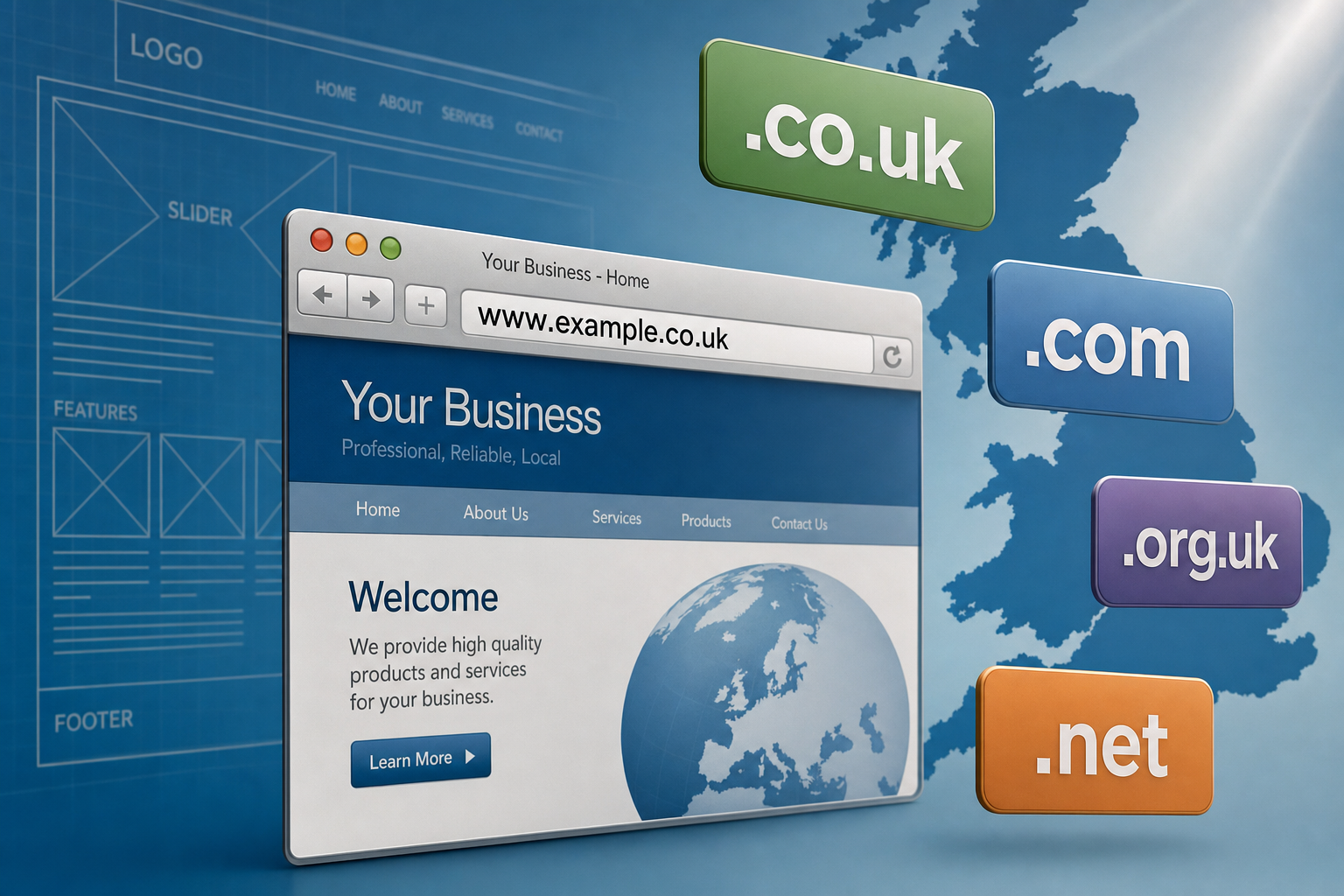
Your domain name is often the first part of your website that a potential customer notices. It appears on your business cards, in email signatures, on search engine results pages, in social media profiles and in conversations with clients. While the name itself deserves careful thought, the domain extension is just as important. Choosing between options such as .co.uk, .com, .org.uk or .net can influence how people perceive your business, how easily they remember your address and how clearly your website communicates where you operate.
For UK business owners planning a new website, redesigning an existing site, or reviewing an online marketing strategy, the right domain extension should support the business's wider aims. It should feel credible, be easy to say aloud, suit your market and avoid unnecessary confusion. A good choice will not make a weak website successful on its own, but it can strengthen your brand, help users understand your offer and provide a sound foundation for search marketing.
What is a domain extension
A domain extension is the final part of a web address, appearing after the last dot. In www.example.co.uk, the extension is .co.uk. In www.example.com, the extension is .com. Some extensions are linked to countries, such as .co.uk for the United Kingdom, while others are more general, such as .com, .net, .org, .biz or .info.
The extension forms part of the full domain name and should not be treated as an afterthought. A business may spend time choosing a memorable brand name only to weaken it with an extension that does not resonate with its audience. For example, a local accountant serving clients in Kent may gain more immediate relevance from a .co.uk address than from an unfamiliar or less trusted alternative. By contrast, a software business selling internationally might prefer .com if it can obtain a suitable name.
Users make quick judgements online. If a domain extension looks familiar and appropriate, it can reassure visitors before they even reach the site. If it seems odd, overly long or unrelated to the business, it may create a small but avoidable barrier.
The main domain extensions for UK businesses
There are many domain extensions available, but most UK businesses will focus on a small number of practical choices. The best option depends on where you trade, how you want to be perceived and whether your preferred name is available.
.co.uk
For many UK businesses, .co.uk is the natural choice. It is widely recognised, trusted by British customers and clearly indicates a UK presence. If your customers are primarily in the United Kingdom, a .co.uk domain extension can help reinforce that you are local, relevant and accessible.
A .co.uk address is particularly suitable for professional services, trades, retailers, charities with commercial activities, local organisations and companies that want to appeal to a UK audience. It also works well in offline marketing because British customers are used to seeing it on vans, shop signs, advertisements and printed literature.
.com
The .com extension remains the most recognised domain extension internationally. It is often associated with established businesses, commercial websites and organisations with a broader reach. If your business trades beyond the UK, or you plan to expand overseas, a .com address can be valuable.
The challenge is availability. Many short, descriptive and brandable .com domains have already been registered. This can lead businesses towards awkward compromises, such as adding unnecessary words, using hyphens or choosing a name that is harder to remember. If the .com version of your name is available and your ambitions are not limited to the UK, it is certainly worth considering. If it is not available, a strong .co.uk domain may be better than a weak .com domain.
.org.uk and .org
The .org.uk extension is commonly used by charities, voluntary groups, community projects and non-commercial organisations in the UK. It can communicate a sense of public purpose or membership activity. The broader .org extension is also well known, particularly for organisations with an international or non-profit focus.
Businesses should be careful with these extensions unless the organisation type fits. A commercial company using .org.uk may confuse users or appear less straightforward than necessary. Trust is built through clarity, and the extension should align with the website's nature.
.net, .biz, .info and other options
Extensions such as .net, .biz and .info can be useful in certain circumstances, but they tend to require more explanation. .net has a long-standing association with networks, technology and internet-related services, although it is used more broadly. .info may suit information-led websites, but it is not usually the strongest choice for a main business address. .biz is intended for business use, but in the UK it has not achieved the same everyday recognition as .co.uk or .com.
That does not mean these extensions should never be used. They can work for a campaign, a supporting website or a project where the wording is especially clear. However, for a primary business website, familiarity usually matters. If your customers have to ask whether they have remembered the extension correctly, you may be creating needless friction.
How your domain extension affects trust and branding
A website is part of your brand, not merely a technical destination. The domain extension appears everywhere your web address appears, so it should be simple, credible and consistent with the impression you want to create.
Trust is especially important for businesses that rely on enquiries, bookings or online sales. A visitor who is deciding whether to send an enquiry form, telephone your office or place an order will look for signals that the business is genuine. These signals include good website design, clear contact information, professional copy, a secure and well-maintained site where appropriate, and a domain name that feels right for the organisation.
For a UK audience, a .co.uk domain can suggest that the business understands local expectations. It may imply UK delivery, UK service standards or UK-based support, although your website should still make these points explicit. A .com domain can give a broader, more international feel. Neither is automatically better; the stronger choice is the one that aligns with the business.
It is also worth thinking about how the domain sounds when spoken. If you regularly give your web address over the telephone, at networking events, or in radio advertising, choose an extension that is easy to say and remember. A simple address such as yourbrand.co.uk is more practical than a long phrase with a less common extension.
Search engine considerations in 2011
Search engines consider many signals when deciding which pages to show, and the domain extension is only one small part of the picture. Good search performance depends on relevant content, accessible website design, sensible page titles, descriptive headings, useful links, fast-loading pages and a site structure that search engines can crawl. A domain extension alone will not secure strong rankings.
That said, the extension can provide a geographical clue. Country-specific extensions, such as .co.uk, are associated with the United Kingdom and can be helpful when targeting UK searchers. If your market is mainly British, this can strengthen the site's broader relevance. For generic extensions such as .com or .net, search engines may use other signals, including hosting location, business address, content, links and settings in webmaster tools, to understand the intended audience.
Some businesses are tempted to choose a domain purely because it contains a keyword. For example, a plumber in Bristol might want a domain name that includes the words "Bristol plumber". Descriptive wording can help users understand what you do, and keywords in a domain may have some search value. However, it is important not to sacrifice brand quality. A domain that is clumsy, forgettable, or overly generic can limit your long-term marketing efforts. A balanced approach is best: choose a domain that is relevant, memorable and capable of supporting a real business identity.
Avoid overloading a domain with several keywords separated by hyphens. It may look less professional, make it harder to communicate, and raise doubts with visitors. Search marketing should be built on useful pages, clear services, good content and genuine reputation, not on trying to force every possible phrase into the web address.
Protecting your business name online
Once you have chosen your preferred domain extension, consider whether you should register a few closely related versions. Many UK businesses choose to secure both the .co.uk and .com versions of their name if available. This can help prevent confusion and reduce the chance of another organisation using a similar address.
You do not need to build separate websites on every domain you register. In many cases, it is sensible to select one primary domain and redirect the others to it. This keeps your marketing consistent and prevents your content from being split across multiple addresses. For example, if your main website is on .co.uk, the .com version can point visitors to the same site, provided it is set up correctly.
Also think about common misspellings, plural forms, and hyphenated alternatives. Not every variation is worth registering, and businesses should avoid collecting domains without a clear reason. However, if a particular mistake is likely, or if your name is often misheard, securing a variation may prevent lost visits.
It is also sensible to use a domain-based email address, such as enquiries@yourbusiness.co.uk, rather than relying solely on a free email account. A professional email address reinforces the brand and makes your communications look more established. When planning your website design and hosting, make sure email requirements are included from the start.
Domain registration essentials
Registering a domain is usually straightforward, but the details matter. The domain should be registered using accurate business or ownership information, and the login details should be stored securely. A surprising number of problems arise when a former employee registers a domain, a temporary supplier or an individual whose details are later lost.
Make sure the business understands who controls the domain, when it is due for renewal and which email address receives renewal notices. Allowing a domain to expire can interrupt the website, email and online advertising. It can also create unnecessary stress if the domain becomes available to others.
When a web design agency or technical partner assists with registration, the arrangement should be clear. The business should know whether it owns the domain, how it can access the account if required and how DNS changes will be managed. DNS settings control where the domain points, including the website hosting and email services. They are not something most business owners need to adjust daily, but they should not be a mystery.
It is also worth checking that the domain name does not create legal or branding difficulties. Avoid choosing a domain that is confusingly close to another established organisation, especially in the same sector. A quick search can reveal whether your proposed name is already being used. For important brands, professional advice may be appropriate before committing to a name and building marketing around it.
How the domain extension fits with website design
Your domain should be considered alongside your website design, content, and digital marketing. A good website is not simply a set of pages; it is a complete experience from the first search result or printed advert through to the enquiry, purchase or telephone call.
The domain extension contributes to that experience by setting expectations. If visitors arrive at a .co.uk website, they may expect UK spelling, UK contact details, UK delivery information and clear references to local service areas. If they arrive at a .com website, they may look for international shipping, regional options or broader company information. The site content should support the promise implied by the domain.
Consistency is important across all marketing channels. Use the same primary domain on your stationery, email signatures, brochures, social media profiles and directory listings. If you use Twitter, Facebook, LinkedIn or YouTube as part of your social media marketing, make sure the web address shown on those profiles matches the domain you want customers to remember. Mixed use of several different domains can weaken recognition and make campaign tracking more difficult.
From a design point of view, the domain should be visible but not intrusive. It should appear clearly in the website header or footer, where appropriate, and match the brand style used elsewhere. If your domain is long, it may affect how it appears on printed materials, exhibition graphics, or vehicle signage. This is another reason to choose a concise, memorable address wherever possible.
Practical examples
Consider a family-run restaurant in Manchester. If its customers are mainly local diners and people searching for somewhere to eat in the area, a .co.uk domain is likely to feel natural and trustworthy. The website can then focus on menus, opening times, location, booking information and local search relevance.
A consultancy serving clients in London, Edinburgh and Birmingham might also choose .co.uk because the market is clearly UK-based. The domain extension supports national positioning, while the website content can include service pages, case-study-style explanations, sector expertise, and clear enquiry routes.
A product manufacturer planning to sell across Europe and North America may prefer .com if the right name is available. In that case, the website design should consider international users, clear contact routes, export information and content that does not feel limited to one town or region.
A community arts group may find .org.uk more appropriate than .co.uk because it suggests an organisation rather than a conventional commercial business. This can support grant applications, volunteer recruitment and public-facing information, provided the website clearly explains the group's purpose.
Common mistakes to avoid
- Choosing an unfamiliar extension for the main website: If customers do not recognise or trust it, they may hesitate or forget it.
- Using too many hyphens: Hyphenated domains can be hard to say aloud and easy to mistype.
- Changing domains without a plan: Moving to a new domain can affect search visibility and should be handled carefully with proper redirects.
- Letting someone else control the registration: Your business should have clear ownership and access arrangements in place.
- Ignoring email: A domain decision affects both the website and professional email addresses.
- Thinking that an extension alone will improve SEO: Search marketing relies on the quality and relevance of the entire website.
Making the right choice
The best domain extension is the one that supports your business goals, reassures your audience and works cleanly across your marketing. For many UK businesses, .co.uk will be the strongest and simplest choice. For organisations with international ambitions, .com may be preferable. For charities, community groups and non-commercial bodies, .org.uk may be more suitable. Other extensions can have their place, but they should be chosen for a clear strategic reason rather than because the preferred .co.uk or .com was unavailable.
Before registering a domain, say it aloud, write it down, imagine it on your website design and consider how it will look in search results and on social media profiles. Check whether it matches your audience, location, and long-term plans. A well-chosen domain extension will not replace good design, useful content or effective digital marketing, but it will give all of those efforts a stronger foundation.
If you are planning a new website, it is worth discussing the domain at the beginning of the project. The right choice can help shape the site structure, branding, email setup and search marketing approach. Taking the time to make this decision now can prevent confusion later and give your business a clearer, more professional online presence.