Website performance has always influenced how people feel about a business online. A slow page, a shifting layout or a checkout that takes too long to respond can make even a well-designed website feel unreliable. In 2021, that user experience is becoming more closely connected with search visibility. Google has confirmed that Core Web Vitals will form part of its page experience signals, with the change expected from May 2021. For UK business owners planning a new website, refreshing an existing one or investing in SEO, this makes performance a practical business consideration rather than a purely technical afterthought.
What are Core Web Vitals
Core Web Vitals are a set of measurements designed to help website owners understand key parts of the user experience. They focus on how quickly a page loads, how soon it becomes usable and how stable it feels as it appears on screen. These measures sit alongside other page experience factors such as mobile friendliness, safe browsing, HTTPS and avoiding intrusive interstitials.
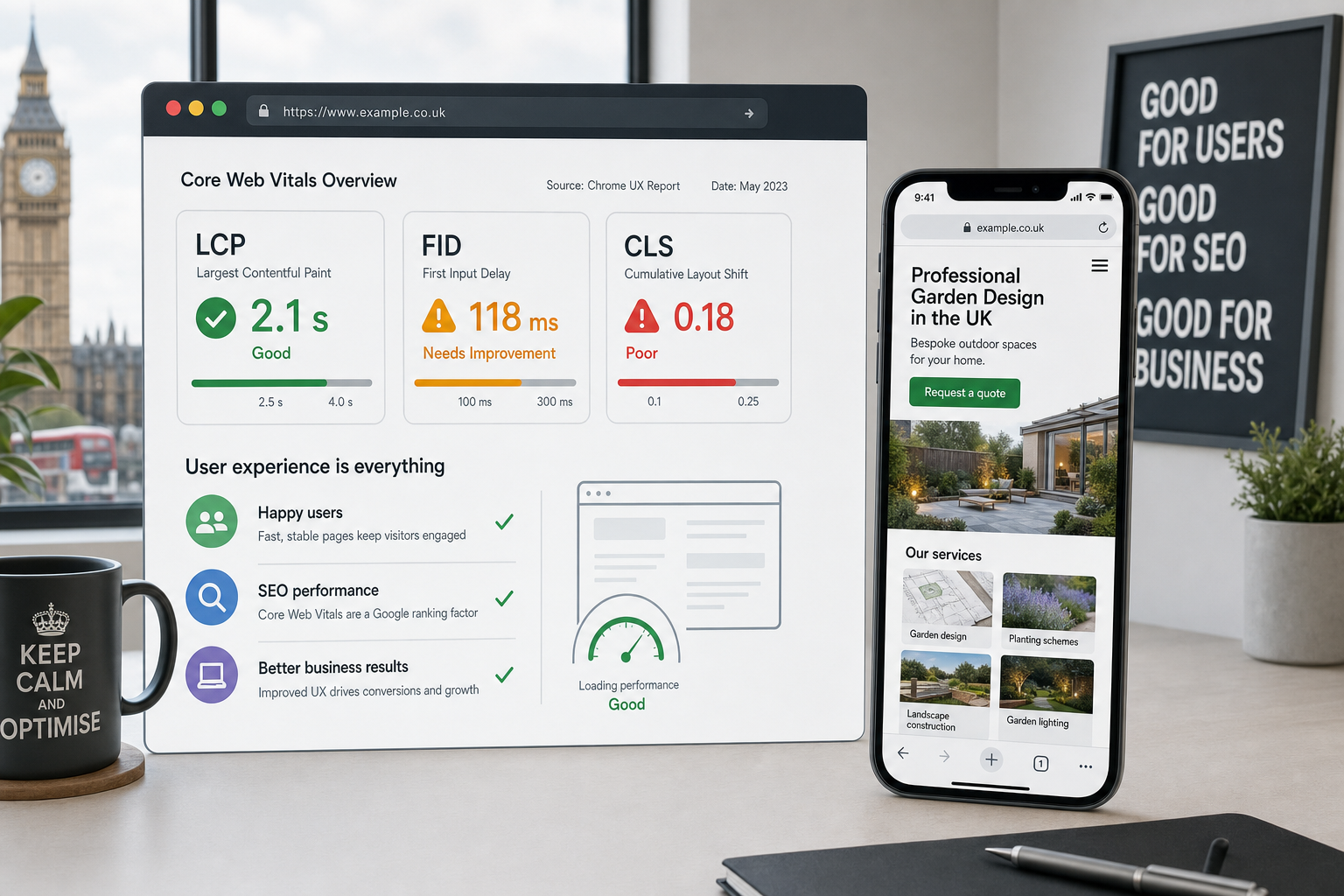
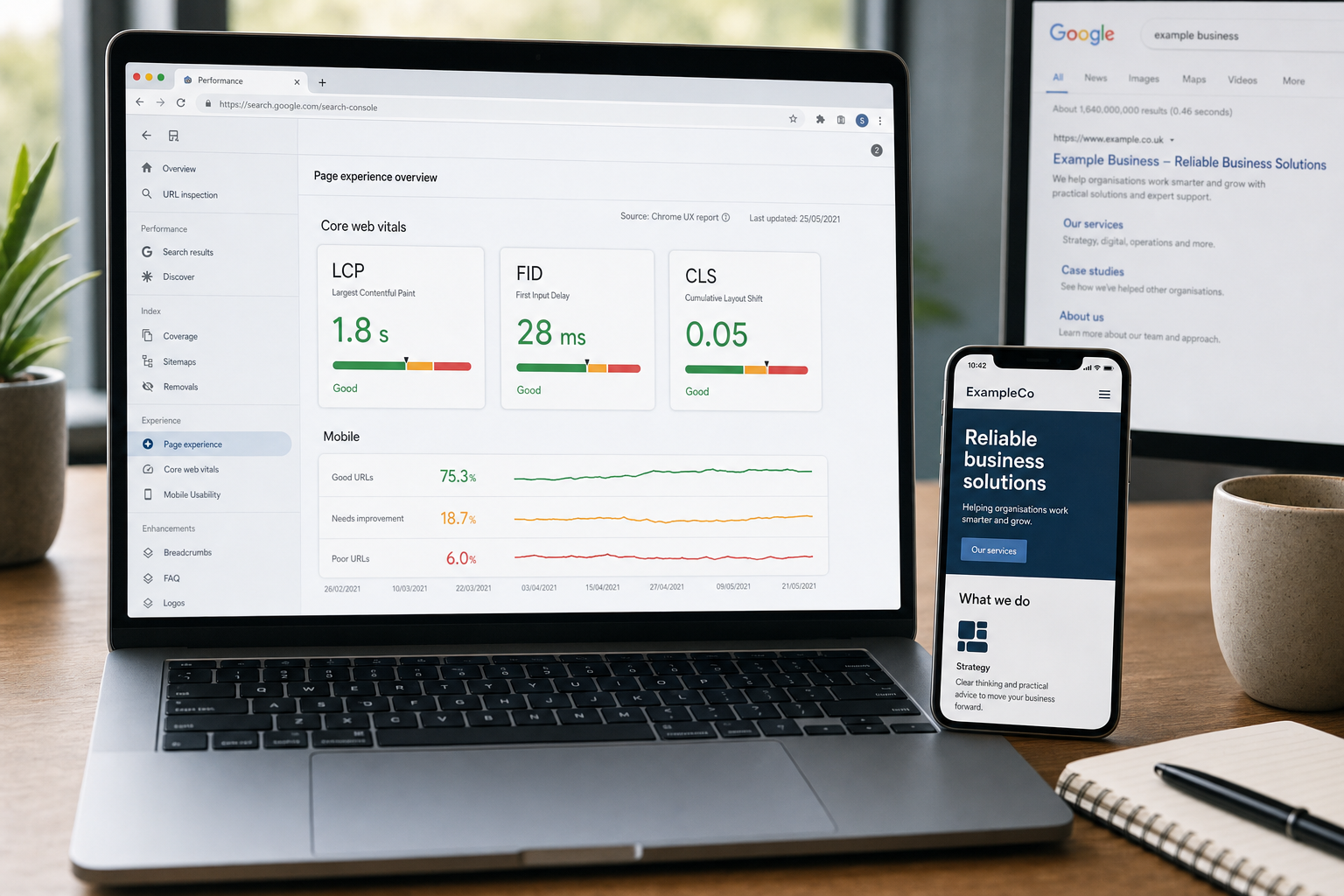
The three Core Web Vitals being used at the start of 2021 are Largest Contentful Paint, First Input Delay and Cumulative Layout Shift. Each one looks at a different part of the experience.
Largest Contentful Paint
Largest Contentful Paint, often shortened to LCP, measures how long it takes for the largest visible content element to load. This could be a hero image, a prominent heading area or a large block of text. In plain terms, it helps to answer an important question: how quickly does the main content appear for the visitor?
For many business websites, a poor LCP score is caused by oversized images, heavy sliders, slow hosting, too many scripts or themes that load more code than the page really needs. A visitor may not know the term LCP, but they will notice if the page seems to hang before anything useful appears.
First Input Delay
First Input Delay, or FID, measures how quickly a page responds when a visitor first tries to interact with it. That interaction might be tapping a menu button, clicking a link, opening a product filter or starting to complete a form. A page can look ready but still feel unresponsive if the browser is busy processing scripts in the background.
This is particularly important for lead generation pages, e-commerce journeys, booking forms and mobile navigation. If a potential customer taps and nothing happens, they may assume the website is broken or abandon the task altogether.
Cumulative Layout Shift
Cumulative Layout Shift, or CLS, measures visual stability. It looks at whether elements move around unexpectedly as the page loads. Common examples include a button shifting down when an image finally appears, an advert space pushing content out of position, or a font change causing text to jump after the visitor has started reading.
Layout shift is frustrating because it interrupts concentration. It can also cause accidental clicks, which is especially damaging on forms, navigation menus and checkout pages. A stable page feels more professional and easier to trust.
Why this matters for business planning
Core Web Vitals are not just an SEO talking point. They are a useful way to discuss website quality in business terms. A faster and more stable website can support enquiries, product sales, content engagement and brand confidence. While good scores alone do not guarantee rankings or conversions, poor performance can hold back other marketing activity.
Many businesses invest in branding, photography, copywriting, paid advertising and social media campaigns, then send visitors to a website that loads slowly on a mobile connection. That weakens the return from each channel. If someone clicks through from a social post, an email campaign or a search result, the website needs to continue the experience smoothly.
For service businesses, performance can affect the first impression before a prospect has read a single case study. For online retailers, every second of hesitation can add friction to browsing and buying. For local businesses, mobile performance is especially important because people may be searching while travelling, comparing options quickly or using a weaker connection.
Core Web Vitals give business owners a clearer vocabulary for discussing speed, responsiveness and visual stability with designers, developers and marketing teams.
How Core Web Vitals fit into SEO in January 2021
Google has said that page experience signals will become part of its ranking systems, with Core Web Vitals included in that group. This does not mean that content quality, relevance, links, search intent and technical SEO stop mattering. They remain essential. However, when competing pages are similar in relevance and usefulness, a better page experience may help create an advantage.
It is sensible to treat Core Web Vitals as part of a broader SEO programme. A page still needs to answer the searcher's question, use clear headings, have well-written content, include appropriate internal links and be accessible to search engines. Performance is one layer of that work, not a substitute for it.
For UK business owners planning SEO in 2021, the practical approach is to prioritise important pages first. These may include the home page, key service pages, category pages, product pages, booking pages, landing pages and blog posts that already attract organic traffic. Improving every page at once may not be realistic, but improving the pages that bring in enquiries or revenue can make an immediate difference.
Design choices that influence performance
Website design and Core Web Vitals are closely connected. A visually impressive design can still be poor for users if it is slow, unstable or awkward on mobile. The aim is not to strip away personality or branding, but to make considered choices about what each page needs to achieve.
Large image banners, background videos, animation effects, third-party widgets and complex page builders can all add weight. Sometimes they are worth using; sometimes they distract from the main goal. A good design process should ask whether each element supports the visitor journey.
- Use images carefully: compress images, choose suitable dimensions and avoid uploading files that are far larger than the design requires.
- Plan mobile layouts first: many users will arrive on phones, so important content, navigation and calls to action should work well on smaller screens.
- Avoid unexpected movement: reserve space for images, banners and embedded content so the layout does not jump as assets load.
- Keep navigation simple: menus should open quickly and make important pages easy to find.
- Question unnecessary effects: animations and sliders can be attractive, but they should not slow down the page or hide essential content.
Performance is easier to achieve when it is planned from the beginning. Retrofitting speed improvements after a website has been built can still help, but it may require more compromises than designing with performance in mind from the outset.
Technology decisions: hosting, platforms and code
The technology behind a website has a direct impact on Core Web Vitals. Hosting quality, server response times, the content management system, theme choice, plugins, scripts and image handling all contribute to the final experience.
For websites built on popular content management systems such as WordPress, performance often depends on disciplined setup. Too many plugins, poorly maintained themes or heavy visual builders can create unnecessary code. That does not mean these platforms cannot perform well; it means they need careful configuration and ongoing maintenance.
Business owners should ask their web team how performance will be measured, not just how the website will look. Useful questions include:
- How will image size and format be managed?
- Will the website use caching where appropriate?
- Are scripts being loaded only where they are needed?
- How will fonts be handled to reduce delays and layout shifts?
- What testing will be carried out on mobile devices and slower connections?
- How will performance be monitored after launch?
Third-party scripts deserve particular attention. Analytics, chat tools, embedded maps, review widgets, tracking pixels and advertising tags can all be useful, but they also add work for the browser. A sensible marketing technology setup balances measurement with speed. If a script is no longer needed, it should be removed rather than left to load on every page.
Social media traffic still needs a fast website
Social media marketing often focuses on creative posts, audience targeting and campaign planning, but the landing experience is just as important. A strong post can generate interest, yet a slow page can waste that attention. This is especially relevant on mobile, where many social media users browse within app-based browsers and may be on variable connections.
If a campaign is promoting a guide, service, event, product launch or seasonal offer, the landing page should be tested before activity begins. The page should load quickly, explain the offer clearly and make the next step obvious. Images used in the campaign should be visually consistent with the landing page, but not so heavy that they damage loading times.
Core Web Vitals can also help teams avoid a common problem: building campaign pages that look impressive in isolation but perform poorly in real use. The best landing pages combine brand presentation, persuasive content and technical efficiency.
Domain registration and the wider trust picture
Core Web Vitals focus on page experience, but they sit within a wider picture of trust and professionalism. Domain registration is one of the early decisions that can influence how a business is perceived online. A clear, memorable domain name supports branding, marketing and customer confidence.
When choosing a domain, business owners should look for a name that is easy to spell, easy to say and closely aligned with the brand. Avoid unnecessary hyphens, confusing abbreviations or wording that could be mistaken for another organisation. For UK-focused businesses, it can be sensible to consider relevant UK domain extensions alongside broader options, depending on brand plans and audience expectations.
Domain ownership should be kept under proper business control. Use accurate registration details, maintain access to the account, keep renewal reminders up to date and make sure the domain is not dependent on a single employee's personal email address. These basics are not glamorous, but they protect the business from avoidable disruption.
It is also worth checking that the domain supports secure browsing through HTTPS once the website is live. Security is part of the page experience signals and is now a normal expectation for professional websites, particularly where forms, account areas or payments are involved.
How to measure Core Web Vitals
Several tools can help website owners and marketing teams review Core Web Vitals in 2021. Google's PageSpeed Insights provides both lab data and, where available, field data based on real user experience. Lighthouse, available in Chrome DevTools, is useful for testing pages in a controlled way. The Core Web Vitals report in Google Search Console can help identify groups of URLs that need attention.
It is important to understand that a single test is not the full story. Results can vary depending on device, connection, server load and page type. Field data, where available, is particularly useful because it reflects how real visitors experience the website. Lab tests are still valuable because they provide diagnostic detail and can be repeated during development.
When reviewing results, do not focus only on the home page. Many visitors enter through service pages, blog posts, product pages or local landing pages. A website can have a quick home page but slow commercial pages, which means the business impact may still be significant.
Practical steps before the May 2021 change
Businesses do not need to panic, but they should avoid leaving performance planning until the last minute. A structured review can identify where improvements are most worthwhile and whether they can be made within the existing website or should form part of a redesign.
- Audit priority pages: test the pages that generate enquiries, sales or organic traffic.
- Review mobile performance: look at how pages behave on common mobile devices, not just desktop screens.
- Optimise images: resize, compress and serve images appropriately for the design.
- Reduce unnecessary code: remove unused scripts, plugins and tracking tags where possible.
- Improve server response: discuss hosting, caching and technical setup with your web team.
- Stabilise layouts: set image dimensions, reserve space for embeds and avoid late-loading elements that push content around.
- Plan future content carefully: make sure new blog posts, landing pages and campaign pages follow the same performance standards.
For a new website project, Core Web Vitals should be included in the brief. For an existing website, they should be added to ongoing SEO and maintenance work. Performance is not a one-off task because websites change over time as new content, plugins, campaigns and tracking requirements are added.
Making performance part of digital strategy
The most successful approach is to treat Core Web Vitals as part of digital strategy rather than as a separate technical exercise. Website design, SEO, content, brand, social media marketing and technology decisions all shape the final experience. A fast, stable website helps each of those areas work harder.
For business owners, the question is not simply whether a website passes a particular test. The more useful question is whether the website helps people move confidently from interest to action. Can visitors find the information they need? Does the page load quickly enough to keep their attention? Does the design feel professional? Is the call to action clear? Can marketing teams send campaign traffic to the site with confidence?
Core Web Vitals provide measurable signals that support those decisions. They encourage better planning, cleaner design, more thoughtful technology choices and a stronger focus on the people using the website. As page experience becomes more visible in search marketing, businesses that invest in performance now will be better placed to compete online throughout 2021.