Choosing a domain name is one of the earliest digital decisions a start-up or new brand will make, yet it often happens in a hurry. A good domain name strategy does more than secure an address for your website. It supports your brand, helps customers remember you, sends consistent signals to search engines and provides a foundation for website design, email, social media marketing and future growth.
For UK business owners, the right choice is not always the shortest name or the most keyword-heavy option. It is the domain that makes commercial sense: easy to say, easy to spell, credible in your market and flexible enough to work as your organisation develops. The following considerations will help you make a decision that still feels sensible once your website, marketing activity and customer base have grown.
Why your domain name matters
Your domain name is often the first piece of your brand that a potential customer sees. It appears in search results, on business cards, in email addresses, on social profiles, in printed advertising and in conversation. If it is confusing, too long or difficult to remember, you create unnecessary friction before someone has even reached your website.
A strong domain can also make your marketing more efficient. When people hear your name at an event, see it on a van or read it in a press mention, they should be able to find you without guessing several variations. The same applies to radio advertising, networking and word of mouth. If a customer has to ask whether there is a hyphen, a number or an unusual spelling, the name may be working harder than it should.
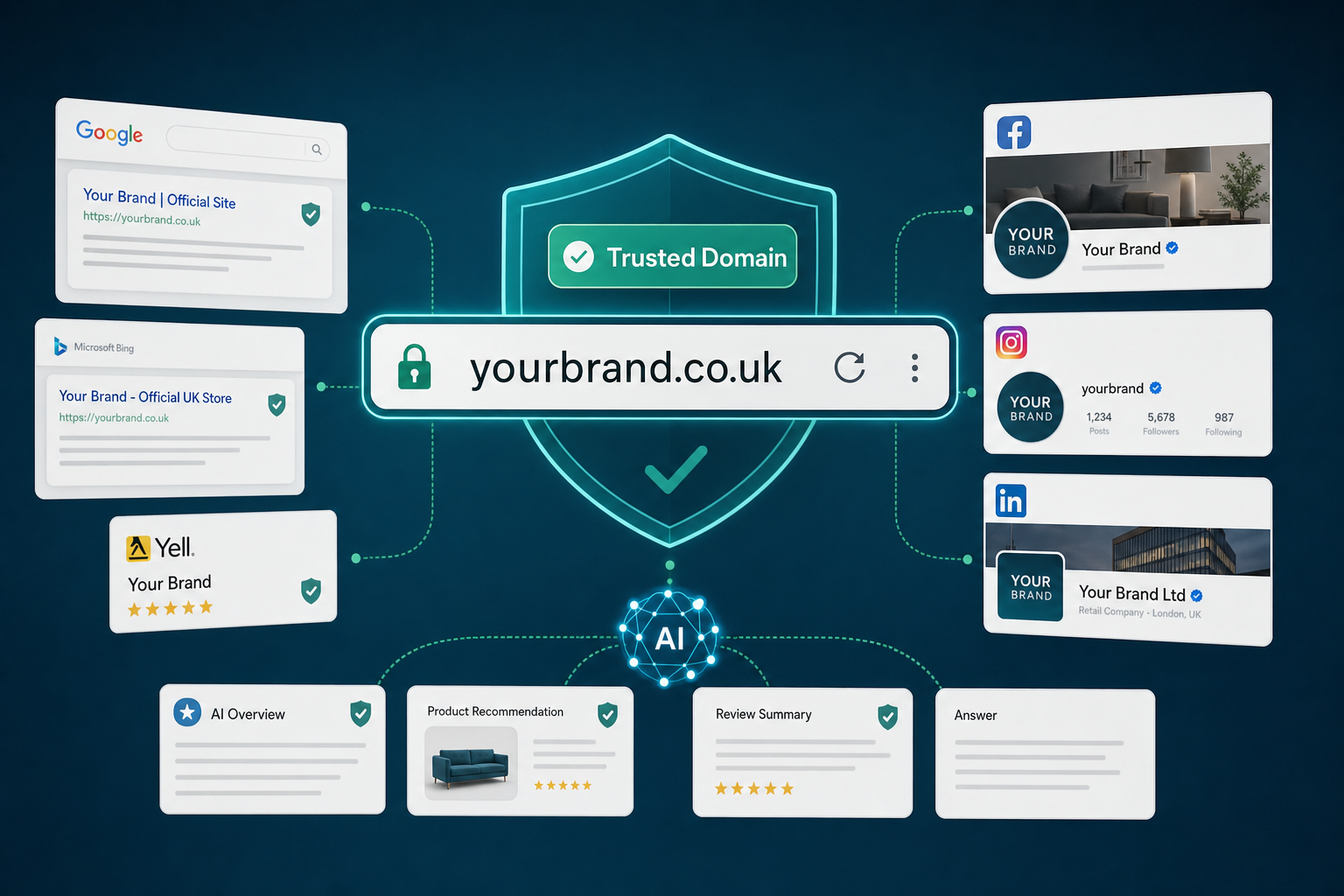
There is also a trust factor. A clear, professional domain supports a clear, professional website. A domain that looks temporary, over-complicated or unrelated to the business can create doubt, particularly for service providers, e-commerce businesses and organisations asking users to submit personal details.
Brand-first or keyword-rich
Many start-ups begin by asking whether their domain should include keywords. There is no single answer, but there is an important principle: keywords may help explain what you do, but they should not replace a proper brand.
A domain such as manchesteraccountants.co.uk tells people exactly what the site is about, but it may feel generic and limiting if the business later expands beyond Manchester or develops a more distinctive identity. A brand-led name such as oakfieldfinance.co.uk may need more marketing at the beginning, but it can be more memorable and more ownable over time.
Search engines have become better at understanding quality, relevance and authority. An exact-match domain is not a shortcut to strong search visibility. If the website is thin, poorly written or difficult to use, a keyword in the domain will not compensate. On the other hand, a sensible keyword can be useful where it fits naturally with the brand, such as for a local trade, a specialist service or a product-led business.
A balanced approach often works best. Consider whether your chosen name gives a reasonable clue about your offer without becoming awkward. For example, a bakery called Flour & Fig might choose a domain that reflects the brand, while a specialist firm might add a descriptive term if the brand name alone is too broad. The goal is clarity, not cramming.
Choosing the right extension
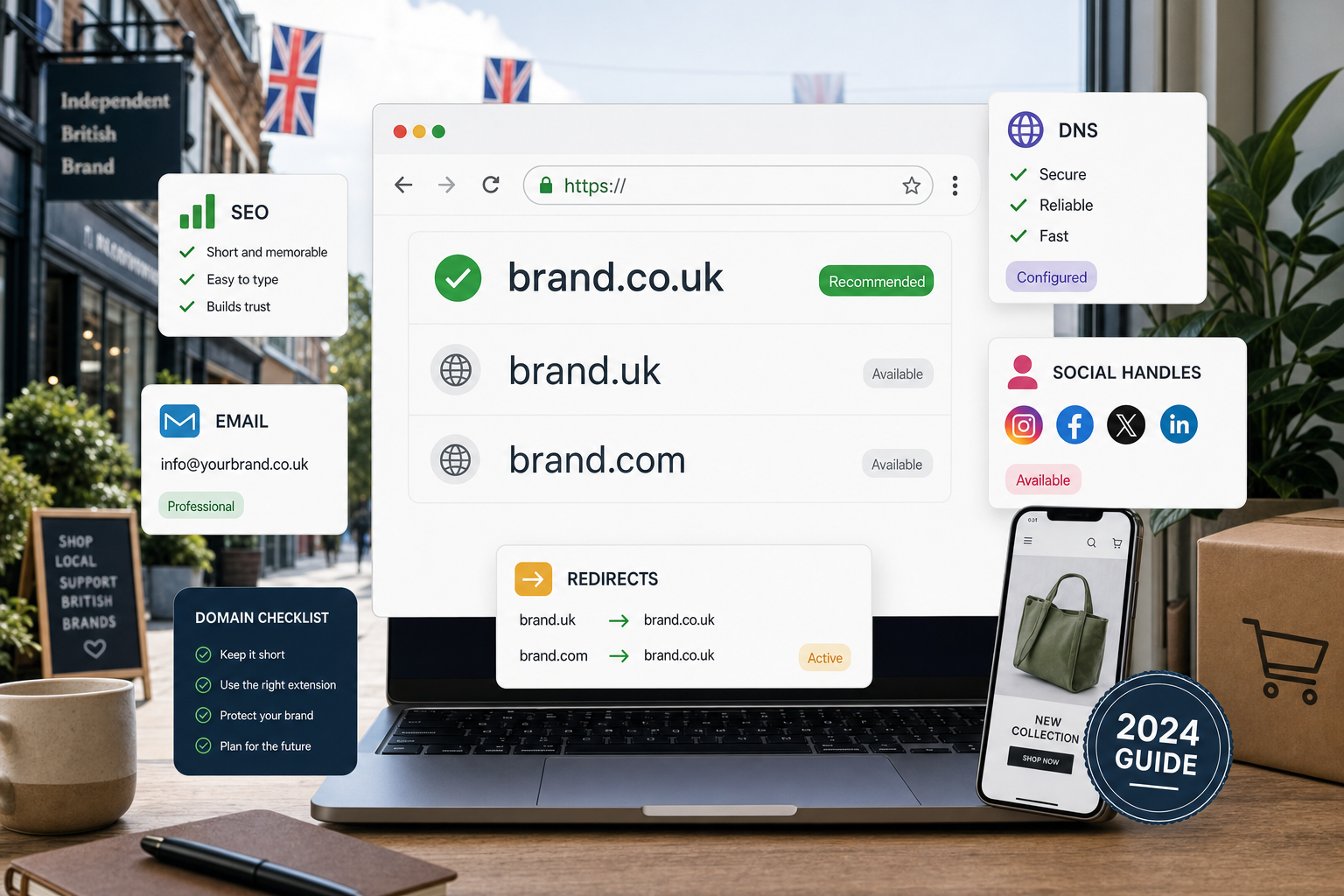
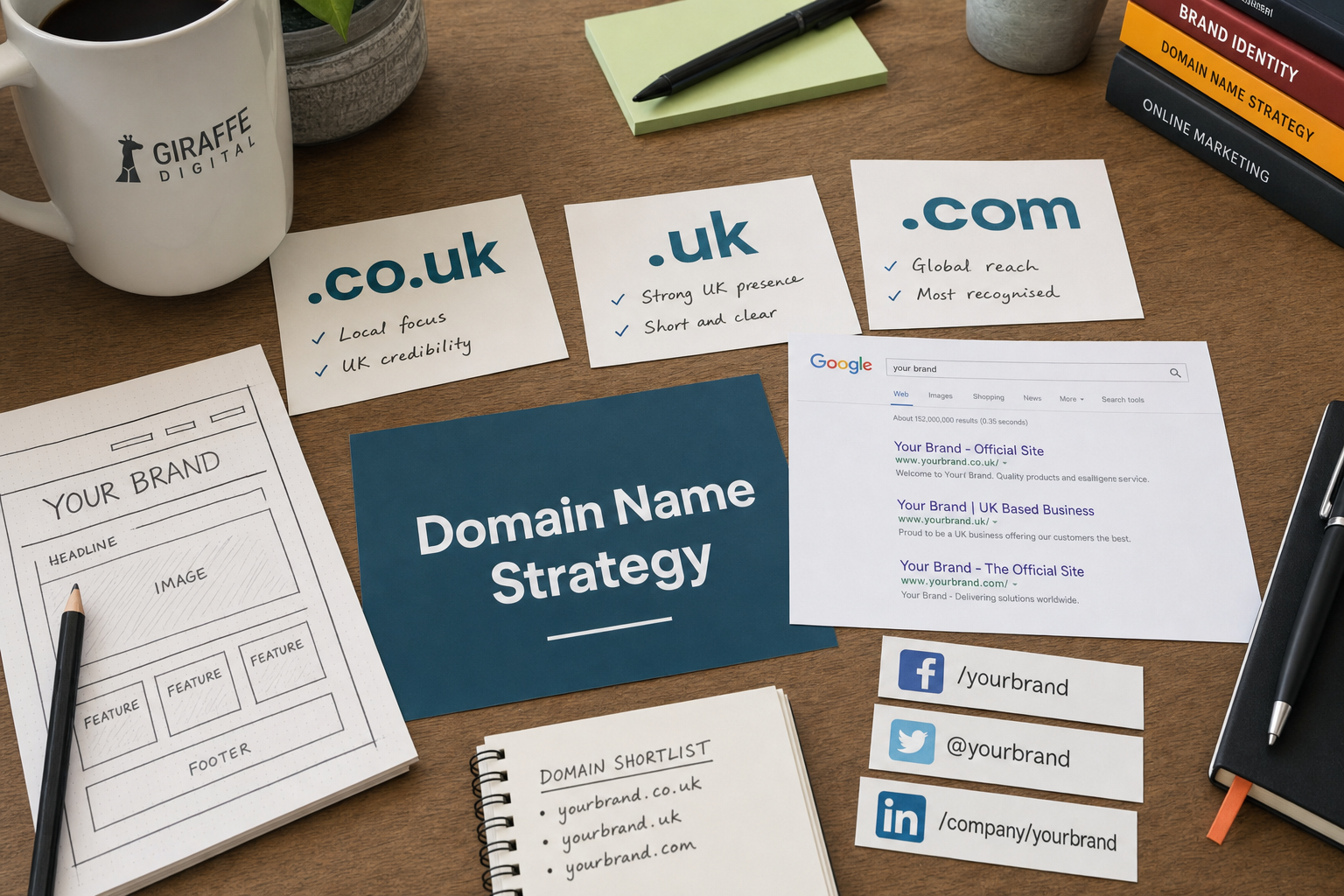
For many UK businesses, .co.uk remains a familiar and trusted option. It signals a UK presence and is widely recognised by customers. The shorter .uk extension is also available and may suit brands that want a concise address, though many businesses will still want to consider how their customers perceive both versions.
If your brand has international ambitions, .com is worth serious consideration. It is widely recognised and can support future expansion, but availability is often more limited. If the exact .com is unavailable, do not automatically settle for an awkward alternative. A clear UK domain may be stronger than a compromised global one.
Other established extensions, such as .org.uk, may be appropriate for charities, community groups and non-commercial organisations. There are also newer domain endings entering the market, including industry and location-based options. These can be interesting, but start-ups should approach them carefully. Ask whether your customers will recognise the extension, remember it correctly and trust it when it appears in an email or search result.
In most cases, it is sensible to secure the most important versions of your brand where available, particularly the UK version you intend to use and any obvious alternative that customers may type. That does not mean buying every possible extension. It means protecting the names that are genuinely relevant to your market, brand and future plans.
Keep it simple, pronounceable and memorable
A practical domain name strategy should include a basic usability test. Say the domain aloud. Spell it over the phone. Imagine it printed on a sign. Type it quickly on a mobile. If it fails any of those tests, think carefully before committing.
Shorter is usually better, but not at the expense of meaning. A concise invented name can be excellent if it is distinctive and easy to spell. A very short abbreviation can be poor if no one remembers what the letters stand for. Likewise, a longer domain can work if it uses familiar words in a logical order.
Be cautious with hyphens and numbers. They can create confusion because people often forget them or misunderstand whether a number should be written as a digit or a word. Hyphens may occasionally help readability, but they are rarely ideal for a primary brand domain. If the non-hyphenated version belongs to another organisation, there is also a risk of sending traffic to the wrong place.
Avoid names that are too close to established brands, even if the available domain looks tempting. Apart from potential legal issues, it can make your business appear derivative or untrustworthy. Your domain should help customers recognise you, not confuse you with someone else.
Think beyond the website
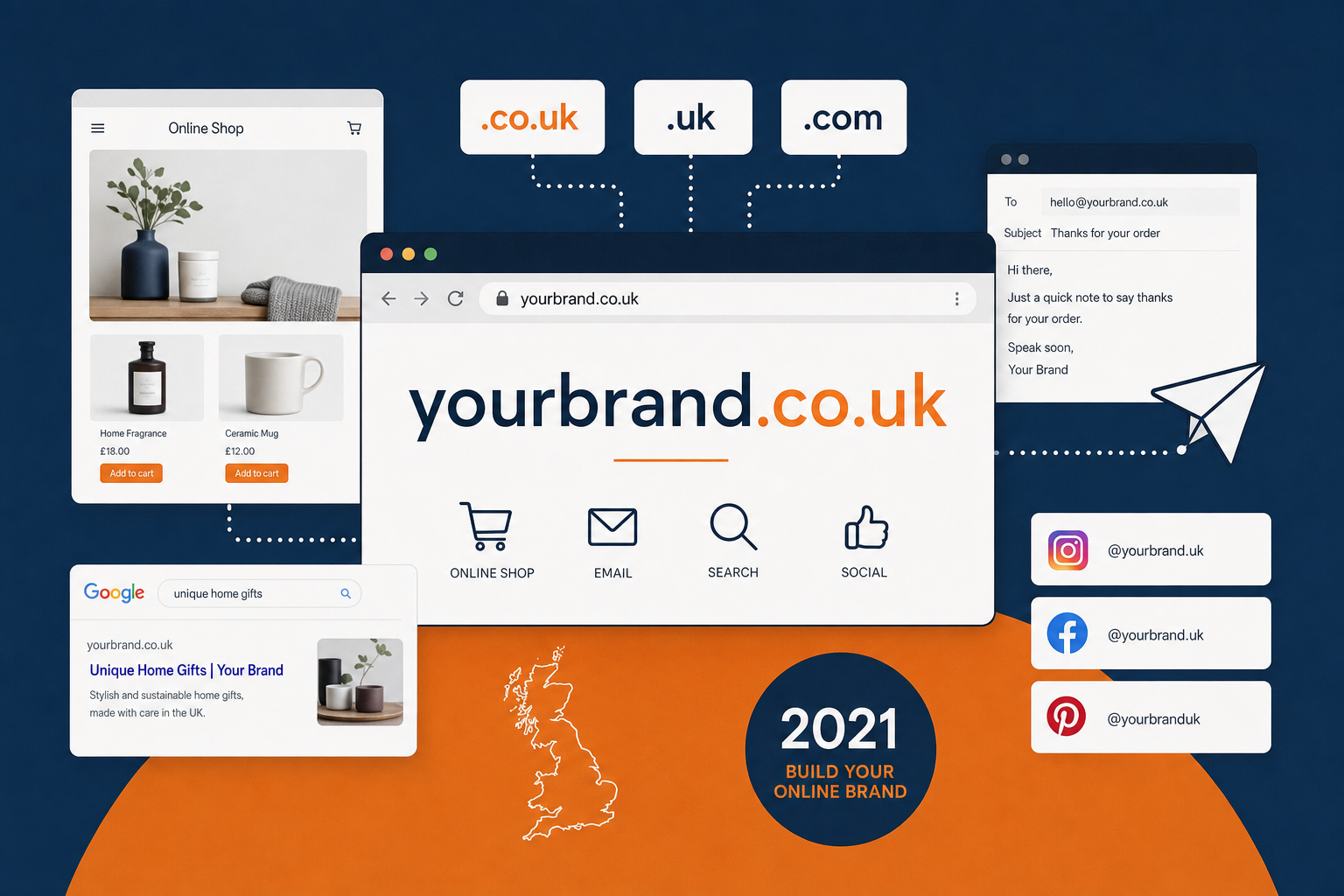
Your domain will influence more than your homepage. It will form part of your email addresses, campaign landing pages, printed materials and social media presence. A professional email address using your own domain usually looks more credible than relying on a free email account, particularly for new businesses trying to build confidence.
Before registering a domain, check whether the same or a very similar name is available on the social platforms that matter to your audience. For many UK businesses, this may include Facebook, Twitter, LinkedIn, Google+, YouTube, Pinterest or Instagram, depending on the sector. The aim is not necessarily to be active everywhere from day one, but to avoid obvious inconsistency across channels.
If the domain is concise but the social handle is unavailable, decide whether that weakens the overall brand. Sometimes a small variation is acceptable, such as adding UK or a sector term. However, if every platform requires a different workaround, the name may be too difficult to own digitally.
Consistency also matters for offline marketing. If a customer sees your poster, searches for your brand and finds matching domain, email and social profiles, you have reduced uncertainty. That consistency can be especially valuable for local businesses, new service providers and organisations building awareness from scratch.
Domain names and website design
A domain is not a design decision in isolation, but it affects how your website is presented. A strong brand name gives designers more room to create a distinctive identity, while a clumsy domain can make headers, navigation, calls to action and email sign-ups feel untidy.
Consider how the domain will appear in the browser, in search snippets and on mobile devices. Mobile usage continues to grow, and a domain that is easy to read on a small screen is an advantage. Long strings of words can be particularly awkward in search results and social sharing previews.
Think about future site structure as well. If you will run campaigns, publish resources or create location pages, the domain should work comfortably with clean URLs. A simple domain followed by clear page addresses, such as /services, /about or /contact, is usually easier for users than a complicated main domain with equally complicated page paths.
Where a business has separate brands, product ranges or markets, there may be a question of whether to use one main domain, subdomains or separate websites. For most start-ups, one strong primary website is easier to manage and promote. Multiple domains can dilute effort unless there is a clear commercial reason and enough resource to maintain them properly.
Search marketing considerations
From an SEO perspective, your domain should support clarity and credibility. It does not need to contain every keyword you want to rank for. Search performance depends on many factors, including useful content, relevant page titles, sound technical structure, quality links, local signals and a good user experience.
If you are targeting a UK audience, using a UK-focused domain can reinforce relevance, particularly when combined with a clear address, contact details and content written for the right market. For local businesses, the domain is only one part of the picture. Location pages, consistent business information, customer reviews and local citations may all support visibility.
Be careful with multiple domains pointing at the same website. If several domain names show the same content without a proper redirect strategy, search engines may see duplicate versions of the site. It is usually better to choose one primary domain and redirect the others to it with permanent redirects. This helps users and search engines understand which version is the main one.
It is also sensible to decide whether the site will use the www version or the non-www version and apply that consistently. The alternative should redirect to the preferred version. This is a small technical detail, but it helps avoid confusion in analytics, links and indexing.
Security is another consideration. If your website collects enquiries, account details or payment information, secure connections are important for user confidence. Even for brochure websites, planning hosting and technical setup properly from the beginning can avoid disruptive changes later.
Practical registration and ownership checklist
Once you have chosen a domain, treat it as a business asset. The person or organisation listed as the registrant should be appropriate, and the contact email address should be monitored. Too many businesses lose control of a domain because it was registered under an individual account, an old email address or an arrangement that was never documented.
Before registering, work through the following points:
- Check spelling carefully: small errors can be expensive in lost time and confusion.
- Confirm ownership details: ensure the domain is registered for the business or the correct legal owner.
- Use a reliable contact email: renewal notices and administrative messages must reach the right person.
- Record access details securely: keep login information available to authorised people, not just one individual.
- Enable renewal safeguards: make sure the domain does not accidentally expire.
- Keep DNS information organised: your domain may control your website, email and other services.
- Document any agency arrangement: if a web designer or marketing partner assists, be clear about who owns and controls the domain.
It is often wise to keep domain registration, website hosting and email arrangements well documented, even if they are managed together. Clear records make it easier to change suppliers, update settings, launch a new website or recover from an administrative problem.
Protecting the brand without overcomplicating it
Brand protection does not mean registering dozens of domains with no plan. It means considering the realistic ways in which customers may look for you or competitors may cause confusion. The most obvious variations are usually the main extension alternatives, common misspellings and singular or plural forms where relevant.
If your brand includes two words, think about whether people may type them together or include a hyphen. If your name includes a word that is often misspelt, a defensive registration may be useful. These additional domains should normally redirect to the primary website rather than becoming separate sites.
For businesses planning to launch in stages, it may be sensible to secure domains for future product names or campaign names before public announcements. This helps avoid disappointment later and gives your marketing team more options. However, each domain should have a purpose. A smaller, well-managed portfolio is better than a confusing collection no one maintains.
Changing domain names later
Sometimes a business needs to change its domain after launch. This might be due to a rebrand, a merger, a clearer naming decision or a move from a temporary name to a stronger long-term one. A change can be managed successfully, but it should not be treated casually.
If your existing website has built search visibility, links, bookmarks or customer recognition, plan the move properly. Map old pages to their closest new equivalents and use permanent redirects. Update internal links, email signatures, printed materials, social profiles, advertising and directory listings. Monitor traffic and search visibility through analytics and webmaster tools so that issues can be spotted early.
The best way to avoid a disruptive change is to invest enough thought at the beginning. That does not mean delaying your business unnecessarily, but it does mean taking the domain decision seriously before your name appears across stationery, signage, social media and search results.
A simple decision framework
When comparing potential domain names, use the following questions as a practical filter:
- Does the name support the brand we want to build?
- Can customers spell it, say it and remember it easily?
- Is the extension appropriate for our UK or international audience?
- Does it avoid confusion with other organisations?
- Will it work well in email addresses and printed marketing?
- Are suitable social media names available?
- Can it support future services, locations or product ranges?
- Is there a clear plan for ownership, renewal and technical management?
If a domain passes those tests, it is more likely to serve the business well. If it fails several, it may be worth returning to the shortlist before making a final decision.
Building a stronger start online
A good domain name strategy sits at the centre of a new brand’s digital foundations. It connects naming, website design, SEO, social media, email and customer trust. The strongest choice is rarely based on one factor alone. It is the name that customers understand, the team can market confidently and the business can grow into.
For start-ups and new brands, the key is to make the decision deliberately. Choose a domain that feels credible, keep the structure simple, protect the most important variations and ensure the business remains in control of its digital asset. With that foundation in place, your website and marketing activity have a much better platform from which to perform.