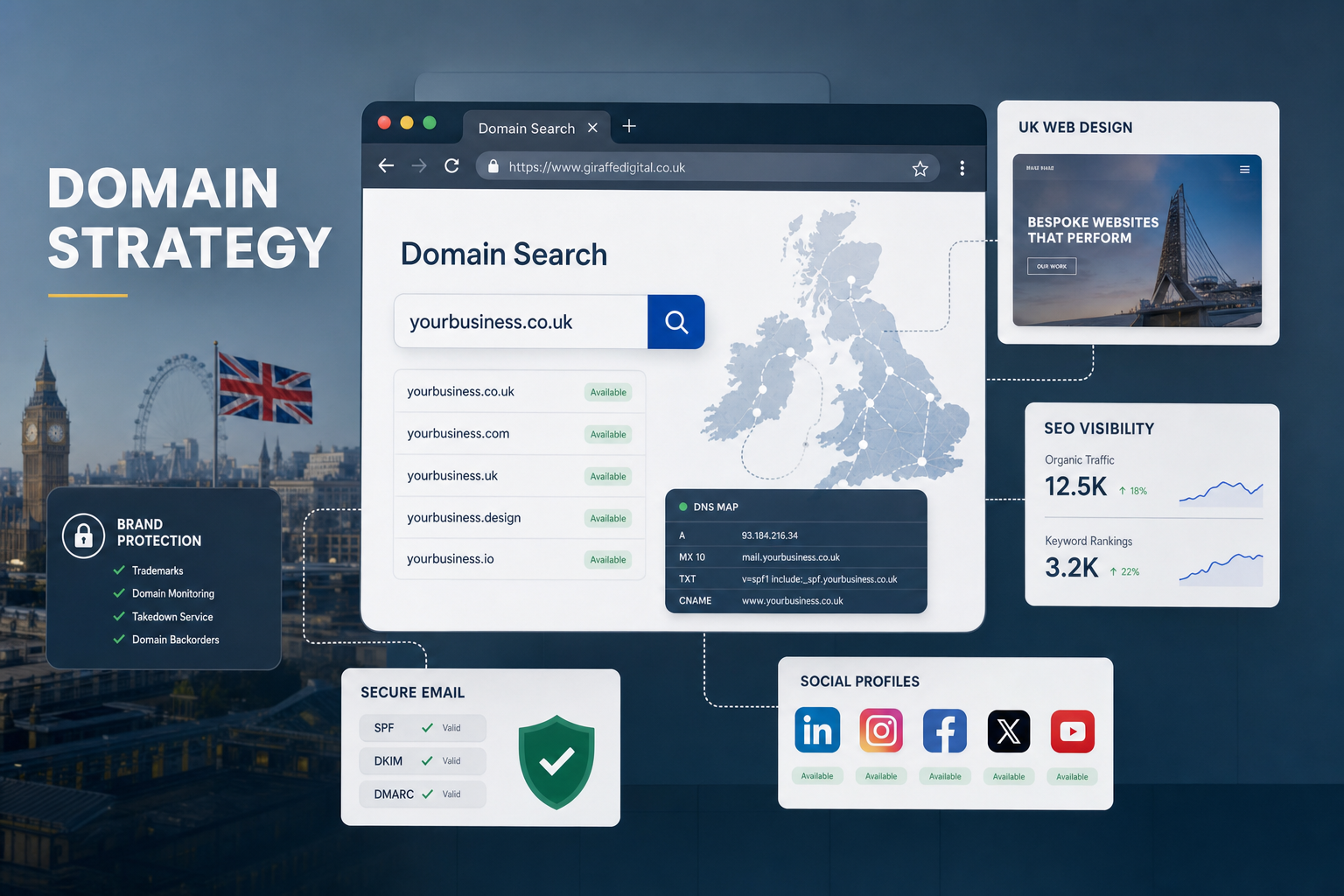
Choosing a domain name is one of the earliest digital decisions a business makes, but it should not be treated as a quick administrative task. In a crowded market, your domain affects how people remember you, how confidently they click, how easily your team can build campaigns and how well your online presence can scale. A considered domain name strategy connects branding, website design, SEO, social media marketing, email, analytics and long-term business planning.
For UK business owners in 2025, the challenge is not simply finding an available web address. Many short, obvious and industry-specific domains have already been registered, while customers are increasingly alert to poor-quality websites, misleading adverts and suspicious links. Your domain needs to feel credible at a glance, work clearly across channels and avoid creating unnecessary friction for people who are ready to enquire, book or buy.
Why domain name strategy matters more than ever
Your domain is often the first piece of your brand that people type, see in search results or encounter on printed material. It appears in email addresses, invoices, proposals, paid adverts, organic listings, social media bios, review profiles and offline signage. A weak choice can make every channel work harder. A strong choice makes your brand easier to recognise and easier to trust.
A good domain name strategy is not about chasing clever wording for its own sake. It is about reducing confusion. If a prospective customer hears your business name on a podcast, sees it on a van or receives a recommendation from a colleague, they should be able to find the right website without guessing through several possible spellings. That clarity has commercial value.
Search behaviour also reinforces the importance of brand consistency. People often search for a company name rather than typing a full address. If your domain, page titles, social handles and brand mentions all align, you make it easier for search engines and users to connect those signals. If they are inconsistent, you risk sending visitors to competitors, old microsites, parked pages or unrelated businesses with similar names.
Start with business goals, not just availability
Many domain decisions go wrong because the search starts with whatever is available rather than what the business needs. Before registering a domain, define what the website is expected to support over the next few years. A local service business, an e-commerce brand, a professional practice and a national training provider may all need different domain approaches.
Ask practical questions before committing:
- Will the business operate locally, regionally, nationally or internationally?
- Is the brand name already established offline, or is it still flexible?
- Will the website include e-commerce, bookings, lead generation, resources or multiple service areas?
- Could the company expand into new services that make a narrow domain restrictive?
- Does the domain need to work clearly in radio, video, print, signage and social media profiles?
- Is the name distinctive enough to protect and build over time?
For example, a plumbing company serving one town may benefit from a location-led domain if the business is intentionally local. However, a consultancy planning to sell services across the UK may find that a location-specific domain becomes limiting. The best domain name strategy reflects where the business is going, not only where it is now.
Brand-led domains versus keyword-led domains
There is still a place for descriptive wording in domains, but search marketing has moved well beyond the idea that exact-match keyword domains automatically win. A domain containing a service or location can help users understand what you do, but it is not a substitute for a strong website, useful content, technical SEO and a trustworthy brand.
A brand-led domain is usually easier to grow. It can support multiple services, build recognition and stand apart from generic competitors. If the name is distinctive, customers are more likely to remember it and search for it directly. This can strengthen branded search demand over time.
A keyword-led domain can work when the wording is natural, relevant and not overly long. A domain that clearly describes a niche service may reassure users, especially in local markets. The risk is that it can sound generic, be harder to protect and become awkward if the business expands. Domains packed with multiple keywords can look dated and may reduce trust if they appear spammy in search results or email inboxes.
In most cases, the strongest option is a domain that balances brand clarity with meaningful context. A memorable brand name supported by clear page titles, service pages, local landing pages and structured website content is usually more effective than relying on the domain alone to explain the business.
Choosing the right domain extension for a UK business
The domain extension, or top-level domain, affects user expectations. For many UK businesses, .co.uk and .uk remain familiar and trusted choices. A .com domain can be useful for companies with international ambitions or brands that want a globally recognisable address. Industry-specific extensions can work in certain cases, but they should be assessed carefully for trust, memorability and customer familiarity.
If your audience is primarily UK-based, a UK-focused extension can reinforce relevance. If you plan to trade internationally, consider whether a single global domain or a country-specific structure will support future SEO, content and operational needs. Changing later can be done, but it requires careful redirects, analytics checks, Search Console verification and communication with customers.
It is also sensible to register defensive variations where appropriate. This may include common extensions, obvious spelling variants and domains that prevent confusion with closely related products or campaigns. The aim is not to collect domains endlessly, but to protect the brand from avoidable problems. Any additional domains should have a clear purpose, such as redirecting to the main site, supporting a campaign or protecting a future brand route.
Make the domain easy to say, spell and share
A domain has to work outside a browser address bar. It may be spoken over the phone, printed on packaging, placed in a social media profile, included in an email signature or mentioned in a meeting. If people need repeated explanations, the domain is already creating friction.
Shorter is usually better, but clarity matters more than length alone. Avoid unnecessary hyphens, unusual spellings, numbers that could be written in different ways and words that are easy to mishear. If your business name includes a pun or deliberate misspelling, test it with people outside the organisation before registering the domain. Internal enthusiasm can hide real-world confusion.
It is worth saying the domain aloud and asking someone to write it down without seeing it. If they make mistakes, consider whether customers will do the same. The best domains are memorable enough for a recommendation to travel from one person to another without being lost on the way.
Check brand consistency across search and social channels
Domain name strategy should sit alongside social media marketing and wider brand planning. Before committing to a domain, check whether matching or close social handles are available on the platforms that matter to your audience. Exact consistency is not always possible, but large differences can weaken recognition.
For a business that relies on professional referrals, a consistent name across its website, company profiles, directory listings and thought leadership content is important. For a consumer brand, consistency across short-form video platforms, image-led social channels, review sites and local listings may matter just as much. The key is to make it obvious that each profile belongs to the same organisation.
Consistency also supports reputation management. When customers see the same brand name, domain, logo style, tone of voice and contact details across channels, they are more likely to trust that they have found the genuine business. That matters in sectors where customers compare multiple suppliers before making an enquiry.
Consider SEO before the website is designed
A domain decision should be made before website design and SEO planning move too far. While the domain alone will not determine rankings, it influences site structure, analytics, tracking, content migration and local search signals. If you are replacing an existing site, changing domain at the same time as redesigning the website can be beneficial, but it must be handled carefully.
For an existing business, review the current domain’s history before moving. Important considerations include existing organic traffic, backlinks, indexed pages, brand searches, email usage and whether the domain has any legacy issues. A domain with years of quality signals may be valuable. Moving away from it without a plan can cause avoidable disruption.
If a new domain is needed, build the website around a clean, logical structure from the start. Service pages, location pages, case studies, resources and contact routes should be easy to navigate. Search engines need to understand the relationship between your domain, your content and the search intent you serve. Users need to find the next step quickly.
Redirect planning is essential when domains change. Old URLs should be mapped to the most relevant new pages, not simply sent to the homepage. Analytics, conversion tracking, Search Console accounts, advertising destinations, email links and third-party profiles all need updating. A good migration is detailed and methodical, not rushed on launch day.
Build trust through technical foundations
Trust is not only visual. A professional domain strategy includes the technical elements that help keep the website and associated communications reliable. Secure browsing, correctly configured DNS, dependable email authentication and sensible access control all contribute to the way customers experience your brand.
Every modern business website should use HTTPS. Visitors expect to see a secure connection, particularly when submitting forms, making payments or sharing personal information. Security certificates are now part of standard website practice rather than an optional extra.
Email is equally important. If your domain is used for business email, authentication settings such as SPF, DKIM and DMARC help receiving mail systems assess whether messages are genuinely from you. Poorly configured email can affect deliverability and may make your organisation more vulnerable to impersonation. This is especially relevant for businesses sending proposals, appointment confirmations, newsletters or e-commerce updates.
Domain access should be managed carefully. Use strong passwords, multi-factor authentication where available and clear ownership records. Avoid leaving domain control with a former employee, old developer account or forgotten email address. The domain is a core business asset and should be treated with the same seriousness as other critical infrastructure.
Use domains carefully for campaigns and sub-brands
Campaign domains, microsites and sub-brands can be useful, but they also add complexity. A separate domain may be appropriate for a distinct product, event or brand initiative. However, creating too many disconnected websites can dilute SEO value, confuse customers and increase maintenance work.
Before registering a campaign domain, decide whether the content would perform better as a section of the main website. In many cases, a well-designed landing page on the primary domain is easier to promote, track and optimise. It benefits from the authority, trust and analytics structure already in place.
Separate domains make more sense when the campaign needs a distinct identity, a separate audience or a long-term brand pathway. Even then, plan how the domain will be used after the campaign ends. Abandoned campaign sites can create outdated search results, broken links and mixed messages about your business.
Avoid common domain mistakes
Some domain mistakes are small irritations; others create lasting digital problems. The most common issue is choosing a name that is too close to another business. This can cause brand confusion, legal risk and wasted marketing spend. Check search results, business registers, trade mark databases and social platforms before settling on a name.
Another mistake is choosing a domain that only makes sense internally. Abbreviations, initials and shortened words may be meaningful to the founding team but unclear to customers. If the domain does not help people understand or remember the brand, it may not serve the business well.
Businesses also sometimes register domains without a management process. Renewal dates, account access, DNS records and email settings should be documented. Losing a domain because ownership details are unclear or renewal reminders go to an unused inbox can be extremely damaging.
Finally, avoid treating the domain as separate from design. A premium-looking website on a confusing domain still feels disjointed. A strong domain with poor design, thin content or slow performance will not deliver its full value. The best results come when naming, design, content and marketing are planned together.
How to assess whether a domain is right for your business
When comparing options, score each domain against practical criteria rather than relying only on preference. A useful domain should be memorable, credible, easy to spell, relevant to the brand, suitable for future growth and consistent with other digital channels.
Consider how the domain will look in a search result, an email address, a social media bio and a printed advert. Think about whether it will still make sense if your services expand. Ask whether it sounds trustworthy to someone who has never heard of your business before.
If you already have an established domain, the question may not be whether a new name is more attractive, but whether the benefits of changing outweigh the risks. A rebrand, merger, strategic repositioning or move into a new market can justify a domain change. Minor dissatisfaction with wording may not.
A strong domain does not replace brand strategy, website design or SEO. It gives them a clearer foundation to build on.
Bringing domain strategy into your wider digital plan
Your domain should sit at the centre of your digital ecosystem. It is the address that paid media, organic search, social media, email marketing, PR and offline activity point towards. If that address is clear, trusted and aligned with your positioning, every marketing channel benefits.
For UK businesses planning a new website in 2025, domain decisions should happen early in the project. Branding, user experience, content architecture, technical SEO and campaign planning all depend on knowing the final domain route. Making the right choice at the start avoids unnecessary redirects, mixed messaging and duplicated work later.
The most effective domain name strategy is simple to explain: choose a domain that customers can remember, search engines can associate with your brand, your team can manage securely and your business can grow into. In a crowded digital market, that clarity is a competitive advantage.