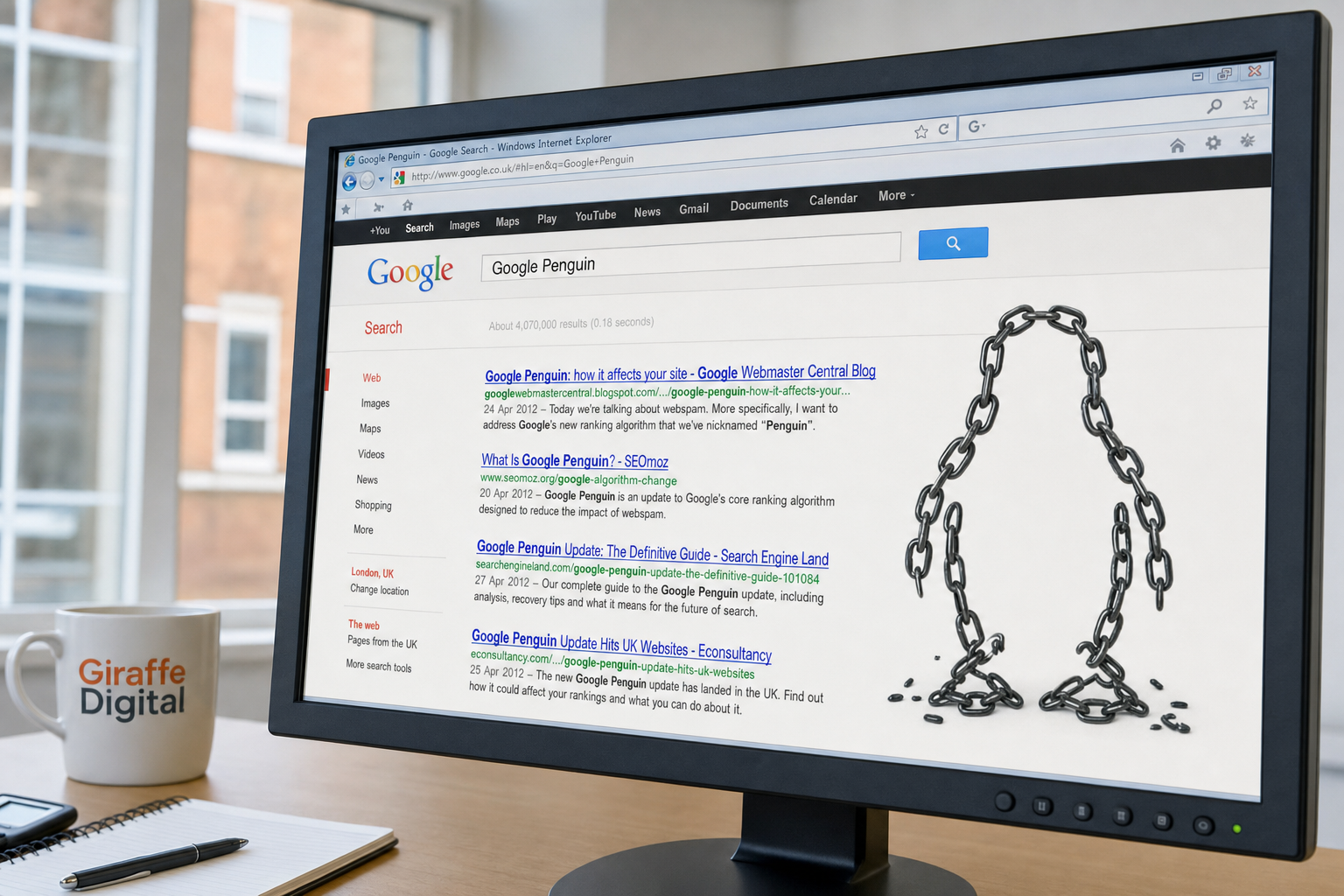
Google Penguin is a useful reminder that search engine optimisation should never be treated as a collection of shortcuts. For UK businesses, the real value of SEO lies in being found by the right people, presenting a trustworthy website and building a reputation that can stand up to scrutiny. As Google improves the way it assesses content, links and user behaviour, business owners need to think less about quick ranking tactics and more about the quality of their overall digital presence.
For many organisations, SEO has historically been associated with adding keywords to pages, submitting a website to directories and trying to gather as many links as possible. Those activities may once have been enough to achieve some movement in the search results, but they are no longer a reliable foundation for growth. Google is increasingly rewarding websites that provide clear information, natural authority and a good experience for visitors. Google Penguin should be understood in that context: it is not simply about avoiding penalties, but about building a website and marketing strategy that deserves to rank.
What Google Penguin Means for Business Owners
Google Penguin places attention on the quality and naturalness of a website’s visibility. If a site appears to have earned links because it is genuinely useful, well known or valued within its market, it is in a much stronger position than a site supported by artificial link building. For a business owner, this changes the conversation from how many links can we get? to why would people want to link to us?
That distinction is important. A local accountant, for example, does not need thousands of unrelated links from low-quality directories to compete online. It may be far more useful to publish clear tax guidance for small businesses, create pages that explain each service properly, secure mentions from relevant local organisations and encourage satisfied clients to refer to useful resources. A manufacturer may benefit from detailed product information, technical data sheets, installation guides, case studies and trade publication coverage. A retailer may earn attention through buying guides, seasonal advice, product comparisons and reliable customer service information.
The common thread is relevance. Google is looking for signs that a website fits naturally into its market. If all the links pointing to a site use the same keyword phrase, appear on unrelated websites or sit within thin pages created only for SEO purposes, the risk increases. If the website is being discussed, cited and shared for genuine reasons, its authority is more defensible.
Why Old SEO Habits Are Becoming Riskier
Some older SEO practices were based on exploiting gaps in search engines rather than improving a business’s online presence. These included excessive keyword repetition, large-scale directory submissions, article spinning, hidden or awkward text, poor-quality link exchanges and creating pages that existed only to capture search traffic. Google Penguin reinforces the need to move away from these habits.
The problem with artificial SEO is that it often creates a weak website. A page written for a search engine rather than a customer may rank briefly, but it is unlikely to persuade visitors to enquire, buy or return. Similarly, a link from an irrelevant website may add very little commercial value, even if it once helped rankings. Business owners should judge SEO by its contribution to enquiries, sales, brand awareness and customer trust, not by rankings alone.
A useful way to assess risk is to review whether each SEO activity would still make sense if search engines did not exist. Would you still want a link from that website because potential customers read it? Would you still publish that article because it helps people understand your service? Would you still use that page title because it clearly describes what you offer? If the answer is no, the tactic may be too dependent on manipulation.
Building a Website That Supports Better SEO
Website design plays a central role in modern SEO. A business can attract visitors through search, but if the site is confusing, slow or poorly structured, those visitors may leave quickly. Google also needs to understand what each page is about, how the website is organised and which content is most important.
A well-designed business website should have a clear navigation structure, concise service pages, strong calls to action and useful supporting content. It should avoid burying important information behind complicated menus or unnecessary visual effects. Search engines and customers both benefit when pages are easy to read and logically connected.
Page titles and headings should be descriptive without being stuffed with keywords. For example, a page titled Commercial Property Solicitors in Bristol is clearer and more useful than a vague title such as Services, while a title that repeats the same phrase several times looks unnatural. The best approach is to write for people first, then ensure the important phrases are present in sensible places.
Technical quality also matters. Clean HTML, efficient images, reliable hosting, sensible internal links and fast-loading pages all contribute to a better experience. Businesses should also make sure contact details are easy to find, enquiry forms work properly and content can be updated without unnecessary difficulty. A website that sits untouched for years can quickly become less useful, particularly if competitors are publishing fresher and more helpful information.
Content That Earns Attention Naturally
One of the strongest responses to Google Penguin is to invest in better content. This does not mean filling a blog with short posts for the sake of it. It means answering the questions customers actually ask, explaining services clearly and demonstrating expertise in a way that is accessible to non-specialists.
Useful content might include frequently asked questions, buying advice, guides for first-time customers, explanations of common mistakes, maintenance tips, industry commentary or downloadable resources. A web design agency may explain what a business should prepare before commissioning a new website. A building firm may publish guidance on planning considerations and project timelines. A training provider may offer advice on choosing the right course for different staff roles.
The aim is to create pages that can earn links and shares because they are genuinely helpful. This supports SEO, but it also supports sales. Prospective customers are more likely to trust a business that explains things clearly before asking for an enquiry. Good content can reduce repetitive questions, qualify leads and give a sales team something useful to send to prospects.
Link Building After Google Penguin
Link building should be approached as reputation building. Instead of chasing volume, businesses should seek relevant opportunities that make commercial sense. This might include contributing expert commentary to an industry website, being listed by a professional body, supporting a local event, publishing research, producing a useful guide or working with suppliers and partners where there is a genuine relationship.
It is also sensible to review existing links. A business that has previously used aggressive SEO may have a backlink profile containing low-quality directories, unrelated sites or repeated keyword-rich anchor text. Not every poor link will cause a problem, but a pattern of unnatural activity is a warning sign. Where possible, businesses should stop building those types of links and focus future work on quality.
Anchor text deserves particular care. If every link to a website uses the exact same commercial phrase, it does not look natural. In the real world, people link using brand names, web addresses, article titles, phrases such as click here and a mixture of descriptive wording. A healthy link profile usually contains variety. Businesses should avoid insisting that every mention uses a target keyword.
The Role of Social Media in a Stronger Search Strategy
Social media marketing is not a replacement for SEO, but it can support visibility, trust and content distribution. Platforms such as Facebook, Twitter, LinkedIn, YouTube and Google+ give businesses ways to share useful material, respond to customers and show a more active side of the organisation.
For a UK business, the key is to choose platforms that suit the audience. A professional services firm may find LinkedIn useful for sharing articles and building relationships. A retailer may use Facebook to promote new products, seasonal offers and customer service updates. A business with visual or instructional content may benefit from YouTube. Twitter can be useful for quick updates, industry conversation and customer engagement.
Social media should not be reduced to posting links back to the website. The strongest approach is conversational and helpful. Share advice, answer questions, highlight useful resources and direct people to website content when it genuinely adds value. Over time, this can help content reach bloggers, journalists, customers and industry contacts who may reference it elsewhere.
Domain Names, Branding and Trust
Domain registration is another area where business owners should think carefully. A good domain name should be memorable, easy to spell and aligned with the brand. Exact-match keyword domains may look tempting, but they are not a substitute for a credible business identity. A domain that sounds trustworthy and can be used confidently on stationery, vehicles, email addresses and advertising is often more valuable than one chosen only for a search phrase.
For UK businesses, it may be sensible to consider relevant UK domain extensions as well as broader commercial options, depending on the market served. Keep the name short where possible, avoid confusing hyphens or unusual spellings, and check that the domain will not be mistaken for another organisation. It is also wise to register important variations where appropriate, maintain accurate ownership records and keep renewal dates under control. Losing a domain through poor administration can be damaging and avoidable.
Brand consistency matters. The business name, domain name, website header, email address and social media profiles should all feel connected. This helps customers recognise the organisation and supports the trust signals that search engines increasingly value.
Measuring SEO by Business Value
Google Penguin encourages businesses to measure SEO in a more mature way. Rankings are useful indicators, but they are not the whole story. A number-one ranking for a phrase that brings no enquiries is not particularly valuable. A more modest ranking for a highly relevant phrase that brings qualified leads may be far more important.
Businesses should monitor website enquiries, telephone calls, contact form submissions, newsletter sign-ups, sales and other meaningful actions. Web analytics can show which pages attract visitors, which search phrases bring traffic and where people leave the site. This information should influence website improvements, content planning and marketing decisions.
It is also worth looking at the quality of enquiries. If SEO brings a high number of unsuitable leads, the website may be targeting the wrong phrases or failing to explain the service clearly. If visitors read several pages before enquiring, that may show the content is helping them make a decision. The best SEO strategy is connected to commercial goals rather than isolated from them.
SEO Checklist for 2012
- Review your website structure: make sure services, products and contact details are easy to find.
- Improve important pages: write clear, useful copy that explains benefits, process and next steps.
- Avoid keyword stuffing: use natural wording and include search phrases only where they help clarity.
- Assess link quality: focus on relevant, genuine links rather than large quantities of weak ones.
- Create helpful content: answer real customer questions through guides, FAQs and articles.
- Use social media sensibly: share useful updates and take part in relevant conversations.
- Protect your brand: choose a clear domain name and keep ownership details well managed.
- Measure outcomes: track enquiries, conversions and the commercial quality of website traffic.
How to Think About SEO Going Forward
The businesses best placed to benefit from Google Penguin are those prepared to treat SEO as part of a wider digital strategy. Search visibility is influenced by branding, website design, content quality, technical reliability, social activity and reputation. Each element strengthens the others when planned properly.
Rather than asking what can be done to satisfy Google this month, business owners should ask what will make their website more useful, credible and discoverable over the long term. That may involve redesigning outdated pages, rewriting thin content, improving calls to action, publishing better advice, building relationships in the industry and presenting the brand more professionally online.
Google Penguin changes the way businesses think about SEO because it rewards a more honest approach. Shortcuts may still be offered by some providers, but the risks are increasingly clear. A well-built website, supported by useful content and genuine marketing activity, is a stronger asset than a site dependent on artificial links. For UK businesses that want sustainable online growth, the message is simple: build something worth finding, and promote it in a way that reflects the quality of the organisation behind it.