HTML5 website development is beginning to change the way businesses think about their websites. For many UK organisations, the immediate question is not whether every feature of HTML5 is ready to use without caution, but how the new approach can help create clearer, more useful and more future-facing websites. The standard is still developing, and browser support varies, yet the direction of travel is already important for business owners planning a new website or considering a redesign.
For several years, website development has often relied on a mixture of XHTML, CSS, JavaScript and plug-ins to deliver richer online experiences. HTML5 aims to make more of those experiences possible within the browser itself. That has practical implications for website design, search engine optimisation, mobile browsing, social media marketing and the long-term maintenance of a company’s online presence.
What HTML5 Means for Business Websites
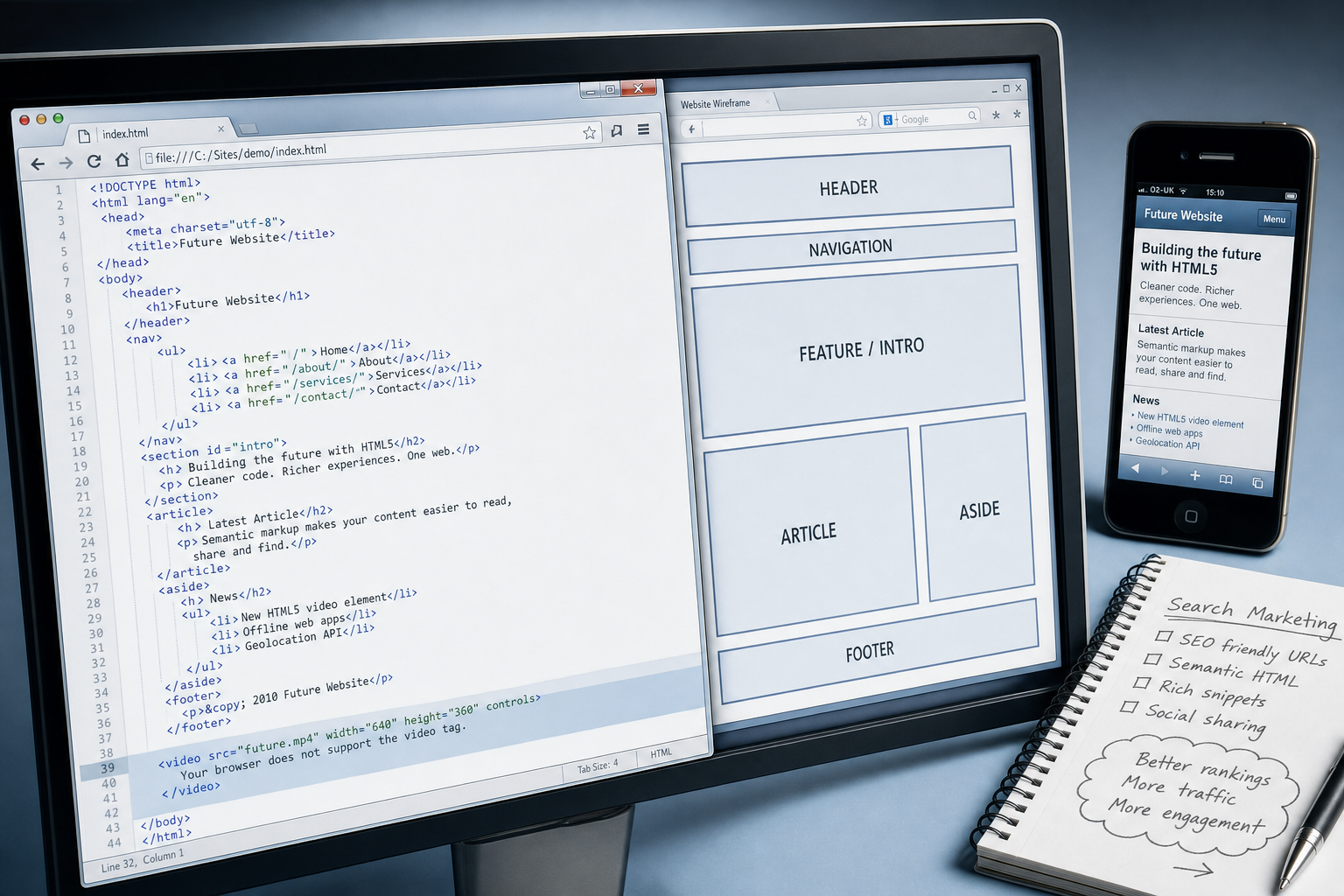
HTML5 is the next major development in the language used to structure web pages. Rather than being a simple visual refresh, it introduces new elements that help describe the purpose of content more clearly. Elements such as header, nav, article, section, aside and footer give developers a more meaningful way to mark up a page.
For a business owner, this may sound technical, but the value is straightforward. A well-structured website is easier to maintain, easier for visitors to use and easier for search engines to interpret. Instead of forcing every area of a page into generic containers, HTML5 encourages developers to define the role of each part of the page. A blog post, a navigation menu, a sidebar promotion and a company footer can all be marked up in a more logical way.
This is particularly useful for businesses that publish regular content. News articles, advice guides, product information, case studies and blog posts all benefit from consistent structure. When a website is planned carefully, HTML5 can support a content strategy that is easier to extend over time.
HTML5 Is Promising, But It Still Requires Careful Planning
In May 2010, HTML5 should be treated as an opportunity rather than a complete replacement for every existing method. Some browsers already support useful parts of HTML5, while others are more limited. Safari, Chrome, Firefox and Opera have been adopting different features at different speeds. Internet Explorer 8 remains widely used and has limited native support for many HTML5 elements, although Microsoft has begun to show more interest in emerging standards through early Internet Explorer 9 previews.
This means that good HTML5 website development must be practical. A business website cannot be built only for the latest browser and ignore a large portion of its audience. A sensible approach is to use HTML5 where it adds genuine value, while ensuring that essential content and functionality still work for visitors using older browsers.
This approach is often described as progressive enhancement. The core content, navigation and calls to action should remain accessible first. Enhanced features can then be added for browsers that support them. For example, a contact form should still allow an enquiry to be submitted even if a visitor’s browser does not support newer form input types. A video should be accompanied by alternative ways to view or access the information where appropriate.
Better Page Structure Can Support Search Marketing
Search engine optimisation in 2010 still depends on the fundamentals: relevant content, crawlable pages, well-written title tags, good internal linking, sensible headings, descriptive page copy and reputable links from other websites. HTML5 does not remove the need for these basics. However, it can help developers build pages that are cleaner and more logically organised.
Search engines need to understand what a page is about. A page with clear headings, useful copy and a sensible structure gives them a better foundation. HTML5’s semantic elements can help separate main content from navigation, sidebars and footer material. This is not a magic ranking technique, but it is part of good technical housekeeping.
Business owners should still ask the right SEO questions when commissioning a website. Will each important service have its own dedicated page? Are page titles written for both search engines and real people? Can the content management system create clean, readable addresses? Is the navigation easy for search engines to crawl? Are redirects handled properly if an older website is being replaced?
HTML5 works best when it is part of a wider search strategy. A beautifully coded website will not perform well if the content is thin, duplicated or poorly targeted. Equally, strong content can be held back by poor structure, slow loading pages or navigation that search engines struggle to follow.
Richer Design Without Losing Usability
One of the most discussed areas of HTML5 is its ability to support richer media and interaction. The video and audio elements are designed to make media part of the page without always relying on external plug-ins. The canvas element opens the door to dynamic graphics and interactive visuals within the browser.
For businesses, the temptation may be to ask for more movement, more effects and more visual novelty. That should be handled with restraint. Website design must still serve the visitor. A manufacturer might use video to demonstrate a product process. A training provider might include short sample lessons. A venue might show a visual tour. A professional services firm might prefer simple diagrams, clear written explanations and downloadable documents.
The key question is whether the feature helps the customer make a decision. Rich media should support the message rather than distract from it. It should also be planned with browser support, connection speeds and accessibility in mind. Many visitors still use slower connections or older office computers, and a website that performs poorly may lose enquiries.
Mobile Browsing Is Becoming More Important
Mobile internet use is growing quickly, helped by smartphones such as the iPhone, BlackBerry devices and Android handsets. The iPad has also brought renewed attention to browsing on touch-screen devices. HTML5 is relevant here because many mobile browsers are moving towards stronger support for modern web standards.
For business owners, mobile does not necessarily mean building a separate mobile website immediately. It does mean considering how pages behave on smaller screens, how navigation works without a mouse, and whether key information can be reached quickly. Telephone numbers, addresses, opening hours, enquiry forms and service summaries should be easy to find.
HTML5 website development can support this by encouraging cleaner code and more flexible structures. Combined with thoughtful CSS, a site can be designed to adapt more gracefully across different screen sizes. This is still an emerging area, and approaches vary, but the principle is already clear: websites should not be designed solely around a large desktop monitor.
Forms, Enquiries and Customer Actions
Many business websites exist to generate enquiries. HTML5 introduces new form input types and attributes that can improve the user experience when supported by the browser. Email fields, telephone fields, date inputs, placeholder text and required fields can make forms more helpful and reduce mistakes.
As with other HTML5 features, these should be implemented carefully. A form must still work if a browser does not recognise a new input type. Server-side validation remains essential, because browser-based validation alone is not enough. However, when used sensibly, HTML5 forms can make common actions smoother for customers.
Consider a local service company with a quotation form. If the form is clear, short and easy to complete, more visitors are likely to submit it. If it uses helpful labels, sensible field order and plain language, it will perform better than a complicated form with unnecessary questions. HTML5 can assist, but good content and user experience decisions remain central.
HTML5 and Social Media Marketing
Social media is becoming a normal part of online marketing for many UK businesses. Twitter, Facebook, LinkedIn, YouTube and business blogs are all being used to share updates, publish advice, answer questions and build relationships. A company website should sit at the centre of this activity.
HTML5 does not replace social media strategy, but it can help support it. A website with well-structured articles, clear sharing prompts and useful landing pages gives social media activity somewhere valuable to point. If a business posts a helpful guide on its blog, shares it on Twitter, and links to it from a newsletter, the website needs to present that guide clearly and encourage the next step.
Business owners should avoid treating social media icons as a substitute for useful content. The best results usually come when the website offers something worth sharing: advice, insight, images, product information, event details or answers to common customer questions. HTML5’s structure can help organise this content in a way that is easier to publish and maintain.
Domain Names, Branding and Long-Term Ownership
A strong website also depends on a sensible domain name strategy. For UK businesses, a clear and memorable domain can support trust, brand recognition and offline marketing. A .co.uk domain is often appropriate for a UK-focused organisation, while a .com may also be useful if the business has international ambitions or wants to protect its brand.
When choosing a domain, keep it short, easy to spell and easy to say aloud. Avoid unnecessary hyphens where possible, and be cautious with names that could be confused with another organisation. If a business trades under a particular brand, it is usually sensible to secure the closest relevant domain names before investing heavily in printed materials, signage or advertising.
Domain registration should also be treated as an ownership issue. The business should know who controls the domain, which email address is used for administration, and when renewal is due. Losing access to a domain can create serious disruption, so these details should be managed carefully as part of the wider digital strategy.
Practical Steps Before Commissioning an HTML5 Website
Before starting an HTML5 website development project, business owners should think beyond the technology itself. A successful website begins with clear commercial objectives. Is the main aim to generate enquiries, sell products, support existing customers, attract job applicants, publish news or strengthen the brand?
Once the purpose is clear, the structure and content can be planned properly. A small professional firm may need strong service pages, staff profiles, testimonials where appropriate, and a regular advice section. A retailer may need product categories, clear delivery information and persuasive product descriptions. A charity may need campaign pages, donation information and accessible explanations of its work.
Useful questions to ask include:
- Which pages are most important for search visibility?
- What information does a visitor need before making an enquiry?
- How will the website integrate with email marketing, social media and offline campaigns?
- Who will update the content after launch?
- Which browsers and devices are most important for the audience?
- What content from the existing site should be kept, improved or removed?
These questions help ensure HTML5 is used to serve business goals rather than simply to follow a trend.
The Importance of Compatibility and Testing
Testing is especially important when working with newer web standards. A website should be checked in the main browsers used by the target audience, including older versions where they remain common. It should also be tested with JavaScript disabled where appropriate, on different screen sizes, and with typical office security settings in mind.
Not every visual detail needs to look identical in every browser, but the website must remain usable. Visitors should be able to read the content, navigate pages, complete forms and understand the calls to action. If an advanced feature fails, the page should degrade gracefully rather than appearing broken.
This is where experienced planning matters. HTML5 website development is not simply a case of using the newest tags. It requires judgement about which features are suitable now, which need fallbacks, and which are better left until support improves.
A Sensible Future-Facing Choice
HTML5 is still evolving, but it is already shaping the future of website development. For UK businesses planning a new website in 2010, it offers an opportunity to build with cleaner structure, richer possibilities and better preparation for the next generation of browsers and devices.
The most effective approach is balanced. Use HTML5 where it improves structure, usability and maintainability. Keep the website accessible to visitors using common browsers. Invest in strong content, clear design, search-friendly architecture and a domain strategy that protects the brand. Connect the website properly with social media and wider marketing activity.
Technology will continue to change, but the purpose of a business website remains constant: to help the right people find, understand and trust the organisation. HTML5 can support that aim when it is used with care, commercial awareness and a clear digital strategy.