For many small businesses, the most valuable enquiries come from people nearby: the customer looking for a plumber in the next town, the couple searching for a restaurant before leaving work, or the office manager trying to find a reliable printer within driving distance. This is where local SEO becomes especially important. Rather than competing with every business on the web, local search helps your company appear when people search for products and services in your area.
Google Places has become a central part of this process. When someone searches for a service with a place name, or when Google believes the search has local intent, map results and local business listings can appear prominently. For a UK small business, a well-managed local presence can turn search visibility into telephone calls, directions, website visits and real enquiries.
What local SEO means for small businesses
Local SEO is the process of improving your visibility for searches connected to a specific location. It includes your website, your Google Places listing, online directories, customer reviews, social media profiles and the consistency of your business details across the web.
A traditional SEO campaign may focus on broad phrases such as accountant, hair salon or web design. A local SEO campaign focuses on phrases such as accountant in Bristol, hair salon in York or web design Portsmouth. These searches usually come from people with clearer intent. They are not just browsing; they are often looking for a provider they can contact, visit or compare immediately.
For a small business, this makes local search particularly practical. You do not always need national visibility to gain profitable enquiries. A strong position in your own town, city or county can be far more valuable than weak visibility across the whole country.
Why Google Places matters
Google Places allows business owners to create and manage a listing that can appear in Google Maps and local search results. The listing may include your business name, address, telephone number, website, opening hours, categories, photographs, service areas and customer reviews.
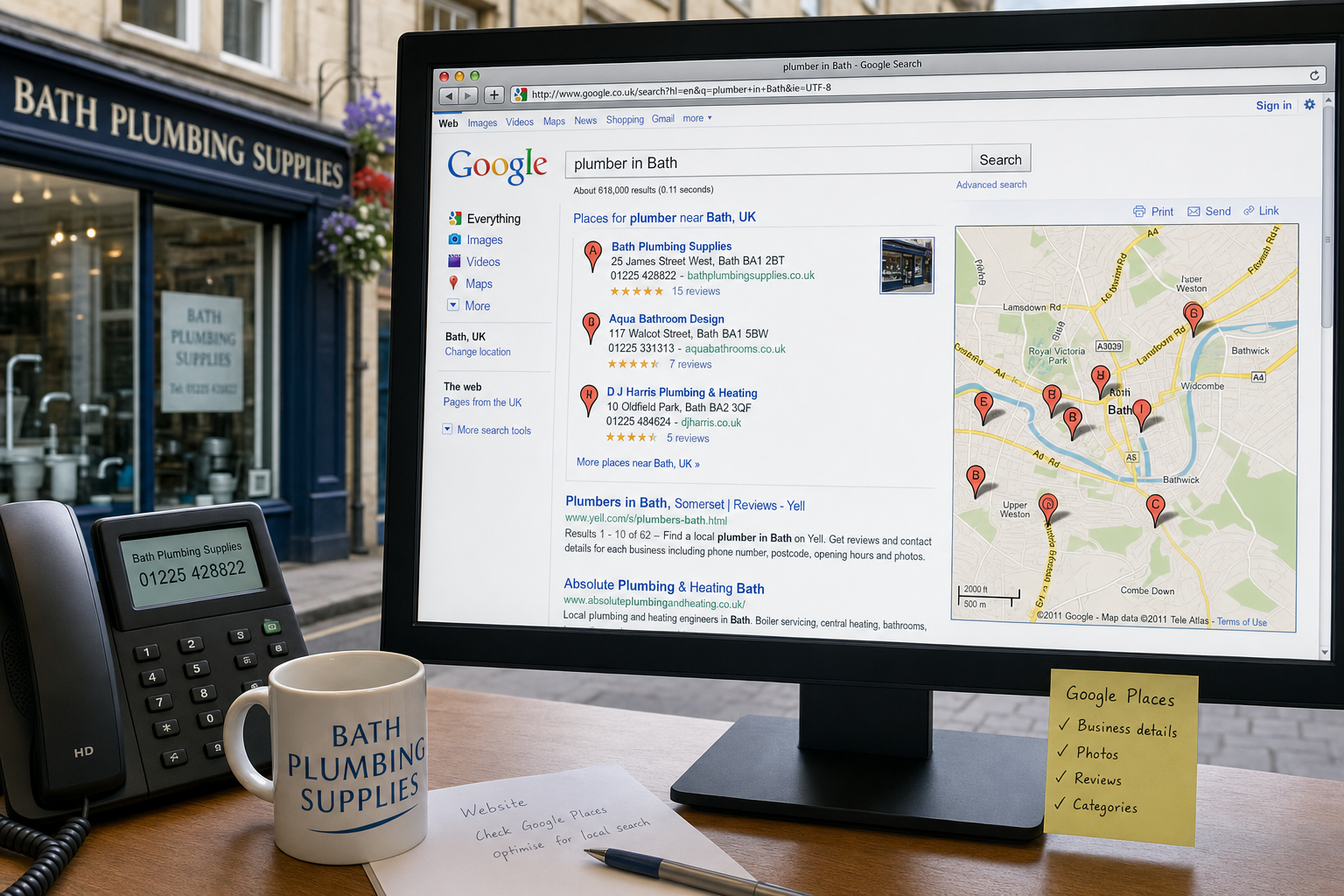
These listings are important because they often appear above or alongside ordinary website results. A searcher may see a map with several local businesses marked by pins, together with contact details and review information. If your business is missing, incomplete or inaccurate, you may lose enquiries before the visitor even reaches your website.
Claiming your Google Places listing is one of the first practical steps a local business should take. Once claimed, you can verify the address is correct, select relevant categories, and add helpful information that reassures potential customers. Verification may involve a postcard or telephone process, so allow time for the listing to be confirmed properly.
Getting the basics right on your Google Places listing
A strong listing starts with accuracy. Your business name, address and telephone number should be written consistently. Avoid adding unnecessary keywords to the business name. If your shop sign, stationery and website use a particular trading name, use that same name in your listing.
Your category choices should describe what the business actually does. A solicitor should not choose broad or unrelated categories to appear in more searches. Relevance matters. If you offer several services, choose the most accurate main category and use the description and website pages to explain the rest.
Photographs can also help. A clear exterior photograph is useful for businesses that customers visit in person, while interior images, team photographs or examples of work can add credibility. For restaurants, hotels, salons, shops and trades, images can make the listing feel more trustworthy and approachable.
Opening hours should be kept up to date. If customers arrive to find you closed, or call outside the times shown on your listing, that poor experience can damage confidence. Local search is not only about rankings; it is about making it easy for people to choose you.
Your website still does much of the work
Google Places is valuable, but it should not replace a well-planned website. Your website gives search engines and customers a clearer picture of what you do, where you operate and why you are a suitable choice. A thin or outdated website can weaken the impact of an otherwise complete local listing.
Start with clear page titles and headings. If you are a dental practice in Leeds, your website should make that obvious in natural language. A page title such as Family Dentist in Leeds"s is more useful than a vague title such as" Welcome ". The same principle applies to trades, professional services, retailers, leisure businesses and local organisations.
Your contact details should be easy to find. Include your address and telephone number on the contact page and, where appropriate, in the footer of the site. If you serve a defined area rather than customers visiting your premises, explain that clearly. For example, a heating engineer may list the towns and villages covered, while still keeping the content readable and honest.
Good website design supports local SEO by improving trust. Visitors should be able to understand your services, find your contact information and make an enquiry without confusion. A cluttered layout, slow-loading pages or hidden contact details can waste the traffic that local search sends you.
Creating useful local content
Search engines need relevant content to understand your business. This does not mean filling pages with repeated place names. It means writing useful, specific information for the people you want to attract.
A local estate agent might publish area guides, advice for first-time buyers and information about nearby transport links. A wedding photographer might show galleries from venues in the region, with permission where needed. A café might describe its location near a station, theatre or shopping street. These details help customers and search engines understand the business's local relevance.
If you serve several towns, consider whether each location genuinely deserves its own page. A page should offer distinct value, not simply swap one town name for another. Thin duplicate pages are unlikely to impress visitors and may not help search performance. It is better to have fewer, stronger pages than a large number of weak ones.
Consistency across directories and citations
Local SEO is influenced by the information about your business that appears across the web. Directory listings, trade bodies, local business groups, review sites and newspaper directories can all act as citations. A citation is a mention of your business details, usually including your name, address and telephone number.
Consistency is vital. If one directory lists an old telephone number, another lists a previous address, and a third lists your business name differently, search engines may struggle to connect those references confidently. Customers may also become frustrated if they find conflicting information.
Review the main places where your business is listed. Check local directories, industry directories, mapping services and any profiles you have created. Make sure the details match your website and Google Places listing. If your business has moved premises or changed telephone number, update old listings wherever possible.
Quality matters more than sheer quantity. A listing on a respected local chamber of commerce website or relevant trade directory is generally more useful than dozens of low-quality directory submissions. Think of citations as part of your business reputation, not just an SEO exercise.
Reviews and reputation
Customer reviews are increasingly visible in local search. They can influence whether someone clicks, calls or looks elsewhere. A business with a complete listing and positive comments may appear more reassuring than one with no visible feedback.
Encourage genuine customers to leave honest reviews, but do not pressure them or attempt to manufacture praise. A simple follow-up email, a printed note, or a polite request after a successful job can be enough. Make it easy by explaining where to leave reviews, but let the customer choose what to say.
Negative reviews should be handled calmly and professionally. If a response facility is available, reply courteously and focus on resolving the issue. Other customers will judge not only the complaint but also the way the business responds. A measured reply can sometimes build more trust than silence.
Social media and local visibility
Social media is not a replacement for a website or Google Places listing, but it can support local marketing. Platforms such as Facebook and Twitter allow businesses to share updates, promote events, answer questions and stay visible with local customers.
For a small business, the key is to be useful rather than noisy. A restaurant might share menu changes, seasonal offers or photographs of new dishes. A retailer might highlight new stock or local events. A professional service firm might share short advice pieces and links to helpful articles on its website.
Social media can also encourage repeat visits and word-of-mouth referrals. When local customers share your updates or mention your business, your name reaches people in their network. This may not produce instant rankings, but it strengthens recognition and can lead to more branded searches and direct enquiries.
Domain names and local branding
Your domain name is part of your digital identity. For a local business, it should be memorable, credible and easy to communicate over the telephone or in print. A short, clear domain is often better than a long phrase stuffed with keywords.
If your business name is distinctive, registering a domain that matches it can strengthen your brand. If your business name is common, you may consider adding a relevant location or service, provided the result still looks professional. Avoid awkward hyphens, confusing spellings or names that are too similar to another organisation.
When registering a domain, use accurate ownership details and keep access information secure. Make sure renewal reminders are monitored by someone responsible within the business. Losing control of a domain can disrupt email, website traffic and customer confidence.
It is also sensible to keep your website, email and printed materials consistent. If your vans, shopfront, business cards and website all present the same name and contact details, customers are more likely to remember and trust you.
Technical considerations for local websites
A local business website does not need to be complicated, but it does need to work properly. Pages should load quickly, navigation should be simple, and contact forms should be tested. Broken links, missing images and outdated information all send the wrong signal.
Many customers now browse on mobile phones, especially when searching for directions, telephone numbers or opening hours. A site that is difficult to read on a smaller screen can lose enquiries. At minimum, ensure that your telephone number, address and main service information are easy to access without excessive scrolling or zooming.
Search engines also need to crawl your website. Avoid building important text entirely into images or using navigation that cannot be followed. Keep the structure logical, with clear links to your main services, location information and contact page. Tools such as analytics packages and search engine webmaster accounts can help you understand how visitors find and use the site.
Measuring local SEO success
Local SEO should be measured by business value, not just rankings. Rankings can vary by location, search history and the exact phrase used. A better question is whether your local search activity is producing more relevant enquiries.
Track telephone calls where possible, monitor contact form submissions and ask new customers how they found you. Website analytics can show which search phrases and pages are bringing visitors. Google Places may also provide information about impressions and actions, helping you see whether people are viewing the listing, clicking for directions or visiting your website.
Do not expect every improvement to happen overnight. Local SEO involves building trust and consistency across several areas. A complete listing, a better website, accurate citations and genuine reviews work together over time.
A practical local SEO checklist
- Claim and verify your Google Places listing.
- Use a consistent business name, address and telephone number across your website and directories.
- Select accurate categories and write a clear business description.
- Add useful photographs and keep opening hours up to date.
- Make your website clear, fast and easy to navigate.
- Include local information naturally within relevant pages.
- Check major directories and correct outdated details.
- Encourage genuine customer reviews and respond professionally.
- Use social media to support local relationships and repeat awareness.
- Measure enquiries, calls and website behaviour, not rankings alone.
Building local visibility with confidence
Local SEO is one of the most practical forms of digital marketing for UK small businesses. It connects your company with people who are already searching for nearby products and services. When your Google Places listing, website, directory information and reputation all support one another, you make it easier for customers to find and choose you.
The best approach is steady and thorough. Keep your details accurate, write for real customers, present your business professionally and treat local search as part of your wider brand. For many small businesses, those fundamentals can make the difference between being overlooked and being contacted at the exact moment a customer is ready to act.