As 2010 approaches, many UK businesses are taking a fresh look at their websites and asking whether they are ready for the next stage of online growth. A website is no longer simply an electronic brochure. For many organisations, it is the first place a potential customer checks before making contact, requesting a quotation, visiting a shop or recommending a service to a colleague. Good website planning helps ensure that the money, time and effort you invest online are focused on clear business outcomes rather than attractive pages alone.
Whether you are commissioning your first site, replacing an ageing one or improving an existing online presence, the decisions made before design work begins are often the most important. A well-planned website should support your sales process, strengthen your brand, make it easier for customers to find information and provide a sound foundation for search marketing, email enquiries and social media activity.
Start with business objectives, not page layouts
The most effective website planning begins with a simple question: what should the website achieve for the business? A local accountancy practice may want more enquiry forms from limited companies. A manufacturer may need to present technical information clearly for buyers and distributors. A hotel may require booking enquiries, location details and reassuring photography. A charity may need donations, newsletter sign-ups and event information.
Before discussing colour schemes or navigation, list the site's practical aim. These might include generating telephone enquiries, building a mailing list, selling products, reducing repetitive customer service calls, attracting staff applications or supporting offline marketing campaigns. Once these objectives are agreed, every design and content decision can be measured against them.
It is also worth deciding how success will be monitored. Web statistics packages can show where visitors come from, which pages they view and whether they complete enquiry forms or other important actions. Even basic reporting is valuable because it replaces guesswork with evidence. If your website is expected to generate leads, make sure enquiry forms, telephone numbers and email addresses are presented clearly and consistently.
Understand the people you want to reach
A website that tries to speak to everyone often persuades no one. During the planning stage, identify the main types of visitor you expect to attract. These may include existing customers, new prospects, suppliers, journalists, job applicants or trade partners. Each group arrives with different questions and levels of knowledge.
For example, a homeowner searching for a building contractor may want reassurance, examples of previous work and clear contact details. A procurement manager looking for an industrial supplier may need specifications, accreditations and delivery information. A visitor who already knows your company name may need a quick way to find your telephone number. In contrast, a visitor arriving from a search engine may need more explanation before enquiring.
Good planning maps these visitor needs before the site structure is drawn. This helps you create navigation that reflects real customer behaviour rather than internal departments. It also helps avoid pages written solely from the company's point of view. Customers usually ask, "Can you help me? Do I trust you? What should I do next?" Your website should answer those questions quickly.
Plan your content before design begins
Content is often the area most underestimated in website projects. Businesses may approve a design quickly, only to discover that writing service pages, sourcing photographs and preparing staff biographies takes longer than expected. Treat content as a core part of website planning, not a last-minute task.
Begin with a sensible page list. Most business websites need a clear home page, service or product pages, an about section, contact information, and often pages for news, testimonials, case studies, frequently asked questions or downloads. Larger organisations may need separate sections for different sectors, branches or audiences.
Each important page should have a defined purpose. A service page, for instance, should explain what is offered, who it is for, why the business is credible and how the visitor can take the next step. Avoid vague marketing claims that could apply to any competitor. Specific, useful information is more likely to build trust and more likely to match the phrases people use in search engines.
Images also need planning. Professional photography can help a website feel distinctive and credible, especially for businesses where premises, people, products or finished work matter. If photography is not possible, choose stock images carefully and avoid visuals that make the business look generic. In 200,,9 many websites still relied heavily on overused handshake and headset imagery; a more considered approach could immediately improve perception.
Build search marketing into the structure
Search engine optimisation should not be treated as a separate exercise bolted on after launch. The foundations are laid during website planning: page structure, wording, internal links, page titles and the way content is organised all influence how easily search engines and customers can understand a site.
Start by researching the language your customers use. A business may describe itself in technical or internal terms, while customers search for simpler phrases. A solicitor, for example, may provide a range of specialist services, but potential clients may search for practical phrases such as conveyancing, employment advice or wills. Each important service should have its own clear page rather than being hidden within a single long general description.
Page titles should be unique and descriptive. Headings should help users scan the content. Search-friendly copy should be written for people first, with natural use of relevant phrases rather than repeated keywords. The primary keyword for this article, website planning, is a good example: it should appear where it genuinely helps the reader, not be forced into every sentence.
Technical details matter too. Clean, readable web addresses are preferable to long strings of numbers and symbols. Important pages should be reachable through normal navigation, not only through a search box or complex script. If replacing an old website, plan redirects from old addresses to new ones so that existing links, bookmarks and search engine listings are not wasted. An XML sitemap can also help search engines discover pages, while a well-structured HTML sitemap may help visitors on larger sites.
Paid search can also form part of a launch plan, particularly where immediate enquiries are important. However, it should not be used as a substitute for a well-built website. Advertising may bring visitors to the door, but the site still has to persuade them to act.
Design for trust, clarity and ease of use
Visual design is important, but its role is to support communication. A successful business website should look professional, reflect the brand and make the next step obvious. Visitors make quick judgements. If a site feels dated, confusing or slow, they may assume the same of the organisation behind it.
Strong design begins with hierarchy. The most important message on a page should be easy to identify. Calls to action, such as requesting a quote, booking a consultation, downloading a brochure or calling the office, should be visible without overwhelming the visitor. Navigation labels should be plain and predictable. Creative wording may suit campaign headlines, but menus usually work best when they are simple.
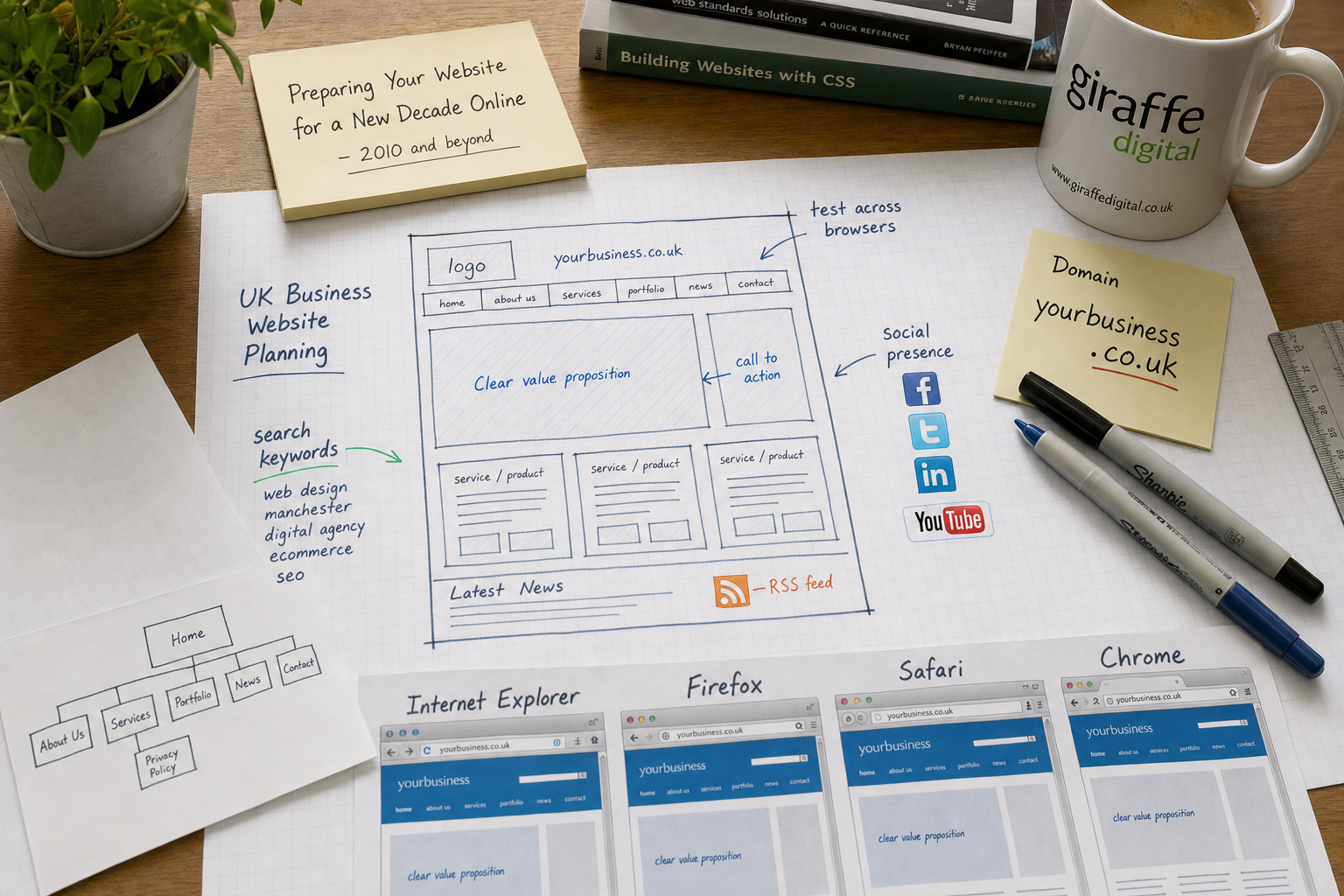
Consider accessibility and readability from the outset. Use sufficient contrast, avoid very small text and make links easy to recognise. Not every visitor will use the same browser, screen size or connection speed. In late 2009, a business website should be tested in commonly used browsers, including Internet Explorer, Firefox, Safari, and Chrome, with attention to older versions still used in many offices. Pages should remain usable where images load slowly or where a visitor is using assistive technology.
Flash can still be useful for certain visual presentations, but it should be used carefully. Important navigation, text and calls to action should not depend entirely on Flash. Search engines and some users may struggle with content that is locked inside animated elements. A site should look engaging, but it must also be practical.
Choose technology that suits the business
The right technical approach depends on how the website will be managed. A small brochure site may not need a complex sys. At the same time, ile a growing company may benefit from a content management system that allows staff to update news, vacancies, product information, or downloads without having to ask a developer for every change.
When choosing technology, think beyond launch day. Who will update the site? How often will content change? Will you need forms, customer logins, product catalogues, online payments or integration with existing office systems? Will the site need room for new sections as the business grows? Planning these requirements early reduces the risk of building a site that has to be replaced too soon.
Hosting should also be considered carefully. A reliable hosting arrangement, regular backups and clear support responsibilities are essential. If the website takes enquiries, stores customer details or processes orders, security and data handling should be treated seriously. Contact forms should be tested, spam protection considered and sensitive information handled appropriately.
Email is another area that deserves attention. Website launches sometimes overlook the practicalities of domain email, forwarding, mailbox setup and staff access. Plan these details so the new website and email arrangements support each other smoothly.
Register and manage domain names sensibly
Your domain name is a key business asset. It appears on stationery, vehicles, advertising, email signatures and search results. Choose a name that is easy to say, easy to spell and closely connected to your business or brand. For UK organisations, a .co.uk domain is often expected, while a .com may also be useful where available and relevant.
Avoid very long names, confusing hyphens or spellings that are difficult to remember over the telephone. If your business name is commonly misspelt, consider whether suitable variations should be registered to protect the brand and capture mistakes. You may also wish to secure related extensions where appropriate, particularly if you advertise widely.
Keep domain ownership details under the business's control, not under the control of an individual employee who may leave. Record renewal dates, login details and administrative contacts securely. Many website problems begin not with design or hosting, but with the loss of access to a domain name. It is far easier to organise this properly at the beginning than to untangle it during an urgent redesign or email outage.
Connect the website with social media and ongoing communication
Social media is becoming a useful part of online marketing for many businesses, but it works best when integrated with a solid website strategy. A profile on Facebook, Twitter or LinkedIn can help extend reach, share updates and start conversations. Still, your website should remain the central place where prospects can find complete, accurate and persuasive information.
During website planning, decide what role social media should play. A professional services firm may use LinkedIn to build relationships and share articles. A retailer may use Facebook to announce new products or events. A company with demonstrations, interviews or product guides may find video useful. A business blog can support search visibility, give staff a voice and provide material to share through social channels.
Do not open social accounts simply because they are fashionable. Consider who will update them, what will be posted and how enquiries will be handled. An abandoned profile can create the wrong impression. A modest, consistent approach is usually more valuable than an ambitious plan that cannot be maintained.
Email newsletters and RSS feeds may also support ongoing communication, especially where customers benefit from regular advice, product updates or event notices. Make it easy for visitors to subscribe, but be clear about what they will receive and how their details will be used.
Prepare for launch and improvement after launch
A good launch is planned, tested and measured. Before the new site goes live, check every form, link, download, telephone number and email address. Review spelling and grammar carefully. Test the site in different browsers and on different computers. Make sure old pages are redirected where necessary and that tracking is in place from the first day.
It is also wise to prepare staff. Reception teams should know if new forms or enquiry types are being introduced. Sales teams should know which pages to send to prospects. If the site includes news or a blog, assign responsibility for future updates. A website quickly loses value if nobody owns it after launch.
Once live, review performance regularly. Which pages attract visitors? Which search phrases bring traffic? Are people completing enquiry forms? Are there pages where visitors leave quickly? These observations can guide improvements. The most successful websites are rarely finished in a single project; they are maintained, measured and refined over time.
A practical foundation for the next decade
Preparing a website for 2010 is not about chasing every new trend. It is about building a clear, useful and credible online presence that supports the way people now research, compare and contact businesses. Strong website planning brings together business objectives, customer needs, content, design, search marketing, technology and ongoing communication.
For UK business owners, the opportunity is significant. A well-planned website can make a small company look more credible, help an established firm generate better enquiries, support sales teams, reduce administrative pressure and strengthen brand perception. The key is to treat the website as a business tool, not just a design exercise.
As the new decade begins, customers will continue to expect faster access to information, clearer communication and more reasons to trust the organisations they choose. Businesses that plan carefully now will be better placed to meet those expectations and make the web a more productive part of their marketing.