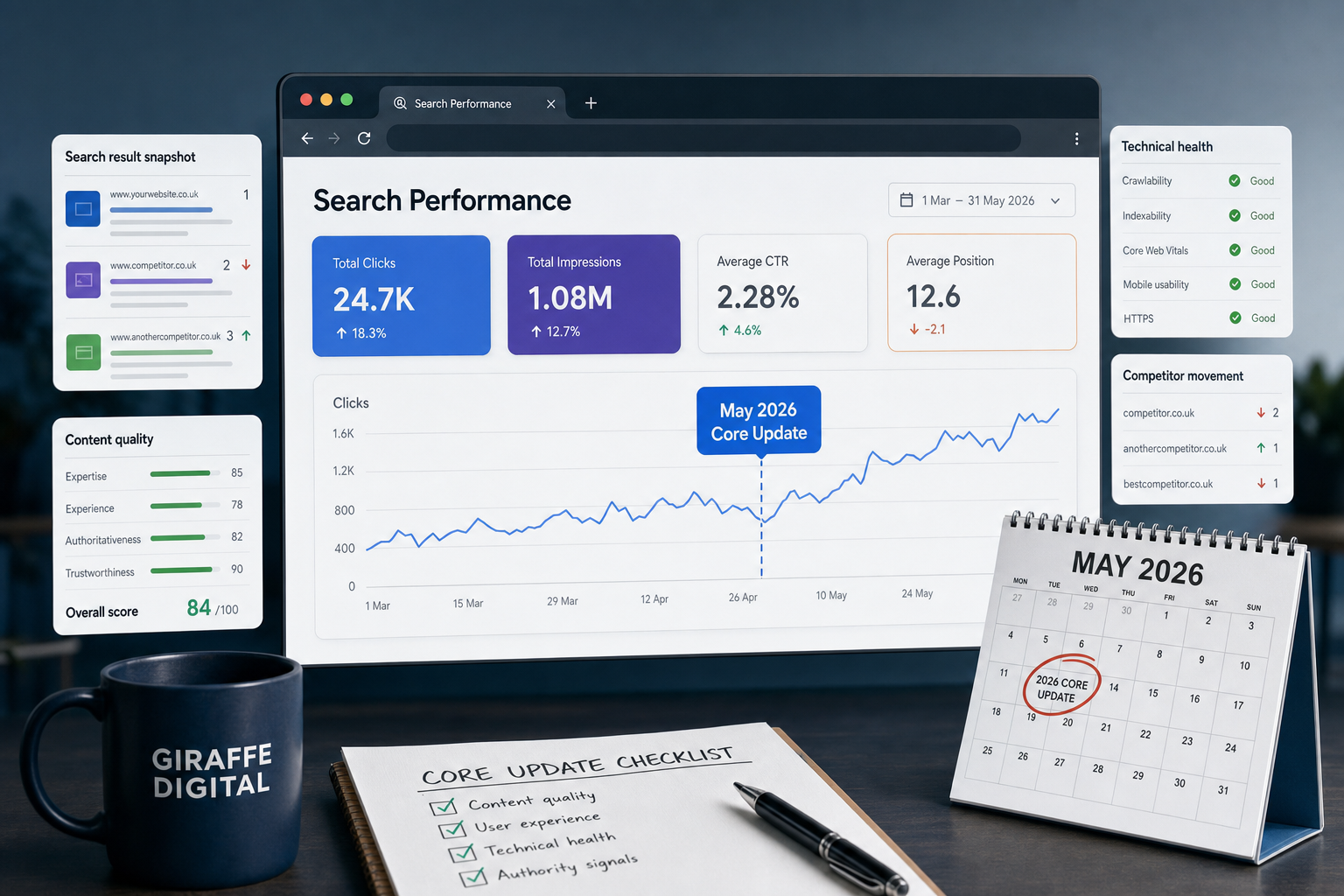
Search engine optimisation is no longer a technical extra reserved for large companies. For many UK businesses, a website is now one of the first places a potential customer will look before making an enquiry, visiting a shop, booking an appointment or requesting a quotation. If your site cannot be found for the phrases your customers are typing into search engines, it is unlikely to deliver its full commercial value.
Good search engine optimisation is about helping search engines understand what your website offers, while also making the site clearer, faster and more useful for real people. It is not a one-off trick, nor is it simply a matter of adding a few keywords to a page. It combines sensible website design, well-written content, sound technical construction, relevant links and ongoing measurement.
Why search engine optimisation matters for business websites
A well-designed website can support many areas of a business: sales, customer service, recruitment, reputation and local visibility. However, even the most attractive site will struggle if it is hidden from people actively searching for what you offer. Search engines are often the starting point for research, whether someone is looking for a local accountant, a hotel, a training provider, a manufacturer or a specialist retailer.
The main value of search engine optimisation is that it connects your website with existing demand. A person searching for a service is already showing intent. They may be comparing suppliers, checking credentials or looking for a telephone number. If your site appears prominently and the page answers their question clearly, you have a better chance of earning the enquiry.
For business owners, this means SEO should be considered early in any website design or redesign project. Decisions about page structure, navigation, copywriting, domain names and content management can all affect how well a site performs in search. Retrofitting SEO after a site has launched is possible, but it is usually more efficient to build with search visibility in mind from the start.
Start with the words your customers actually use
The foundation of search engine optimisation is understanding your customers' language. Many businesses describe their products and services using internal terminology, trade phrases or brand-led wording. Customers may search in simpler, more direct ways. For example, a legal practice may refer to conveyancing services, while a customer may search for house purchase solicitor. A manufacturer may speak about bespoke fabrication, while a buyer may search for custom metal parts supplier.
Begin by listing your core services, products, locations and common customer questions. Speak to sales staff and reception teams, as they often know the exact phrases customers use on the telephone. Review enquiry emails and note repeated wording. Look at your competitors' websites and industry directories for common patterns, but avoid copying content. The aim is to identify relevant phrases and then create useful pages that deserve to appear for those searches.
It is helpful to group keywords by intent. Some visitors are ready to enquire, using phrases such as "emergency plumber in Leeds" or "commercial insurance broker Bristol". Others are still researching, with searches such as how to choose office furniture or what a business continuity plan is. A strong website can serve both needs: service pages for direct enquiries and informative pages or articles for research-led visitors.
Build pages that search engines can understand
Search engines read pages in a structured way. They look at the page title, headings, body copy, links and other signals to understand what a page is about. A clear, well-organised page is better for both search engines and visitors.
Use clear page titles and headings
Every important page should have a unique page title that describes its subject. The title is one of the strongest on-page signals and is often used as the clickable heading in search results. Keep it specific and useful. Instead of a title such as Services, a more descriptive title might be Commercial Printing Services in Manchester or Office Cleaning for Businesses in Kent.
Headings should guide the reader through the page. They should not be stuffed with repeated keywords, but they should make the topic clear. A page about website design for small businesses should use headings that explain the service, process, benefits and next steps, rather than vague slogans.
Write useful descriptions for search results
The description shown in search results is not simply a technical field. It is a short advert for the page. A good description should summarise the offer naturally, include the main subject, y and encourage the right visitor to click. Avoid exaggerated claims. A straightforward description that explains what the page offers will usually perform better than a vague marketing line.
Create clean URLs and logical navigation
Short, readable web addresses help people and search engines understand your site. A page address such as /services/office-cleaning is clearer than a long address filled with numbers or session information. If you are planning a new site, ask your web designer or developer how page addresses will be created and whether they can be kept simple.
Navigation should also be straightforward. Important pages should not be buried several clicks away from the home page. Use sensible categories and link related pages together. For example, a page about business broadband could link to related pages on telephone systems, IT support, and connectivity advice, where relevant. These internal links help visitors continue their journey and help search engines discover and understand your content.
Content should demonstrate expertise and answer questions
Search engine optimisation is closely linked to content quality. A thin page with a few lines of generic copy is unlikely to convince visitors or perform well over time. Business websites should explain services clearly, answer common questions and provide enough detail for a potential customer to take the next step.
A good service page might include who the service is for, what is included, where it is available, how the process works, what makes the business credible and how to enquire. If there are important considerations, such as lead times, accreditations, coverage areas or specialist sectors, include them where appropriate. This information helps visitors qualify themselves and reduces unnecessary enquiries.
Regular articles or guides can also support search visibility. A firm of accountants might publish practical guidance on record-keeping, payroll deadlines, or choosing accounting software. A building company might explain planning considerations, maintenance advice or the stages of a renovation project. A hotel might write about local attractions, conference facilities or seasonal events in the area. The best content is genuinely helpful, closely related to the business and written in plain English.
Do not create pages solely to repeat keywords. Search engines are increasingly good at identifying poor-quality, repetitive and artificial content. More importantly, people can recognise it immediately. If a page reads badly, it reflects poorly on the business.
Choose and manage your domain name carefully
Your domain name is part of your brand and can influence how people remember, type and trust your website address. When registering a domain, choose something clear, professional and easy to spell. For many UK businesses, a UK-focused domain can be suitable, particularly if the company primarily serves customers in Britain. If your organisation trades internationally, you may wish to consider whether a broader domain is also appropriate.
A domain does not need to contain every keyword to perform well in search. A memorable brand-led domain can be far more valuable than a long, awkward address packed with search terms. If you include a location or service in the domain, make sure it still looks credible on business cards, vehicles, email signatures and printed material.
Keep registration details organised and ensure the domain is renewed on time. It is wise for the business owner or organisation to have clear control over the domain registration, rather than leaving ownership unclear. If a web design supplier assists with registration, ensure responsibilities are documented, including renewal reminders and access arrangements.
Earn links from relevant and trusted websites
Links remain one of the most important factors in search engine optimisation. When another website links to yours, it can act as a signal of trust, relevance and authority. Not all links are equal. A link from a respected industry body, local chamber, supplier, customer, publication or specialist directory is usually far more valuable than dozens of links from unrelated or low-quality websites.
Good link building begins with real business relationships. Consider whether trade associations, professional memberships, local organisations, event listings, suppliers or partner companies can legitimately reference your website. If you sponsor a local event, contribute an article to a trade publication, n or provide a useful resource, there may be a natural opportunity to include a link.
Avoid schemes that promise large numbers of instant links. Search engines are wary of artificial link patterns, and poor-quality links can damage asite'ss reputation. The safest approach is to build links that would still make sense even if search engines did not exist: links that bring relevant visitors, reflect genuine relationships and support your brand.
Use social media and online PR to support visibility
Social media is becoming an increasingly useful part of digital marketing for many businesses, although it should be approached with clear purpose. Networks such as Facebook, Twitter and LinkedIn can help companies share updates, build relationships, promote useful content and listen to customer conversations. Blogs, forums and video-sharing sites can also play a role, depending on the sector.
Social activity is not a replacement for search engine optimisation, but it can support it. Useful articles shared through social channels may attract readers, enquiries and links. A well-maintained company blog can give customers a reason to return to the site and can provide material for email newsletters or press outreach. Online PR can also help, particularly when a business has genuine news, research, commentary or community involvement to share.
The important point is to avoid treating social media as a broadcast-only channel. A company that posts sales messages is unlikely to build much interest. Share practical advice, answer questions, highlight staff expertise and point people towards genuinely useful pages on your website.
Do not ignore local search
For businesses that serve a defined area, local search visibility is essential. A person searching for a restaurant, solicitor, dentist, garage, venue or building contractor will often include a town, city or county in the search. Your website should make your location clear, with an address, telephone number and service areas where appropriate.
Consider creating separate, useful pages for genuine locations or branches, but avoid producing near-identical pages for every town in a county to capture searches. If you have an office in Birmingham, a page about that office can include directions, opening hours, local team information, and available services. If you only cover surrounding areas from a single base, explain your coverage honestly on the relevant service pages.
Local business listings, reputable directories and map-based listings can also help customers find you. Keep your business name, address and telephone number consistent. Inaccurate listings can confuse customers and reduce trust.
Make sure the technical basics are in place
Technical problems can prevent a good website from being found. Search engines need to be able to crawl your pages, follow links and read the content. If important text is locked inside images, complicated scripts or files that search engines cannot easily process, it may not be properly understood.
Ask your web developer to check that the site has a sensible structure, a robots. txt file where needed, an XML sitemap for larger sites, and no unnecessary barriers to crawling. Pages should load quickly, as slow sites frustrate visitors and may reduce enquiries. Images should be appropriately compressed and provided with descriptive alt text where useful, for both accessibility and context.
Website design should balance visual appeal with usability. Clear navigation, readable text, obvious enquiry options and consistent branding all contribute to performance. A site that wins traffic but hides the telephone number or makes forms difficult to complete is wasting opportunities.
Measure results and improve over time
Search engine optimisation should be measured. Website analytics can show how many visitors arrive from search engines, which pages they land on, how long they stay and whether they complete enquiry forms or other goals. Server logs and webmaster tools can provide further insight into crawling and search visibility.
Do not judge SEO only by rankings for one phrase. Rankings vary, and different visitors use different searches. A more useful view combines rankings, search traffic, enquiries, telephone calls, brochure downloads and other business outcomes. If a page attracts visitors but generates no enquiries, it may need clearer copy, stronger calls to action, n or better alignment with search intent.
Review performance regularly. Update pages when services change, add helpful content where customers need more information and refine page titles or descriptions if search listings are not attracting clicks. Search engine optimisation is an ongoing programme of improvement, not a single launch task.
Common SEO mistakes to avoid
- Building the site entirely around design without considering search. Attractive visuals are important, but structure, text and usability matter just as much.
- Using the same title on every page. Each important page should have a unique and descriptive title.
- Hiding important words in images. Search engines and some visitors may not be able to read them properly.
- Repeating keywords unnaturally. Write for people first, using relevant terms naturally.
- Buying or joining poor-quality link schemes. Links should be relevant, credible and earned where possible.
- Forgetting local information. If location matters to your customers, make it clear on your site.
- Launching and leaving the site unchanged for years. A business website should develop as the business develops.
A practical first step for business owners
If you are unsure where to begin, start with a simple review of your website. Choose five important services or products and search for the phrases a customer might use. Check whether your site appears, whether the relevant page is clear, and whether a visitor knows what to do next. Then review the page title, headings, copy, links and contact options for each page.
From there, create a manageable improvement plan. You might rewrite key service pages, add clearer location information, improve internal links, publish a helpful article each month and seek legitimate links from trusted business relationships. Small, consistent improvements can make a significant difference over time.
Search engine optimisation works best when it is treated as part of a wider digital strategy. It should support branding, website design, content planning, social media marketing and customer communication. For UK businesses investing in a new or improved website, the aim is not simply to attract more visitors. The aim is to attract the right visitors, answer their questions and turn search visibility into real business opportunities.