Search engines are very good at reading pages, but they do not understand a website in quite the same way a person does. A visitor can look at a page and recognise an address, a review, an event date, a product, a recipe, a member of staff or a set of opening hours. A search engine has to interpret that information from the words, headings, links and code on the page. Structured data gives those details clearer meaning.
For UK businesses investing in website design, search engine optimisation and digital marketing, structured data is a useful way to help search engines understand what a page is about. It does not replace strong content, good technical SEO or a well-designed user journey, but it can support all three. Used properly, structured data can make your content easier to interpret, easier to categorise and, in some cases, eligible for richer search results.
What is structured data
Structured data is a standardised way of labelling information on a web page so that search engines can identify it more accurately. Instead of simply publishing a paragraph that says your shop is open from 9 am to 5 pm, structured data can mark those times as business opening hours. Instead of leaving a review rating as plain text, structured data can identify the rating value, the review author and the item being reviewed.
The most commonly discussed vocabulary is Schema.org, a collaborative project supported by major search engines. It provides agreed terms for different types of information, such as local businesses, organisations, products, events, articles, reviews, people, recipes and breadcrumbs. When these terms are added correctly to a page, they provide helpful context.
There are several ways to add structured data, including microdata, RDFa and JSON-LD. In 2017, JSON-LD is increasingly popular because it can be added as a separate script within the page, making it neater to manage than marking up individual pieces of visible content. The right method often depends on the website platform, content management system and development approach.
It is important to remember that structured data should describe content that is genuinely present on the page. It is not a shortcut for adding hidden claims, false reviews or extra keywords. Search engines expect markup to match the visible content and to be helpful to users.
Why structured data matters for search visibility
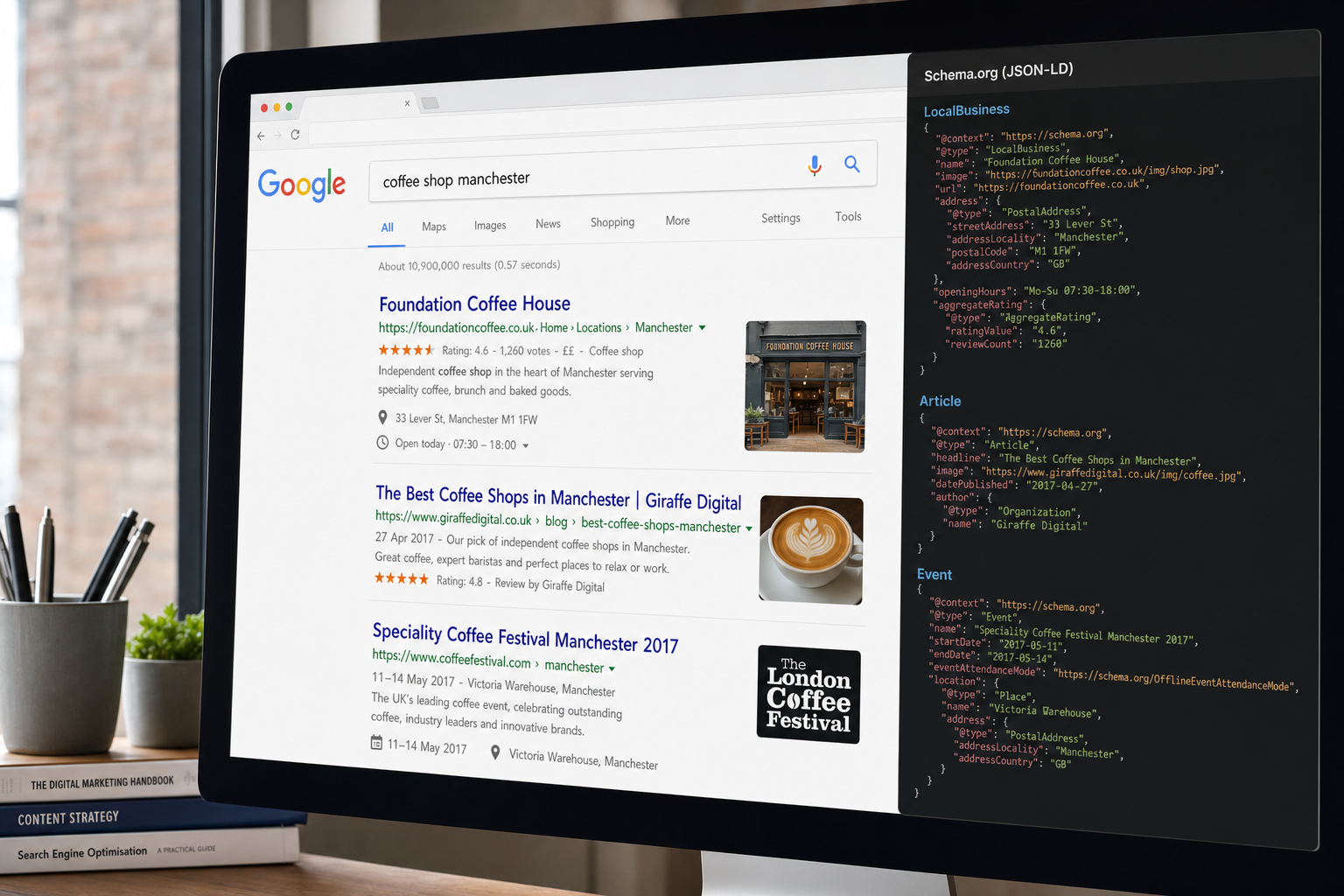
Search results are no longer limited to a blue title, a green URL and a short description. Depending on the query, users may see star ratings, business details, event dates, breadcrumbs, product information, recipe details or other enhanced elements. Structured data is one of the ways search engines decide whether a page is eligible for these enhanced results.
Eligibility does not mean a rich result is guaranteed. Search engines still apply quality checks and may choose not to display enhanced information for every search. Even so, structured data can improve the chances that your page is understood in the right context.
For a business owner, the value is straightforward. Better understanding can lead to a more relevant search presentation. A page about an upcoming event can show dates more clearly. A product page can give search engines clearer information about the product. A local business page can identify the organisation, address and contact details. A blog article can be marked as an article, with the headline and publication date made clear.
This can improve the quality of traffic as much as the quantity. A searcher who sees useful information before clicking may arrive with a better understanding of what your business offers. That can support enquiries, bookings, visits and sales, particularly when combined with clear calls to action and a well-designed website.
Useful examples for UK businesses
Structured data is not only for large retailers or publishers. Many smaller organisations can benefit from marking up key information. The best starting point is to look at the pages that matter most to your customers and your marketing goals.
Local business information
A local service provider, shop, restaurant, clinic or office-based business can use structured data to identify its name, address, telephone number, opening hours and business type. This can help search engines connect the business details on the website with other information they have discovered across the web.
For local SEO, consistency is important. Your name, address and telephone number should be accurate on your website and on reputable directories and social profiles. Structured data reinforces that clarity, but it should not be used as a substitute for keeping your visible contact details up to date.
Products and services
Product markup can be useful for e-commerce websites where the page contains genuine product details. Depending on the content and search engine treatment, it can help identify the product name, description, image, availability and review information. If your website sells online, structured data should be considered alongside product page copy, image optimisation, category structure and a simple checkout journey.
Service businesses may not always fit neatly into product markup. In those cases, the priority should be to write clear service pages, use appropriate headings, include useful detail for customers and apply organisation or local business markup where relevant. Do not force a schema type simply because it looks appealing. Accuracy is more valuable than over-optimisation.
Articles and blog posts
Businesses that publish advice, news or guidance can use article markup to make the headline, author, date published and main image clearer to search engines. This is particularly useful when a blog forms part of a wider content marketing strategy.
A good blog post still needs a strong title, useful content and a reason for the reader to trust it. Structured data can support the technical interpretation of the article, but it cannot turn thin content into a valuable resource. If you want your content to perform, answer real customer questions and keep the information specific to your market.
Events
Venues, training providers, charities and community organisations may run events that deserve their own pages. Event structured data can help identify the event name, date, location and other key details. This is especially useful where there are several events on one website and each needs to be understood separately.
As always, make sure the marked-up information is also visible to users. If an event date changes, update the page and the structured data together. Out-of-date event information can frustrate searchers and damage trust.
Breadcrumbs
Breadcrumbs show the position of a page within the wider site structure, such as Home, Services, Search Engine Optimisation. Breadcrumb structured data can help search engines understand that hierarchy and may influence how the page path appears in search results.
From a website design perspective, breadcrumbs are also useful for visitors. They help people move back through categories or sections without feeling lost. This is a good example of technical SEO and user experience working together.
Structured data and website design
Structured data is most effective when it is considered during website planning, rather than added as an afterthought. A good website design process should define the content types the site will use: service pages, location pages, products, case studies, blog posts, events, team profiles and contact pages. Once these content types are clear, it becomes much easier to decide which structured data is appropriate.
For example, a business with several branches may need a page structure that clearly separates each location. Each location page can then include unique address details, opening hours, contact information, map details and relevant local copy. Structured data can describe those details more precisely, but the design and content must provide the foundation.
Similarly, an e-commerce website should have product templates that can handle product names, descriptions, prices where shown, availability, imagery and reviews if they are part of the site. Adding structured data at template level can make implementation more consistent and easier to maintain.
Mobile usability should also be part of the discussion. Searchers are often using mobile devices when looking for contact details, directions, opening times or quick product information. Structured data can support search understanding, but your website still needs to load reliably, display clearly and make it easy for visitors to take the next step.
How structured data supports digital marketing
Structured data sits within a broader digital marketing strategy. It can support SEO, but it should also connect with content planning, branding, social media and conversion optimisation.
When your website presents information clearly, your marketing becomes more coherent. The same product name, event details, business description and contact information should appear consistently across your website, search listings, social media profiles and marketing materials. Consistency helps users and reduces confusion for search engines.
Social media platforms use their own metadata formats, such as Open Graph and Twitter Cards, to display shared links with the right title, description and image. These are not the same as Schema.org structured data, but they serve a similar purpose: they help a platform understand and present your content. For a polished digital presence, both search-focused structured data and social sharing metadata should be considered.
For example, if you publish advice on choosing a new website design, article markup can help search engines understand the page, while social metadata can ensure that, when the page is shared on Facebook, LinkedIn or Twitter, it displays with a suitable title and image. This creates a more professional impression and can improve engagement.
Domain names, branding and trust
Structured data can help search engines understand your website, but it works best when the rest of your online presence is clear and trustworthy. One of the earliest decisions for many businesses is the domain name. A good domain should be easy to spell, easy to say, relevant to the brand and suitable for long-term use.
When choosing a domain, avoid unnecessary hyphens, confusing spellings and names that are too close to another organisation’s brand. Think about how the domain will look on business cards, vehicle graphics, signage, email addresses and social media profiles. If customers cannot remember it or spell it, you may lose valuable direct traffic and enquiries.
For UK businesses, a relevant UK domain can help reinforce location and trust, particularly where the audience is primarily domestic. Many organisations also register sensible variations to protect their brand. The main point is to choose a domain strategy that is clear, professional and consistent with the business name.
Once the domain is in place, structured data can reinforce the identity of the organisation by marking up the business name, website URL, logo and contact details where appropriate. This does not replace brand building, but it can support a cleaner online footprint.
Implementation tips and common mistakes
Before adding structured data, audit the website content. Identify the pages that deserve markup and decide which schema types are genuinely appropriate. It is better to implement a smaller amount of accurate markup than to cover a website with irrelevant or incorrect data.
- Match the visible content: Do not mark up information that users cannot see on the page.
- Use the most specific relevant type: Choose a schema type that accurately describes the page, rather than selecting one because it appears to offer more search features.
- Keep business details consistent: Make sure names, addresses, telephone numbers and opening hours match the visible page and other reputable online profiles.
- Validate before publishing: Use available testing tools to check for errors and warnings.
- Review after site changes: Template updates, new plugins and redesigns can accidentally remove or alter markup.
- Avoid spammy markup: False reviews, misleading ratings and hidden claims can cause problems and damage trust.
Google’s Structured Data Testing Tool is a useful way to check whether markup can be read correctly. Search Console can also help website owners identify some structured data issues. These tools should be part of a wider quality assurance process that includes checking page content, mobile display, forms, navigation and analytics tracking.
If your website uses a content management system, structured data may be handled by the theme, plugins or custom development. Each approach has advantages and risks. Plugins can be convenient, but they still need configuring correctly. Custom development can provide more control, but it should be documented so that future updates do not break the implementation.
A sensible starting point
If you are not yet using structured data, start with the pages that are most important to your business. For many UK organisations, that means the home page, contact page, key service pages and any pages that feature products, events or articles.
- List your main page types and the information each one contains.
- Check which Schema.org types are relevant to those pages.
- Make sure the visible content is accurate, helpful and complete.
- Add structured data in a clean, maintainable way.
- Test the markup and correct any errors.
- Monitor search performance and review the implementation after website changes.
This measured approach avoids unnecessary complexity. Structured data is not about adding every possible label to every page. It is about giving search engines reliable context where it matters.
Structured data is part of a stronger website
Structured data is a valuable technical addition, but it should never be treated as a standalone SEO strategy. It works best alongside strong content, sensible site architecture, fast and reliable pages, clear branding, mobile-friendly design and an ongoing plan for digital marketing.
For business owners, the key benefit is clarity. Structured data helps search engines understand who you are, what you offer and how your content is organised. When that clarity is combined with a website that serves customers well, it can contribute to stronger visibility, better presentation in search and a more trustworthy online presence.
If you are planning a new website or improving an existing one, structured data is worth discussing early. It can be built into page templates, content planning and technical SEO from the outset, making it easier to maintain as your website grows.