Voice search is no longer a novelty reserved for technology enthusiasts. With more people using Siri, Cortana, Google voice search and Amazon Alexa to ask questions, find local businesses and complete everyday tasks, it is beginning to influence how search engine optimisation should be approached. For UK business owners, the opportunity is not to chase a passing trend, but to understand how spoken searches differ from typed searches and how a well-planned website can answer those searches clearly.
The growth of smartphones has already changed search behaviour. People now expect fast answers while travelling, shopping, commuting or comparing services. Voice search adds another layer to this behaviour because spoken queries tend to be longer, more natural and often more urgent. A user may type Italian restaurant Bristol, but they are more likely to say Where is the nearest Italian restaurant open tonight? That difference matters for website content, local SEO, page structure and digital strategy.
What makes voice search different
Traditional SEO has often centred on short keyword phrases. Those phrases still have value, but voice search encourages more conversational language. People do not usually speak in the same way they type. They ask complete questions, use everyday wording and expect a useful answer rather than a list of pages to investigate.
This shift is particularly important for businesses that depend on local enquiries, appointments, bookings or service-led searches. A homeowner looking for an emergency plumber, a parent searching for a nearby nursery, or a business owner looking for website design support may all use voice search when they need a quick, practical response.
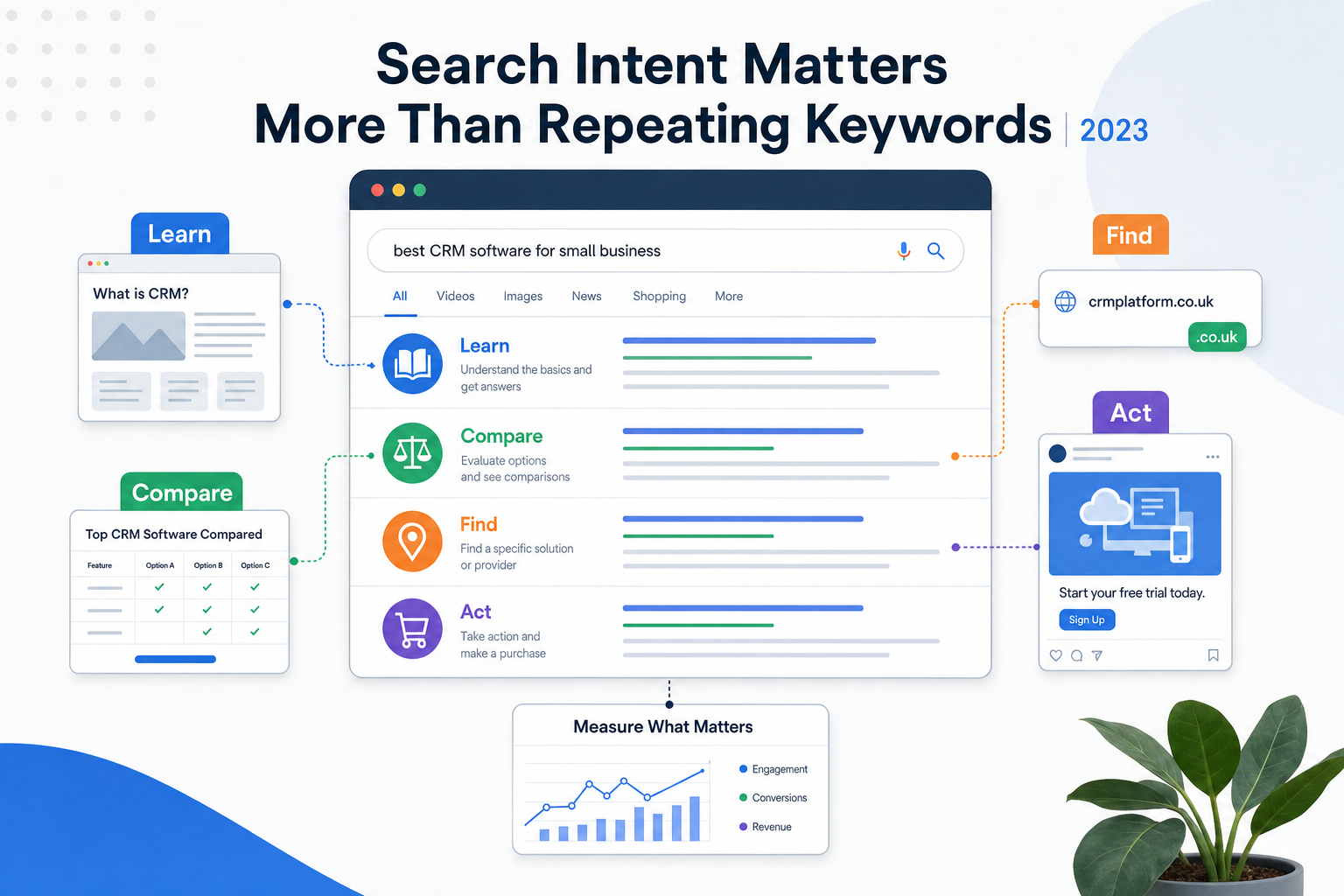
Voice search also tends to favour intent. Search engines are becoming better at understanding whether a person wants to know something, go somewhere, buy something or contact someone. In practical terms, this means your website should make it easy for both users and search engines to understand who you are, what you offer, where you operate and what action someone should take next.
Why voice search SEO matters for UK businesses
Voice search SEO is not a separate discipline that replaces existing SEO. It is better understood as a development within broader search marketing. The strongest foundations remain the same: useful content, sound technical performance, mobile-friendly design, clear navigation, credible branding and consistent business information across the web.
However, voice search places more pressure on clarity. If a search engine is trying to return one helpful answer to a spoken question, vague pages and thin content are less likely to perform well. A page that explains a service in plain English, answers common questions and includes accurate local information is more useful than a page written purely around repeated keyword phrases.
For example, a firm offering accountancy services in Manchester may have a page about small business accounting. To support voice search, that page could also answer questions such as:
- What accounting services does a small business need?
- When should a sole trader speak to an accountant?
- Do you work with businesses in Manchester and the surrounding areas?
- How can a new company prepare for its first tax return?
These are the kinds of questions potential customers may ask aloud. Answering them properly can help your website become more useful, more relevant and more aligned with natural search behaviour.
Build content around questions and useful answers
One of the most practical steps for voice search SEO is to review your existing content and identify the questions your customers regularly ask. These may come from sales calls, email enquiries, social media comments, live chat conversations or meetings. If customers ask the same thing repeatedly, there is a strong chance similar questions are being asked in search engines.
Good voice search content does not need to be complicated. In many cases, a clear question followed by a concise answer is very effective. The aim is not to stuff a page with every possible phrase, but to provide genuinely helpful information in a structure that is easy to scan.
Service pages can be improved by adding short explanatory sections. Blog posts can explore common problems in more detail. FAQ pages can help, provided they are written for real users rather than used as a dumping ground for keywords. A strong answer should be specific enough to be useful, but concise enough for someone seeking quick guidance.
For example, a web design business might answer How long does a new business website take to build? with a short explanation covering planning, content, design, development and testing. The answer should avoid promising a universal timeframe, but it can explain the factors that affect a project. This type of content helps potential customers and supports search visibility.
Local search is central to many voice queries
Many spoken searches have local intent. People ask for businesses near them, directions, opening times, contact details or services available in a particular town or region. For any business serving a defined area, local SEO should be a priority.
Start with consistency. Your business name, address and telephone number should be accurate on your website and across reputable online listings. Opening hours should be kept up to date, especially for businesses where a wasted journey could quickly lead to frustration. If you have more than one location, each location should have its own clear page with useful information rather than a single generic contact page.
Local landing pages should not be created merely by swapping town names in otherwise identical text. Search engines and users both value substance. A useful local page might include services offered in that area, directions, nearby landmarks, parking information, team details, genuine project examples where available, and answers to area-specific questions.
Reviews also influence trust. While reviews are not solely a voice search issue, they are part of the wider online reputation that can affect local visibility and customer choice. Encourage satisfied customers to leave honest feedback on appropriate platforms, and respond professionally where responses are available.
Website design must support fast, mobile-friendly answers
Voice search is closely linked with mobile behaviour. If someone asks a question on a phone, the next step may be to open a search result, tap to call, request directions or compare a few options. A slow or confusing website can quickly lose that enquiry.
A voice search SEO strategy should therefore include website design and performance. Pages should load quickly on mobile connections, text should be easy to read without pinching and zooming, and important calls to action should be clear. Telephone numbers should be easy to tap, contact forms should be simple, and navigation should not get in the way of the answer a visitor came to find.
It is also important to structure pages logically. A clear heading hierarchy, descriptive page titles and well-written introductory paragraphs help users and search engines understand the purpose of a page. If your website buries key information several clicks deep, it may struggle to meet the expectations of searchers who want immediate answers.
Technical quality matters too. Broken links, duplicate pages, confusing redirects and poor mobile usability can all weaken search performance. Voice search may feel like a new behaviour, but it rewards many of the same good practices that underpin a strong website.
Use structured information where it helps
Search engines rely on many signals to understand a business and its content. Structured data can help provide clearer information about things such as an organisation, address, opening hours, reviews, events or products, where appropriate. It should be implemented carefully and accurately, reflecting what is visible and true on the page.
Structured information is not a shortcut to rankings, and it should not be treated as a replacement for good content. Its role is to support clarity. If your website already contains well-written, accurate information, appropriate structured data can help search engines interpret it more confidently.
For local businesses, the basics are particularly important: correct contact details, clear address information, relevant service descriptions and consistent opening hours. For publishers and advice-led businesses, clear article structure and author or organisation details can help establish context.
Think carefully about domain names and brand clarity
Domain registration remains an important branding decision. A good domain name should be memorable, easy to spell, easy to say aloud and suitable for use across marketing channels. This becomes even more relevant as voice search grows, because people may hear your brand name in conversation, on the radio, in a podcast or through word of mouth before searching for it.
Avoid domain names that are unnecessarily long, awkward to pronounce or easy to confuse with another business. Hyphens and unusual spellings can create friction when someone has to say or remember the address. A domain should support your brand rather than forcing customers to work around it.
For UK businesses, it is often sensible to consider whether a UK-focused domain extension is appropriate alongside broader brand protection. The right choice depends on your audience, market and long-term plans. Before registering a domain, check that the name aligns with your business identity, does not cause confusion in your sector and can be used consistently across your website, email and social media profiles.
Social media can reinforce voice search visibility
Social media does not replace SEO, but it can support the same business goals. Active, consistent social profiles help customers recognise your brand, discover useful content and verify that your organisation is current. When people ask friends for recommendations or encounter your business through social content, they may later search for you by name using voice.
The most useful social media activity is often the most practical. Share answers to common customer questions, promote helpful guides, highlight opening times, explain services and show the personality of your business in a professional way. If your website contains a useful article answering a common question, social media can help put that answer in front of the right audience.
Consistency is key. Your business name, location, profile descriptions and contact information should match your website wherever possible. Conflicting information can confuse customers and weaken trust.
How to start improving your website for voice search SEO
Preparing for voice search does not require a complete change of direction. It requires a sensible review of how well your existing digital presence answers real customer questions. A practical starting plan might include the following:
- List common questions from customers, enquiries, sales conversations and support requests.
- Review key pages to see whether those questions are answered clearly and naturally.
- Improve local information, including address details, opening hours, service areas and contact options.
- Check mobile usability so visitors can read, call, enquire and navigate without frustration.
- Strengthen page speed by reviewing images, scripts and hosting performance.
- Write in natural language while still using relevant search phrases where they fit.
- Keep business information consistent across your website, listings and social profiles.
- Measure enquiries so you can understand which pages and topics contribute to business value.
Measurement is important, although voice search data is not always separated clearly in standard reporting. Rather than looking for a single voice search metric, monitor broader indicators: growth in mobile organic traffic, increases in local enquiries, improved rankings for question-based searches and stronger engagement with helpful content.
A useful development, not a gimmick
Voice search SEO should be viewed as part of a wider movement towards clearer, more useful digital communication. Search engines are trying to understand intent, and users expect websites to provide answers quickly. Businesses that invest in helpful content, strong website design, local accuracy and consistent branding are well placed to benefit as spoken search becomes more common.
The best approach is to focus on the customer. What do they need to know? What are they likely to ask? What would help them choose your business with confidence? If your website answers those questions better than your competitors, voice search becomes less intimidating and much more commercially useful.
For UK businesses planning a new website, refreshing their SEO strategy or reviewing their digital marketing, now is a sensible time to include voice search in the conversation. It does not require abandoning proven search principles. It simply encourages a more natural, customer-focused approach to being found online.