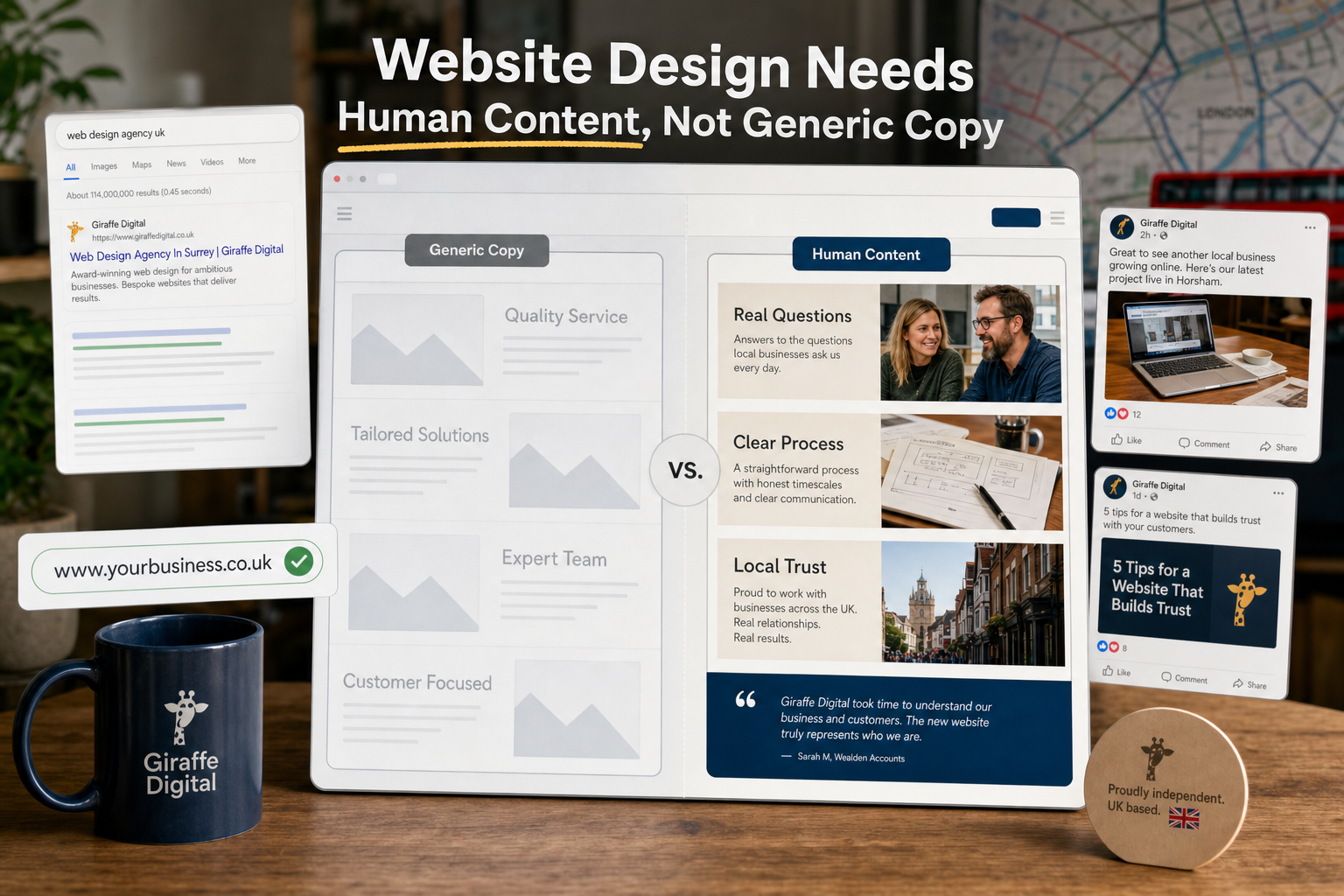
A well-designed website can create a strong first impression, but design alone rarely persuades someone to enquire, buy, book or subscribe. Visitors need to understand who you are, what you offer, why it matters and what they should do next. That is where human website content becomes essential. Clear, specific and believable copy gives your website substance. It helps your design feel purposeful rather than decorative, and it supports the wider digital marketing activity that brings people to your business in the first place.
For many UK business owners, website copy is treated as the final task before launch. The pages are designed, the images are chosen, the navigation is agreed, and then someone asks, “What shall we write here?” That approach often leads to generic statements such as “we are passionate about quality” or “we put customers first”. Those lines are not necessarily wrong, but they are rarely distinctive. They could appear on almost any website in almost any sector. If your words do not sound like your business, your website will struggle to build confidence.
In 2023, businesses are working in a noisy digital environment. Search results are competitive, social media feeds move quickly, and customers often compare several providers before making contact. Strong content helps your website stand out by answering real questions, reflecting your expertise and showing that there are people behind the brand.
Why generic website copy weakens good design
Website design is about much more than colours and layout. Good design guides attention, supports usability and makes information easier to absorb. However, even the strongest design system needs meaningful words to work properly. A service page with vague copy gives visitors little reason to continue. A homepage with broad claims but no useful detail can leave people unsure whether they have found the right business.
Generic copy usually has three problems. First, it lacks context. It may say that a company offers “tailored solutions”, but it does not explain what that means in practice. Secondly, it lacks proof. It makes claims without examples, evidence or a clear reason to believe them. Thirdly, it lacks personality. It sounds polished, but it does not feel connected to a real team, location, process or customer need.
Consider the difference between these two approaches. A generic line might say, “We provide professional services to meet your needs.” A more human version might say, “We help growing independent retailers organise their accounts, plan cash flow and keep paperwork under control before deadlines become stressful.” The second version is still simple, but it tells the reader who the service is for, what problem it solves and which outcome matters.
This level of specificity helps both users and search engines. Visitors can quickly decide whether the business is relevant to them. Search engines can better understand the page topic and the intent it serves. Human content is not about stuffing keywords into every paragraph. It is about writing useful, accurate and well-structured information that deserves to be found.
Human website content supports trust and decision-making
Most people arrive on a business website with questions. They may want to know whether you serve their area, whether you understand their sector, how your process works, what makes your approach different, or what they need to do before getting started. If the content does not answer those questions, the visitor may leave and continue comparing options elsewhere.
Human website content builds trust by reducing uncertainty. It uses plain English, explains next steps and avoids hiding behind jargon. This is especially important for service-led businesses where the customer is not simply buying a product, but choosing people to work with. A clear explanation of your process can be more persuasive than a large banner image. A thoughtful frequently asked question can remove the hesitation that stops someone submitting an enquiry.
Trust also comes from consistency. Your website, social media channels, email marketing and search presence should feel as though they belong to the same organisation. If your social posts are friendly and practical but your website sounds stiff and impersonal, the experience feels disconnected. If your website promises careful advice but your service pages are thin and rushed, the message does not hold together.
Business owners do not need to overshare or make every page informal. The aim is not to write casually for the sake of it. The aim is to sound credible, helpful and recognisably human. That might mean explaining your approach in a confident professional tone, using examples from common customer situations, or replacing empty phrases with direct information.
What useful human content looks like on a business website
Useful content starts with the visitor. Before writing a page, ask what someone needs to know at that point in their journey. A homepage should usually confirm relevance quickly. A service page should explain the service, who it is for, the problems it addresses, what makes the approach suitable and how to take the next step. An about page should do more than list dates; it should help people understand the values, experience and people behind the business.
Strong content also uses real language from customers. If prospects often ask whether a service is suitable for small businesses, explain that clearly. If people are unsure whether you work remotely, locally or nationally, state it. If there are common misconceptions about your industry, address them. The best website copy often comes from listening carefully to sales calls, enquiries, support conversations and social media comments.
A useful content structure for a service page might include the following:
- A clear opening statement: explain what the service is and who it helps.
- The problem or need: describe the situation that brings someone to the page.
- Your approach: outline how you work without overwhelming the reader.
- Key benefits: focus on meaningful outcomes, not generic claims.
- Useful details: include location, timescales, requirements or common questions where relevant.
- A clear call to action: tell the visitor what to do next and what will happen after they enquire.
Good content is also easy to scan. Headings should be descriptive, not decorative. Paragraphs should be short enough to read comfortably on mobile. Bullet points should support clarity, not replace proper explanation. Calls to action should be visible and specific, such as “Book a consultation”, “Request a quote” or “Speak to our team”, depending on the business model.
How human content improves SEO without sounding forced
Search marketing in 2023 continues to reward pages that are helpful, relevant and created for people rather than purely for rankings. Keywords still matter because they reflect how people search, but they should be used naturally. The primary keyword for a page should guide the topic; it should not dominate every sentence.
For example, a page about website design for restaurants might include relevant phrases such as online booking, menu updates, local search visibility, mobile-friendly design and customer reviews. These terms help search engines understand the subject, but they also help potential customers because they relate to real concerns. The best SEO content serves both purposes at once.
Human website content can also support expertise and experience. A business can explain how it works, what it has learnt from common projects, what customers should consider before making a decision and what mistakes to avoid. This is more valuable than repeating the same high-level statements found across competitor websites.
Local SEO is another area where human detail matters. A business that serves a region should make that clear in a natural way. Rather than creating dozens of near-identical location pages, it is usually better to write genuinely useful pages that explain services, service areas, local relevance and practical information. Thin, duplicated content may be quicker to publish, but it rarely creates a strong impression.
Blog content can also help when it is planned properly. A good article answers a specific question or covers a topic your customers care about. It should link logically to relevant service pages and provide useful next steps. Publishing articles simply to keep a blog active is less effective than creating a smaller number of genuinely helpful resources.
Design and content should be planned together
One of the most common website project mistakes is separating design and content too much. If designers work with placeholder copy for too long, the final pages may not support the real message. Sections might be too short for necessary explanations, or too long for the point being made. Calls to action may appear before the reader has enough confidence to act. Important proof points may be pushed into areas where they are easily missed.
Content should influence the layout from the beginning. If a business needs to explain a complex process, the design might include a step-by-step section. If trust is a barrier, the site may need space for accreditations, testimonials, case study summaries or frequently asked questions. If the main goal is enquiry generation, the page should make contact options clear without feeling pushy.
Likewise, design can improve content by making it easier to read and act on. Good spacing, hierarchy, typography, contrast and mobile usability all affect how people respond to the words. A strong message can be weakened if it is buried in dense blocks of text or displayed in a font that is difficult to read on smaller screens.
When content and design work together, every section has a job. The hero area confirms relevance. The introduction explains the value. The supporting sections answer questions. The proof points build confidence. The calls to action guide the next step. This is how a website becomes a business tool rather than a digital brochure.
The role of social media in shaping website content
Social media marketing can provide useful insight for website content. Comments, messages and post engagement often reveal what customers care about most. If a short educational post performs well on LinkedIn, Instagram or Facebook, it may indicate a topic worth expanding into a website article or service page section. If followers repeatedly ask the same question, that question should probably be answered on the website.
Your website should also give social media visitors a smooth next step. People who click through from a post may not be ready to buy immediately, but they should land on a page that continues the conversation. If a post discusses a common problem, the linked page should address that problem directly rather than sending everyone to a generic homepage.
It is also worth remembering that social platforms are rented spaces. They are valuable for reach, conversation and community, but your website remains the place where you control the structure, message and conversion journey. Human website content gives your social activity somewhere stronger to point.
Domain registration, naming and brand clarity
Your domain name is part of the first impression your business creates online. It should be easy to read, easy to say and difficult to misunderstand. For UK businesses, a suitable domain may include a UK-focused extension, a sector-relevant name or a brand name that can grow with the organisation. The right choice depends on how customers recognise you and how you plan to market the business.
When choosing a domain, avoid unnecessary complexity. Hyphens, unusual spellings and long strings of words can make a web address harder to remember and more likely to be typed incorrectly. If your preferred name is unavailable, consider whether a clearer brand variation is better than a compromised domain that looks awkward in print, email signatures and social profiles.
It is also sensible to think beyond the website. Check whether your chosen name can be used consistently across social media handles, email addresses and printed materials. Consistency helps people recognise your business and reduces confusion. Domain registration should be handled carefully, with accurate ownership details, secure account access and renewal reminders. Your domain is a business asset, so it should not be treated as an afterthought.
Practical ways to make your website content more human
If your current website feels generic, you do not always need to start again from scratch. Begin by reviewing your most important pages: homepage, main services, about page and contact page. Read each one from the perspective of a potential customer. Does it explain what you do clearly? Does it answer likely questions? Does it show why someone should trust you? Does it guide the reader towards a next step?
Replace vague claims with specific information. Instead of saying “excellent customer service”, explain how customers are supported. Instead of saying “bespoke solutions”, describe what is adapted and why. Instead of saying “years of experience” without context, explain how that experience benefits the customer.
You can also add human detail through examples. These do not need to be invented success stories or named results. A simple scenario can help, such as “A small manufacturer may come to us when their existing website no longer reflects their product range” or “A local professional services firm may need clearer enquiry routes for different types of client.” Examples make content easier to understand because they connect services to real situations.
Finally, make sure the content sounds like something your business would actually say. Read it aloud. If it feels unnatural, overcomplicated or interchangeable with a competitor, revise it. Professional does not have to mean bland. Clear, confident and useful language is often more persuasive than copy that tries too hard to impress.
A better website starts with better words
Website design and human content should not compete for attention. They should support each other. Design creates structure, flow and visual confidence. Content provides meaning, reassurance and direction. When both are planned together, your website becomes easier to understand, easier to trust and more likely to generate valuable enquiries.
For UK business owners investing in website design, SEO, branding or digital strategy, the message is simple: do not leave the words until the end. Human website content is not decoration. It is a core part of the user experience and a major contributor to search visibility, brand perception and conversion. Generic copy may fill a page, but human content helps people choose your business.