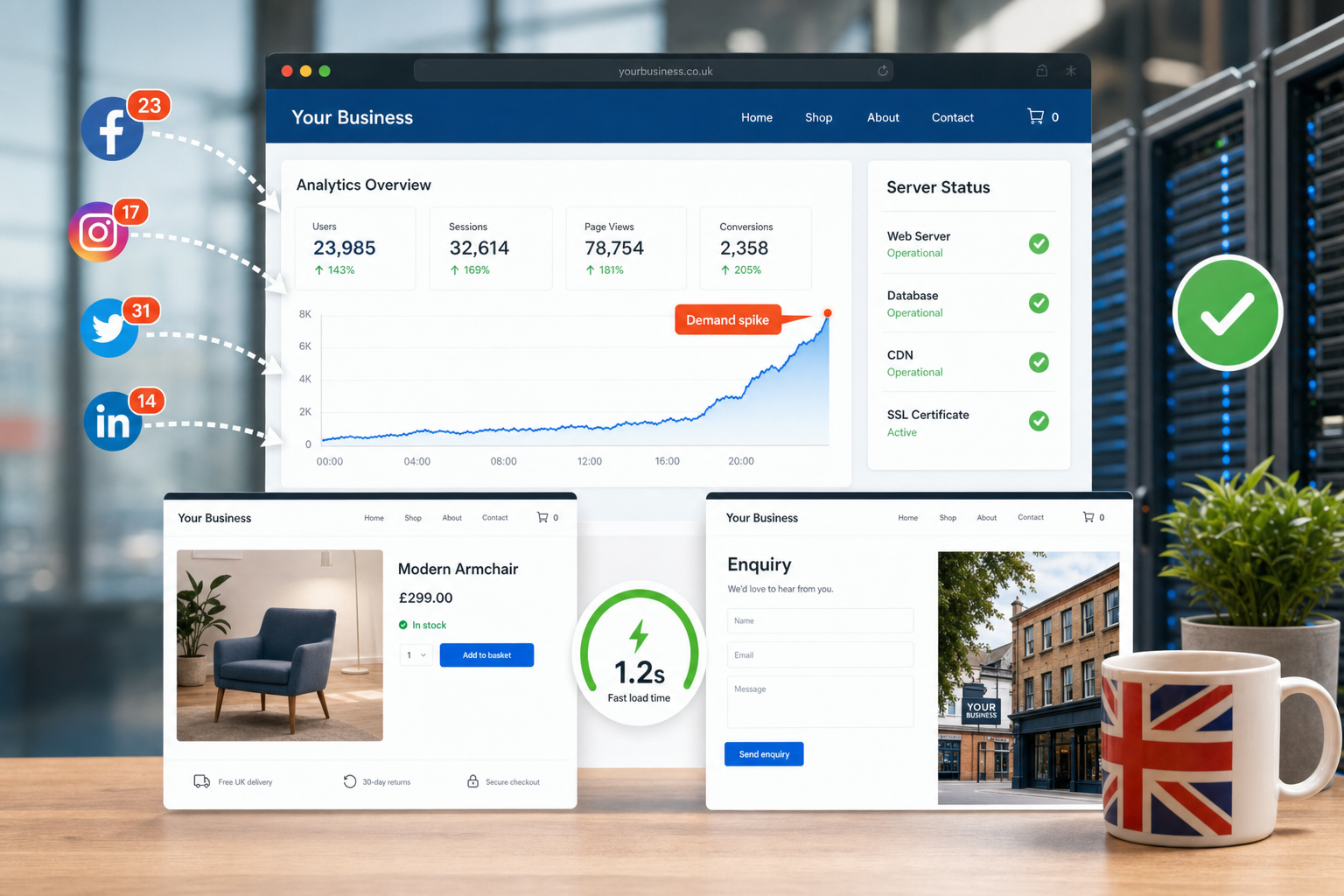
When online demand rises suddenly, a business website can move from steady trading to intense pressure in a matter of hours. A successful social media post, seasonal campaign, local news mention, email promotion or shift in customer behaviour can all send more people to your site than usual. That extra attention is valuable, but only if your website is ready to serve visitors quickly, clearly and reliably.
For UK business owners, website demand spikes are not simply a technical concern. They affect customer confidence, sales, enquiry quality, advertising performance and brand perception. If a page loads slowly, breaks on mobile or shows limited availability without clear messaging, the opportunity can be lost. If the site remains fast, well structured and easy to use, a short burst of demand can become a genuine business advantage.
Why website demand spikes matter for business performance
A demand spike is a sharp increase in visitors, page views or customer actions over a short period. It may come from a planned campaign, such as a product launch or seasonal promotion, or from something less predictable, such as a social post being shared widely. In 2020, many businesses are also seeing online behaviour change quickly as customers research, book, order and communicate more through digital channels.
The challenge is that many websites are built for average use rather than peak demand. A site that appears to perform well on a quiet Tuesday morning may struggle when hundreds or thousands of visitors arrive at once. Product pages may take longer to load, enquiry forms may fail, checkout steps may become sluggish and images may not display properly. Even if the site does not go offline completely, poor performance can quietly reduce conversions.
Speed and stability are important because online users have limited patience. A slow website can make a perfectly reputable business feel unreliable. Visitors may assume that a delayed checkout is unsafe, that a frozen booking form has not submitted, or that a blank page means the business is no longer operating. During a spike, those small moments of doubt can cost enquiries and sales.
There is also a marketing cost. If you are paying for traffic through search or social advertising, every visitor who leaves because the site is slow represents wasted spend. If a campaign is working well enough to create a spike, the website should be ready to make the most of that attention.
Common causes of slowdowns during busy periods
Website demand spikes often reveal issues that were already present but less visible. Understanding the most common causes helps business owners prioritise the right improvements.
Hosting that cannot cope with peak traffic
Hosting is the foundation of website performance. Basic hosting can be suitable for smaller brochure sites, but it may not be enough for e-commerce stores, booking systems or campaigns that attract bursts of traffic. During a spike, limited server resources can lead to slow response times, database errors or temporary downtime.
Businesses should review whether their hosting is appropriate for the site’s current role. A website that began as a simple online presence may now be handling orders, live stock information, customer accounts, downloadable resources and marketing landing pages. The hosting environment should match that responsibility.
Large images and heavy pages
Image quality matters in website design, especially for products, venues, portfolios and food, but large, unoptimised images can dramatically slow a site. A single oversized banner or gallery can add unnecessary weight to a page, particularly for mobile users on variable connections.
Before a promotion goes live, key landing pages should be reviewed for image size, compression and layout. Images should be sharp enough to support the brand, but not so large that they delay the visitor’s first interaction. Modern image formats can be useful where browser support is suitable, but reliable fallbacks remain important.
Too many scripts, plugins and third-party tools
Many websites rely on analytics, tracking pixels, live chat tools, review widgets, embedded maps, payment scripts and social media feeds. These can all be useful, but they also add requests and dependencies. If a page loads too many external scripts, it may become slower just when traffic is highest.
It is worth auditing third-party tools regularly. Ask whether each script has a clear business purpose, whether it is still needed and whether it loads in the most efficient way. During an important campaign, simplicity can be a strength.
Poor mobile experience
For many consumer-facing businesses, a demand spike will arrive largely through mobile. Social media traffic, local searches and email clicks are often mobile-led. If a site looks acceptable on desktop but is awkward on a phone, the business may lose the very audience the campaign has attracted.
Mobile performance is not only about screen size. Buttons need to be easy to tap, menus need to be clear, forms should be short, and key information should appear quickly. A beautiful design that makes customers pinch, zoom or hunt for the next step is not doing its job.
How website design supports stronger performance
Good website design is not simply about appearance. It should support speed, clarity, accessibility and conversion. During website demand spikes, design decisions become even more important because visitors need to understand the offer quickly and act with confidence.
A strong landing page should answer the visitor’s immediate questions: what is being offered, who it is for, why they should trust the business, and what they should do next. This is especially important when traffic comes from a social media post or advert. If the page does not clearly match the message that brought the visitor there, they are more likely to leave.
Navigation should be straightforward. Important pages such as delivery information, opening hours, booking details, returns, contact options and frequently asked questions should not be hidden. If demand is driven by a specific product or service, link directly to the relevant page rather than sending users to the homepage and expecting them to search.
Forms deserve particular attention. Enquiry, booking and checkout forms should request only the information required at that stage. Every unnecessary field adds friction. Clear confirmation messages are also essential, so users know their order, booking or enquiry has been received. During busy periods, duplicate submissions and confused follow-ups can create extra administration for the business.
Trust signals can also reduce hesitation. Clear contact details, secure checkout indicators, delivery information, reviews where appropriate, professional photography and consistent branding all help visitors feel they are dealing with a credible organisation. When traffic is arriving quickly, trust must be established quickly too.
Preparing your site before a campaign or seasonal rush
The best time to prepare for website demand spikes is before they happen. A short pre-campaign checklist can prevent many avoidable problems.
- Test key journeys: Visit the site as a customer would. Check the route from advert or social post to landing page, basket, checkout, enquiry or booking confirmation.
- Review page speed: Use performance testing tools such as PageSpeed Insights or Lighthouse to identify slow pages, oversized assets and render-blocking resources.
- Check mobile behaviour: Test pages on different screen sizes and connections. Pay close attention to menus, forms, buttons and payment steps.
- Optimise images: Compress large visuals, serve appropriately sized images and avoid uploading full-resolution files where they are not needed.
- Update software safely: Keep the content management system, plugins and themes maintained, but avoid making major untested changes immediately before a launch.
- Confirm tracking: Ensure analytics, conversion goals and advertising tracking are working so you can understand what happened during the spike.
- Prepare content: Write clear stock, delivery, booking or availability messages in advance, particularly if demand may outpace supply.
For e-commerce sites, stock handling is especially important. If a product may sell out, the page should explain what happens next. Can customers join a waiting list? Is there an alternative? Will there be more stock soon? A thoughtful message can preserve goodwill even when the customer cannot buy immediately.
For service businesses, capacity is the equivalent of stock. If appointment slots, consultations or installation dates become limited, your website should manage expectations clearly. A well-written form, automatic confirmation and sensible follow-up process can help turn high demand into organised enquiries rather than missed opportunities.
The role of SEO during demand spikes
Search engine optimisation is often associated with long-term growth, but it also matters during periods of sudden demand. If people are searching for your brand, products, services or local availability, your website should make it easy for search engines and users to find the right information.
Page titles, meta descriptions, headings and on-page copy should accurately reflect the content. For example, if a bakery is promoting local delivery, the relevant page should make the location, service and ordering process clear. If a consultancy is running a webinar or downloadable guide, the landing page should be specific rather than vague.
Local SEO is particularly valuable for UK businesses serving a defined area. Keep opening hours, contact details and service information consistent across your website and local listings. If temporary changes apply, update them promptly. Customers searching on mobile may be ready to call, visit, book or order immediately, so accuracy is essential.
Technical SEO also supports performance. Search engines need to crawl and understand pages efficiently. Clean internal linking, sensible redirects, a clear sitemap and well-structured content all help. During a demand spike, avoid creating rushed duplicate pages or thin landing pages that confuse users and dilute search visibility.
It is also sensible to monitor Google Search Console around campaign periods. Search queries, indexing issues and mobile usability reports can highlight opportunities or problems that may not be obvious from analytics alone.
Social media can create demand faster than your site expects
Social media marketing can generate traffic very quickly. A timely Instagram post, Facebook update, LinkedIn article or tweet can encourage a surge of visits within minutes. Paid social campaigns can do the same at a larger and more predictable scale. This speed is one of social media’s strengths, but it also places pressure on the destination page.
Before publishing a post that is likely to attract attention, check that the linked page is ready. The message on the page should match the message in the post. If the post promotes a specific offer, the page should not make visitors search for it. If the post answers a common question, the page should continue that helpful tone.
It is also worth planning customer service responses. When a campaign performs well, comments, direct messages and email enquiries may increase alongside website visits. Clear website information can reduce repetitive questions, while prepared replies can help the team respond consistently.
Social proof can be powerful, but embedded feeds and heavy widgets should be used carefully. If including social content slows an important landing page, consider whether a static testimonial, image or concise quote would do the job more efficiently.
Domain names, branding and customer confidence
Your domain name plays a quiet but important role during online demand spikes. When more people are seeing your links in search results, social posts, adverts and email campaigns, the domain should look trustworthy, memorable and consistent with your brand.
Choose a domain that is easy to spell, say and recognise. Avoid unnecessary hyphens, confusing abbreviations or names that are too close to another organisation’s brand. For UK-facing businesses, consider whether a UK-focused domain, a broader international option, or both, best suits your audience and future plans.
Businesses should also protect key variations where sensible, particularly if the brand is being promoted widely. This may include common spelling variations or relevant domain extensions. The aim is to reduce customer confusion and protect the brand, not to collect domains without a clear reason.
Keep domain registration details, renewal settings and administrative access well managed. A lapsed domain can cause serious disruption, especially during a busy trading period. Access should not depend on one person’s personal email account, and responsibilities should be documented so the business can act quickly if changes are needed.
Measuring what happens when demand rises
A demand spike should teach you something useful. Analytics can show which channels drove traffic, which pages received the most visits, where users dropped out and which devices were most common. This information helps improve future website design, SEO, content and advertising decisions.
Look beyond total visitor numbers. A large increase in traffic is encouraging, but conversion behaviour matters more. Did users complete forms? Did checkout abandonment rise? Did mobile users perform differently from desktop users? Did a particular page load slowly or attract high exits? These details point towards practical improvements.
Server logs and hosting reports can also be helpful. They may show whether performance problems were linked to traffic volume, database load, bots, image requests or specific pages. If you work with a web development or digital marketing partner, sharing this information can make troubleshooting more accurate.
After the spike, hold a short review. Identify what worked, what broke, what customers asked and what should be improved before the next campaign. This turns a busy period into a learning opportunity rather than a one-off event.
Building a resilient digital presence
Website demand spikes are a sign that people are paying attention. The goal is not to fear them, but to prepare for them. A resilient website combines reliable hosting, efficient design, clear content, sensible tracking, strong SEO foundations and marketing activity that sends users to the right place.
For many UK businesses, the website is now central to sales, enquiries, bookings and customer communication. That makes performance a commercial issue as much as a technical one. When your site loads quickly, explains clearly and handles increased demand, your marketing has a stronger chance of turning interest into action.
If you are planning a campaign, launching a new service, refreshing your brand or expecting seasonal demand, review your website before traffic rises. A focused performance check can uncover issues while there is still time to fix them. The businesses that benefit most from online attention are often those that have prepared quietly in advance.