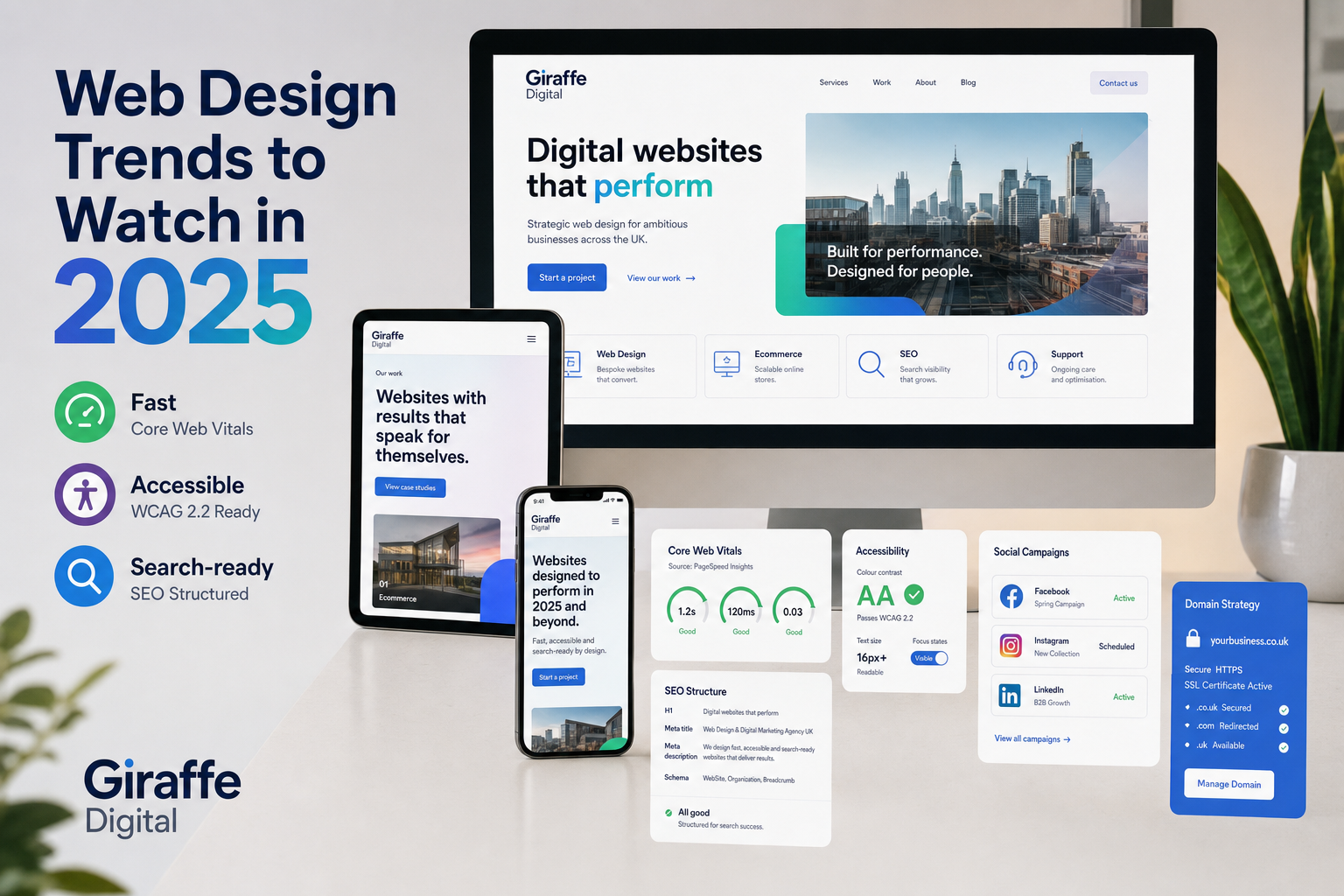
For UK business owners planning a new website, redesign or digital marketing programme this year, the Web Design Trends to Watch in 2025 are not just about visual style. They are about making websites faster, clearer, more trustworthy and easier to connect with search, social media and sales activity. Good design now has to support the full customer journey: being found, being understood, being trusted and being contacted.
The businesses that benefit most from modern website design will be those that balance creativity with commercial purpose. A striking layout can help your brand stand out, but it must also guide visitors towards useful information, remove friction on mobile devices, load quickly and support measurable marketing activity. The trends below are the ones most likely to matter for practical business value in 2025.
Design that puts clarity before decoration
Bold visuals still have a place, but website design in 2025 is moving towards clearer communication. Visitors are impatient, especially on mobile, and they need to understand what you offer within seconds. That means strong page hierarchy, concise headings, helpful calls to action and page sections that answer real customer questions.
For a service business, this might mean replacing a vague hero message with a clear statement of who you help, what you do and where you operate. For an e-commerce business, it may mean sharper product categories, better filtering and product pages that explain delivery, returns, materials and care instructions without forcing users to hunt for details.
Minimalism is not the same as emptiness. The best websites use space intentionally so that important content is easier to scan. This is particularly important for users comparing several suppliers. If your competitors explain their services more clearly, your design may be costing you enquiries, even if it looks impressive.
Performance-led design and Core Web Vitals
Fast websites remain a major priority in 2025. Speed affects user experience, conversion rates and search performance. It is no longer enough for a website to look polished on a designer’s large screen; it also needs to work well on everyday mobile connections, older devices and busy networks.
Performance-led design means making careful decisions about images, video, animation, tracking scripts, fonts and hosting. Large background videos, heavy sliders and unnecessary plug-ins can slow a website down. Used sparingly, motion can improve engagement. Used without restraint, it can create frustration and dilute the message.
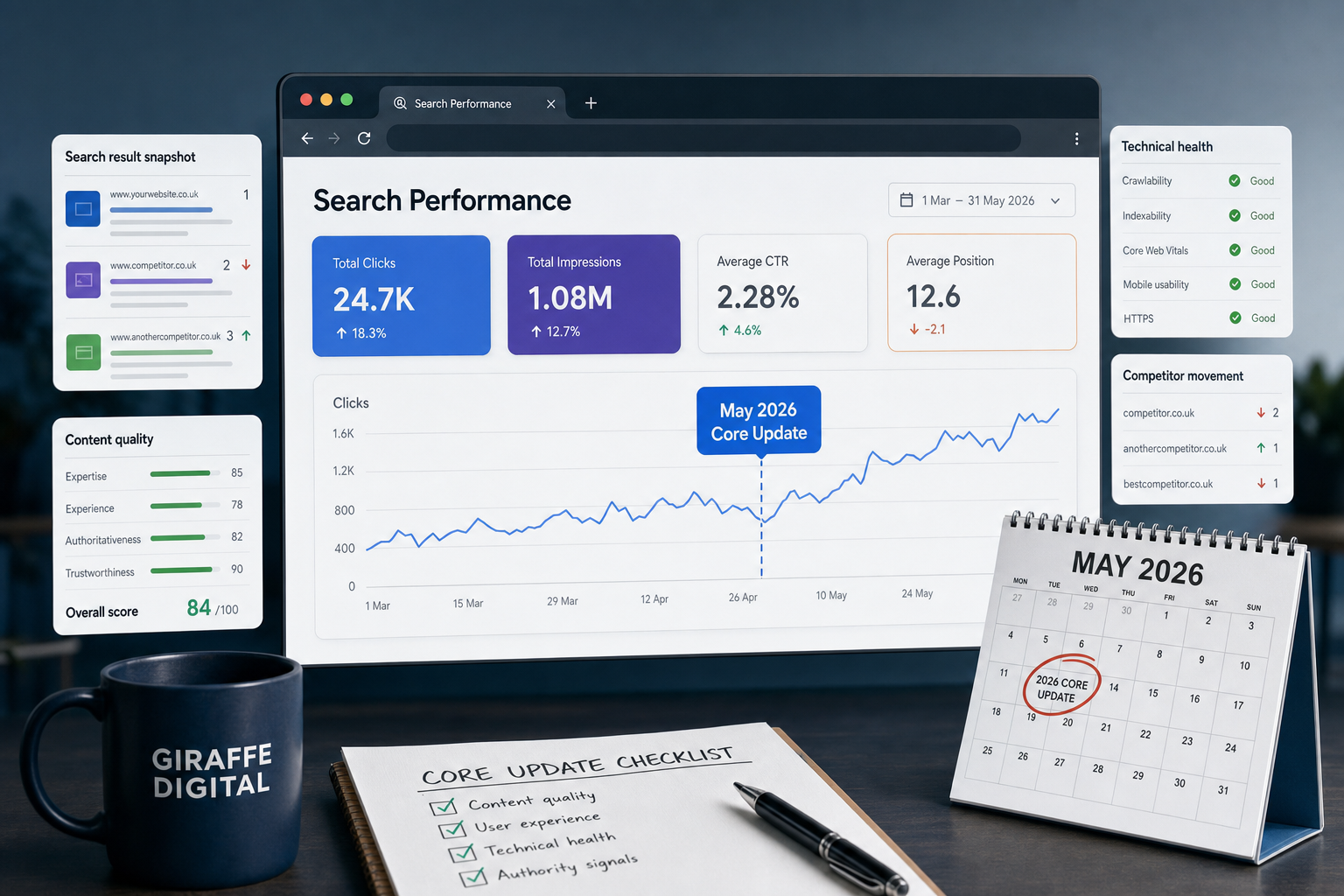
Core Web Vitals continue to shape how businesses think about page experience. In particular, Interaction to Next Paint has placed more emphasis on responsiveness: how quickly a page reacts when someone taps, clicks or types. A page that appears to load but feels sluggish can damage confidence and stop visitors from completing forms, browsing products or booking appointments.
Practical actions include compressing images, serving modern image formats where suitable, reducing unused code, limiting third-party scripts and reviewing hosting quality. Performance should be part of the brief from the start, not a final technical fix once the design is finished.
Accessibility as a standard, not an afterthought
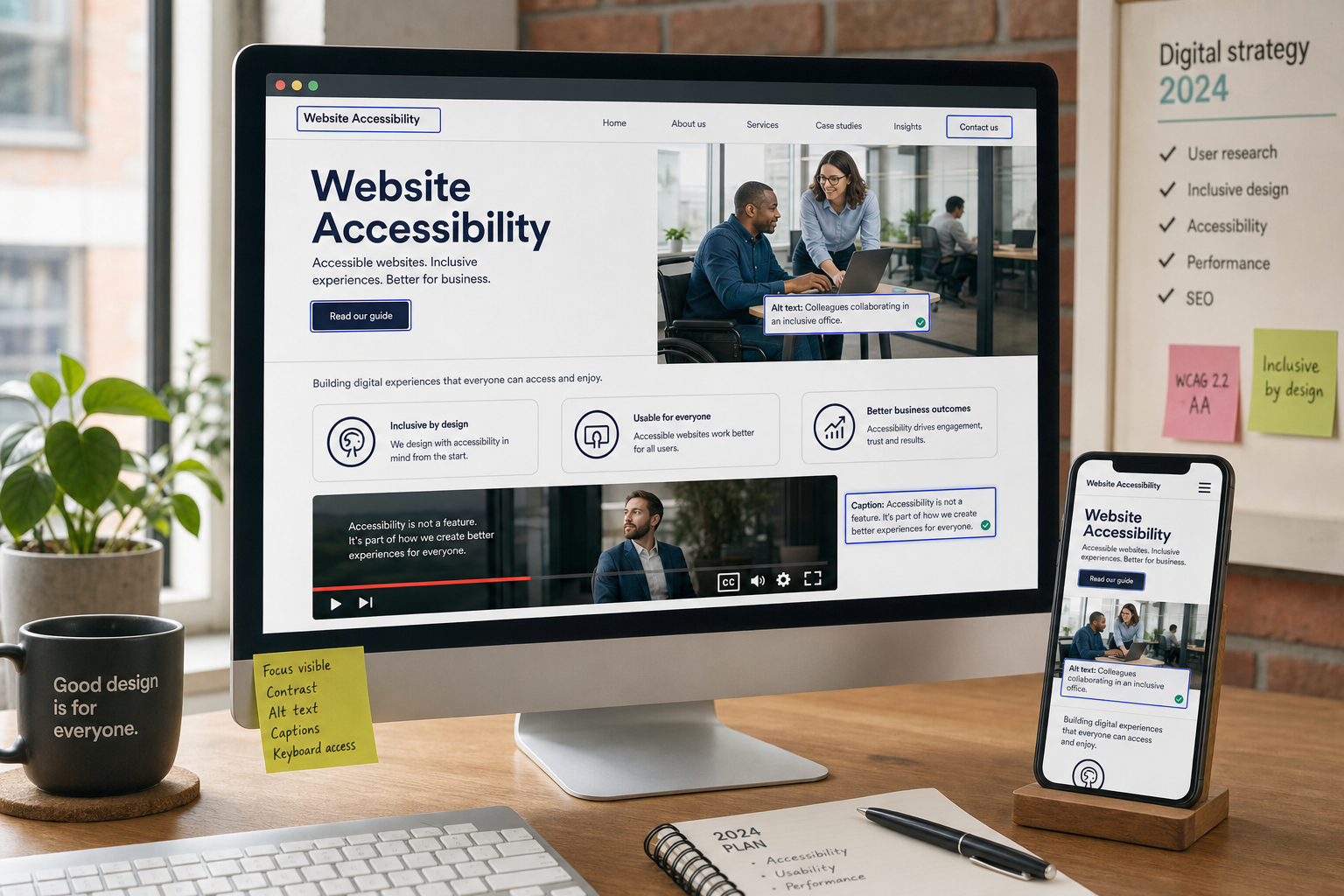
Accessible design is becoming a normal expectation for responsible organisations. It improves usability for people with disabilities, but it also benefits many other users: people browsing in bright sunlight, older customers, users with temporary injuries, people using mobile devices one-handed and anyone trying to complete a task quickly.
In 2025, businesses should be paying close attention to contrast, readable type sizes, keyboard navigation, meaningful link text, clear form labels and logical page structure. Accessibility guidance such as WCAG 2.2 provides a useful benchmark, but the commercial point is straightforward: if people cannot use your website easily, they are less likely to become customers.
Accessibility also supports SEO because well-structured pages are easier for search engines to interpret. Proper headings, descriptive alternative text and clear content relationships all help users and search systems understand what each page is about.
AI-assisted content without losing the human voice
AI tools are influencing website planning, content creation and customer service, but they should not replace expertise, brand judgement or quality control. The most useful approach is to use AI to support research, ideation, outlining and repetitive tasks, while keeping final content accurate, original and genuinely helpful.
For UK businesses, this is particularly important in sectors where trust matters, such as professional services, health, finance, education, property and technical B2B services. Visitors want to see real knowledge, practical detail and evidence that you understand their situation. Generic pages that could belong to any competitor will struggle to persuade.
AI can also support website personalisation, search functions, chat interfaces and content recommendations. However, these features should be introduced carefully. A chatbot that cannot answer basic questions, or sends users in circles, can do more harm than good. If automation is used, it should have clear boundaries, easy escalation to a human contact and accurate information about services, opening hours and next steps.
Brand storytelling with proof built in
Customers are increasingly cautious online. They want to know who is behind a business, what makes it credible and whether it can deliver. In 2025, strong website design is making more room for trust-building content: case studies, accreditations, staff expertise, process explanations, genuine testimonials, appropriate guarantees and clear contact details.
This does not mean cluttering every page with badges and claims. It means weaving reassurance into the experience. A landing page for a local trade business might show service areas, insurance information, recent project photos and a simple explanation of how quotes work. A consultancy might highlight sector experience, useful insights, speaker profiles and a transparent engagement process.
Photography and illustration also play a role. Stock imagery can still be useful in some contexts, but overly generic visuals weaken credibility. Bespoke photography, carefully chosen icons, brand-led illustrations and real project imagery can make a business feel more distinctive and trustworthy.
Search-focused website architecture
Search marketing is not something to add after a website goes live. The structure of a website affects how easily search engines and visitors can understand it. In 2025, businesses should be planning pages around real search intent: what prospective customers are looking for, what stage of the buying process they are in and what information will help them take the next step.
This often means creating focused service pages rather than relying on one broad services overview. For example, a company offering design, maintenance and digital marketing may need separate pages for each core service, with supporting articles that answer common questions. Local businesses may also need well-written location content that is genuinely useful rather than repetitive or thin.
Technical SEO should be considered alongside design. Clean navigation, crawlable links, descriptive page titles, structured headings, schema markup where relevant, sensible internal linking and well-managed redirects all protect long-term visibility. If an existing website is being redesigned, preserving valuable URLs and content should be part of the migration plan.
Connected social media and website journeys
Social media marketing and website design need to work together more closely. Many visitors now arrive after seeing a short video, a carousel post, a recommendation, a paid advert or a company update. The page they land on should continue the same message and make the next step obvious.
If a campaign on Instagram, LinkedIn, Facebook or TikTok promotes a specific service, offer, event or guide, sending visitors to a generic homepage can waste attention. A focused landing page with matching visuals, clear benefits, relevant proof and a simple form is usually more effective. This also makes performance easier to measure.
Websites should also provide content that can be repurposed for social media. Strong blog posts, project pages, FAQs, guides, team stories and product explainers can all become posts, short videos, email content and paid campaign assets. This gives businesses more value from each piece of content and keeps brand messaging consistent.
First-party data, privacy and better measurement
Privacy expectations continue to influence digital marketing. Businesses need to collect useful data while respecting consent and being clear about how information is used. A well-designed website should make privacy notices, cookie choices and contact preferences easy to understand.
First-party data is becoming more valuable. Email sign-ups, enquiry forms, account areas, downloadable resources, event registrations and customer surveys can help businesses build direct relationships rather than relying entirely on rented attention from social platforms or paid advertising.
Measurement also needs to be more thoughtful. Rather than focusing only on page views, businesses should track meaningful actions such as form submissions, phone clicks, quote requests, brochure downloads, newsletter sign-ups and e-commerce revenue. Good design makes these actions easy to complete; good analytics helps you understand which channels and pages are contributing to them.
Domain strategy and brand protection
Domain registration is often treated as a small administrative task, but it can have long-term brand and marketing implications. A strong domain should be easy to spell, easy to say aloud and closely aligned with the business name. For UK organisations, it is sensible to consider relevant UK domain options as well as broader alternatives if the business has international ambitions.
When choosing a domain, avoid confusing spellings, unnecessary hyphens and names that are too close to another organisation’s brand. If you are launching a new business, check domain availability early in the naming process so that your brand, website and email addresses can work together neatly.
It may also be worth registering common variations to protect the brand and reduce the risk of customer confusion. These can redirect to the main website where appropriate. Keep ownership details, renewal dates and access credentials well managed, especially if multiple people or suppliers are involved. Losing control of a domain can disrupt email, search visibility and customer trust.
Flexible technology choices
The best website platform depends on the business model, internal team and growth plans. Some organisations need an easy-to-manage content management system. Others need e-commerce capability, booking tools, gated content, integrations with customer relationship management software or multilingual content.
In 2025, flexibility matters. A website should be built in a way that allows content updates, campaign landing pages, SEO improvements and future integrations without requiring a full rebuild each time. That does not always mean choosing the most complex technical solution. For many small and medium-sized businesses, the right answer is a stable, well-supported platform configured properly.
Before commissioning a website, ask practical questions. Who will update the content? What integrations are needed? How will forms be handled? What security and backup processes are in place? Can the site scale if traffic grows? How easy is it to add new service pages, blog posts or product categories? These answers will shape the long-term value of the project.
More sustainable digital design
Sustainability is increasingly relevant to digital projects. Websites use energy through hosting, data transfer and device processing. While a single page may seem small, unnecessary page weight across thousands of visits adds up. Lighter, faster websites can support environmental goals while also improving performance.
Sustainable web design often overlaps with good user experience: optimised images, efficient code, fewer unnecessary scripts, careful use of video and clear journeys that help users find information quickly. Businesses that already communicate environmental responsibility should make sure their website does not undermine that message with bloated pages and wasteful design choices.
How to prioritise these trends for your business
Not every trend needs to be adopted at once. The right priorities depend on your goals. If your website receives traffic but few enquiries, focus on conversion, clarity and trust signals. If your search visibility is weak, look at site structure, content quality and technical SEO. If your brand feels dated, review the visual identity, photography, messaging and page design. If social media drives attention but not action, improve landing pages and campaign tracking.
A useful starting point is to audit your current website against a few simple questions:
- Can visitors understand what we do within a few seconds?
- Does the website load quickly and respond smoothly on mobile devices?
- Are our most important services or products easy to find?
- Do our pages answer the questions customers ask before they buy?
- Is the brand credible, current and consistent across the website and social media?
- Are enquiries, purchases or bookings easy to complete?
- Do we know which marketing channels are generating valuable leads?
The most effective websites in 2025 will combine design, content, technology and marketing strategy. They will not simply look modern; they will help businesses communicate clearly, earn trust and turn attention into action.
A successful website should feel effortless to the visitor, but that ease comes from careful planning: clear messaging, accessible design, strong technical foundations and marketing activity that works together.
For business owners, the opportunity is to treat a website as an active growth asset rather than a static brochure. By focusing on the web design trends in 2025 that improve usability, visibility, credibility and measurement, your website can support better enquiries, stronger campaigns and a more confident digital presence.