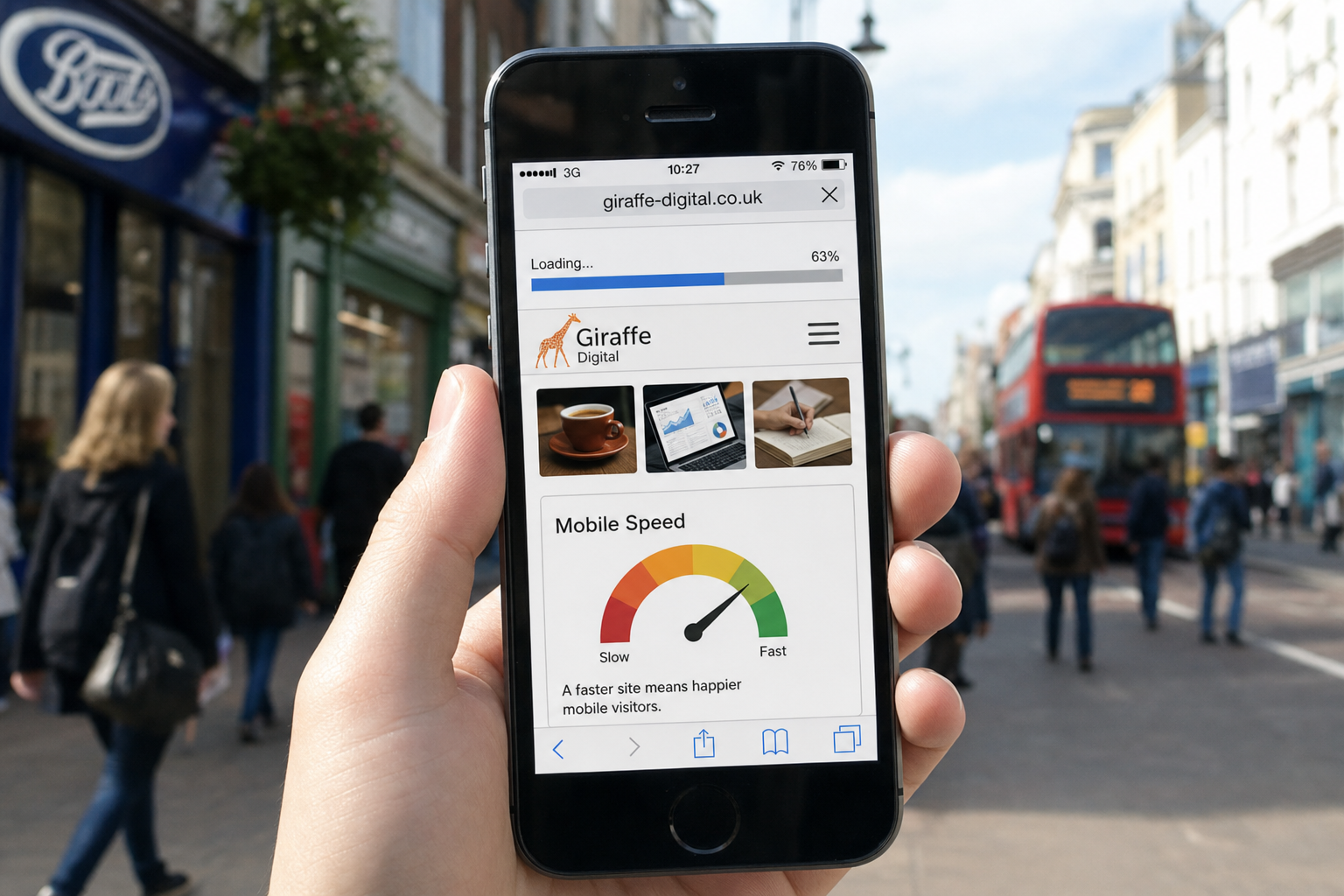
Mobile visitors are no longer a small side audience for most UK businesses. Customers use phones to compare services on the train, check opening hours in a car park, read reviews outside a shop and click through from social media while watching television. If your website is slow on a mobile connection, many of those visits will end before your message has had a chance to work.
Mobile website speed is not just a technical nicety. It affects how people experience your brand, how likely they are to make an enquiry, and how confidently search engines can recommend your pages to mobile users. A site that looks polished on a desktop computer can still feel frustrating on a phone if it takes too long to load over 3G, weak Wi-Fi or a congested network.
Mobile users are often impatient because their situation demands it
When somebody visits your website from a desktop computer, they may be sitting at a desk with a stable broadband connection and time to browse. Mobile visitors are often in a very different frame of mind. They may be walking between meetings, looking for a telephone number, checking whether you serve their area, or deciding whether to visit your premises. Their intent can be strong, but their patience is often limited.
A slow website creates small moments of doubt. Has the page broken? Is the business still active? Will the contact form work? Is there a quicker competitor? These questions are rarely spoken aloud, but they shape behaviour. If a page feels heavy, confusing or unresponsive, a visitor can return to the search results or social feed in seconds.
This is particularly important for local and service-led businesses. A mobile visitor may want to call a solicitor, book a table, request a quote, find a showroom or check delivery information. The faster your site presents useful information, the more likely that visitor is to take the next step.
Speed influences trust, enquiries and sales
Your website is often the first practical demonstration of how organised and attentive your business feels. A quick, clear mobile experience suggests reliability. A slow one can make even a reputable organisation feel behind the times.
For an e-commerce website, speed can have a direct effect on revenue. Product images, filters, basket pages and checkout steps all need to work smoothly on a phone. If each step is delayed, the customer has more opportunities to abandon the purchase. For brochure websites, the effect may be less visible but still important. Slow pages can reduce form submissions, telephone calls, appointment bookings and newsletter sign-ups.
It is worth remembering that a mobile visitor may have reached your site after seeing a post on Facebook, Twitter, LinkedIn, Google+ or another social platform. Social media browsing is fast and casual. If the landing page takes too long to appear, the user can easily return to the feed. In that situation, the cost is not only a lost visit; it is a lost opportunity to turn interest into action.
Mobile speed and search visibility in 2015
Search engines want to send users to pages that answer their query and work well on the device being used. Mobile friendliness is now an important consideration for businesses that rely on organic search, and user experience is part of the wider quality picture. A website that is difficult to use on a phone is less competitive than one that presents relevant content quickly and clearly.
Google has been placing increasing emphasis on mobile-friendly pages, and UK businesses should treat mobile performance as part of search marketing rather than as a separate technical concern. A slow mobile website can weaken the value of good content, well-written page titles and strong local relevance because users may leave before engaging.
This does not mean speed alone will make a poor page rank well. The fundamentals still matter: useful content, clear page structure, descriptive titles, sensible internal linking, genuine authority and a website that answers real customer questions. However, if two businesses offer similar relevance, the one with the cleaner and faster mobile experience is in a stronger position to satisfy visitors.
What makes a mobile website slow
Mobile speed problems usually come from a combination of design choices, technical decisions and content management habits. A page may not feel heavy when tested on office broadband, but the same page can struggle on a mobile signal.
Large images
Images are one of the most common causes of slow pages. A full-width banner image saved at an unnecessarily large size can add significant weight before the visitor has even reached your main message. Product photographs, team images and gallery pages can also become slow if every image is uploaded straight from a camera without proper resizing and compression.
Good website design should balance visual quality with performance. Images should be large enough to look professional on modern screens, but not so large that they delay the page. For mobile layouts, consider whether every decorative image is truly needed.
Too many scripts and add-ons
Modern websites often rely on scripts for sliders, maps, analytics, social sharing buttons, forms, tracking and interactive elements. Some are useful, but too many can slow a page down or delay important content. A homepage with a rotating banner, several embedded social feeds, a map, multiple tracking tags and heavy animation may look lively but perform poorly on a mobile connection.
Every additional feature should earn its place. If an element does not help the visitor understand your offer or take action, consider removing it or moving it to a more appropriate page.
Overcomplicated design
A mobile website should not simply be a squeezed version of the desktop experience. Responsive design can work very well, but only when the layout is planned carefully. Large navigation menus, multi-column sections, background videos and complex forms can become awkward and slow on smaller screens.
Practical mobile design means prioritising. What does the visitor need first? Usually, it is a clear headline, a short explanation, contact details, a call button, location information or a simple enquiry route. The rest can follow in a logical order.
Poor hosting and configuration
The server behind your website also matters. If the hosting environment is slow to respond, even a well-designed page can feel sluggish. Caching, file compression and efficient website code can all help reduce loading time. These are not glamorous subjects, but they support every marketing activity that sends traffic to your site.
Practical steps to improve mobile website speed
Improving speed does not always require a complete rebuild. Many businesses can make meaningful gains by reviewing the pages that matter most and removing unnecessary weight.
- Test on real devices. Do not rely only on your office computer. Check key pages on a smartphone using mobile data as well as Wi-Fi.
- Focus on important pages first. Start with the homepage, main service pages, product categories, contact page, landing pages and checkout or enquiry forms.
- Compress and resize images. Upload images at sensible dimensions and use appropriate file formats for photographs, graphics and logos.
- Reduce clutter. Remove unnecessary sliders, oversized banners, duplicate calls to action and widgets that do not support the visitor journey.
- Simplify forms. On mobile, ask only for the information you genuinely need at the first point of contact.
- Use clear calls to action. Make phone numbers, enquiry buttons and location details easy to find and easy to tap.
- Review third-party scripts. Keep useful analytics and marketing tools, but remove old tracking codes and abandoned plugins.
- Check technical basics. Browser caching, compressed files and clean code can all improve the way pages load.
Tools such as Google PageSpeed Insights and mobile-friendly testing can provide useful pointers, but they should not replace human judgement. A score is helpful, yet the real question is whether a customer can quickly understand who you are, what you offer and how to act.
Designing for mobile visitors from the start
The best mobile performance usually comes when speed is considered at the planning stage. If a website is designed first for a large screen and then adjusted afterwards, mobile users may be left with compromises. A better approach is to think about content hierarchy, navigation and calls to action early in the website design process.
For a service business, this might mean placing a concise, benefit-led introduction near the top of each page, followed by a prominent enquiry button and supporting trust signals. For a local retailer, it may mean making opening times, address, telephone number and key product categories easily accessible. For a professional organisation, it may mean simplifying long pages into clear sections that load efficiently and read well on a phone.
Typography also matters. Text should be readable without pinching and zooming. Buttons should be large enough to tap accurately. Menus should be simple. These design decisions help both speed and usability because they encourage a leaner, more deliberate page.
Connecting speed with social media marketing
Social media campaigns often create short bursts of attention. A seasonal offer, blog post, competition, event announcement or new product launch can bring mobile visitors to your website quickly. If the landing page is slow, that attention is wasted.
Before promoting a page through social media, test it on a phone. Does it load quickly enough? Is the headline visible without delay? Does the image support the message without being too heavy? Is there a clear next step? A strong social post and a slow landing page are pulling in opposite directions.
It is also sensible to match the page to the platform. A visitor arriving from a short social update may not want to read a lengthy corporate page before seeing the offer or information promised. Speed is not just about files and servers; it is also about how quickly the page satisfies the expectation created by the marketing message.
Domain choices and mobile confidence
Domain registration is not usually discussed alongside website speed, but it is part of the wider trust picture. A clear, memorable domain name helps mobile users recognise your business and return to your website without friction. On a small keyboard, long or confusing domains are easier to mistype and harder to share verbally.
For UK businesses, a relevant UK domain can help reinforce location and credibility. Keep the name as short and clear as possible, avoid unnecessary hyphens where you can, and choose a spelling that matches your brand. If your business name is difficult to spell, consider whether supporting domains are needed to protect common variations, while ensuring your main website has one clear primary address.
From a search and branding perspective, consistency is important. Use the same domain across your printed materials, email signatures, social profiles and directory listings. A fast website on a clear domain gives visitors fewer reasons to hesitate.
Measuring the business value of speed
Website speed should be measured in commercial terms, not only technical terms. Analytics can help you compare mobile and desktop behaviour, including bounce rate, pages viewed, enquiry completions and sales. If mobile users leave more quickly than desktop users, speed and usability are sensible areas to investigate.
Look at your most important journeys. How many steps does it take to contact you? How long does the checkout take? Can a visitor move from a social media post to a useful page without confusion? Do key landing pages work on slower connections? These questions connect technical performance with real business outcomes.
It is also useful to review speed after publishing new content or adding new features. A website can begin well and gradually become slower as more images, plugins, scripts and tracking codes are added. Treat performance as an ongoing part of website management rather than a one-off launch task.
A faster mobile website supports every part of your digital strategy
Mobile website speed strengthens search marketing, improves the return from social media, supports paid campaigns and helps visitors feel confident about your brand. It makes your content easier to reach and your calls to action easier to complete.
For UK business owners planning a new website or reviewing an existing one, speed should be part of the brief from the beginning. Ask how the design will work on real mobile connections, how images will be handled, how forms will behave, and how performance will be maintained after launch. A beautiful website that loads slowly is not working as hard as it should.
The businesses that take mobile performance seriously are not simply chasing a technical score. They are respecting the time, attention and circumstances of their customers. In a competitive online market, that respect can be the difference between a missed visit and a valuable enquiry.