Trust has always influenced whether people buy, enquire or leave a website, but it is becoming even more important for UK businesses competing online. Visitors make quick judgements about whether a business looks genuine, reliable and safe to contact. Search engines also use a range of quality indicators to understand whether a website deserves visibility. This means website trust signals are not just design extras; they are practical business assets that can affect enquiries, sales, search performance and brand reputation.
For a small business, professional services firm, retailer or local organisation, the challenge is simple: your website needs to reassure people before they have spoken to you. A visitor may have found you through Google, a social media post, a referral or an advert, but they will still look for signs that confirm you are credible. If those signs are missing, unclear or inconsistent, they may choose a competitor that feels safer and more established.
What are website trust signals
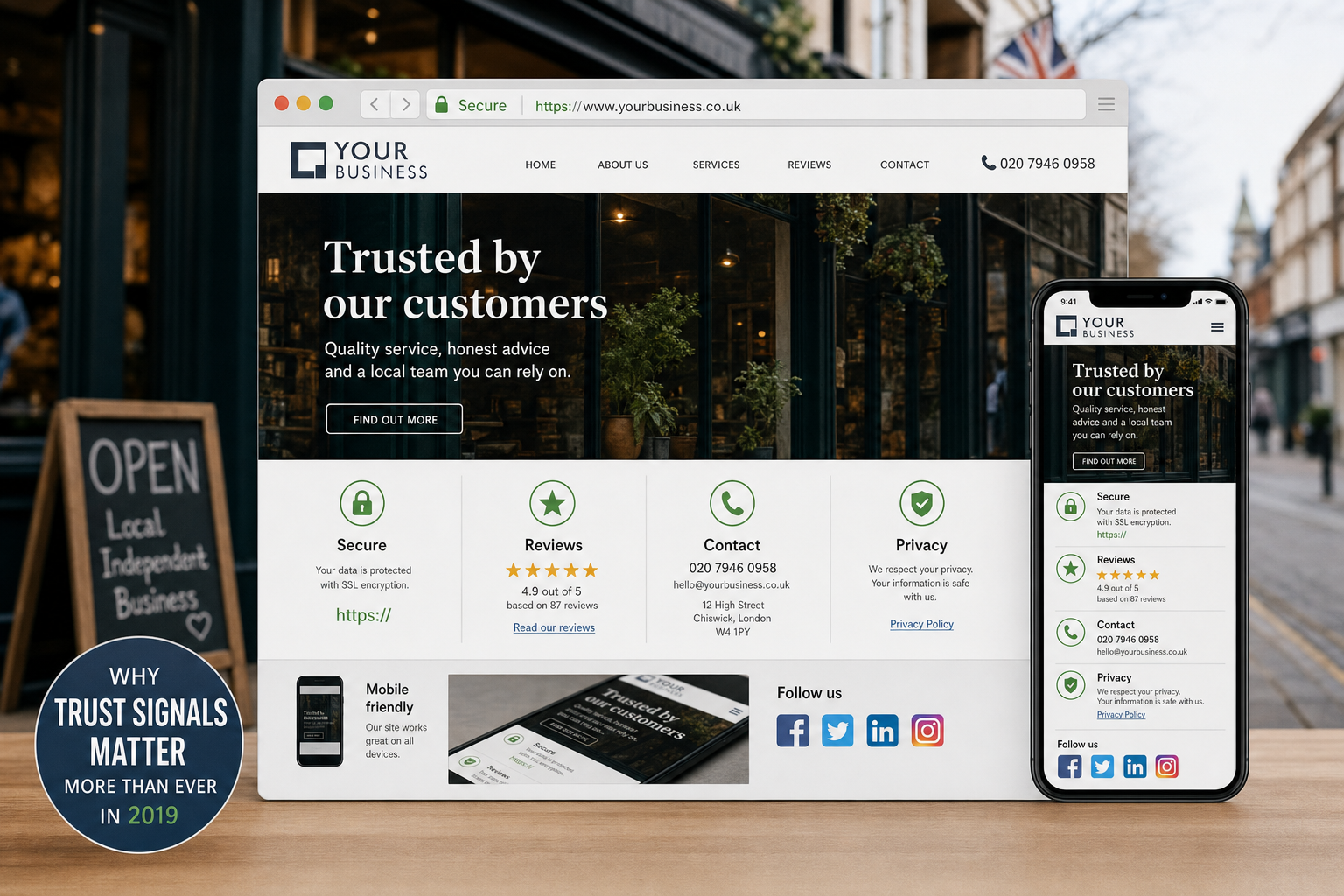
Website trust signals are the visible and technical cues that help visitors believe a website is legitimate, secure and worth engaging with. Some are obvious, such as customer testimonials, contact details, secure payment information and professional branding. Others are less visible, such as a properly configured secure connection, consistent domain registration details, fast-loading pages and clear privacy information.
Trust signals work together. A modern design can make a strong first impression, but if there is no telephone number, no company information and no secure connection, that impression quickly weakens. Equally, a business may have strong reviews and years of experience, but if its website looks neglected or performs poorly on mobile, visitors may question whether the company is still active.
The strongest websites combine visual reassurance, useful content, technical reliability and transparent communication. They do not force visitors to guess who is behind the site, what the business does, where it operates or how to make contact.
Why trust matters more for search and conversions
Website trust signals matter because online users have become more selective. People compare multiple businesses before making decisions, particularly for purchases or services that involve cost, risk or personal information. A visitor looking for a solicitor, accountant, builder, marketing agency, holiday provider or healthcare service is unlikely to convert if the website raises doubts.
Trust also supports conversion rate optimisation. Increasing traffic is useful, but traffic alone does not generate value. If visitors arrive and leave because the site feels dated, unclear or insecure, the marketing budget is being wasted. A trusted website gives people enough confidence to take the next step, whether that is calling, completing a form, booking an appointment or making a purchase.
From an SEO perspective, search engines are increasingly focused on quality, relevance and user satisfaction. Google’s guidance has long encouraged useful, authoritative content and a positive user experience. While no single testimonial or badge will guarantee rankings, a trustworthy website is more likely to earn engagement, links, mentions and repeat visits. These all support a stronger digital presence over time.
There is also a reputational benefit. A business with consistent trust signals across its website, social media profiles and wider online listings appears more professional. That consistency helps potential customers feel they are dealing with a real organisation rather than a disconnected or neglected online presence.
Design trust signals visitors notice immediately
Design is often the first trust signal people encounter. Before they read a paragraph or compare services, visitors respond to layout, imagery, typography and ease of use. A website does not need to be flashy, but it must feel current, clear and appropriate for the audience.
Professional visual identity
A consistent logo, colour palette and type style help a website feel established. Inconsistent branding can make a business look as though it has been assembled in a hurry. This is particularly important when visitors arrive from social media or search results; the brand they see on the website should match what they have seen elsewhere.
High-quality imagery also matters. Authentic photos of premises, team members, products or projects can be powerful, especially for local and service-based businesses. Generic stock photography is not always a problem, but if it is overused or irrelevant, it can reduce confidence. Visitors want to understand who they are dealing with.
Clear navigation and page structure
A trustworthy website makes information easy to find. Main services, contact details, about information, case studies, FAQs and policies should not be hidden. If a visitor has to work too hard to understand the offer, they may assume the business is disorganised.
Clear headings, short paragraphs and logical calls to action are particularly important on mobile devices. With more users browsing on smartphones and search engines placing greater emphasis on mobile-friendly websites, a site that works well on smaller screens is now a basic expectation rather than a bonus.
Visible contact details
Contact information is one of the simplest and most effective website trust signals. A telephone number, email address, enquiry form, business location and opening hours can all help reassure visitors. For businesses that serve a local area, showing a real location or service region can also support local SEO and make the organisation feel more accessible.
Forms should be straightforward and should explain what happens after submission. If a form asks for sensitive information without explanation, users may hesitate. A short message such as We will only use these details to respond to your enquiry can reduce uncertainty.
Technical trust signals: security, speed and reliability
Technical details may not be as visually obvious as design, but they strongly influence trust. A website that triggers browser warnings, loads slowly or breaks on mobile will quickly lose credibility.
Secure browsing with HTTPS
HTTPS is now a core expectation for business websites. A secure connection helps protect information exchanged between the visitor and the site, and modern browsers clearly indicate whether a page is secure. If a website collects enquiries, logins, bookings or payments, secure browsing is essential. Even for brochure websites, HTTPS supports professionalism and user confidence.
Visitors do not need to understand the technical details to notice a warning in the address bar. If a browser marks a site as not secure, some users will leave immediately. For that reason, SSL certificate configuration and regular checks should be treated as part of website maintenance.
Fast, stable performance
Page speed affects both user experience and search performance. A slow site can feel unreliable, especially on mobile connections. Large image files, poor hosting, unnecessary scripts and outdated website software can all contribute to delays.
Improving speed is not just a technical exercise. It has a direct commercial impact. If a visitor is comparing several suppliers and one website loads quickly while another feels sluggish, the faster site may win the enquiry simply by reducing friction.
Reliable mobile experience
Mobile-friendly design is now fundamental. Buttons need to be easy to tap, text should be readable without zooming, and forms should be simple to complete. A website that looks professional on desktop but awkward on mobile sends a mixed message. For many businesses, mobile traffic represents a significant share of visitors, particularly from local search and social media.
Testing across common devices and browsers is a useful habit. It helps identify issues that may not be visible in the office but could be costing enquiries from real users.
Content signals that prove expertise
Trust is built through what a business says as well as how the website looks. Useful, accurate and specific content helps visitors understand whether the organisation is the right fit for their needs.
Clear service information
A trusted website explains services in plain English. It should avoid vague claims and instead answer practical questions: what does the business provide, who is it for, what problems does it solve and what should the customer do next?
For example, a professional services firm may explain the stages of its process, the types of clients it supports and the information needed for an initial consultation. A trades business might show examples of previous work, explain service areas and outline how quotes are arranged. These details make the website more useful and more credible.
About pages with real substance
An About page is often one of the most visited pages on a business website. It should do more than state that the company is passionate and customer-focused. Visitors want to know who is behind the organisation, how long it has been operating, what experience it has and what values guide its work.
Team profiles, qualifications, memberships and accreditations can all support trust where relevant. However, they should be accurate and kept up to date. Outdated staff pages or expired accreditation references can have the opposite effect.
Helpful blog and advice content
Publishing useful articles can demonstrate expertise, support SEO and give social media channels something meaningful to share. The best content answers real customer questions rather than simply promoting services. Guides, checklists, explanations and opinion pieces can all help a business become more visible and more trusted.
Quality matters more than volume. A small number of well-written, relevant articles is usually more valuable than a large archive of thin or duplicated content. Each article should have a clear purpose and should reflect the knowledge of the business.
Social proof and reputation signals
Social proof is one of the most persuasive categories of website trust signals. People often feel more confident when they can see that others have had a positive experience with a business.
Testimonials and reviews
Testimonials should be specific, genuine and relevant. A quote that explains what problem was solved or what result was achieved is more useful than a generic statement such as Great service. Where possible, include a name, business type or location, provided the customer has given permission.
Reviews from recognised platforms can also support trust, particularly for local businesses, hospitality, retail and service providers. If reviews are displayed on a website, they should be presented honestly. Avoid editing them in a way that changes meaning, and do not create fake reviews. Short-term manipulation can cause long-term reputational damage.
Case studies and portfolio examples
Case studies help visitors see how a business works in practice. They do not need to reveal confidential information or make exaggerated claims. A useful case study can explain the challenge, the approach and the outcome in a clear, factual way.
For creative, construction, marketing and consultancy businesses, portfolio examples can be especially reassuring. They show evidence of capability rather than asking visitors to rely on promises alone.
Active social media presence
Social media can reinforce website trust when profiles are consistent, active and professional. Platforms such as Facebook, Instagram, Twitter and LinkedIn are commonly used by UK businesses to share updates, advice, reviews, behind-the-scenes content and customer service messages.
A neglected profile can create uncertainty, especially if the most recent post is years old. Businesses do not need to be everywhere, but they should maintain the channels they choose. Linking from the website to relevant social profiles can help visitors verify that the organisation is active and engaged.
Consistency is important. Logos, descriptions, opening hours, contact details and website links should match across profiles and directories. Inconsistent information can confuse users and weaken local search signals.
Domain and business identity signals
A domain name is a small but important part of online trust. It appears in search results, adverts, email addresses and browser bars, so it should be clear, memorable and appropriate for the business.
UK businesses should choose a domain that reflects their brand and is easy to spell. Where possible, avoid unnecessary hyphens, confusing abbreviations or wording that could be mistaken for another organisation. A relevant domain helps customers remember the website and reduces the risk of mistyped visits.
It is also sensible to keep domain registration details, renewal settings and administrative access well organised. Losing control of a domain can interrupt email, website access and marketing activity. Business owners should know who manages their domain, when it renews and which email address receives important notices.
Where privacy options are available and appropriate, businesses should consider how their details are displayed publicly. The key point is to balance transparency with sensible data protection. Customers should be able to identify and contact the business through the website, even if certain registration details are protected.
Email addresses using the business domain can also improve trust. An address such as hello@yourbusiness.co.uk usually feels more professional than a generic personal email account, particularly for enquiries, invoices and customer service.
Legal, privacy and policy signals
Clear legal and policy information reassures visitors that the business takes its responsibilities seriously. With GDPR now in force in 2018, many users are more aware of how their personal data is collected and used. A website should explain this in plain language.
Privacy policies should be accessible and relevant to the way the website actually operates. If a site uses contact forms, analytics, email marketing sign-ups or cookies, the policy should explain how data is handled. Cookie notices should be clear rather than deliberately confusing.
For e-commerce websites, delivery, returns, refunds and payment information should be easy to find before checkout. For service businesses, terms of engagement, booking policies or consultation details can help set expectations. Good policy content reduces uncertainty and can prevent misunderstandings later.
A useful trust signals checklist
Business owners can improve website trust by reviewing the site from a visitor’s point of view. The following checklist is a useful starting point:
- Secure connection: Is the entire website served over HTTPS without browser warnings?
- Contact details: Are telephone numbers, email addresses, forms and locations easy to find?
- Mobile usability: Can visitors read, navigate and enquire comfortably on a smartphone?
- Brand consistency: Do the website, social profiles and online listings use consistent names, logos and descriptions?
- Clear services: Does each key service page explain who it is for and what happens next?
- Proof: Are testimonials, reviews, case studies or portfolio examples visible and believable?
- Freshness: Are blog posts, copyright dates, team details and opening hours up to date?
- Policies: Are privacy, cookie, delivery, returns or service terms easy to access where relevant?
- Speed: Does the website load quickly on desktop and mobile connections?
- Domain control: Are domain renewals, email access and administrative ownership properly managed?
This review does not need to be complicated. Even small improvements, such as adding clearer contact details, updating outdated content or improving mobile forms, can make a website feel more credible.
Building trust into your digital strategy
Website trust signals should not be treated as a one-off design task. They are part of a wider digital strategy that includes SEO, content marketing, social media, brand identity, website maintenance and customer communication.
When trust is built into the strategy, every channel supports the others. Search results lead to helpful pages. Social posts point to consistent information. Reviews and testimonials reinforce service claims. Technical maintenance keeps the experience secure and reliable. Over time, this creates a stronger online presence that is easier for customers to believe in.
For UK business owners planning a new website or reviewing an existing one, trust should be considered from the beginning. Ask what a cautious visitor would need to see before making an enquiry. Then make those signals visible, honest and easy to understand.
A trustworthy website does more than look professional. It reduces doubt, supports search marketing, strengthens brand perception and helps turn interest into action. In a competitive market, that can make a significant difference to how many visitors become real customers.