Good search results rarely happen by accident. For a business website to attract the right visitors, answer their questions and encourage enquiries, the content behind it needs a clear plan. Content planning is the process of deciding what to publish, who it is for, how it supports the business, and how each page or article will be found, read and acted upon. For many UK businesses, it is the missing link between an attractive website and a website that steadily produces value.
Search marketing in 2014 is no longer a matter of filling pages with repeated phrases and hoping for the best. Search engines are increasingly good at understanding whether a page is useful, trustworthy and relevant. Visitors are also more selective. They compare options, read reviews, check social profiles and expect websites to be clear on desktop, tablet and mobile. A considered content plan helps bring all of this together: website design, search engine optimisation, social media marketing, branding and the practical information customers need before they make contact.
Why content planning matters for search visibility
Every page on your website has a job to do. Some pages explain your services, some build confidence, some answer common questions and some help people decide whether your business is the right fit. Without a plan, websites often become a collection of disconnected pages, written at different times, in different styles and with no clear search purpose.
Content planning gives structure to that process. It helps you identify the search terms that matter, but it also encourages you to think beyond individual keywords. A person searching for a local accountant, for example, may begin with a broad phrase such as small business accountant, then move on to more specific questions about tax returns, bookkeeping software, limited company accounts or deadlines. A useful website can support that whole journey rather than relying on one general service page.
The strongest content plans are built around customer needs and business goals. If your aim is to increase enquiries for a particular service, your plan should include a well-written service page, supporting advice articles, clear calls to action, relevant internal links and social updates that draw attention to the topic. This approach is more sustainable than chasing quick wins because it improves the overall usefulness of the website.
Start with business objectives, not just keywords
Keyword research is still important, but it should not be the first and only consideration. Before deciding what to write, ask what the business needs the website to achieve. Do you want more local enquiries? Better-quality leads? More repeat sales? Greater awareness of a new service? Stronger support for a sales team? Different objectives require different types of content.
A small building firm may want to showcase completed projects and answer practical questions about planning permission, extensions and renovation timescales. A professional services firm may need content that demonstrates expertise, explains complex issues in plain English and reassures visitors about the process of making an enquiry. A retailer may need category pages, buying guides, seasonal advice and product information that reduces uncertainty before purchase.
Once the objectives are clear, keyword research becomes more useful. You can look for phrases that reflect genuine customer intent, then match them to suitable pages. A broad phrase may suit a main service page, while a longer question may be better answered in a blog post or guide. The aim is not to create a page for every possible variation, but to organise content so that each page has a clear topic, a clear audience and a clear purpose.
Build a practical content map for your website
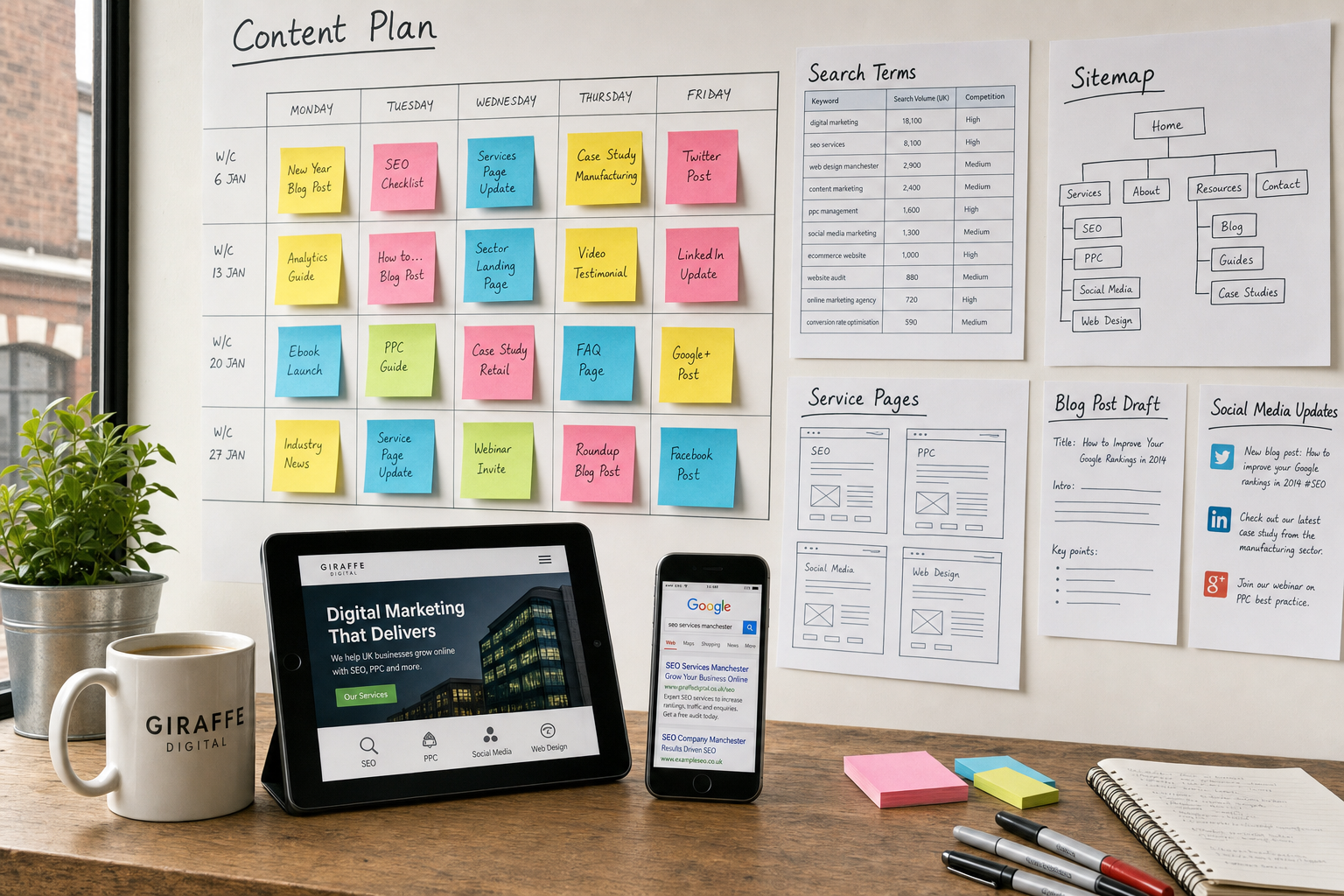
A content map is a simple document that lists the main pages and planned articles on your website, along with the purpose of each item. It need not be complicated. A spreadsheet, planning document or printed sitemap can be enough, provided it is kept up to date and shared with the people responsible for the website.
Start with the core structure of the site. Most business websites need clear pages for services, information about the business, contact details, locations served, case studies or examples of work, and frequently asked questions. Each core page should be written to help visitors understand what you do, why it matters and what they should do next.
Then look for supporting content. These are the articles, guides, checklists and updates that answer questions before a customer is ready to enquire. For example, a web design company might plan articles on choosing a domain name, preparing content for a new website, understanding responsive design and improving local search visibility. Each article supports a wider commercial objective while also offering something genuinely useful to readers.
Your content map should include:
- Page or article title: a working title that explains the subject clearly.
- Primary audience: the type of customer or stakeholder the content is for.
- Search focus: the main phrase or topic the page should be relevant to.
- Purpose: whether the content should inform, reassure, compare, demonstrate or encourage an enquiry.
- Call to action: the next step you would like the reader to take.
- Owner and date: who will write or approve it, and when it should be reviewed.
This kind of planning reduces duplication and makes it easier to brief designers, copywriters, SEO specialists and internal teams. It also helps you spot missing information before a visitor does.
Plan content around customer questions
One of the most reliable sources of content ideas is the set of questions your customers already ask. Sales calls, email enquiries, support conversations and meetings often reveal exactly what people need to know before they buy. If the same questions come up repeatedly, they probably deserve a place on your website.
For instance, a business offering office refurbishment might be asked how long a project takes, whether staff can remain on site, what happens during the design stage and how disruption is managed. Each of these questions could become a section on a service page or a separate advice article. By answering them clearly, the website becomes more helpful for visitors and more relevant for search engines.
Good question-led content should be specific, honest and easy to read. Avoid vague marketing claims where practical detail would be more useful. Instead of saying that your service is high quality, explain your process, show what customers should expect and provide guidance that helps them make a better decision.
Use an editorial calendar to keep publishing manageable
Many businesses begin with good intentions but struggle to publish regularly. An editorial calendar solves this by turning ideas into a realistic schedule. It does not have to mean publishing every day. For many smaller businesses, one well-planned article each fortnight or month is more valuable than a burst of rushed posts followed by silence.
A useful editorial calendar should include seasonal opportunities, business priorities and regular review points. A garden centre might plan spring planting guides, summer care advice and winter preparation articles. An accountancy firm may plan content around tax deadlines, payroll changes and common year-end questions. A web design and digital marketing agency might plan around website launches, search guidance, social media campaigns and content preparation for busy trading periods.
Planning ahead also improves quality. Subject experts can be asked for input early, images can be prepared properly, and articles can be reviewed for accuracy before publication. This is especially important where content relates to legal, financial, medical or technical subjects. A planned approach avoids last-minute writing that feels thin or uncertain.
Make content work with website design
Content planning should happen before or during website design, not after the design is finished. A website layout can only serve the business properly when the content requirements are understood. If a service page needs testimonials, enquiry prompts, related articles, images, downloadable information or location details, the design should allow for these elements from the start.
Responsive design is now an important consideration for business websites. Visitors may find your site through a desktop search at work, a tablet at home or a mobile phone while travelling. Content should therefore be structured in a way that remains clear on smaller screens. Short paragraphs, descriptive headings, meaningful page titles and concise calls to action all help.
Good design also supports readability. A page that is crowded, confusing or difficult to scan can undermine even well-written content. Headings should guide the reader through the page, navigation should be straightforward, and important information should not be hidden behind unnecessary effects. Search visibility brings people to the page, but design and content together determine whether they stay.
Connect content planning with social media marketing
Social media can extend the reach of your content, but it works best when it is planned rather than improvised. A new article can be shared on Twitter, Facebook, LinkedIn or Google+ with a short introduction tailored to the audience on each platform. Visual businesses may also benefit from image-led platforms where appropriate, provided the content fits the brand and customer base.
The key is to avoid treating social media as a separate activity. If your website publishes a guide to choosing the right service, your social updates can highlight different points from that guide over several days or weeks. A single article might provide a question for LinkedIn, a practical tip for Twitter, an image for Facebook and a discussion point for an industry group.
Social activity can also feed back into the content plan. Comments, shares and questions show which topics interest your audience. If a short update about a common problem attracts attention, it may be worth developing into a fuller website article. This creates a useful cycle: planned website content supports social media, and social responses help shape future content.
Do not overlook domain names and technical foundations
Content planning is more effective when the technical basics are sound. A clear domain name, reliable hosting, sensible site structure and clean navigation all help visitors and search engines understand the website. When choosing a domain name, aim for something memorable, easy to spell and closely connected to your business name or activity. Avoid making the name unnecessarily long or difficult to say aloud.
For UK businesses, it is worth considering the expectations of your audience when choosing an appropriate domain extension. A UK-focused organisation may benefit from a domain that clearly feels relevant to a British audience, while a business with international ambitions may need a broader approach. The important point is to register and manage domains carefully, keeping renewal details secure and ensuring that the business retains control of its digital assets.
From a content perspective, the website structure should make sense. Important pages should be easy to reach through the main navigation, and related pages should link to one another where useful. If you publish an article that supports a service, link back to the relevant service page. If a service page refers to a topic explained elsewhere, link to the supporting guide. Internal linking helps visitors continue their journey and gives search engines a clearer understanding of the relationships between pages.
Write for people first, while giving search engines clear signals
Good content planning balances customer usefulness with search clarity. Page titles, headings and introductory paragraphs should make the subject obvious. This does not mean forcing the same phrase into every sentence. It means using natural language that reflects how customers search and how your business talks about its services.
Each important page should have a unique focus. If several pages compete for the same phrase, search engines may struggle to decide which is most relevant, and visitors may find the site repetitive. A planned structure helps prevent this. Your main service page can cover the broad topic, while supporting articles can answer narrower questions.
Quality matters. Thin pages, copied text and generic articles rarely build confidence. Aim to publish content that demonstrates understanding, explains choices and gives the reader a reason to trust your business. Where possible, include practical examples, clear processes, common mistakes to avoid and advice based on real business experience without inventing claims or results.
Measure performance and review the plan
A content plan should be treated as a working document. After publishing, review how pages perform. Look at which pages attract visits from search, which ones lead to enquiries, which articles are shared and where visitors leave the site. Analytics data can reveal useful patterns, but it should be interpreted alongside business knowledge. A page with modest traffic may still be valuable if it brings highly relevant enquiries.
Review older content regularly. Business services change, staff move on, regulations are updated and customer expectations shift. An article that was useful two years ago may need revised wording, new examples or clearer links to current services. Updating existing content can often be as valuable as publishing something new, particularly if the page already attracts relevant visitors.
It is also worth checking whether your content still matches your brand. As businesses grow, their tone of voice, positioning and service mix may develop. A planned review helps ensure the website continues to present the organisation accurately and professionally.
A simple content planning process for business owners
If you are unsure where to begin, start with a straightforward process. First, list your main services and the customers you most want to attract. Second, write down the questions those customers ask before they make a decision. Third, map those questions to existing pages or new content ideas. Fourth, decide which pages are most important commercially and prioritise them. Finally, create a manageable schedule for writing, approval, publication and review.
This does not need to become an overwhelming exercise. Even a basic plan can make a noticeable difference by giving your website a clearer purpose. Over time, the plan can become more detailed, incorporating seasonal campaigns, new services, social media activity, email newsletters and design improvements.
The most important principle is consistency. A useful website is built through a series of deliberate decisions: what to publish, how to structure it, where to promote it and when to review it. Content planning brings those decisions together and helps ensure that your digital marketing is not just busy, but purposeful.
Turning planning into better search results
Better search results come from relevance, usefulness and clarity. Content planning supports all three. It helps your business understand what customers are looking for, create pages that answer those needs and organise the website so visitors can take the next step with confidence.
For UK business owners investing in website design, SEO, branding or digital strategy, content should not be treated as an afterthought. It is the substance that gives a website meaning. With a clear plan, your website can become easier to find, easier to use and more effective at supporting real business objectives.