Older website pages can be surprisingly valuable. They may already have search visibility, inbound links, social shares, enquiries in their history or useful information that customers still want. However, if the copy, layout, imagery or guidance has not been reviewed for some time, the page may gradually lose performance. A well-planned content refresh helps bring those pages back into line with your current services, brand, customers and search marketing goals.
For many UK businesses, refreshing content is a sensible alternative to constantly publishing new pages without reviewing what already exists. It allows you to build on existing authority, improve user experience and make better use of the website you have already invested in. When combined with good website design, practical SEO and joined-up social media marketing, a content refresh can help older pages work harder for your business.
What is a content refresh
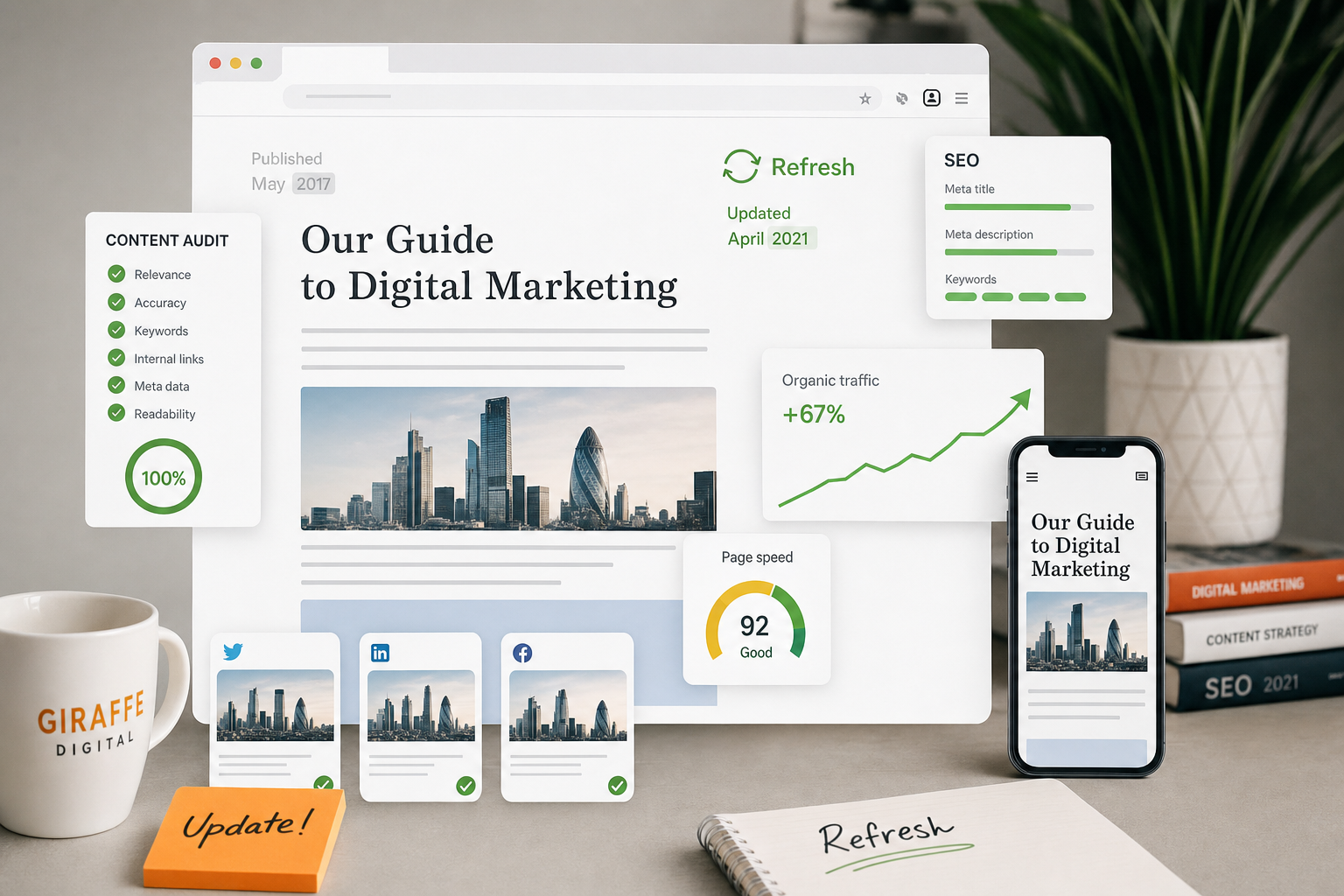
A content refresh is the process of reviewing and improving an existing website page rather than starting again from scratch. It might involve updating the written content, restructuring headings, replacing outdated examples, improving internal links, adding clearer calls to action, compressing images, checking page speed or making the page more suitable for mobile visitors.
It is not simply changing a few words to make the page look recently edited. A useful refresh should improve the page for real users. If someone lands on the page from Google, a social media post or a referral link, they should find information that is accurate, current and easy to act on.
For example, a local service page written several years ago might still describe services your business no longer prioritises. A blog post may refer to old social media image sizes or outdated marketing habits. A product guide might have weak internal links and no clear route to enquiry. Refreshing those pages can make them more relevant without losing the benefit of their existing web address.
Why older pages often lose performance
Website content can become weaker over time for several reasons. Search behaviour changes, competitors improve their pages, your own business develops and the expectations of website users continue to rise. A page that performed well when first published may not remain competitive if it is left untouched.
One common issue is outdated information. In digital marketing, website design and technology, advice can date quickly. Guidance about social media platforms, mobile browsing, search engine optimisation or online security may need reviewing more often than general company information. Even small inaccuracies can reduce trust, especially if a visitor is comparing several suppliers.
Another issue is search intent. A page may rank for a useful search term but fail to answer what users now expect from that query. If competitors offer clearer guidance, better page structure, frequently asked questions or stronger examples, your older content may start to slip.
Design also plays a part. Older pages may not be as easy to read on mobile devices, may have images that load slowly or may use layouts that feel disconnected from the rest of the website. By 2021, most businesses understand that a website must work well on smartphones, but many still have individual pages that were built before their current design standards were in place.
The business value of refreshing content
A content refresh can provide several practical benefits for business owners. It can help improve visibility in search results, but it also supports brand perception, lead generation and customer confidence.
From an SEO perspective, refreshing a page gives you the opportunity to improve relevance around the terms your customers are searching for. That does not mean forcing keywords into every paragraph. It means making sure the page clearly explains the topic, uses natural language, answers common questions and links to related services or resources.
From a conversion point of view, a refresh can make the next step clearer. If an older page receives visitors but few enquiries, the issue may be unclear messaging rather than a lack of traffic. Adding a concise call to action, improving the order of information or linking to a relevant contact form can make the page more commercially useful.
There is also a brand benefit. When your website contains current, helpful and consistent content, it shows that your organisation is active and attentive. This is especially important for businesses selling professional services, design, technology, consultancy or marketing support, where trust is built through clear communication.
How to choose which pages to refresh first
Not every page needs the same level of attention. A structured review will help you prioritise the pages most likely to deliver value.
Start by looking at your analytics and search performance data. Pages with existing search impressions, declining visits, high bounce rates or low enquiry rates may be good candidates. You can also review pages that previously generated leads but have become less active over time.
It is also worth identifying pages that are important to your sales process. Service pages, location pages, detailed guides and comparison-style articles often deserve priority because they influence buying decisions. If these pages feel thin, outdated or unclear, they may be holding back enquiries.
Another useful approach is to look at pages that receive social media traffic. If you regularly share older blog posts on LinkedIn, Facebook, Twitter or Instagram, make sure those articles still represent your business accurately. Social visitors may be encountering your brand for the first time, so the landing page needs to feel current and helpful.
Useful questions to ask during a review
- Is the information still accurate and relevant to customers in 2021?
- Does the page clearly explain who the service or topic is for?
- Are the headings useful, descriptive and easy to scan?
- Does the page include a clear next step for the visitor?
- Are internal links pointing to the most relevant current pages?
- Do images load quickly and support the message?
- Does the page work well on mobile devices?
- Could the content be improved with examples, FAQs or clearer explanations?
What to update during a content refresh
A strong content refresh usually includes several small improvements rather than one dramatic change. The exact work depends on the page, but the following areas are a good starting point.
Improve the opening section
The first few lines of a page should confirm that the visitor has arrived in the right place. Avoid vague introductions and get to the point quickly. If the page is about website design for small businesses, say so clearly. If it explains a marketing service, make the benefit obvious early on.
Update facts, examples and guidance
Remove references to old platforms, outdated features or services you no longer offer. Replace them with examples that match how customers make decisions now. For instance, if an article discusses social media marketing, it should reflect current platform behaviour, such as the importance of visual content, consistent posting, community engagement and adapting messages for each channel.
Strengthen headings and structure
Good headings help both users and search engines understand the page. Break long sections into clear topics. Use headings that describe the content below them rather than generic labels. A well-structured page is easier to scan and more likely to keep visitors engaged.
Add or improve internal links
Older pages often link to content that has since been moved, renamed or replaced. Review internal links and point users towards your best current pages. A blog post about content marketing might link to your SEO service page, website design page or a guide about social media strategy, depending on the context.
Review calls to action
Every important page should make it easy for the reader to take the next step. That may be contacting your team, requesting a consultation, reading a related guide or viewing a service page. The call to action should feel natural and helpful, not forced.
Content refresh and website design
Content and design should work together. If an older page has useful information but poor layout, it may still underperform. Visitors need to read, understand and act without unnecessary friction.
When refreshing content, check how the page appears on desktop, tablet and mobile. Look at font sizes, spacing, buttons, image placement and the order of information. A page may look fine on a large screen but feel cramped or confusing on a phone.
Page speed is also important. In 2021, Google’s page experience signals and Core Web Vitals have increased the focus on loading performance, interactivity and visual stability. While content quality remains essential, a slow or awkward page can damage the user experience. Compressing images, removing unnecessary scripts and keeping layouts stable can support both users and search performance.
Accessibility should not be ignored either. Clear language, sensible heading structure, readable contrast and descriptive link text all help more people use your website. These improvements also tend to create a better experience for every visitor, not just those using assistive technologies.
Refreshing content for SEO without overdoing it
SEO in 2021 is not about repeating a keyword as often as possible. A page about a content refresh should naturally use that phrase, but it should also cover related ideas such as updating old pages, improving search visibility, checking internal links, reviewing metadata and aligning the page with user intent.
When you refresh a page, review the title tag and meta description as well as the on-page copy. The title should be accurate and compelling, while the description should give searchers a clear reason to click. These elements may not guarantee higher rankings on their own, but they influence how your page appears in search results.
It is also useful to compare your page with the current search results for your target topic. Look at what successful pages include, but avoid copying them. Your aim is to make your page more helpful, more specific and more aligned with your own business expertise.
If a page has valuable backlinks or has been shared widely, be careful before changing its web address. In many cases, it is better to keep the existing URL and improve the page. If a URL change is unavoidable, make sure appropriate redirects are in place so users and search engines can find the updated content.
How social media can support refreshed content
Once a page has been refreshed, it should not simply sit quietly on the website. Social media can help reintroduce useful content to customers, prospects and professional contacts.
For LinkedIn, you might share a practical insight from the refreshed article and link to the full guide. For Facebook, a short explanation of the problem the page solves may work well. For Instagram, a carousel or story could highlight key points, with a link from your profile or relevant campaign route. Twitter can be useful for short tips, industry comments or linking to timely resources.
The key is to avoid posting the same message everywhere without adjustment. Each platform has its own audience behaviour and format. A refreshed page gives you a reason to create several smaller pieces of social content, such as tips, statistics, questions, short videos or graphics.
It is also worth involving your team. Sales, customer service and account management colleagues often know which questions customers ask most frequently. Their input can help you improve the page and create more relevant social posts around it.
Domain registration, old URLs and long-term ownership
A content refresh is also a good opportunity to check the foundations of your website. Domain registration may not be as visible as design or copywriting, but it is essential to your online presence.
Make sure your domain name is registered in the correct ownership details for the business and that renewal reminders are monitored. Losing access to a domain can disrupt your website, email and marketing activity. Businesses should keep domain records organised and ensure that more than one trusted person understands how renewals are managed.
If you are refreshing content across a website, check whether old campaign domains, microsites or redirected addresses are still needed. Some may continue to support search visibility or printed marketing materials, while others may no longer serve a purpose. Any decision to let a domain lapse should be made carefully, with consideration for existing links, customer recognition and email use.
When choosing new domain names for campaigns or services, keep them clear, memorable and aligned with your brand. Avoid names that are difficult to spell, too close to another organisation’s brand or likely to confuse customers. A good domain strategy supports trust as well as marketing.
A simple content refresh process
For business owners who want a practical starting point, the following process can help keep the work manageable.
- Audit: List important pages and gather basic data such as visits, search queries, enquiries and social shares.
- Prioritise: Choose pages with business value, existing visibility or clear signs of decline.
- Review: Read each page from a customer’s point of view and note anything outdated, unclear or missing.
- Improve: Update copy, headings, links, imagery, calls to action and technical issues where needed.
- Check: Test the page on mobile and desktop, review spelling and grammar, and make sure links work.
- Republish and promote: Share the refreshed page through suitable social channels, email newsletters or internal sales resources.
- Measure: Monitor search visibility, traffic, engagement and enquiries over the following weeks and months.
This process does not need to be complicated, but it should be consistent. A quarterly content review can prevent important pages from becoming stale and can help your website keep pace with your business.
When to rewrite instead of refresh
Some pages need more than a refresh. If a page targets the wrong audience, covers too many unrelated topics or no longer supports your services, a full rewrite may be more effective. Likewise, if several thin pages compete for the same search term, it may be better to combine them into one stronger resource.
However, rewriting should still be handled carefully. Consider the existing URL, inbound links, search performance and user journey before removing or merging pages. A page that looks weak at first glance may still have value if it attracts relevant visitors or supports another part of the website.
A good content refresh respects what is already working while improving what is holding the page back.
Make your existing content work harder
Publishing new content remains important, but older pages should not be forgotten. Your website is an evolving business asset, not a static brochure. By reviewing and improving existing pages, you can increase the value of past work and create a better experience for future visitors.
A thoughtful content refresh can improve search relevance, strengthen brand trust, support website design improvements and give your social media channels useful material to share. It can also help you spot wider issues, from unclear service positioning to outdated domain arrangements or weak conversion paths.
For UK business owners planning SEO, branding, website design or digital strategy work in 2021, refreshing existing content is a practical place to start. It is focused, measurable and closely linked to the way customers already find and judge your business online.