An expert interview can supply a month of useful social content when it contains enough distinct insight. The opportunity is to explain different decisions, examples and misconceptions from one well-prepared conversation. Repeating the same quote in twelve designs may fill a calendar, but it does little to help an audience learn.
Plan the interview around the questions your customers actually ask. Then turn its strongest material into formats suited to specific tasks: a short explanation, a practical checklist, a worked example or a discussion prompt. Each piece should stand on its own while remaining faithful to the expert's meaning.
A month is a planning period, not a promise about reach or a requirement to post at a particular frequency. Choose a volume your team can review and publish consistently. The following process shows how one conversation can become a coherent set of useful assets.
Choose an interview topic with several practical angles
Select a subject where the expert can explain real decisions rather than deliver a broad promotional message. A website migration interview might cover preparation, redirect mapping, content ownership, testing and common misunderstandings. These angles are connected, but each can help a reader complete a different task.
Use customer questions to develop the brief. Ask which parts of the subject cause confusion and where a small explanation could prevent an avoidable mistake. The interview should produce useful distinctions, not simply a list of claims that the company is experienced.
Define the audience's starting knowledge. A business owner preparing a first migration needs different explanations from a technical manager comparing deployment approaches. Tell the expert who the material is for so examples and terminology suit the intended reader.
Agree the intended uses of the recording and material with the participant before the interview. Clarify whether you plan video clips, attributed quotes, edited written posts or graphics. Also agree how potentially sensitive examples will be handled and which details require separate approval.
Prepare questions that reveal reasoning
Ask for the sequence of a real task, the reasons behind a recommendation and the conditions that change the answer. “What should a business check first?” often gives more useful material than “What are your top tips?” because it invites prioritisation and context.
Follow an abstract statement with a concrete request. If the expert says preparation is essential, ask what a prepared customer has supplied, what is commonly missing and what happens when that information arrives late. These details turn a familiar statement into an explanation readers can use.
Ask for boundaries and exceptions. An expert may recommend one approach for a small brochure website and another for a customer portal. Preserving that distinction prevents a short social post from turning conditional advice into an inaccurate universal rule.
Keep a question list without treating it as a script that cannot change. Useful examples may emerge unexpectedly. Follow them far enough to understand the lesson, then return to the planned subjects, so the conversation provides both depth and coverage.
Create a reliable source record
Record the conversation with the agreed arrangements and check that the audio is usable. A transcript helps locate ideas, but it needs review against the recording, particularly for specialist terms, product names, negation and numbers. Automated transcription can produce plausible errors.
Mark useful passages with time references and a short description of the insight. Separate exact quotations from editorial summaries. This distinction makes review easier and prevents an edited paraphrase from appearing as the participant's verbatim words.
Create an idea inventory containing the question, the answer's main point, its context, a possible format and any verification required. Include a link or time reference to the source passage, so a reviewer can inspect the original meaning without searching the entire recording.
Flag unsupported figures or examples that need checking. A confident anecdote may illustrate a lesson without establishing a general statistic. Either verify the claim from an appropriate source, label it accurately as a particular example or remove it from the planned asset.
Turn distinct insights into distinct formats
Choose formats according to what the idea needs. A process may work as a short checklist. A misconception may suit a concise video explanation. A comparison may benefit from a carousel with one decision criterion per slide. A detailed example may belong in a longer post or article.
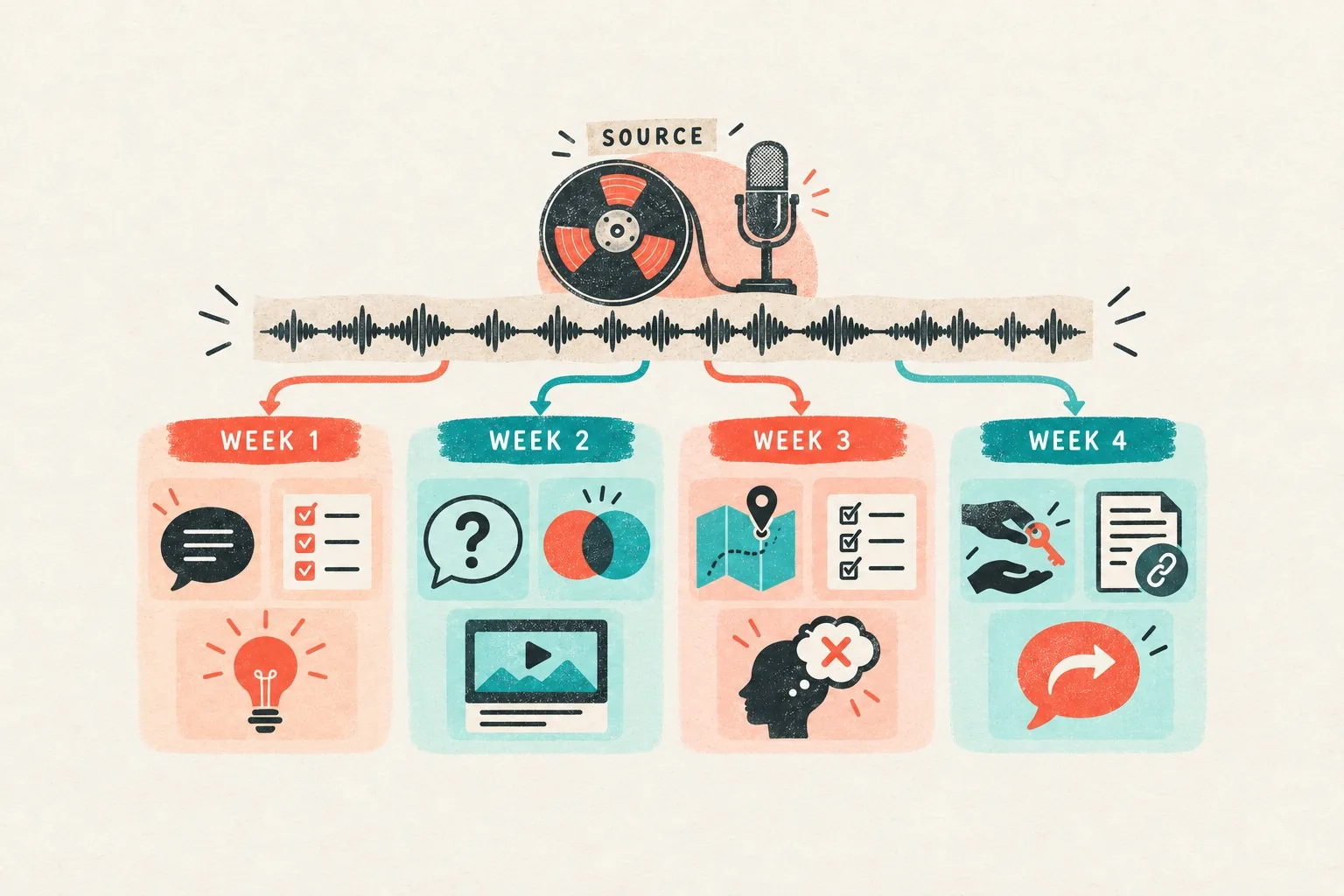
For an illustrative four-week plan, use three assets a week: one explanation, one practical application and one question or example. Twelve assets are possible when the interview contains twelve worthwhile angles. If it provides fewer, publish fewer and commission further material instead of stretching weak points.
Make each asset understandable without the rest of the series. Name the task, provide the necessary context and explain the useful conclusion. A clip beginning with “that is why it matters” may depend on a preceding minute the audience will never see.
Adapt the presentation without distorting the substance. A shorter headline can introduce the idea, but the accompanying copy should preserve relevant conditions. Avoid turning “this can help when the data is accurate” into “this always works” merely because the second version is punchier.
Organise the month around a learning journey
Arrange the material so the audience moves from understanding the problem to applying the advice. In the first week, explain the decision and common misunderstandings. Later weeks can explore preparation, examples and checks. This creates continuity without requiring readers to encounter every post in order.
Vary the depth and the invitation. Some pieces should simply answer a question well. Others can link to a relevant guide, ask readers about a practical difficulty or explain where the service fits. A useful calendar does not need to attach a sales request to every insight.
Account for the expert's availability during publication. If an asset invites complex questions, someone needs to own the response process. Decide which questions the social team can answer and which require the expert, then keep the handover manageable.
Maintain a small asset register with the source reference, copy, format, owner, review status and publication date. A clear register helps the team distinguish approved material from rough notes and prevents an outdated draft from being published accidentally.
Review accuracy, accessibility and presentation
Give the expert a focused review task: verify meaning, facts, conditions and examples. Give an editorial reviewer responsibility for clarity, grammar and suitability for the audience. Combining these checks is useful, but they assess different qualities.
Check captions against the audio before publishing video. Include dialogue and meaningful sound information, with accurate timing and terminology. An unchecked automatic transcript may omit important context or misrepresent what was said. Our accessible website media guide provides the related checks.
Make visual text readable and avoid placing essential information only inside an image. Provide useful accompanying copy and appropriate alternative text where supported. Test the final asset at the size people will see on a phone, not only on the designer's large monitor.
Inspect crops, thumbnails and links in the publishing context. A well-designed full-size image can lose its meaning when cropped, and a truncated caption can hide a qualification. Review the actual presentation rather than approving only the source files.
Use feedback to plan the next interview
Review the questions and responses the series generates. Look for misunderstandings, requests for examples and subjects people want explained further. Engagement figures can show attention, but they do not establish that an audience understood or applied the advice.
Compare formats against their intended tasks. A checklist may be saved for later, while an explanatory clip may prompt a useful question. Avoid declaring one format universally better based on a single month's results or a small audience.
Giraffe Digital's digital strategy service connects content and customer journeys. A reviewed interview workflow helps turn internal expertise into a sustainable source of material that teaches, supports relevant conversations and informs the next round of content.