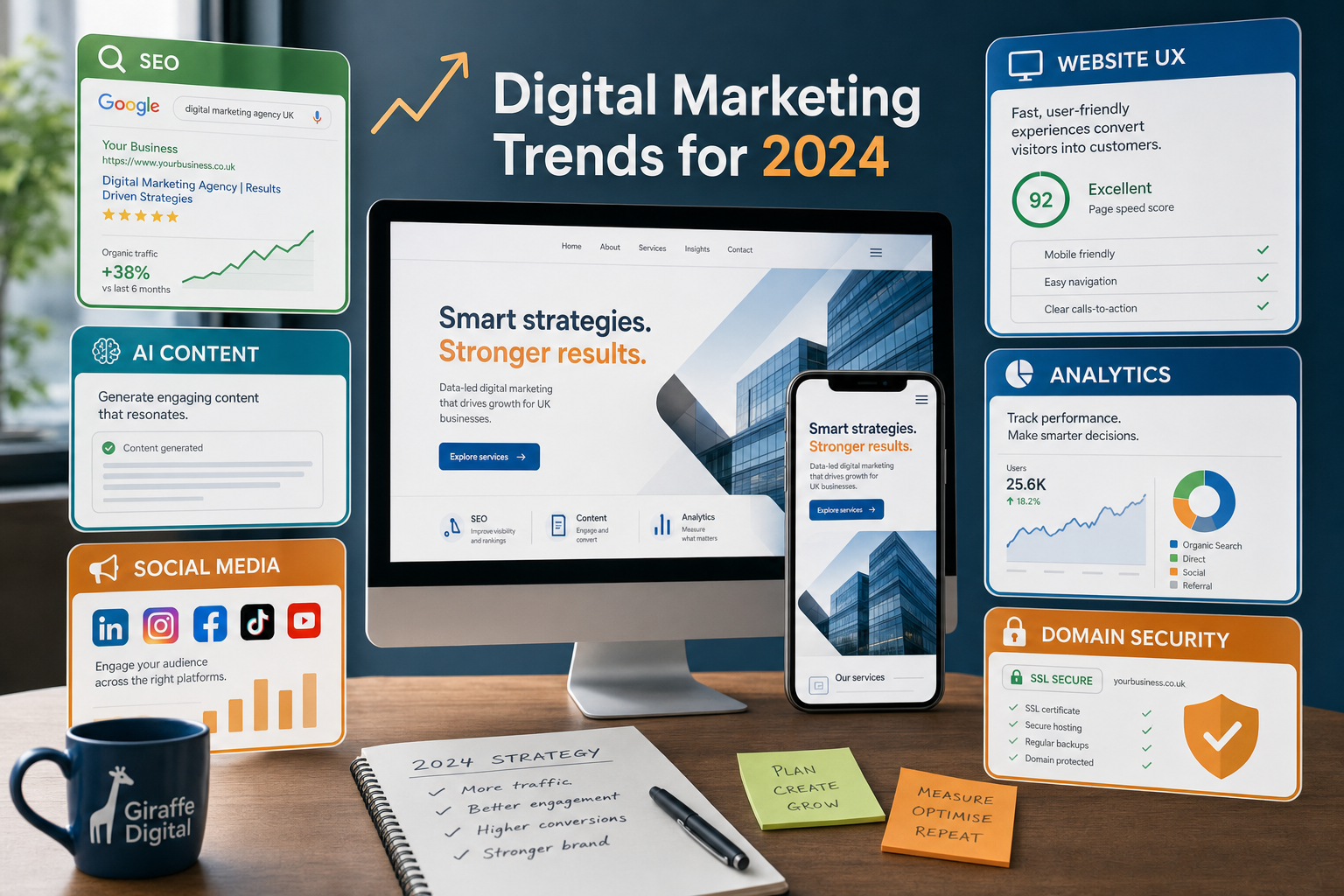
As 2024 begins, business owners are facing a more complex digital landscape than ever. Search behaviour is changing, social platforms are becoming more crowded, customers expect faster and more useful websites, and artificial intelligence is now part of everyday marketing conversations. The good news is that the most valuable digital marketing trends 2024 has to offer are not about chasing every new feature. They are about building a clearer, more useful and more measurable online presence.
For UK businesses, the priority should be practical progress. A stronger website, better content, clearer branding, reliable data and a more joined-up digital strategy can create value long after a campaign has ended. Whether you are planning a new website, refreshing your SEO, investing in social media marketing or reviewing your domain name, the trends below can help you make smarter decisions this year.
AI-assisted marketing becomes part of the workflow
Artificial intelligence is already affecting how businesses plan, write, analyse and optimise digital marketing activity. In 2024, the most effective use of AI will not be replacing human judgement, brand knowledge or creativity. It will use AI tools to speed up research, generate ideas, summarise data, create first drafts, and support more consistent marketing processes.
For a business owner, this could mean using AI to brainstorm blog topics, draft social media captions, identify frequently asked customer questions or turn a long guide into shorter content for email and social media. The important point is that AI output still needs editing, fact-checking, and shaping to fit your brand voice. Generic content is easy to produce, but it rarely builds trust.
Search engines and customers are both becoming better at recognising content that is vague, duplicated or written without first-hand knowledge. Businesses should therefore focus on useful, accurate and original material. AI can help with structure and efficiency, but your expertise, customer insight, local knowledge and evidence should do the heavy lifting.
Helpful SEO matters more than keyword volume
SEO in 2024 is about far more than adding keywords to pages. Search engines continue to reward content that genuinely answers user intent, demonstrates experience and makes it easy for visitors to take the next step. The primary keyword, such as digital marketing trends 2024, still has a role, but it should sit naturally within a page that is useful and well organised.
For UK businesses, practical SEO should start with understanding what customers are trying to do. A service page should explain who the service is for, what problem it solves, what is included, where the business operates and what the visitor should do next. A blog post should answer a question clearly and provide enough depth to be worth reading. A location page should avoid thin, duplicated copy and instead offer genuine relevance to that area.
Technical SEO also remains important. Fast-loading pages, clean site architecture, descriptive page titles, logical headings, internal linking and mobile-friendly design all help search engines and users understand your website. If your website has grown over several years, 2024 is a sensible time to audit old content, remove pages that no longer help, update outdated information and improve pages that have potential but are underperforming.
Website design shifts towards clarity, speed and trust
A visually appealing website is important, but design in 2024 needs to do more than look modern. Visitors expect pages to load quickly, navigation to be obvious and information to be easy to scan on both desktop and mobile. If a customer cannot understand what you offer within a few seconds, they are unlikely to spend long searching for the answer.
Strong website design should support the customer journey. That means clear calls to action, well-structured service pages, readable typography, consistent branding and reassuring trust signals. Examples include testimonials, case study summaries, accreditations, useful FAQs, team information and straightforward contact options. These elements help customers feel confident before enquiring.
Accessibility should also be part of good design. Websites should use sufficient colour contrast, clear button labels, descriptive link text and layouts that work well across different devices. Accessibility is not only a compliance consideration; it improves the experience for a wider audience and often leads to better usability for everyone.
First-party data and privacy-aware marketing become essential
Businesses are becoming less able to rely on broad third-party tracking and more responsible for building direct relationships with their audiences. In 2024, email lists, enquiry data, customer preferences and website analytics will be increasingly valuable, provided they are collected and used responsibly.
A good starting point is to review how your website captures enquiries. Are contact forms clear? Do users understand what will happen after they submit a form? Are newsletter sign-ups genuinely useful, or are they hidden and underdeveloped? Businesses should offer a fair value exchange, such as helpful updates, practical guides, early access to events or relevant insights, rather than asking people to subscribe without a reason.
Measurement also needs attention. Many businesses now use modern analytics platforms, but the data is only useful if goals and conversions are set up correctly. Form submissions, phone clicks, email clicks, downloads and key page visits can all help you understand which marketing activity is producing meaningful engagement. Rather than chasing vanity metrics, focus on the actions that indicate real commercial interest.
Social media marketing becomes more selective and content-led
Social media in 2024 is crowded, fast-moving and increasingly driven by short-form video, community interaction and authentic content. However, that does not mean every business needs to be active everywhere. A better strategy is to choose the platforms where your audience is most likely to spend time and where your business can publish consistently.
For many UK businesses, LinkedIn remains valuable for professional services, recruitment, partnerships and business-to-business visibility. Instagram and Facebook can support local engagement, visual storytelling and community building. TikTok continues to influence how people discover products, trends and ideas, particularly through short, informal video. X, formerly Twitter, can still be useful in sectors where news, commentary and public conversation are important.
The strongest social content usually feels specific rather than generic. Behind-the-scenes updates, quick tips, project walkthroughs, customer questions, founder insights and educational posts can all perform well when they are relevant to the audience. A building firm might share before-and-after project clips. A solicitor might explain common misconceptions in plain English. A retailer might show product comparisons or seasonal buying advice.
Consistency matters, but quality matters more. A realistic content plan that your team can maintain is better than an ambitious schedule that disappears after a few weeks. Reusing ideas across formats can help: one blog post can become a LinkedIn carousel, a short video, an email section and several social captions.
Brand consistency becomes a competitive advantage
As more content is created using templates and AI tools, distinctive branding becomes increasingly important. Your logo, colours and typography are only part of the picture. Your tone of voice, photography style, messaging, customer service and website experience all contribute to how people remember your business.
In 2024, strong brands will be clear about what they do, who they help and why customers should choose them. This should be visible across the website, search results, social media profiles, email signatures, downloadable documents and online listings. If your business looks different on every platform, potential customers may hesitate or fail to recognise you when they return.
A practical brand review can reveal quick improvements. Check whether your profile images are consistent, your service descriptions are up to date, your website imagery still represents the business, and your messaging speaks to current customer needs. Small inconsistencies can make a business look less established than it is.
Domain names and digital foundations deserve attention
Domain registration is often treated as an administrative task, but it plays an important role in credibility, brand protection and long-term marketing. In 2024, businesses should choose domain names that are easy to spell, easy to say and closely aligned with the brand. A shorter, memorable domain is usually better than one filled with hyphens, unusual abbreviations or unnecessary keywords.
For UK organisations, it can be sensible to secure relevant domain extensions that support the brand and reduce confusion. The best choice depends on your audience, trading area and plans. Before registering a domain, check that it does not create spelling issues, trademark concerns or awkward meanings when written without spaces.
It is also worth keeping domain ownership organised. Make sure the domain is registered to the correct business contact, renewal details are up to date, and access is not tied to a former employee or supplier. Losing control of a domain can cause serious disruption to a website, email and marketing activity. A simple annual review can prevent avoidable problems.
Content needs to support the buying journey
Many businesses create content only for people who are ready to buy immediately. In reality, customers often research for days, weeks or months before making contact. Your digital marketing should support different stages of that decision.
Early-stage content might answer broad questions, explain options or help customers understand a problem. Mid-stage content can compare services, outline processes, explain what to expect and address common objections. Later-stage content should make it easy to enquire, book a consultation or request more information.
Examples could include a website design agency publishing a guide to planning a new business website, an accountant explaining what records a start-up should keep, or a home improvement company showing how to prepare for an installation. The best content reduces uncertainty and helps potential customers feel more informed.
Local visibility remains vital for UK businesses
For businesses serving specific towns, cities, or regions, local digital marketing remains a major opportunity in 2024. Customers often search with local intent, even when they do not include a place name. Search engines use location signals, website relevance, reviews, business listings and content to help decide which results to show.
A strong local presence starts with accurate business information. Your name, address, phone number, opening hours and service areas should be consistent across your website and online profiles. Reviews also matter, not only for rankings but for customer confidence. Businesses should encourage genuine feedback and respond professionally, especially when a review raises a concern.
Local content should be meaningful rather than repetitive. Instead of creating near-identical pages for every nearby area, focus on real relevance: completed projects, local service details, regional knowledge, community involvement or practical advice for customers in that location.
Video and visual content keep growing, but strategy comes first
Video remains one of the most effective ways to explain, demonstrate and humanise a business. In 2024, short-form video is particularly useful for social media, while longer videos can support product education, recruitment, training and service explanations.
Businesses do not need a full production team to start using video well. Clear lighting, good sound and a simple structure can be enough for many formats. A practical video might answer one common customer question, show a product in use, introduce a team member or explain a process step by step.
Visual content should also support website performance. Large, unoptimised images can slow down pages, so it is important to compress files, use appropriate formats and provide descriptive alternative text where relevant. Good visuals can improve engagement, but they should not damage speed or accessibility.
Marketing technology should simplify, not complicate
There is no shortage of marketing technology available in 2024, from analytics and email platforms to customer relationship management systems, scheduling tools and automation software. The risk is that businesses adopt too many tools without a clear plan, creating more admin rather than better results.
Before adding another system, consider what problem it needs to solve. Do you need better enquiry tracking? More consistent email communication? Clearer reporting? Easier social media scheduling? A smaller, well-integrated set of tools is usually more effective than a collection of disconnected platforms.
Automation can be valuable when used thoughtfully. For example, a website enquiry could trigger an internal notification, a confirmation email to the customer and a task for a team member to follow up. However, automation should not make communication feel cold or impersonal. Customers still value timely, human responses.
How to prioritise your digital marketing in 2024
With so many trends competing for attention, the best approach is to focus on the areas that will have the greatest business impact. Start with your website, because it is often the destination for search, social, email and advertising activity. If your website is slow, unclear or difficult to use, other marketing channels will struggle to perform.
Next, review your visibility. Are your key services easy to find in search? Are your social profiles active and consistent? Is your local information accurate? Are you measuring the enquiries that matter? These foundations can reveal opportunities before you invest in larger campaigns.
Finally, build a realistic content and improvement plan. Digital marketing works best when it is ongoing, measured and refined. A monthly programme of useful content, technical improvements, social activity and reporting can often produce stronger long-term value than irregular bursts of activity.
The most important digital marketing trends 2024 brings are not simply new tools or platforms. They are the shift towards clearer customer experiences, more trustworthy content, better data and stronger digital foundations.
Final thoughts
Digital marketing in 2024 rewards businesses that are useful, consistent and easy to trust. AI can improve efficiency, but expertise still matters. Social media can increase visibility, but only when the content is relevant. SEO can bring valuable traffic, but only when pages genuinely help users. Website design can make a strong first impression, but it must also support action.
For UK business owners, this year is an opportunity to strengthen the essentials: a fast, persuasive website, a clear brand, accurate data, helpful content, secure domain management, and a sensible channel strategy. By focusing on practical improvements rather than short-lived hype, your business can build a digital presence that supports growth throughout 2024 and beyond.