For many UK businesses, 2016 will be the year when digital marketing moves from being a useful extra to a central part of the business plan. Customers are researching more carefully, comparing options more quickly and expecting clearer information before they make an enquiry or purchase. Whether you run a local service business, an e-commerce shop, a professional practice or a growing B2B organisation, your online presence needs to work harder than a static brochure. The most effective digital marketing priorities are not necessarily the most fashionable ones. They are the activities that help the right people find you, understand your value and take the next step with confidence.
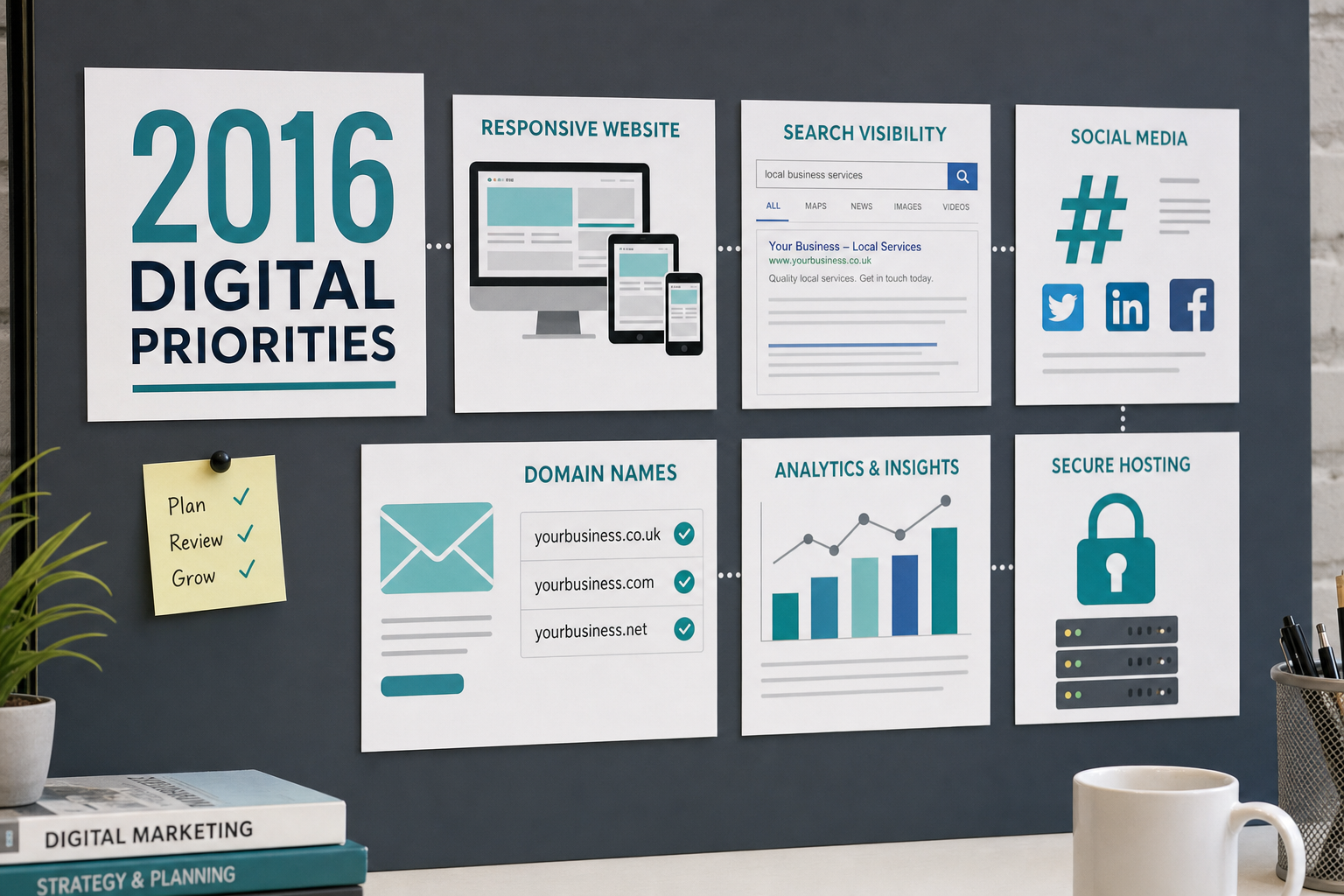
The areas that deserve particular attention during 2016 include website design, search visibility, social media marketing, content, domain choices, technology and measurement. The aim is not to do everything at once, but to make sensible decisions that improve performance over time.
Start with a website that supports business goals
Your website remains the centre of your digital marketing activity. Social media profiles, online adverts, email campaigns and search listings may all introduce people to your organisation, but in most cases the website is where they judge credibility and decide whether to get in touch. A modern business website needs to do more than look smart. It should explain your offer clearly, guide visitors towards useful actions and perform well across desktop, tablet and mobile devices.
In 2016, responsive website design should be treated as a requirement rather than an optional improvement. More customers are browsing on smartphones, and many will leave quickly if a page is difficult to read, slow to load or awkward to navigate on a smaller screen. Google has also made mobile-friendliness a visible part of the search experience, so a poor mobile site can affect both customer perception and search performance.
Good design should make decisions easier for the visitor. A service business, for example, should make its key services, location, contact details and enquiry process obvious. An e-commerce website should help people compare products, understand delivery options and complete checkout without unnecessary friction. A professional practice should build trust through clear explanations, useful resources and strong calls to action.
Website priorities to review
- Clarity: Can a new visitor understand what you do within a few seconds?
- Navigation: Are the most important services, products or details easy to find?
- Mobile experience: Does the site resize properly and remain easy to use on a smartphone?
- Speed: Are images, scripts or hosting arrangements slowing down key pages?
- Calls to action: Is there a clear next step, such as calling, booking, enquiring or buying?
- Trust signals: Are testimonials, accreditations, case studies, guarantees or credentials presented appropriately?
A redesign should not be approached as a cosmetic exercise alone. Before changing colours or layouts, identify what the website needs to achieve. This might include more qualified enquiries, better local visibility, improved conversion from paid search traffic, or a more professional brand impression for sales meetings and referrals.
Make search visibility a long-term priority
Search engine optimisation remains one of the most valuable digital marketing priorities for 2016, especially for businesses that depend on regular enquiries. People use search engines when they already have a need, question or problem. If your website provides the right answer at the right moment, search can become a reliable source of relevant traffic.
SEO in 2016 is not about stuffing pages with repeated keywords or building low-quality links. Search engines have become better at recognising useful, relevant pages, and poor tactics can do more harm than good. A sound SEO approach should combine technical quality, useful content, sensible keyword targeting and genuine authority.
Start by understanding how customers search. They may not use the same language you use internally. A business owner looking for help may search for practical phrases such as website design for accountants, local SEO services, emergency plumber in Bristol or business branding agency. Your pages should reflect real customer language while still reading naturally.
Practical SEO actions for 2016
- Review important pages: Make sure each key service or product has a dedicated, well-written page.
- Improve page titles and descriptions: These influence how your pages appear in search results and should encourage clicks without exaggeration.
- Strengthen local signals: For local businesses, keep name, address and telephone number details consistent across your website and reputable directories.
- Use structured content: Clear headings, useful paragraphs and a logical page structure help users and search engines understand the page.
- Create helpful resources: Guides, FAQs, buying advice and industry commentary can attract search traffic and build credibility.
- Earn quality links: Look for genuine mentions from suppliers, trade bodies, local organisations, press coverage and useful partnerships.
Technical SEO should also be checked. Broken links, duplicate pages, poor redirects, blocked pages and slow loading times can all reduce performance. If your website is being redesigned or moved to a new platform, plan the migration carefully. Redirect old URLs to suitable new ones and monitor traffic after launch. A new website should not mean losing search visibility that has taken years to build.
Build content that answers customer questions
Content marketing has matured quickly, but its core value remains simple: useful information helps potential customers make better decisions. In 2016, businesses should focus less on producing content for its own sake and more on creating material that supports the buying journey.
A customer may begin with a broad question, such as whether they need a new website, how to choose a supplier or what a particular service includes. Later, they may compare providers, look for examples, check credentials and ask about process. Your content should help at each stage. A concise service page might be supported by a more detailed guide, a set of frequently asked questions, a downloadable checklist or a blog post explaining common mistakes.
For example, a local building firm could publish guidance on planning a home extension, choosing materials or preparing for a quotation. A solicitor might explain the broad steps in a conveyancing process. A manufacturer could publish technical buying guides for trade customers. The aim is to demonstrate expertise before the sales conversation begins.
Keep content practical and purposeful
Every piece of content should have a purpose. It might help you rank for a relevant search term, support an email campaign, answer a sales objection or show that your team understands a specific sector. Avoid thin posts that repeat generic advice. It is better to publish one genuinely useful article each month than several rushed updates that add little value.
Make sure your content is written in plain English. Technical expertise is valuable, but customers should not have to work hard to understand it. Use examples, explain terms where necessary and guide readers towards a sensible next step.
Use social media with a clear commercial purpose
Social media marketing can support brand awareness, customer service, recruitment, networking and traffic generation, but it needs a plan. Many businesses make the mistake of opening profiles on every platform without knowing what they will publish or who they are trying to reach. In 2016, it is better to choose the right channels and use them consistently.
Facebook can be useful for consumer-facing businesses, community engagement, local promotions and visual updates. Twitter remains effective for conversation, events, industry news and direct engagement. LinkedIn is particularly relevant for B2B organisations, professional services and recruitment. Instagram and Pinterest can work well for visual sectors such as interiors, fashion, food, travel, design and lifestyle brands. YouTube can support product demonstrations, advice videos and brand storytelling where video is practical.
The right mix depends on your audience. A firm selling specialist services to finance directors may find LinkedIn and email more valuable than daily Facebook posts. A restaurant, fitness studio or retailer may benefit from regular visual updates and local engagement. A manufacturer might use social media to support trade relationships, exhibition activity and technical credibility.
Social media priorities to focus on
- Consistency: Keep profiles active enough to look current and reliable.
- Relevance: Share updates that matter to customers, not just internal announcements.
- Response: Monitor comments and messages so enquiries are not missed.
- Visual quality: Use strong images and clear branding where appropriate.
- Measurement: Track referral traffic, enquiries and engagement rather than chasing vanity metrics alone.
Paid social advertising is also becoming more accessible for businesses that want to reach specific audiences. The key is to test carefully. Start with a clear objective, such as promoting a guide, attracting event registrations or reaching local customers, and review whether the campaign produces meaningful results.
Plan paid search around intent and conversion
Paid search, including Google AdWords and Bing Ads, can be highly effective because it places your business in front of people who are actively searching. It can also become expensive if campaigns are not planned carefully. The priority for 2016 should be relevance: relevant keywords, relevant adverts and relevant landing pages.
A common mistake is sending all paid traffic to the homepage. If someone searches for a specific service, they should arrive on a page that directly matches that search. The page should explain the service, build trust and make the next action obvious. This improves the customer experience and can also improve campaign efficiency.
Paid search is particularly useful when launching a new website, promoting a seasonal offer, testing demand in a new location or supporting keywords where organic rankings are still developing. However, it should be measured closely. Track calls, enquiries, form submissions and sales where possible. Clicks alone do not prove success.
Choose and manage domain names carefully
Your domain name is a practical brand asset. It appears on business cards, vehicles, email addresses, search results and advertising. A good domain is easy to remember, easy to spell and aligned with your organisation. While exact-match domains can still have some appeal, they should not be chosen at the expense of credibility or long-term brand value.
For UK businesses, a relevant UK domain extension can help signal location and trust, particularly for local or national companies serving a UK audience. Many organisations also choose to protect closely related versions of their name to reduce confusion. This might include common spelling variations or appropriate alternative extensions. The important point is to manage domains centrally and keep renewal details up to date.
When choosing a domain, avoid names that are too long, easily misunderstood over the phone or too close to another business. Consider how it will look in an email address and whether it supports future growth. A name that is too narrow may become limiting if your services expand.
Domain registration considerations
- Keep the name short, memorable and easy to spell.
- Choose an extension that suits your market and audience.
- Register sensible variations where there is a clear business reason.
- Keep ownership details, renewal dates and access credentials secure.
- Use professional email addresses connected to your domain rather than relying on personal accounts.
Domain decisions should be made alongside branding, website structure and email planning. A rushed choice can create unnecessary complications later.
Invest in trustworthy technology and website security
Customers are becoming more aware of online trust. If your website handles enquiries, accounts, payments or personal information, security and reliability matter. Even for a simple brochure site, downtime, warnings or broken forms can damage confidence.
In 2016, businesses should review hosting quality, backup arrangements, software updates and access control. If your website uses a content management system, keep it maintained. Out-of-date plugins, themes or extensions can create security and performance problems. Make sure there is a clear process for updates, testing and recovery if something goes wrong.
HTTPS should also be considered, especially for e-commerce websites, login areas and any site collecting sensitive information. Search engines have indicated a preference for secure websites, but the main reason is user trust and data protection. If you move from HTTP to HTTPS, ensure the change is implemented properly with redirects, updated internal links and search monitoring.
Technology should make marketing easier, not more complicated. Choose systems that your team can realistically use. A complex platform that nobody updates will not serve the business as well as a simpler, well-maintained website that supports regular improvement.
Measure what matters and improve steadily
Digital marketing offers a major advantage over many traditional activities: it can be measured. That does not mean every decision should be reduced to a single number, but it does mean businesses should understand what is working.
At a basic level, make sure analytics are installed correctly and that enquiry forms, telephone calls, downloads or purchases are tracked where possible. Review where traffic comes from, which pages attract visitors, how people move through the site and where they leave. This information can highlight opportunities that are not obvious from opinion alone.
For example, if a service page receives good traffic but few enquiries, the issue may be the page content, the call to action, the form or the offer itself. If a blog post attracts visitors but they do not explore the rest of the website, add clearer internal links to relevant services. If mobile visitors leave more quickly than desktop visitors, review the mobile layout and loading speed.
Useful measures for business owners
- Organic search traffic to key pages.
- Enquiries, calls, bookings or sales generated from the website.
- Conversion rate by device type.
- Paid search cost per enquiry or sale.
- Email campaign opens, clicks and responses.
- Social media referral traffic and meaningful engagement.
- Performance of landing pages used in campaigns.
Measurement should lead to action. Set a regular review schedule and make improvements in manageable stages. Small changes to headlines, page structure, forms, navigation and calls to action can make a significant difference over time.
Bring branding and digital strategy together
A strong digital presence is not only about traffic. It is also about how your business is perceived. Your brand should be consistent across your website, social profiles, email newsletters, advertising, printed materials and customer communications. Inconsistency can make a good business look less established than it really is.
Review your tone of voice, visual style, imagery and messaging. Do they reflect the type of customers you want to attract? Do they explain why someone should choose you rather than a competitor? Do they support trust before a conversation begins?
Digital strategy brings these decisions together. Instead of treating SEO, social media, website design and paid advertising as separate tasks, look at how they support the same commercial goals. A campaign might begin with a useful guide, promoted through email and social media, supported by search-optimised landing pages and measured through enquiries. When the pieces work together, the whole marketing effort becomes more effective.
Set realistic priorities for the year ahead
Most businesses do not need to chase every digital trend. They need to get the fundamentals right and build from there. For 2016, the strongest digital marketing priorities are likely to include a mobile-friendly website, clearer content, better search visibility, more purposeful social media, careful domain management, reliable technology and meaningful measurement.
Start by auditing your current position. Identify the biggest barriers between your customers and a successful enquiry or purchase. Then choose a small number of improvements that will have the greatest business value. This might mean redesigning key service pages, improving local SEO, refreshing outdated branding, launching a focused paid search campaign or creating a content plan around common customer questions.
Digital marketing works best as an ongoing programme rather than a one-off project. The businesses that benefit most in 2016 will be those that combine practical planning with regular improvement. By focusing on the activities that help customers find you, trust you and act, your online presence can become a stronger and more measurable part of business growth.