Video marketing is becoming an increasingly useful way for UK businesses to explain what they do, how their products work and why a customer should get in touch. A well-planned video can make a service easier to understand, bring a product to life and give a website visitor the confidence to take the next step. It does not need to be a television advert, nor does it need to be over-produced. For many organisations, the most effective videos are clear, concise and focused on solving a customer problem.
For business owners investing in website design, search engine optimisation or social media marketing, video should be considered as part of the wider digital strategy. It can support written content, improve a page's usefulness, and provide material that can be shared through email newsletters, social networks, and sales conversations. The key is to treat video as a practical communication tool rather than a novelty.
Why video helps people understand what you offer
Most websites have to answer several questions very quickly. What does the business provide? Who is it for? How does it work? What makes it credible? A page of text can answer these questions, but some products and services are far easier to explain when people can see them in action.
A manufacturer might use a short video to show how a piece of equipment is assembled, maintained or used safely. A professional services firm might use video to introduce a process, such as how an initial consultation works or what information a client should prepare. A retailer might demonstrate the size, texture, fit or functionality of a product in a way that still photography cannot fully capture.
Video is particularly helpful when the customer needs reassurance. If a service feels complex, expensive or unfamiliar, a calm explanation can reduce uncertainty. Seeing a real person speak clearly about the business can also make the organisation feel more approachable. This is valuable for smaller businesses that want to compete with larger brands by showing expertise, character and attentiveness.
Choosing the right type of business video
Before filming anything, decide what the video needs to achieve. A video intended to attract attention on a social network may differ from one that supports a detailed product page. A good starting point is to identify the questions customers ask most often and decide whether video would answer them better than text alone.
Product demonstrations
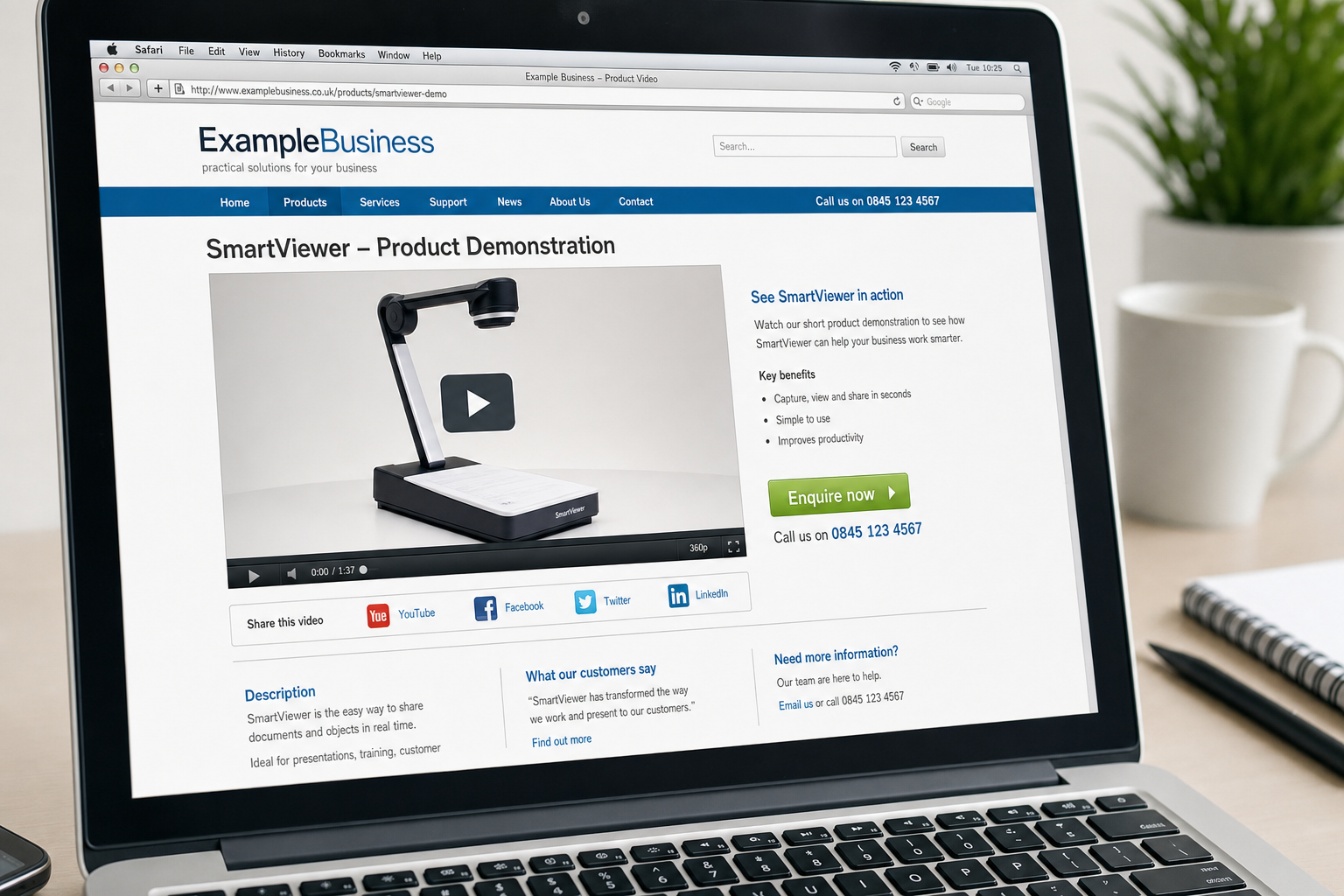
A product demonstration should show the product being used realistically. Keep the structure simple: introduce the problem, show the product, demonstrate the main features and explain the benefit of each feature. Avoid trying to cover every technical detail in one clip. If the product is complex, a series of shorter videos will usually be more useful than a single long video.
Service explanations
Service businesses can use video to describe a process. For example, a web design agency might explain the stages of a website project, from initial planning and content gathering through to design, development, testing and launch. An accountancy firm might explain what happens during a first meeting. This type of video helps set expectations and can reduce repetitive enquiries.
Frequently asked questions
Short answer videos can work well when customers regularly ask the same questions. Each clip should answer one question clearly. This approach is useful for search marketing because each video can sit on a focused page with a relevant heading, supporting text and a transcript. It also gives sales staff a useful link to send to prospects.
Behind-the-scenes and trust-building content
For some businesses, showing how work is carried out can be persuasive. A workshop, studio, office, warehouse or showroom can all provide useful visual context. The aim is not to show everything, but to demonstrate care, standards and personality. This can be especially effective for businesses where quality, craft, service or reliability are important selling points.
Planning video content around the customer journey
Effective video marketing should not be planned in isolation. Consider where a potential customer is likely to encounter the video and what they will need at that stage. Someone on a home page may need a short overview. Someone on a product page may need detail. Someone comparing suppliers may need evidence of expertise and a clear reason to enquire.
On a website, the most useful places for video include home page introductions, product or service pages, campaign landing pages, help sections, and blog articles. A video placed on a page should support the page's purpose. If the page is intended to generate enquiries, the video should lead naturally towards a call to action, such as completing a contact form, requesting a brochure or telephoning the business.
It is important not to hide key information only in the video. Many visitors will still scan the page before deciding whether to watch. Include a clear written summary, bullet points and contact details. This helps users who cannot watch with sound, users on slower connections and search engines that rely primarily on text to understand the page.
Website design considerations for video
Video can improve a website, but only when it is presented thoughtfully. A large video file that slows the page or an auto-playing clip that interrupts the visitor can do more harm than good. The design should make the video inviting without allowing it to dominate the page unnecessarily.
Use a clear thumbnail image that shows what the video is about. A strong thumbnail is often the difference between a video being watched or ignored. It should be relevant, tidy and consistent with the brand. Avoid using a random frame in which the speaker is mid-sentence or the product is unclear.
Keep the video close to the related written content. If a product page includes a demonstration, place the video near the product description or feature list. If it is an introductory film, position it to support the page's first impression. Always include a visible route to the next step, such as an enquiry button or telephone number near the video area.
Technical compatibility should also be considered. Many websites still use Flash-based players, but mobile browsing is growing, and some popular mobile devices do not support Flash. If video is important to the page, ensure there is a suitable alternative for mobile users. Hosted video platforms can make playback easier across different browsers and devices, while self-hosted video gives more control but requires careful attention to file formats, bandwidth and testing.
Using social media to extend the reach of video
Once a video is published, it should not be left to sit unnoticed on a website. Social media can help extend its reach, especially when the video answers a practical question or demonstrates something genuinely useful. In 2011, many businesses were already using platforms such as YouTube, Facebook, Twitter, LinkedIn and Vimeo to distribute content and encourage discussion.
YouTube is often the first choice for video hosting and discovery because many people already search for video content on the platform. Properly completed title, description, and tags can help users understand the subject before they click. Include a link back to the relevant page on your website in the description, and make sure the video itself gives viewers a reason to visit the site or contact the business.
Facebook can be useful for more informal sharing, especially if your customers already follow the business there. Twitter can help promote new videos, although the message needs to be concise and the link should be supported by a clear reason to watch. LinkedIn is useful for business-to-business content, particularly service explanations, expert commentary and industry guidance.
Do not treat social media posting as a one-off announcement. A single video can be used in several ways: shared when first published, referenced in a related blog post, included in an email newsletter, sent to prospects after a meeting or added to a frequently asked questions page. The more relevant the video is to real customer questions, the longer its useful life will be.
Search marketing benefits of video
Video marketing can support search engine optimisation when it is planned correctly. Search engines need clear signals to understand a page's topic and value. A video without surrounding text, a poor title, or no supporting content is unlikely to perform as well as a carefully structured page.
Start with the page itself. Use a descriptive page title, a clear heading, and well-written copy that explains the product or service. Add a transcript or detailed summary beneath the video where appropriate. This makes the content more accessible and gives search engines useful text to index. It also helps visitors who prefer to read before watching.
If using a public video platform, write a clear title and description in natural language that customers are likely to use when searching.ng Avoid stuffing the description with repeated keywords. Instead, describe the problem, the product or service, the location if relevant and the benefit to the viewer. For example, a local business might mention the town or region it serves where that is genuinely useful.
For websites with several videos, consider using a video sitemap to help search engines discover the content. Each important video should have its own relevant page rather than being buried in a large gallery with little context. Strong internal linking can also help: link from blog articles, service pages and help content to the most useful video pages.
Video can also encourage people to spend longer on a page and may increase the likelihood of enquiries if the content is persuasive. However, it should not be seen as a shortcut around good website structure, clear copy or proper SEO. It works best as part of a complete approach.
Branding, tone and production quality
A business video does not have to look like a glossy advert, but it should feel professional. Poor sound, shaky footage, unclear lighting or a rambling script can damage confidence. Viewers will forgive simple production if the information is useful, but they are less forgiving when they cannot hear, see or understand what is being explained.
Prepare a short outline before filming. This does not need to be a word-for-word script, but it should include the main points in order. Aim for plain English and avoid jargon unless the audience expects it. If technical terms are necessary, explain them clearly. The best business videos often feel conversational, but they are still carefully planned.
Branding should be present without overwhelming the content. A simple introduction, consistent colours, a tidy setting and a clear closing screen can be enough. Include contact details or a website address where appropriate, but do not turn the entire video into a sales pitch. The purpose is to help the viewer understand and trust the business.
Domain names and campaign planning
If video forms part of a wider campaign, think carefully about where the content should live online. In most cases, publishing video on the main business website is the best approach because it strengthens the existing domain and keeps visitors close to the enquiry path. A separate domain may be useful for a specific campaign, product launch or event, but it should be chosen with care.
When registering a domain name, keep it short, memorable and easy to spell over the telephone. For UK businesses, a relevant UK domain can help reinforce location and trust, while a wider commercial domain may be useful for broader markets. Avoid unnecessary hyphens, confusing abbreviations and names that are too close to another brand. Check that the domain supports the long-term marketing plan rather than only a short-term idea.
It is also wise to keep ownership details, renewal dates and access information organised. A domain name is a business asset, and losing control of it can cause serious disruption. If designers, developers or marketing partners assist with registration or management, the business should still understand who owns the domain and how it is renewed.
Measuring whether video is working
Video marketing should be measured against business objectives, not vanity alone. Views can be encouraging, but they do not automatically mean the video is helping the business. Look at whether viewers take useful actions after watching, such as visiting the website, completing a form, telephoning, downloading information, or asking better-informed questions.
Website analytics can show whether pages containing video are attracting visitors and whether those visitors continue through the site. Video platforms may provide information about views, audience retention and where viewers are coming from. These figures can help identify whether a video is too long, whether the opening is engaging enough and which distribution channels are working best.
Feedback from sales and customer service teams is also valuable. If a video reduces confusion, improves the quality of enquiries or helps customers make decisions more quickly, that is a meaningful result. Over time, this feedback can guide the next videos you produce.
Practical tips before you start filming
- Start with one clear purpose: decide whether the video should explain, demonstrate, reassure or generate an enquiry.
- Keep it concise: many product and service explanations work best when they are short and focused.
- Invest in sound: clear audio is often more important than elaborate visuals.
- Use real customer questions: build videos around the issues people already raise with your team.
- Support the video with text: add summaries, transcripts or key points for accessibility and SEO.
- Test playback: check the video on different browsers, connection speeds and mobile devices where possible.
- Include a next step: make it easy for the viewer to enquire, read more or request further information.
Making video part of a wider digital strategy
Video is most effective when it is connected to the rest of the business's online presence. A helpful video can improve a service page, support a blog article, strengthen a social media update and provide useful material for email marketing. It can also help make a brand feel more human, especially when the tone is clear, honest and focused on the customer's needs.
For UK business owners planning a new website or improving an existing one, video marketing is worth considering early in the process. It affects page layout, content planning, hosting decisions, calls to action and search marketing. By planning video alongside website design and SEO rather than adding it at the end, the final result is more likely to be useful and measurable.
The best starting point is simple: choose one product or service that people often misunderstand, write down the questions customers ask, and produce a clear video that answers them. If it helps people understand, trust and contact your business, it has done its job.