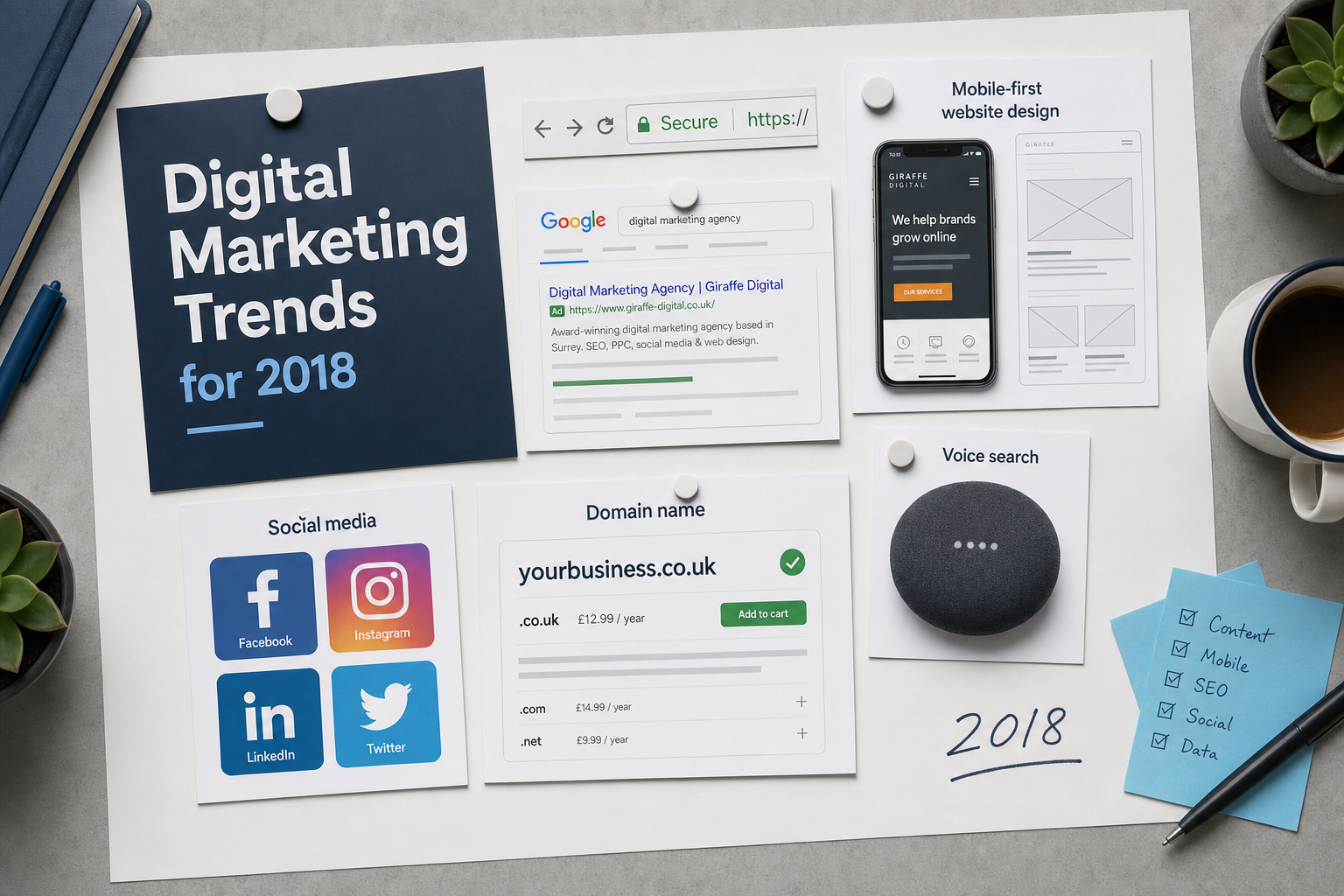
As 2018 begins, UK businesses have an important opportunity to review how their website, search visibility, social media and wider digital strategy work together. The strongest Digital Marketing Trends for 2018 are not about chasing every new idea; they are about making practical improvements that help customers find you, trust you and take action. For many organisations, that means a faster website, clearer messaging, more useful content, better local search visibility and a more considered approach to social media advertising.
Digital marketing is becoming more connected. A potential customer might first see your business through a social post, then search your name on a mobile phone, read reviews, compare your website with a competitor and finally make an enquiry days later. Each step needs to feel consistent and credible. The following trends are especially relevant for business owners planning website design, SEO, branding or digital strategy work in 2018.
Mobile-first website design becomes essential
Mobile usage has been growing for years, but 2018 is the point at which many businesses can no longer treat mobile visitors as secondary. Customers expect to browse, compare and contact businesses quickly from a phone. If a website is difficult to use on a small screen, slow to load or awkward to navigate, visitors are likely to leave before they understand your offer.
A mobile-first approach means planning the most important content, calls to action and navigation for smaller screens before expanding the design for desktop users. This helps prevent clutter and encourages clearer decisions about what really matters. For example, a service business may need a visible telephone number, a simple enquiry form, concise service summaries and clear location information. An e-commerce business may need faster product filtering, more prominent delivery details and a smoother checkout experience.
Responsive design remains a sensible foundation, but it should be combined with careful user experience planning. Buttons need to be easy to tap, forms should ask only for necessary information, and pages should avoid unnecessary elements that slow visitors down. Good design in 2018 is not just about how a site looks; it is about whether customers can confidently complete the task they came to do.
Speed, security and technical quality will influence trust
Website performance is becoming increasingly important for both users and search engines. Slow-loading pages create frustration, particularly on mobile connections, and can reduce enquiries or sales. Businesses should review image sizes, hosting quality, code efficiency and unnecessary scripts. Even modest improvements can make a website feel more professional and easier to use.
Security is another area that deserves attention. The use of HTTPS is now a clear expectation for many websites, especially those collecting enquiry details, account information or payments. A secure site helps protect data in transit and reassures visitors that the business takes its online presence seriously. Browser warnings and visible security indicators can affect confidence, so security should be part of any website review or redesign project.
Technical quality also includes reliable forms, clean page structures, sensible redirects, readable URLs and a logical site architecture. These details may not feel exciting, but they support search visibility and reduce friction for users. In 2018, businesses that invest in solid technical foundations will be better placed to benefit from content, advertising and social media activity.
SEO becomes more focused on intent and usefulness
Search engine optimisation continues to move away from narrow keyword repetition and towards satisfying the intent behind a search. This is especially important for competitive local and service-based markets. A business still needs to understand the phrases people use, but the content must genuinely answer questions, explain services and help customers make decisions.
For example, a firm offering home improvement services might create separate, well-written pages for each core service, supported by practical guides, FAQs and location information. A professional services company might explain common problems, outline processes and make it clear who the service is suitable for. This type of content can improve search relevance while also reducing uncertainty for potential customers.
Local SEO remains particularly valuable for UK businesses serving defined areas. Consistent business details, well-structured location pages, relevant reviews and accurate map listings can all support visibility. Businesses should also consider how search snippets appear. Clear page titles, useful meta descriptions and structured content can encourage more people to click when the business appears in search results.
Voice search is also gaining attention as more people use smartphones and home assistants for quick questions. This does not mean every business needs a separate voice strategy, but it does support the case for natural, conversational content. Pages that answer specific questions clearly may be better suited to how people increasingly search.
Content marketing needs a sharper commercial purpose
Many businesses have tried blogging or content marketing, but not all have connected it to clear commercial goals. In 2018, content should be planned around customer needs and business priorities rather than published simply to fill a calendar. A useful article, guide or landing page should answer a real question, support a stage in the buying journey or help a prospect understand why your business is a good fit.
A purposeful content plan might include educational articles for early-stage researchers, comparison-style guidance for people evaluating options, and detailed service pages for those closer to enquiring. Seasonal content can also be useful when planned properly. For example, an accountancy firm might prepare tax-related guidance ahead of key deadlines, while a hospitality business might create content around bookings, events and local attractions.
Quality matters more than volume. Thin, generic posts are unlikely to build trust or long-term visibility. Instead, businesses should aim for content that reflects real expertise, uses clear language and includes helpful next steps. Strong content also supports social media, email marketing and paid campaigns by giving audiences something worthwhile to engage with after the initial click.
Social media marketing becomes more strategic and paid-led
Organic reach on major social platforms has become less predictable, especially for business pages. This means that simply posting updates and hoping for visibility is unlikely to be enough. In 2018, social media marketing should be treated as a strategic channel with clear audience targeting, planned creative and measurable objectives.
Facebook remains important for many consumer-facing businesses, community organisations and local brands, but paid promotion is often needed to reach the right people consistently. Instagram continues to grow as a visual platform, with Stories offering a more informal way to show products, behind-the-scenes activity, events and brand personality. LinkedIn can be valuable for business-to-business marketing, recruitment and professional credibility, while Twitter remains useful for conversation, customer service and timely updates in some sectors.
The businesses that perform best on social media are usually those that understand what each platform is for. A long technical explanation may work better as a website article shared on LinkedIn, while a quick product demonstration may be more suited to Instagram or Facebook video. Rather than posting identical content everywhere, businesses should adapt the message, format and call to action for each audience.
Measurement is also important. Likes and shares can indicate engagement, but enquiries, email sign-ups, event bookings and sales are usually more meaningful. Social activity should be connected to website analytics wherever possible so that business owners can see what happens after someone clicks.
Video, visual content and richer storytelling continue to grow
Video is becoming a more accessible and persuasive format for many businesses. It can be used to explain services, introduce a team, demonstrate a product or answer common questions. Short, focused videos often work best on social media, while longer explanatory content may be more suitable for website pages or presentations.
Businesses do not always need elaborate production to benefit from video, but quality still matters. Clear sound, steady framing, good lighting and a purposeful message make a significant difference. A poorly planned video can damage credibility, while a simple but well-structured video can make a brand feel more approachable and trustworthy.
Visual consistency is also an important part of digital branding. Images, colours, typography and layout should feel connected across the website, social profiles, email newsletters and advertising. In a crowded online environment, recognisable branding helps customers remember a business and distinguish it from competitors.
Domain names and digital identity deserve careful thought
A domain name remains a key part of a business's digital identity. It appears on websites, email addresses, printed materials, vehicles, adverts and search results. Choosing the right domain should therefore be a strategic decision, not an afterthought.
For most UK businesses, a domain should be easy to spell, easy to say aloud and closely aligned with the brand. Shorter names are often more memorable, but clarity is more important than being clever. Hyphens, unusual spellings and confusing abbreviations can make it harder for customers to find the business or type the address correctly.
Exact-match domains can still be useful in some situations, but they should not be relied upon as a shortcut to search visibility. Search engines are increasingly focused on overall quality, relevance and trust. A strong brand supported by useful content, sound technical SEO and consistent marketing will usually be more valuable than a keyword-heavy domain with little substance behind it.
Businesses should also consider protecting their names where appropriate. Registering sensible variations, securing relevant UK extensions and keeping renewal details up to date can reduce risk. Domain ownership, DNS access and email configuration should be properly documented so that the business is not dependent on a single individual or supplier for critical access.
Marketing automation and personalisation become more practical
Automation is no longer only for large organisations. Email sequences, enquiry follow-ups, customer segmentation and remarketing can all help smaller businesses communicate more effectively. The key is to use automation to improve relevance, not to overwhelm people with generic messages.
For example, a website enquiry could trigger a polite confirmation email explaining what happens next. An online shop might send helpful product care advice after a purchase. A training provider could send reminders and useful resources to people who have registered interest in a course. These are simple ways to improve customer experience while saving administrative time.
Personalisation should be handled carefully and respectfully. Customers are increasingly aware of how their information is used, and the General Data Protection Regulation comes into force in May 2018. UK businesses should review consent, privacy notices, mailing lists and data-handling processes. Good marketing depends on trust, and trust is easier to maintain when communications are transparent and relevant.
Analytics and measurement need to guide decisions
Digital marketing is most effective when decisions are based on evidence. Website analytics, call tracking, enquiry forms, campaign data and search performance reports can help businesses understand what is working and where improvements are needed. However, data is only useful when it is connected to clear questions.
Business owners should identify the actions that matter most, such as contact form submissions, telephone calls, newsletter sign-ups, bookings or purchases. These should be tracked as accurately as possible. A website that attracts thousands of visitors but generates few enquiries may need clearer calls to action, better service pages or a more persuasive offer. A smaller audience that converts well may be more valuable than high traffic from poorly matched searches.
Regular review is important. A monthly or quarterly assessment can reveal patterns, such as which content attracts enquiries, which social campaigns bring engaged visitors or which pages cause users to leave. This allows marketing budgets and effort to be focused where they are most likely to support business growth.
How businesses should prepare for 2018
The most useful approach is to prioritise. Not every trend will be relevant to every business, and trying to do everything at once can dilute effort. Start by reviewing the current website experience, search visibility, brand consistency, content quality and social media performance. Then identify the areas most likely to improve customer confidence and generate measurable enquiries or sales.
A clear 2018 digital marketing plan might include improving mobile performance, refreshing key service pages, setting up better conversion tracking, planning quarterly content, testing paid social campaigns, and reviewing domain and security arrangements. These steps are achievable for many businesses and can create a stronger foundation for future growth.
Digital Marketing Trends for 2018 point towards a more mature online environment. Customers expect speed, clarity, security and relevance. Businesses that focus on these fundamentals, while adopting new tools where they add genuine value, will be better positioned to compete online throughout the year.