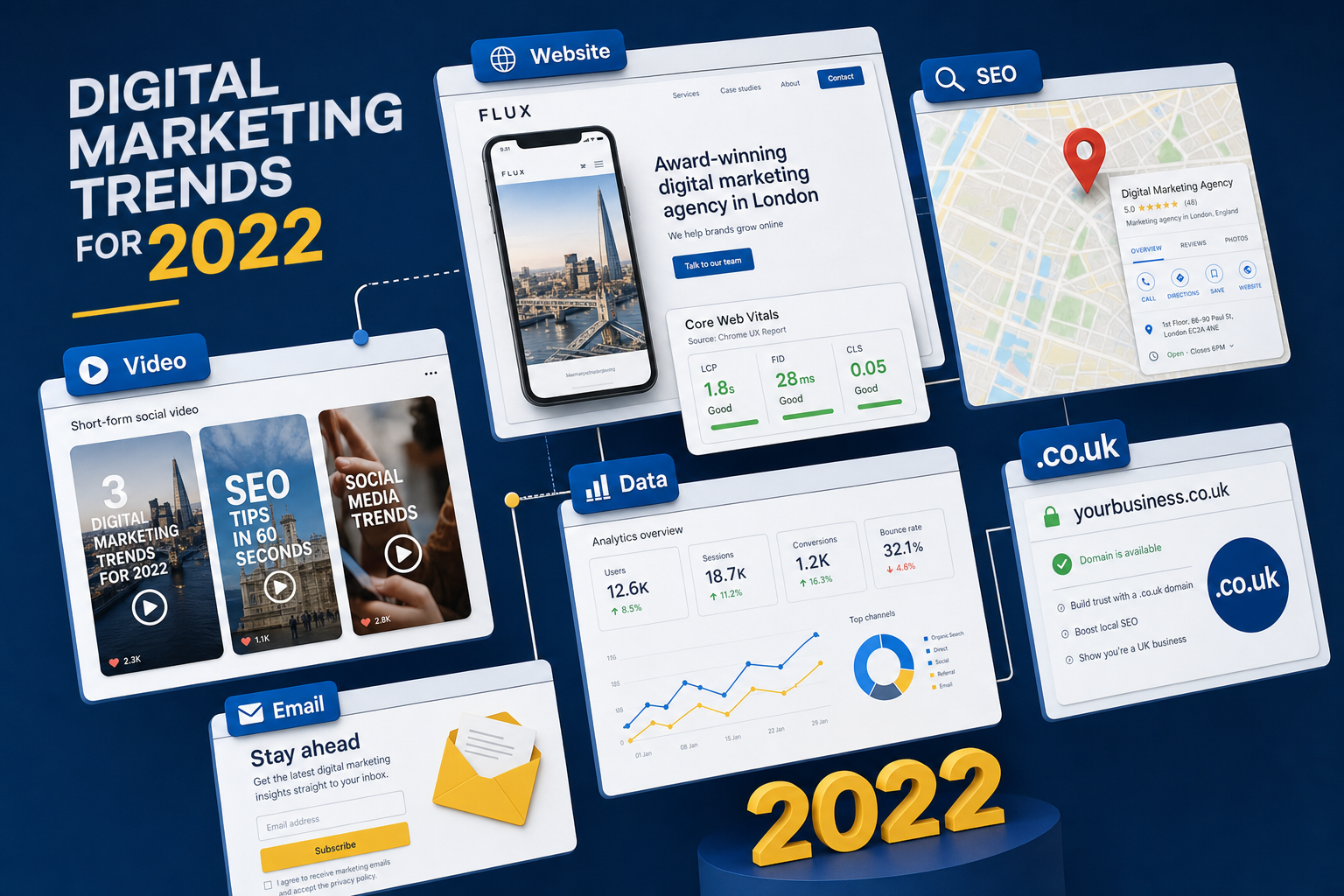
As businesses plan for growth in 2022, digital marketing is no longer a separate activity that sits outside the rest of the organisation. Your website, search visibility, social channels, brand identity, customer data and online reputation all work together to influence how people discover, trust and buy from you. The most useful Digital Marketing Trends for 2022 are not about chasing every new platform or tactic. They are about building a stronger, clearer and more measurable online presence that supports real business goals.
For UK business owners, the coming year is a good time to review whether your digital activity is helping customers take the next step. Can people find you in search? Does your website explain your value quickly? Are your social posts building trust, or simply filling a schedule? Are you collecting useful first-party data with proper consent? The trends below focus on practical improvements that can help your business compete online in 2022.
1. Websites need to be faster, clearer and more conversion-focused
Your website remains the centre of your digital marketing. Social media can introduce people to your business, and search engines can send visitors your way, but your website usually has the job of turning interest into action. In 2022, a good business website should load quickly, be easy to use on mobile and clearly explain what you offer.
Website design is moving further away from cluttered pages, vague straplines and unnecessary decoration. Visitors want to understand who you help, what problem you solve and what to do next. This is especially important for service-based businesses, where trust and clarity affect the quality of enquiries.
Practical improvements include reviewing your homepage message, simplifying navigation, making contact options easy to find and improving key landing pages. If your calls to action are hidden, inconsistent or too generic, users may leave before making an enquiry. A clear button such as Book a consultation, Request a quote or Speak to our team is often more useful than a vague button label.
Performance also matters. Google’s Core Web Vitals have made page experience a more visible part of search marketing conversations, and users have little patience for slow or unstable pages. Large images, excessive scripts and poorly built themes can make a website feel sluggish. In 2022, businesses should treat speed, mobile usability and accessibility as part of the design process, not as technical extras added at the end.
2. Search marketing is becoming more intent-led
SEO in 2022 is less about chasing individual keywords in isolation and more about understanding search intent. A potential customer searching for emergency plumber near me has a very different need from someone searching for how to choose a bathroom installer. Both searches may be valuable, but they require different pages, messages and calls to action.
Businesses should review whether their website content matches the questions and concerns of their audience. Service pages need to be specific, useful and well structured. Blog content should answer genuine questions rather than exist only for keyword coverage. Location pages, where relevant, should provide meaningful local information instead of thin, duplicated text.
Local SEO will remain important for many UK businesses in 2022. A well-maintained Google Business Profile, accurate opening hours, strong reviews and consistent contact details across the web can support local visibility. Businesses should also add relevant photos, keep service information up to date and respond professionally to reviews.
Search results are also becoming more varied, with featured snippets, map results, image results, video results and frequently asked question-style content all competing for attention. This means your SEO strategy should include a mixture of well-written pages, helpful articles, structured page headings and visual content where appropriate. The goal is not only to rank, but to be the most useful and trustworthy result for the query.
3. First-party data and privacy will shape better marketing
Privacy is one of the most important Digital Marketing Trends for 2022 for businesses that rely on online advertising, email marketing or website analytics. Changes to browser tracking, mobile privacy settings and cookie consent have made it harder to depend on third-party data in the same way as before. For UK organisations, this sits alongside the ongoing need to follow GDPR and PECR requirements.
The practical response is to build stronger first-party data. This means collecting information directly from people who choose to hear from you, such as email subscribers, customers, event attendees, members or enquiry leads. The quality of this data is often more valuable than its size because it reflects a real relationship with your audience.
Businesses should make sign-up forms clear, explain what people will receive and avoid asking for more information than necessary. For example, a consultancy might offer a useful planning guide in exchange for an email address, while a retailer might invite customers to join a mailing list for product updates and useful advice. Consent should be clear, records should be maintained and unsubscribe options should be easy to use.
Analytics should also be reviewed. Many businesses have tracking installed but rarely look at the information in a meaningful way. In 2022, it is worth focusing on practical measures such as enquiry form completions, phone link clicks, popular service pages, traffic sources and landing page performance. These insights can help you improve your website and campaigns without relying on guesswork.
4. Short-form video and social storytelling will keep growing
Short-form video has become a major part of social media marketing, with platforms such as TikTok, Instagram Reels and YouTube Shorts encouraging quick, engaging content. For businesses, this does not mean every post needs to follow a trend or be highly polished. It does mean that audiences are increasingly comfortable consuming quick explanations, behind-the-scenes updates and practical tips in video format.
In 2022, businesses can use short-form video to make their expertise more visible. A solicitor might explain a common misunderstanding in plain English. A fitness studio might demonstrate a simple exercise. A manufacturer might show the quality control process behind a product. A local café might share how a seasonal menu item is prepared. The format works best when it is useful, authentic and easy to understand.
Social media should also be more strategic. Posting every day without a clear purpose can waste time. Instead, businesses should define a small number of content pillars, such as education, proof, culture, product information and community involvement. This makes planning easier and creates a more consistent brand presence.
Different platforms still serve different purposes. LinkedIn remains valuable for business-to-business visibility, recruitment and professional credibility. Instagram suits visual brands, lifestyle content and community engagement. Facebook continues to be useful for many local businesses and community-based audiences. TikTok offers discovery potential for businesses willing to create entertaining or educational short-form content. The best platform is the one your audience actually uses and where your business can communicate consistently.
5. Brand consistency matters more as competition increases
As more businesses invest in digital marketing, standing out becomes harder. A strong brand is not just a logo; it is the consistent impression people get from your website, social media, emails, imagery, tone of voice and customer experience. In 2022, businesses that look professional, communicate clearly and show their personality are more likely to build trust online.
Brand consistency starts with the basics. Use the same name, visual style, colours, typography and messaging across your digital channels. Make sure your website reflects the same level of quality as your sales conversations or physical premises. If your social media is informal but your website is cold and generic, the customer experience can feel disconnected.
Your brand positioning should also be clear. Who do you serve? What makes your approach different? Why should someone choose you instead of a competitor? These questions should be answered across your homepage, service pages and campaign landing pages. Vague claims such as high-quality service or industry-leading solutions are less persuasive than specific benefits, examples of your process and clear evidence of expertise.
A strong digital brand helps customers recognise you, understand you and remember you when they are ready to buy.
6. Domain names and digital foundations need careful attention
Domain registration can seem like a small administrative task, but it is an important part of your online identity. A good domain name should be easy to spell, easy to say and closely connected to your business name or service. For UK businesses, it is often sensible to consider relevant UK domain extensions alongside broader options, depending on your market and audience.
When choosing a domain, avoid unnecessary hyphens, confusing spellings or names that are too close to another organisation. Think about how the domain will look on a van, business card, email address, advert or social profile. If you have to explain it every time, it may cause problems later.
It is also sensible to keep domain ownership details organised within the business. Make sure renewal dates are monitored, access is not tied only to one individual and DNS settings are documented. Losing access to a domain or allowing it to expire can disrupt your website, email and marketing activity.
Secure hosting, SSL certificates, reliable backups and professional email setup should be treated as part of your digital marketing foundations. Customers may not notice when these elements are working well, but they will quickly notice if your site is unavailable, security warnings appear or emails fail to arrive.
7. Content quality will beat content volume
Publishing more content is not always the answer. In 2022, many businesses would benefit from improving existing content before creating large numbers of new pages. This includes rewriting weak service pages, updating old blog posts, improving internal links and making key information easier to find.
Good content helps customers make decisions. It explains your services, answers common questions and reduces uncertainty. For example, a website design agency might publish guidance on planning a new website, what to prepare before a project starts and how to choose the right platform. A trades business might explain what affects project timescales and how customers can prepare their property. A professional services firm might clarify its process and what clients can expect at each stage.
Content should also support sales conversations. If your team repeatedly answers the same questions by email or phone, those answers may deserve a place on your website. This saves time, improves trust and helps potential customers qualify themselves before getting in touch.
8. Paid advertising will need better landing pages and measurement
Paid search and social advertising can still be highly effective in 2022, but rising competition means businesses need to be more disciplined. Sending paid traffic to a weak homepage is rarely the best use of budget. Campaigns usually perform better when they lead to a relevant landing page with a clear message, strong proof points and a simple enquiry route.
Before increasing advertising activity, review the full journey. Does the advert match the landing page? Does the page answer the user’s likely question? Is the form too long? Is the phone number easy to tap on mobile? Are you tracking enquiries accurately? Small improvements in these areas can make campaigns more effective without changing the media spend.
Businesses should also avoid measuring success only by clicks or impressions. These numbers can be useful, but they do not show whether marketing is generating quality enquiries or sales. Better measures include conversion rate, enquiry quality, cost per lead, repeat business, assisted conversions and the performance of different landing pages.
Preparing your business for digital marketing in 2022
The strongest digital marketing strategies for 2022 will be practical, connected and customer-focused. A fast, well-designed website supports SEO. Clear branding improves trust. Useful content supports social media, search and sales. First-party data improves communication. Better measurement helps you decide what to do next.
Rather than trying to follow every trend at once, start with the areas most likely to affect your business. If your website is slow or unclear, fix that first. If local enquiries matter, improve your local search presence and reviews. If you rely on social media, create a more consistent content plan. If your marketing data is limited, improve tracking and consent-led data capture.
The businesses that benefit most from Digital Marketing Trends for 2022 will be those that combine creativity with solid foundations. By investing in your website, search visibility, brand, content and data, you can create a digital presence that works harder for your business throughout the year.