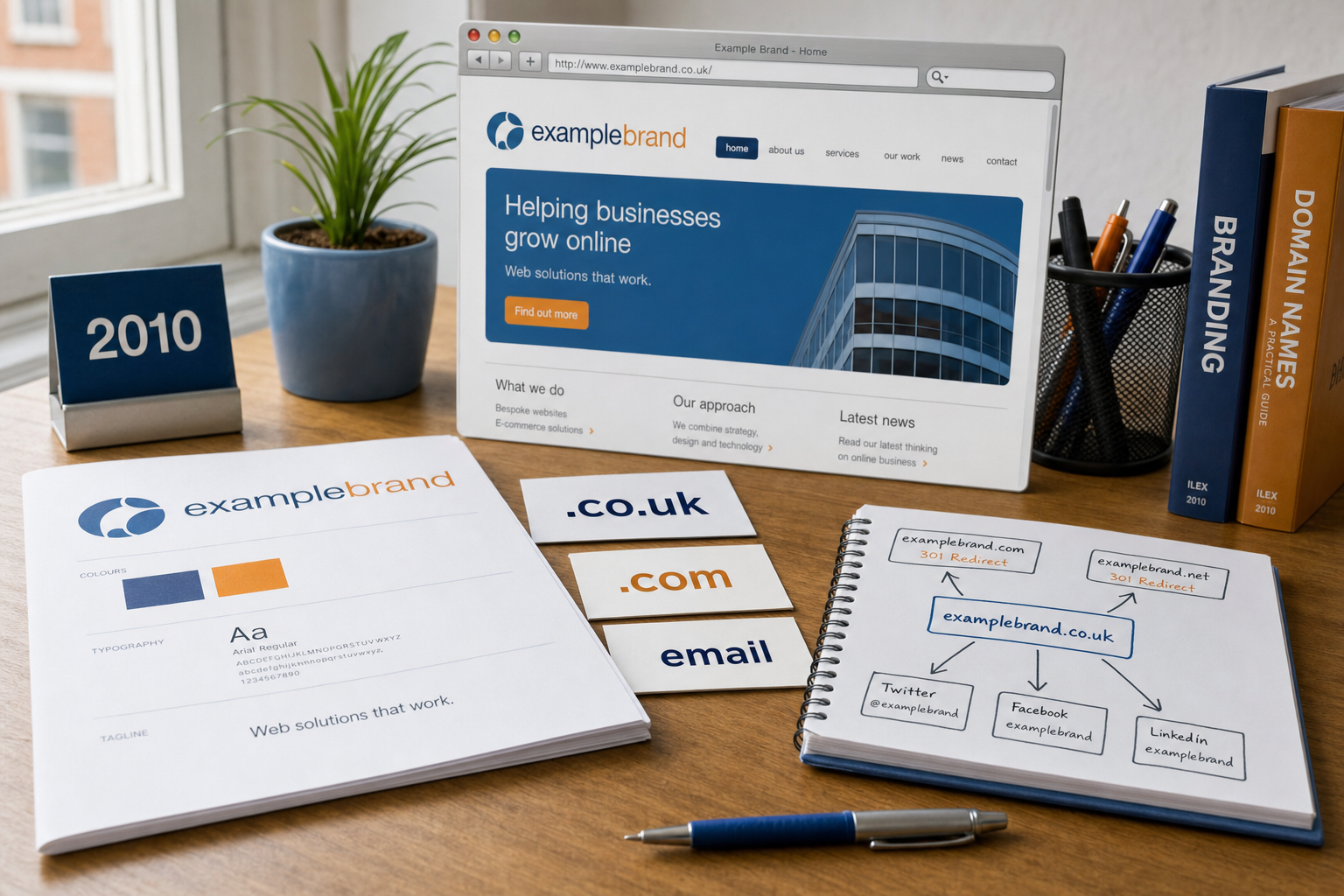
For a growing business, a domain name is more than a technical address. It is part of the way people remember you, recommend you and decide whether you look credible enough to contact. The right choice of brand domain names can support your website design, email, search marketing, and broader brand protection. The wrong choice can create confusion, send enquiries elsewhere or leave openings for competitors and opportunists.
Many UK businesses are now investing more in their websites, search engine optimisation, and social media activity. Yet the domain name is sometimes treated as an afterthought, chosen quickly just before a site goes live. It is worth giving it the same consideration as a trading name, a logo, or a printed brochure. A clear, defensible domain can become one of the most useful marketing assets your organisation owns.
Why brand domain names matter
Your domain name is often the first piece of your online presence a customer sees. It appears on business cards, vans, letterheads, directory listings, email signatures, search results and adverts. If it is easy to understand and type, it helps people reach you without friction. If it is awkward, too long or easily confused, it can quietly reduce response rates from otherwise good marketing.
Brand domain names are particularly valuable because they build recognition over time. A descriptive domain, such as a town-and-service combination, may be useful for a campaign, but your main domain should ideally reinforce the business name people already know. When a customer hears your name in conversation, sees your vehicle in traffic or reads about you in a local publication, they should be able to make a sensible guess at your web address.
A branded domain also improves trust. Customers are becoming more cautious about where they enter details or request quotes online. A business using a domain that matches its trading name, supported by a professional website and consistent email addresses, looks more established than one relying on a generic address or a confusing variation. This does not mean every small company needs a large corporate identity, but it does mean clarity and consistency count.
Choosing a domain that supports your brand
The best domain names are simple, memorable and difficult to misinterpret. If your company name is short and distinctive, the decision may be straightforward. If it is long, commonly misspelt, or similar to other organisations, you may need to think carefully about which version will work best online.
As a rule, choose the shortest clear version of your trading name that customers would naturally use. Avoid unnecessary words if they make the address clumsy. For example, a business called Greenfield Office Supplies might prefer greenfieldoffice.co.uk if that is the phrase customers commonly use, while still registering the fuller version where appropriate. The important point is that the chosen domain should feel connected to the real business, not like an unrelated keyword exercise.
Hyphens can sometimes make words easier to read, especially in a long domain, but they are often forgotten when spoken aloud. If you choose a hyphenated version, consider whether the non-hyphenated version should also be registered and redirected. Numbers can create similar problems. If your brand includes a number, decide whether customers are likely to type the numeral or the word, and protect both if the distinction matters.
It is also worth checking how the domain looks when written without spaces. Some perfectly reasonable business names become ambiguous or unfortunate when run together. Read the address aloud, write it in lower case and ask someone outside the business to type it after hearing it once. This simple exercise often reveals problems before they become expensive habits.
Choosing extensions for UK businesses
For most UK businesses, the main decision is whether to use a UK-focused domain, an international domain, or both. A UK extension can reassure domestic customers that the business is based in, or serves, the United Kingdom. An international extension can be useful when the brand may trade beyond the UK, when customers expect it, or when a shorter, cleaner version is available.
In many cases, it is sensible to register the main UK and international versions of the same brand domain name if available. One should be chosen as the primary web address, while the other redirects to it. This prevents confusion, protects the brand from unnecessary risk and makes it easier to use the address in different types of marketing. For example, a UK retailer may use the UK version in local advertising while still retaining the international version to prevent others from using the same name.
Other extensions can have a role, but they should be chosen with care. Some are suited to charities, information projects, or specific types of online services, while others may not command the same level of trust for a mainstream trading business. Registering every possible extension is rarely practical or necessary. Focus first on the versions customers are most likely to type, remember and trust.
Protecting your business from confusion and misuse
Brand protection is not only about large companies. Smaller firms can suffer real inconvenience when a similar domain is registered by someone else, even without any deliberate intent. A supplier may send an email to the wrong address, customers may land on a competing site, or a third party may benefit from your reputation.
A practical protection plan starts with the obvious variations. Consider registering common misspellings, singular and plural forms, hyphenated and non-hyphenated forms, and the main UK and international extensions. You do not need to build separate websites for each one. In most cases, these domains should redirect to your main website using a permanent redirect, so visitors and search engines understand the preferred destination.
If your brand name is distinctive and important to future growth, it is also sensible to consult a qualified adviser on trade mark considerations. Domain registration alone does not give you full legal rights to a name, and owning a registered trade mark does not automatically mean every domain can be recovered without process. However, aligning your trading name, trade mark position, and domain portfolio can significantly reduce risk.
Keep accurate records of who owns each domain, where it is registered, when it renews, and which contact details are associated with it. A surprising number of businesses lose control of domains because they were registered by a former employee, a friend or an old supplier using personal details. Your business should know exactly which names it controls and should keep renewal notices going to a monitored address.
Using domains properly with your website design
A domain name is most powerful when a professional, well-structured website supports it. If your web address is clear but the site looks dated, loads slowly or fails to explain what you do, the brand benefit is wasted. The domain brings people to the door; the website has to help them take the next step.
When planning a new website design, decide which domain will be the primary address from the start. Use one consistent version throughout the site, in navigation, on contact pages and in printed material. If alternative domains are used, they should redirect cleanly to the primary address rather than showing duplicate copies of the same website. Duplicate sites can confuse visitors and may also dilute search visibility.
Your domain should also be reflected in professional email addresses. An address using your own domain is generally more credible than a free webmail address, particularly for sales enquiries, account correspondence and customer service. It reinforces the brand with every message sent and makes the business appear more permanent.
For businesses with more than one service, location, or campaign, sub-sections of the main site are often preferable to separate domains. For example, a firm offering installation, repair, and maintenance may create dedicated pages within a single branded website rather than splitting the activity across several small sites. This helps build authority around the main brand and keeps marketing easier to manage.
Search marketing and domain names
Domain names can influence search marketing, but they should not be viewed as a shortcut. Search engines look at many signals, including relevant content, links, site structure, page titles, headings and the general usefulness of a website. A keyword-rich domain may help people understand a site, but a strong brand domain with good content and sensible optimisation can perform very well.
For a growing business, the safest long-term approach is to build search visibility around the brand and the services it provides. Use your main domain consistently, create well-written pages for key products and locations, and ensure each page has a clear purpose. A domain stuffed with keywords may look tempting, but it can be difficult to turn into a memorable brand and may appear less trustworthy in offline marketing.
If you already own several domains, avoid spreading your effort too thinly. One well-maintained website is usually more valuable than a collection of thin, neglected sites. Supporting domains can be redirected, used for specific printed campaigns or reserved for future projects, but they should not create a confusing network of duplicate pages.
Paid search campaigns can also benefit from a clear domain. When your advert displays a web address that matches the business name and the landing page, the message feels more coherent. This can help customers feel confident they are clicking through to the right place, especially when comparing several suppliers.
Social media and consistent naming
Social media is becoming a more important part of online marketing for many businesses. Professional networking sites, microblogging services, video-sharing sites, and social profile pages can all influence how customers encounter your brand. While these profiles are not replacements for your own website, they can help build awareness and spark conversation
Where possible, secure social profile names that match your brand domain names or trading name. Consistency makes it easier for customers to find you and reduces the chance of another party using a confusingly similar name. Even if you are not ready to use every channel actively, it may be sensible to reserve the most important names and complete a basic profile with correct contact details.
Do not build your whole digital presence on a social platform you do not control. Your domain and website should remain the centre of your online marketing. Social activity should point people back to useful pages on your site, where you control the presentation, content, enquiry forms and measurement. This is especially important for businesses investing in search marketing, email campaigns or offline advertising.
Practical steps before registering a domain
Before registering a new domain, take a moment to consider the bigger picture. Search for the proposed name, look for similar businesses, test spelling variations and consider how the address will look on a sign, advert or email footer. Ask whether it is easy to say over the telephone. If you have to explain it every time, it may not be the strongest choice.
Make sure the domain is registered under the correct business name and that administrative access is secured. Use a reliable registration provider, keep login details safe and record renewal dates. If a web designer or marketing supplier registers a domain on your behalf, agree ownership and access in writing before work begins. The domain should be a business asset, not something that becomes difficult to retrieve later.
Check that the contact email used for the domain will remain accessible. Avoid relying on an individual employee email address if that person may leave. A monitored general address can be more reliable for renewal reminders and administrative notices. Missing a renewal can result in website downtime, lost email and unnecessary stress.
Once the domain is registered, configure it properly. Set up email, point the web address to the correct hosting, and redirect any secondary domains to the primary site. Test both versions, with and without the common website prefix, so visitors arrive successfully whichever one they type. Good technical set-up is not glamorous, but it prevents many avoidable problems.
When to use more than one domain
There are good reasons to own more than one domain. You may want to protect a brand, support a specific campaign, cover a product name or prepare for expansion into a new region. The key is to understand the purpose of each domain and to manage them as a small portfolio rather than a random collection.
Campaign domains can be useful when a short, memorable address is needed for radio, print or outdoor advertising. However, the campaign should still connect clearly to the main brand. If visitors arrive at a promotional address and then see a completely different company identity, trust may be reduced. A clean redirect or a branded landing page can solve this.
Product domains can work where a product has its own name and marketing strategy, but they should not compete with the main company site unless there is a deliberate plan. For most growing businesses, it is better to build one strong web presence and use additional domains to support it.
A domain strategy for steady growth
Brand domain names should be treated as part of your overall digital strategy. They affect how people remember you, how professional your email looks, how consistently your website is promoted and how well your brand is protected from confusion. The decisions are not complicated, but they do deserve attention before a website design or marketing campaign gathers momentum.
Start with a clear primary domain that reflects your trading name. Register the most important variations and extensions where they are likely to matter. Keep ownership records tidy, configure redirects correctly and use the domain consistently across your website, email, printed material and social profiles. Then support it with useful content, sound search optimisation and a website that gives visitors confidence.
For UK business owners investing in design, SEO or online marketing, a good domain strategy is a practical foundation. It will not replace good service, strong content or effective promotion, but it will help all of those things work harder. A memorable, protected and well-managed domain is one of the simplest ways to make your brand easier to find, trust and recommend.