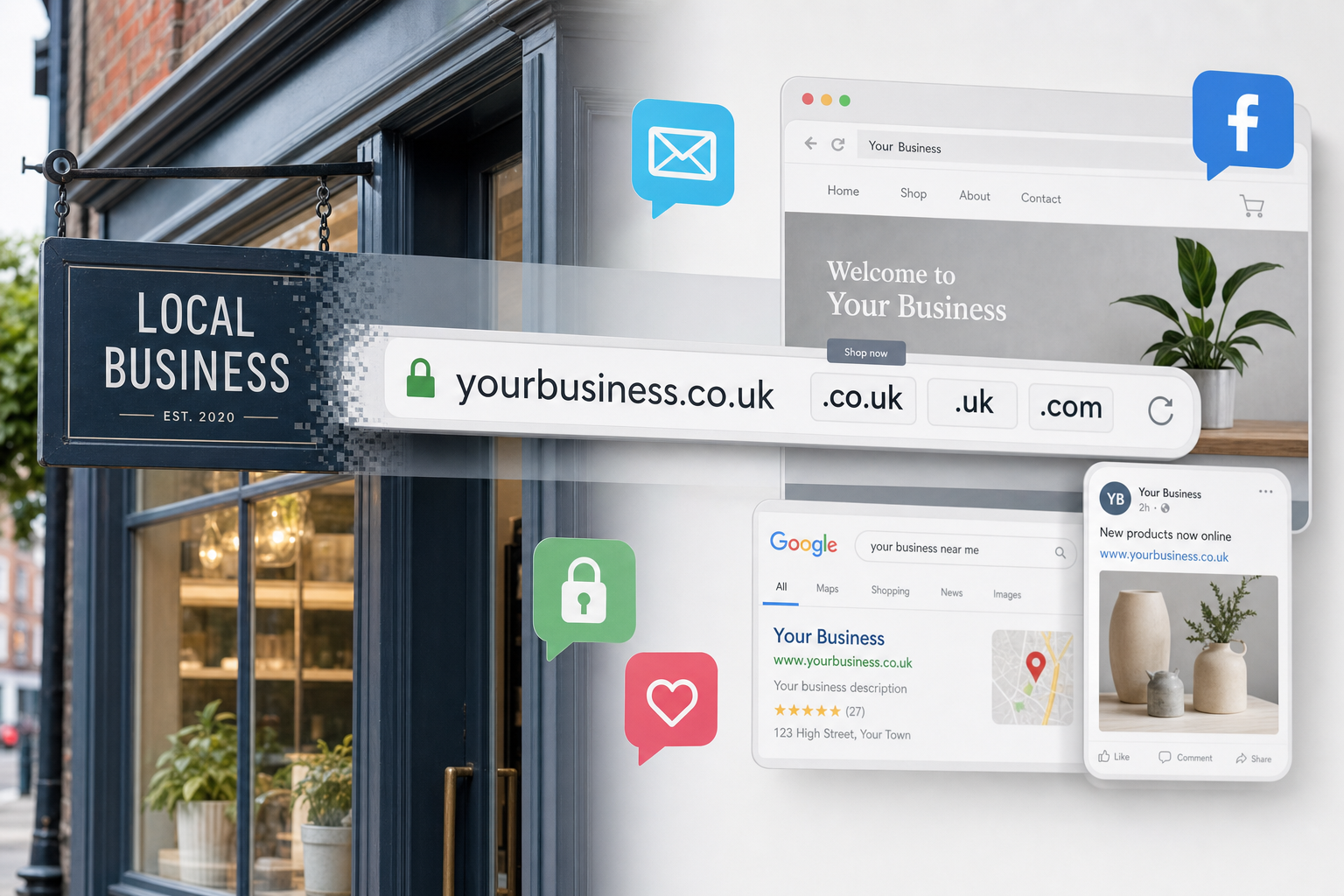
Choosing a domain name is one of the first practical decisions many new business owners make. Whether you are launching a side business from home, preparing an online shop, or turning an existing local service into a more professional digital presence, your domain name will sit at the centre of your brand. It appears on your website, email address, invoices, social profiles, search listings, packaging and printed materials. For that reason, domain names for new side businesses and online shops deserve more thought than simply picking the first available address that sounds close enough.
A good domain name does not build a business by itself, but it can make your marketing easier. It can help customers remember you, give your website a more credible first impression, and provide a stable foundation for search engine optimisation, content marketing and paid advertising. The right choice should feel clear, trustworthy and practical now, while still allowing room for the business to develop.
Why your domain name matters when starting up
For a new business, a domain name is often the first owned digital asset. Social media accounts are useful, but they sit on platforms you do not control. A domain gives you a home base that can remain consistent even if algorithms, platform features or customer behaviour change. It also allows you to use a branded email address, which usually looks more professional than a free personal email account when speaking to suppliers, customers and press contacts.
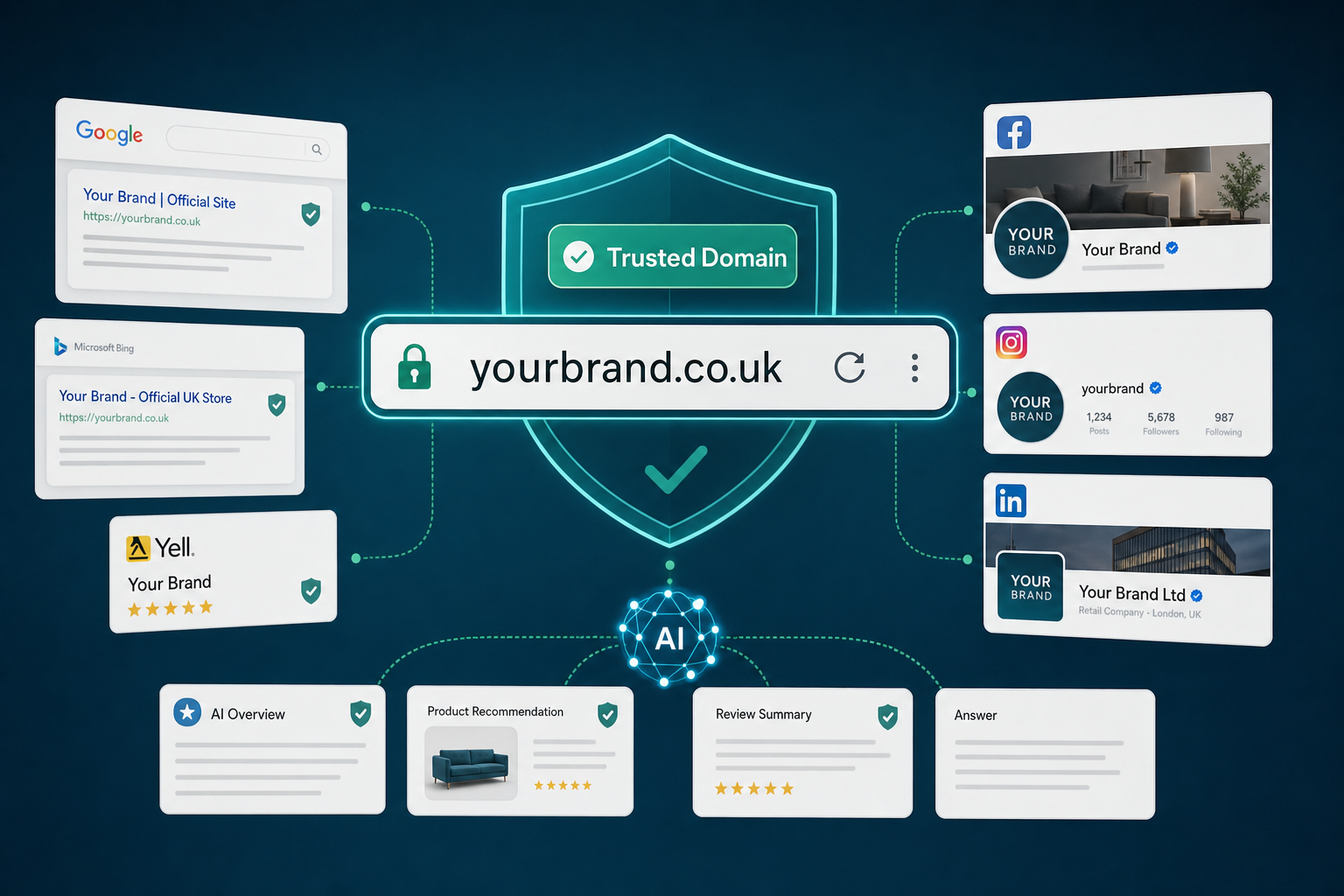
Trust is especially important for online shops and service businesses asking people to enquire, book or pay. A clear domain name can reassure visitors that they have reached the correct business. It can also make word-of-mouth easier. If someone hears your business name on a phone call, in a podcast interview or at a local networking event, they should have a reasonable chance of finding you afterwards.
From a search marketing perspective, your domain is one of many signals that contribute to your online visibility. It is not a shortcut to high rankings. Search engines consider content quality, relevance, technical performance, links, user experience and many other factors. However, a sensible domain can support those efforts by being memorable, consistent with your brand and easy to reference from other websites.
Brandable, descriptive or exact-match: what should you choose
Many start-up founders begin by asking whether their domain should include a keyword. For example, a new handmade candle shop in Bristol might look at options such as bristolcandles, oakandwick, or a combination of both. Each approach has strengths and weaknesses.
A descriptive domain can quickly explain what you do. This is useful if your business name is still unfamiliar or if you trade in a specific local area. A name such as yorkshireplantcare or brightonbikerepairs is immediately understandable, although it may feel limiting if the business later expands into new products, locations or services.
A brandable domain is usually more distinctive. It might be a coined name, a real word used creatively, or a combination of two words that suggests a feeling rather than directly describing the offer. Brandable names can be stronger over the long term because they are easier to protect, style and build campaigns around. The trade-off is that you may need clearer website copy and marketing activity to explain what the business does.
Exact-match domains, where the domain mirrors a target search phrase, are no longer the simple ranking tactic they were sometimes considered to be in earlier years. A domain containing a useful word can still be helpful for clarity, but it should not come at the expense of quality, trust or usability. If a keyword-heavy address looks awkward, spammy or difficult to say, it may work against the professional impression you are trying to create.
Choosing the right extension for a UK business
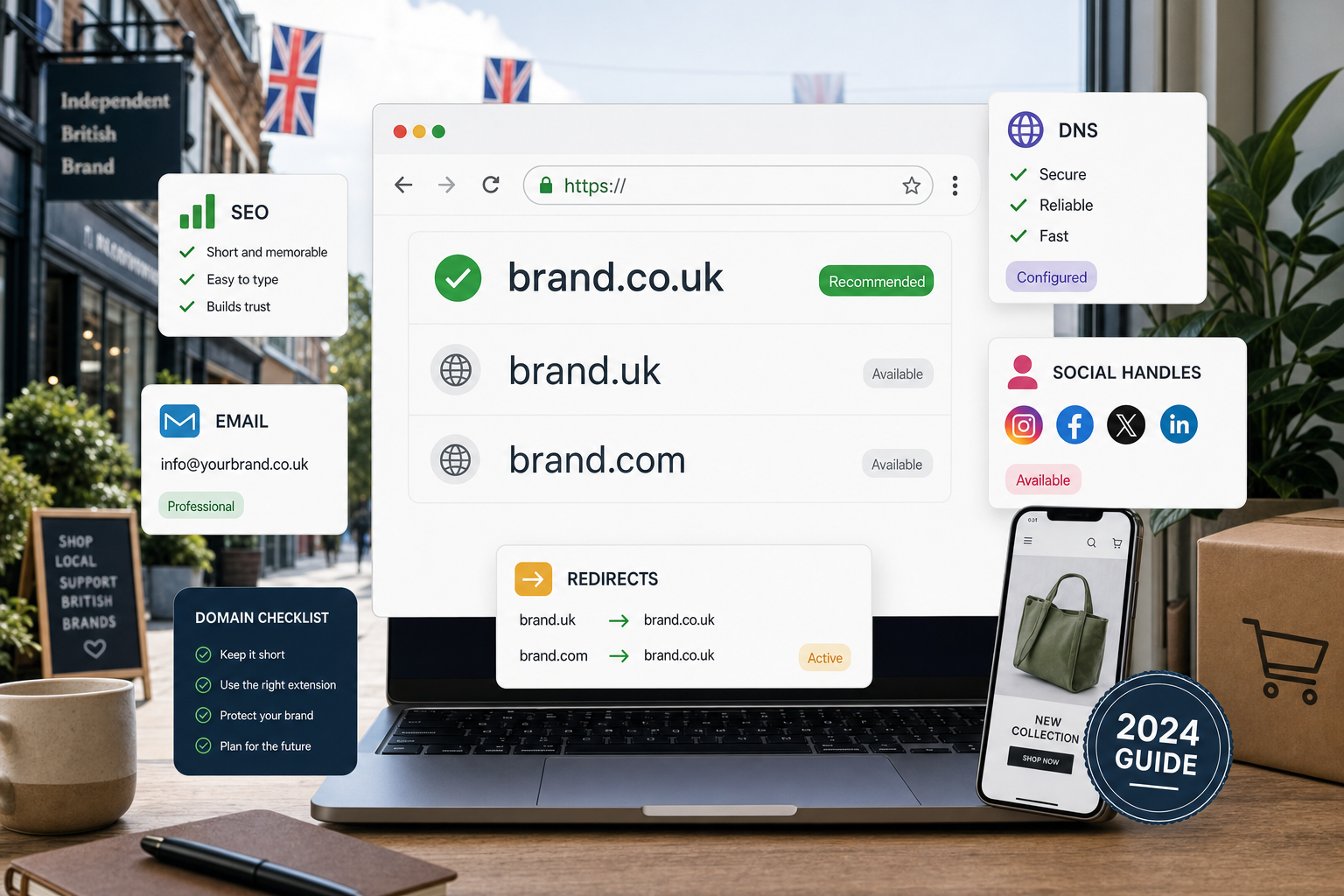
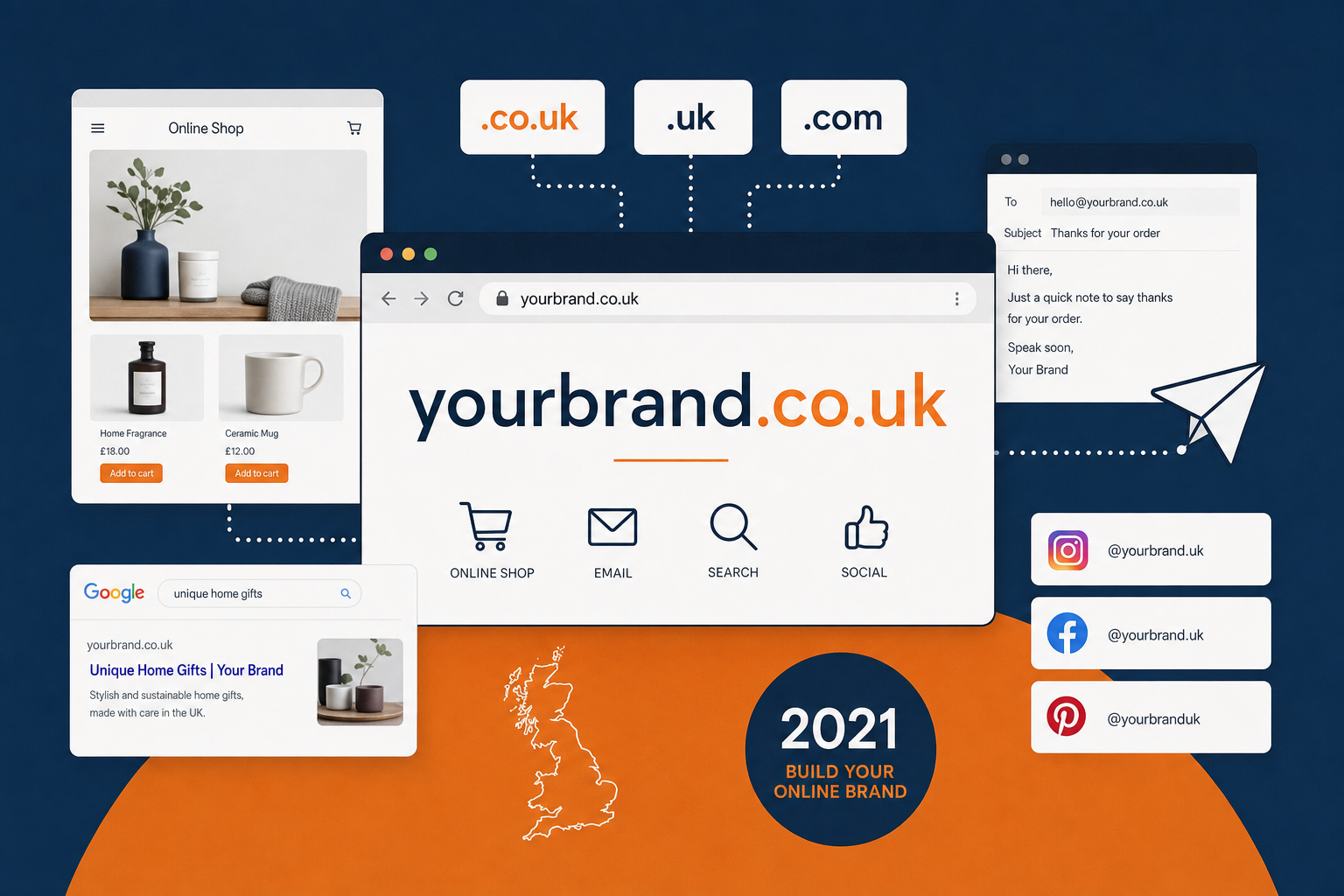
The extension, also called the top-level domain, is the part at the end of the address. For UK businesses, .co.uk remains a familiar and trusted option. The shorter .uk extension is also available and can work well for businesses that want a concise address. A .com domain is widely recognised and may be useful if you plan to sell internationally or want a more global feel.
There are also many newer extensions, such as .shop, .store, .studio, .design and .online. These can be useful when the most obvious .co.uk or .com versions are unavailable, and they can help communicate your sector. However, they should be chosen carefully. Some customers still instinctively type .co.uk or .com, so a less familiar extension may require slightly more consistency in your marketing.
If your budget and availability allow, it is often sensible to secure the most relevant versions of your main domain, especially common UK and international variants. This can help protect your brand from confusion and makes future expansion easier. You do not need to build separate websites on each version. In most cases, one primary domain should be used for the website, with other domains redirecting cleanly to it.
Practical checks before registering a domain
Before registering a domain, take time to check whether the name is suitable beyond simple availability. A domain might be technically available but still create branding, legal or marketing problems. Start by searching the web for the name and similar phrases. Look for businesses in the same sector, especially in the UK, that could cause confusion.
It is also wise to check trade mark databases and consider getting legal advice if the name will be central to a serious venture. Avoid choosing a domain that is too close to an established brand, even if the exact domain is free. Confusion can damage your credibility and may create avoidable disputes later.
Say the domain aloud. Does it pass the radio test? If someone hears it once, can they spell it? Avoid unnecessary hyphens, numbers and unusual spellings unless they are a deliberate and well-supported part of the brand. A clever spelling may look good in a logo, but it can become frustrating if customers keep typing the wrong address.
Check how the domain looks in lowercase, as web addresses are often displayed that way. Words can accidentally join together to form unintended meanings. Also consider whether the name works in an email address. A domain that is already long can make email addresses look untidy, particularly for staff names or department addresses.
Domain registration basics for new business owners
When you are ready to register, use a reputable domain registration provider and make sure the domain is registered in the correct name. For a sole trader, that may be the business owner. For a limited company, it is usually better for the company to be the registrant. Keep access details secure, use a strong, unique password, and ensure renewal reminders go to an actively monitored email address.
Set the domain to renew reliably and keep payment details up to date. Losing a domain because of an expired renewal can interrupt your website, email and online shop at the worst possible moment. It can also create a risk that someone else registers the domain after it lapses.
You should also understand the difference between domain registration, website hosting and email hosting. They are connected, but they are not the same service. Your domain is the address. Hosting is where your website files or shop platform live. Email hosting handles your mailbox. Keeping these elements organised from the beginning makes it easier to work with web designers, developers and marketing partners later.
How your domain affects website design and structure
A strong domain should support a clear website structure. For a start-up website, the first version does not need to be complicated, but it should have room to grow. A service business may begin with a homepage, service pages, an about page, a contact page and a small blog or advice section. An online shop may need product categories, product pages, delivery information, returns information and customer support content.
Your domain choice should also match the level of professionalism in your website design. If your domain is clean and memorable but the site is slow, confusing or poorly written, the benefit is quickly lost. In 2021, customers expect websites to work well on mobile devices, load quickly and provide clear calls to action. For online shops, product information, photography, checkout clarity and secure browsing are essential.
HTTPS should be in place from the start. A secure certificate helps protect data and prevents browsers from showing avoidable warnings. It is now a basic expectation for any credible business website, particularly for e-commerce, enquiries and account areas. Search engines also favour secure, well-maintained websites as part of a broader commitment to quality and user safety.
Using your domain with e-commerce platforms
Many new online shops start on hosted e-commerce platforms or WordPress with WooCommerce. These tools can be an efficient way to begin selling without building everything from scratch. However, it is still important to connect your own domain rather than relying on a temporary platform address. Your own domain gives customers a consistent destination and keeps your brand at the front of the experience.
Think carefully about product category names and URLs. A simple structure such as yourdomain.co.uk/collections/ceramic-mugs or yourdomain.co.uk/category/skincare can be easier for customers and search engines to understand than overly long or automatically generated addresses. If you later change platforms, plan the move carefully so that important URLs are redirected and search visibility is not lost unnecessarily.
For side businesses, it can be tempting to launch quickly and fix the details later. Speed can be useful, but the domain, analytics, Search Console access, email and basic SEO settings should still be set up properly. These foundations make it easier to measure what is working and improve the site over time.
Social media consistency and brand protection
Your domain should work alongside your social media handles. Before committing to a business name, check whether closely matching handles are available on the platforms most relevant to your audience. For many UK start-ups, that might include Instagram, Facebook, LinkedIn, Twitter, Pinterest or TikTok, depending on the product, service and customer base.
Exact matches are not always possible, but consistency helps. If your domain is very different from your social handles, customers may become unsure whether they have found the right organisation. A simple pattern, such as using the same core name with a UK or sector word added where needed, can keep the brand recognisable.
Social platforms are excellent for discovery, conversation and community, but they should guide people back to your website when appropriate. Your domain is where you can present your full offer, publish detailed content, capture enquiries and build an email list. This balance is particularly important for start-ups that do not want to rely entirely on one platform for sales.
SEO considerations for domain names for start-ups
When planning domain names for start-ups, it is helpful to think of SEO as a long-term process rather than a one-off naming trick. A concise, relevant domain can improve click confidence in search results, especially when paired with well-written page titles and descriptions. However, the domain will not compensate for thin content, weak page structure or a poor customer experience.
If you are targeting a local market, you do not necessarily need the town or county in the domain. Local relevance can be built through page content, contact details, Google My Business, local citations, customer reviews and useful service area pages. A location in the domain can be effective for a business that intends to remain local, but it may be restrictive if expansion is likely.
Avoid changing domains without a clear reason. Domain changes can be managed, but they require planning, redirects, updates to business listings, email changes and careful monitoring. For a start-up, it is better to choose a domain you can confidently use for several years. Stability helps customers recognise you and gives your SEO activity a consistent base.
Common mistakes to avoid
- Choosing a name that is too narrow: A domain based on one product may become limiting if your range grows.
- Using awkward spellings: If customers cannot spell it after hearing it, you may lose direct traffic and referrals.
- Relying only on social media: Social profiles are useful, but your domain and website should be your owned base.
- Ignoring email: A branded email address can improve trust in sales, support and supplier conversations.
- Forgetting renewals: Missed renewals can disrupt websites and email, so administration matters.
- Copying competitors too closely: Similar names create confusion and can weaken your brand from the start.
A simple decision process
If you are deciding between several domain options, score each one against a practical checklist. Is it easy to say, spell and remember? Does it suit the type of business you are building? Is it flexible enough for future products or locations? Are matching or similar social handles available? Could it be confused with another UK business? Does it look professional in an email address?
Once you have a shortlist, ask a few trusted people to write the domain after hearing it spoken. Their mistakes will show you where customers may struggle. You can also test how the name feels in common marketing situations: on a business card, in an Instagram bio, at the bottom of an invoice, in a Google search result and on packaging. A good domain should feel natural in all of these places.
Finally, consider how the name supports the story you want to tell. Start-ups often evolve, but the best domains provide a steady anchor. They give the business a recognisable identity and make it easier to build a professional website, run search campaigns, develop content and connect social activity into a wider digital strategy.
Building a stronger digital foundation
Your domain name is only one part of launching a successful side business or online shop, but it is a decision worth making carefully. It influences branding, customer trust, website design, email, SEO and social media marketing. For UK business owners, the aim should be a domain that is clear, credible and suitable for growth.
Start with the customer. Choose a name they can understand, remember and trust. Then support it with a well-designed website, useful content, secure technology and consistent marketing. When those elements work together, your domain becomes more than an address. It becomes a practical foundation for building visibility, confidence and long-term business value online.