Email deliverability has moved from a technical afterthought to a practical business priority. If your emails do not reach the inbox, your campaigns, customer service updates, booking reminders and sales follow-ups lose value before anyone has a chance to read them. For UK business owners investing in website design, SEO, branding or digital strategy, stronger sending practices now sit alongside good content and clear user experience as part of a reliable online presence.
In 2024, major mailbox providers are applying stricter expectations to commercial senders. The direction is clear: businesses need to prove they are who they say they are, send to people who have asked to hear from them, make unsubscribing simple and keep complaint rates low. These rules may feel technical at first, but they encourage the same behaviour that customers already expect from trustworthy brands.
Why email deliverability matters more in 2024
Email remains one of the most direct digital marketing channels available to a business. Search and social media are essential for visibility, but email gives you a way to speak to an audience that has actively chosen to hear from you. That value depends on whether your messages are accepted, filtered, delayed, placed in promotions tabs or sent to spam.
Email deliverability is the combination of technical setup, sender reputation, list quality, content, engagement and compliance that affects whether messages reach the inbox. It is not the same as delivery. A message can be technically delivered to a mailbox provider and still land in spam, where it is unlikely to be seen.
For a small or medium-sized business, poor deliverability can have immediate commercial consequences. Enquiries may not receive nurturing emails. Repeat customers may miss offers or service reminders. Event attendees may not see booking details. E-commerce customers may overlook abandoned basket emails. Even account-related messages can be affected if the sending domain has a poor reputation.
The benefit of better sending practices is not simply technical compliance. It creates a more dependable customer experience. When your website, social content, email sign-up process and brand messaging all set the right expectations, subscribers are more likely to recognise your emails, open them, click through and trust what they see.
The 2024 sender requirements businesses need to understand
Large mailbox providers, including Gmail and Yahoo Mail, have introduced stricter requirements for bulk senders. These are especially relevant if your organisation sends high volumes, but the principles are useful for every business. Even if your list is modest, following these practices helps protect your sender reputation as you grow.
Authentication is no longer optional
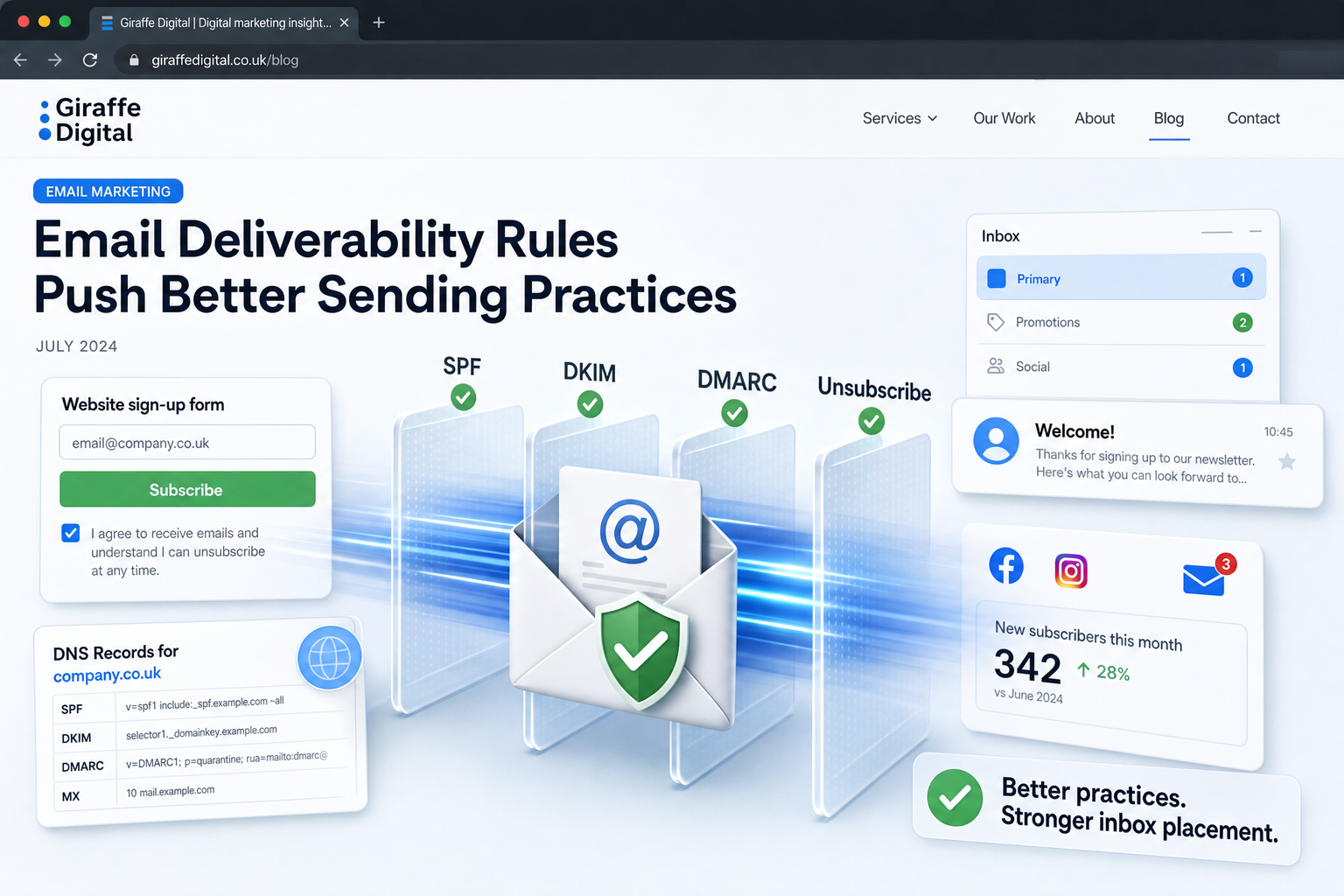
Email authentication helps mailbox providers confirm that a message is genuinely authorised by the domain it claims to come from. The three core records to understand are SPF, DKIM and DMARC.
SPF identifies which mail servers are allowed to send email for your domain. DKIM adds a digital signature that helps prove the email has not been altered in transit. DMARC tells receiving mail servers what to do when SPF or DKIM checks fail, and it provides reporting that can help you spot unauthorised use of your domain.
By July 2024, businesses sending marketing email should treat these records as essential housekeeping. They are configured in your domain’s DNS settings, often using details supplied by your ememail marketinglatform, CRM, e-commerce system or IT provider. If you use several platforms to send email, each one needs to be authorised correctly.
Unsubscribing must be simple
Marketing emails should make it easy for people to opt out. For many bulk senders, one-click unsubscribe support is now expected, alongside a visible unsubscribe link in the message. This is not just a compliance exercise. If someone cannot unsubscribe easily, they are more likely to mark your message as spam, which damages reputation and can affect future inbox placement for people who do want to hear from you.
A good unsubscribe process should be clear, fast and respectful. Avoid forcing people to log in, complete a long form or wait weeks for removal. If you offer preferences, keep them genuinely useful: for example, monthly updates, event invitations, product news or service reminders. Do not use preference centres as a way to hide the unsubscribe option.
Complaint rates need close attention
Mailbox providers look at how recipients behave. If too many people ignore, delete or complain about your messages, your future campaigns may be filtered more aggressively. Google’s sender guidance refers to keeping spam complaint rates below 0.3%, with a lower rate being safer. In practice, businesses should aim for very low complaint levels by sending relevant messages to people who have given clear permission.
Monitor complaint data where your email platform provides it, and pay attention to softer warning signs such as falling open rates, high bounce rates, declining clicks and increased unsubscribes. These signals can suggest your list has grown stale, your content is misaligned or your sign-up expectations are unclear.
Good deliverability starts with your website
Your website is often where your email list begins. A well-designed sign-up journey helps attract the right subscribers and sets expectations before the first campaign is sent. This is where website design, content strategy and email deliverability meet.
Every sign-up form should explain what the person is signing up for. “ Join our newsletter” is better than nothing, but it is still vague. A stronger version might say: “ Receive monthly marketing tips, website improvement ideas and service updates from our team.” This gives subscribers a clearer reason to join and makes later emails feel expected rather than intrusive.
For e-commerce, hospitality, professional services and membership organisations, different forms may need different messaging. A quote request form, a downloadable guide, a competition entry and a newsletter sign-up are not the same type of consent. Be specific about follow-up communication and make sure your email platform records the source of each subscriber.
Confirmation pages also matter. After someone completes a form, tell them what will happen next. If they need to confirm their subscription, say so clearly and encourage them to check their inbox. If your first email is a welcome message, make it useful: include what they asked for, remind them why they are receiving it and provide a clear route back to your website.
Website accessibility and mobile usability also support better email results. Many users will sign up on a mobile device and later read emails on the same device. Forms should be easy to complete, privacy wording should be readable and buttons should be large enough to tap. A frustrating sign-up process can lead to poor-quality data, mistyped addresses and lower engagement.
Domain setup, branding and sender trust
Your domain is part of your brand identity, and it also carries technical reputation. When planning a new website or rebrand, email should be considered early rather than added at the end. A domain that looks professional on a website should also be configured to send authenticated email reliably.
Choose a domain that is easy to read, spell and remember. Avoid confusing punctuation or wording that could look suspicious in an inbox. Register the domain through a business-controlled account, keep ownership details and renewal settings properly managed, and make sure trusted team members can access DNS settings when needed. Do not leave critical domain access tied to a former supplier, employee or personal email address.
Some organisations use a subdomain for marketing email, such as news.example.co.uk or mail.example.co.uk. This can help separate marketing activity from core business email, but it must still be authenticated and managed carefully. A subdomain is not a shortcut for poor list quality. If people complain or ignore your messages, reputation problems can still build.
Consistent branding supports deliverability indirectly because it helps recipients recognise you. Use a familiar sender name, a clear subject line and email design that matches your website. If your website uses calm, professional language but your emails suddenly use aggressive sales copy, recipients may lose trust. Recognition reduces uncertainty, and uncertainty is one reason people mark messages as spam.
Content and list quality are as important as DNS records
Technical authentication opens the door, but content and engagement influence whether you stay welcome. Businesses should avoid treating email as a dumping ground for every announcement. A smaller, more engaged list is usually more valuable than a larger list filled with people who no longer recognise your brand.
Start with consent. Purchased lists, scraped contacts and old spreadsheets are high-risk. They often contain outdated addresses, spam traps and people who have no relationship with your organisation. Sending to these contacts can create bounces and complaints quickly. It can also undermine the trust you are building through SEO, social media and website content.
Segment your audience where it makes sense. A local service business might separate prospects, current customers and past customers. A B2B organisation might segment by sector, interest or enquiry type. An e-commerce business might use purchase behaviour, but should still avoid overwhelming people with too many messages. Segmentation allows you to send fewer, better emails.
Subject lines should be accurate rather than manipulative. Avoid pretending a message is a personal reply if it is a campaign. Do not overuse urgency where there is no genuine deadline. If an offer, event or update is useful, explain it clearly. Misleading tactics may earn a short-term open, but they damage long-term trust and can increase complaints.
It is also sensible to clean your list. Remove hard bounces promptly. Consider re-engagement campaigns for inactive subscribers, then suppress contacts who do not respond. This can feel counter-intuitive because the list becomes smaller, but it often improves performance. Mailbox providers see stronger engagement, and your reporting becomes more meaningful.
How social media and email should work together
Social media marketing can support email growth, but the two channels should not be blurred carelessly. A follower is not automatically an email subscriber. If someone follows your business on Instagram, LinkedIn, Facebook or TikTok, that does not mean they have consented to receive marketing emails. Use social platforms to invite people to subscribe voluntarily through a clear landing page.
For example, a business running a webinar could promote the event on social media, send traffic to a dedicated website page, explain what attendees will receive by email, and then follow up with relevant resources. This creates a clean path from social discovery to website conversion to email engagement. It also gives the business better data on which channels are generating quality subscribers.
Social content can also help set expectations. If your email newsletter shares practical advice, show examples of that value in your social posts. If your brand is known for professional, plain-English guidance, keep that tone consistent in campaigns. Consistency across channels helps people recognise your business and reduces the chance that your emails feel unexpected.
Practical steps for UK businesses to improve email deliverability
Improving email deliverability does not require every business owner to become a technical specialist, but it does require ownership. Marketing, web, IT and leadership teams should know who is responsible for domain settings, list management, content approval and performance monitoring.
- Audit your sending platforms: list every system that sends email for your domain, including marketing platforms, CRM tools, e-commerce platforms, booking systems and help desk software.
- Check SPF, DKIM and DMARC: confirm that each legitimate sender is authenticated and that your DMARC record is present. Start with a monitored approach if you need visibility before applying stricter policies.
- Review sign-up forms: make sure your website explains what people are subscribing to, records consent clearly and avoids pre-ticked marketing permissions.
- Improve your welcome email: remind subscribers why they are hearing from you, deliver any promised resource and give them a clear next step.
- Make unsubscribing easy: use a visible unsubscribe link and support simple opt-out processes for marketing messages.
- Watch engagement: track opens with caution because privacy features can affect reporting, but pay close attention to clicks, replies, conversions, bounces, complaints and unsubscribes.
- Clean inactive contacts: run re-engagement campaigns where appropriate and suppress people who no longer interact.
- Align email with your website and brand: use recognisable sender names, consistent design and landing pages that match the promise of the email.
Businesses should also document their setup. Keep a simple record of DNS changes, email platforms, sending domains, consent sources and key contacts. This is useful when changing agencies, redesigning a website, launching a new campaign or investigating deliverability problems.
Where digital strategy fits in
Email deliverability is not an isolated technical project. It is part of a wider digital strategy that includes search visibility, website performance, content planning, social media and brand trust. A strong SEO campaign can bring the right visitors to your website, but if the email sign-up is unclear, the follow-up is inconsistent or the domain is poorly configured, that opportunity may be wasted.
Likewise, a visually polished email template will not compensate for weak consent or confusing messaging. The most effective approach is joined-up: search brings relevant visitors, website design guides them towards useful actions, social media reinforces brand awareness, and email maintains the relationship with permission and consistency.
For business owners, the message is encouraging. The newer deliverability rules are not asking reputable organisations to do something unnatural. They are pushing the market towards clearer permission, better technical standards and more respectful communication. Those are also the foundations of better marketing.
If your business is planning a new website, a rebrand, a CRM change or a more structured digital marketing programme, review email deliverability at the same time. It is far easier to build authentication, consent, content and reporting into the strategy from the start than to fix problems after campaigns begin landing in spam.
Better email deliverability is not about tricking filters. It is about proving your identity, respecting your audience and sending messages people are glad to receive.
As mailbox providers continue to reward trustworthy senders, businesses that take deliverability seriously will be in a stronger position. They will protect their domain reputation, improve campaign reliability and give customers a more coherent experience from first website visit to long-term relationship.