GDPR has changed the way many UK businesses think about email marketing, but it has not made email any less valuable. If anything, it has encouraged a healthier approach: smaller, clearer, better-managed lists made up of people who genuinely want to hear from you. For business owners investing in website design, SEO, social media marketing and wider digital strategy, this is an opportunity to connect the dots between compliance, trust and commercial performance.
The most important shift is from volume to relevance. Before GDPR came into force in May 2018, many organisations treated email lists as assets to be grown at almost any cost. Purchased lists, vague sign-up language and blanket campaigns were common. Now, businesses need to be more deliberate. The question is no longer simply, How many people can we email? It is, Who has a clear reason to hear from us, what have they agreed to receive, and how can we provide genuine value?
What GDPR means for email marketing
The General Data Protection Regulation applies to the way personal data is collected, stored and used. Email addresses, names, company roles and behavioural information can all be personal data where an individual can be identified. For email marketing, this means businesses need a lawful basis for processing that data and must be able to explain how and why it is being used.
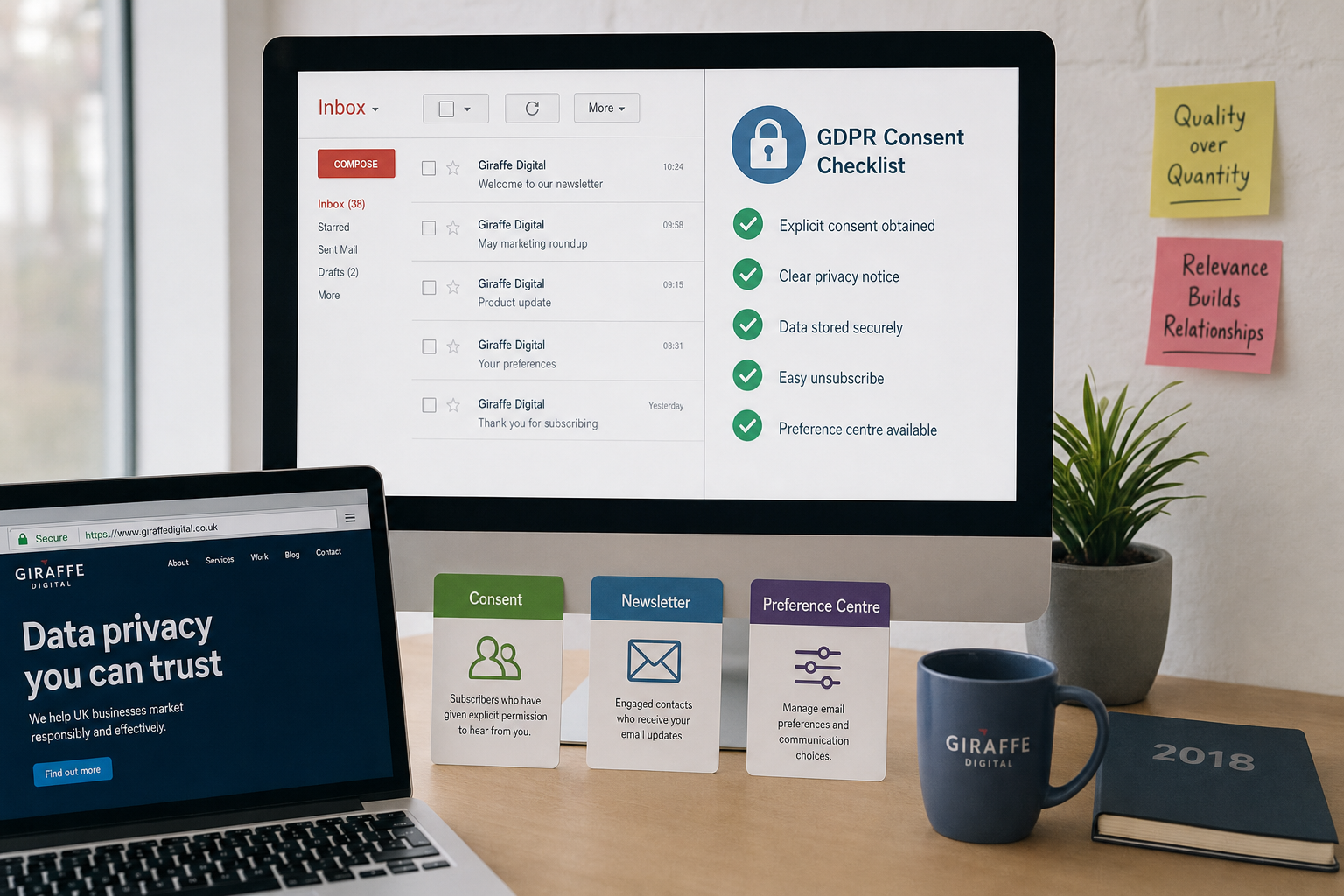
Consent is often discussed first, but it is not the only lawful basis. Some organisations may rely on legitimate interests for certain business-to-business communications, provided they have carried out a careful assessment and the recipient would reasonably expect the contact. However, consent remains a clear and practical route for many marketing campaigns, especially newsletters, promotional offers and regular updates. It must be freely given, specific, informed and unambiguous.
Pre-ticked boxes, hidden consent statements and bundled permissions are not suitable. A person should understand what they are signing up for before they submit a form. If someone requests a brochure, that does not automatically mean they have agreed to receive a weekly newsletter. Likewise, entering a competition should not quietly add them to every marketing list you operate.
UK businesses also need to consider the Privacy and Electronic Communications Regulations, commonly known as PECR, which sit alongside GDPR for electronic marketing. In practical terms, this means your email marketing process should be designed with both data protection and electronic communications rules in mind. A well-structured approach will help you reduce risk while improving the quality of your communications.
Why quality beats quantity
A large email database may look impressive, but if it contains outdated contacts, disengaged subscribers or people who did not knowingly opt in, it can damage your marketing results. Poor list quality often leads to lower open rates, more unsubscribes, more spam complaints and weaker engagement. It can also make it harder to judge whether your content, offer or website journey is working.
A smaller, more engaged list is usually more valuable. These subscribers are more likely to open your emails, click through to your website, enquire about your services and share your content. They are also more likely to understand your brand because they have chosen to receive communication from you. That choice matters. It creates a relationship built on permission rather than interruption.
For example, a local professional services firm may previously have emailed every address gathered from networking events, old enquiries and bought-in lists. After reviewing its approach, it might decide to keep only those contacts with a clear lawful basis, add a simple newsletter sign-up to its website, and offer useful sector updates once a month. The list may shrink, but the level of meaningful engagement can improve because the audience is more relevant.
Quality also supports better decision-making. If your list contains people who actively want to hear from you, your email statistics become more useful. A low click-through rate may indicate that the topic, subject line or call to action needs improving, rather than being distorted by a database full of uninterested recipients. Clean data makes marketing easier to measure and refine.
Building compliant sign-up journeys on your website
Your website is one of the most important parts of a GDPR email marketing strategy. It is where many subscribers first choose to join your list, so the design of your forms, privacy information and calls to action should be clear and purposeful.
A good sign-up form should explain what the person will receive. Instead of a vague button saying “Submit”, use language that sets expectations, such as signing up for monthly marketing tips, product updates or event invitations. If you offer more than one type of communication, consider separate options so people can choose what is relevant to them.
Keep the form short. Ask for the information you genuinely need. For many newsletters, an email address and perhaps a first name will be enough. If you ask for a phone number, job title or company size, be ready to explain why. Collecting less data reduces friction for the user and supports the GDPR principle of data minimisation.
Your privacy notice should be easy to find and written in plain English. It should explain who you are, what data you collect, why you collect it, how long you keep it, who you share it with where relevant, and how individuals can exercise their rights. It should not be hidden in dense legal language that no reasonable customer would read.
From a website design perspective, trust signals matter. A secure site using HTTPS, clear branding, professional copy and well-structured pages can all support confidence. If a visitor is unsure whether your business is credible, they are less likely to subscribe. GDPR compliance should therefore sit alongside good design, strong content and a smooth user experience.
Improving content so subscribers want to stay
Once people have joined your list, the next challenge is keeping their attention. GDPR may help you gain permission, but value keeps the relationship alive. Every email should have a purpose that benefits the reader, not just the sender.
For many businesses, useful email content might include practical advice, industry commentary, seasonal reminders, event information, case-study-style learning points, product guidance or links to helpful articles on the website. The key is to understand what your audience needs at different stages of the buying journey.
A business investing in SEO should also think about how email and website content support each other. If you publish a detailed guide on your website, email can help distribute it to an interested audience. In turn, the guide can attract organic search traffic and invite new readers to subscribe. This creates a more sustainable cycle than sending isolated sales messages with no wider content strategy.
Subject lines should be honest and specific. Over-promising may generate an initial open, but it can damage trust. A subject line such as “A quick guide to preparing your website for Christmas enquiries” is more useful than something vague or sensational. Similarly, calls to action should be clear. If you want the reader to book a consultation, download a guide or read an article, make that next step obvious.
Frequency is another important consideration. More email is not always better. A monthly update that is genuinely useful may outperform a weekly email sent simply because the calendar says so. Monitor engagement, listen to feedback and give subscribers control where possible.
Segmenting your list for relevance
Segmentation is one of the clearest ways to make email marketing more valuable after GDPR. Rather than sending every message to every subscriber, divide your list based on useful and lawful information. This might include customer type, location, interests selected at sign-up, previous enquiries or the services they have shown interest in.
For example, a company offering website design, hosting and digital marketing support may have different audiences. A start-up may need guidance on domain registration, branding and a first website. An established retailer may be more interested in improving conversion rates, search visibility and email automation. Sending the same message to both groups will often dilute the relevance.
Segmentation does not need to be complicated. You can begin with a few simple categories and improve over time. The important point is that the data used for segmentation should be accurate, necessary and handled transparently. If you ask subscribers to choose topics, honour those choices. If someone signs up only for event updates, do not assume they want general promotional emails as well.
Good segmentation can also reduce unsubscribes. People are less likely to leave your list when the content feels relevant to their needs. It can also support stronger landing pages, because each email can link to a page designed around a specific audience or service rather than a generic page that tries to do everything.
Connecting email with social media and search marketing
Email should not operate in isolation. A strong digital strategy uses each channel for what it does best. Search marketing helps people find you when they are actively looking. Social media helps you stay visible, share ideas and encourage conversation. Email helps you maintain a direct relationship with people who have chosen to hear from you.
After GDPR, it is sensible to rely less on mass outreach and more on permission-based audience building. Social media can support this by directing followers to valuable website content and clear sign-up opportunities. For instance, a business might share a useful blog post on LinkedIn or Twitter, then invite readers to subscribe for future advice. The sign-up remains voluntary and transparent, while the content demonstrates expertise.
Paid social advertising can also be used to promote guides, events or newsletter sign-ups, provided the landing page is clear about what people will receive. The same principle applies to search campaigns. If you are running paid search adverts for a downloadable resource, do not hide newsletter consent within the download form. Give people a clear choice.
Organic search also benefits from quality content. Well-written guides, service pages and blog articles can answer the questions your customers are already asking. Email can then keep those readers engaged after their first visit. This is especially useful for considered purchases, where a prospective customer may not be ready to enquire immediately.
Domain registration, branding and trust
Email marketing performance is also influenced by brand trust. One simple but important step is using a professional domain name that matches your business identity. Sending marketing emails from a consistent business domain looks more credible than using a personal or generic address, and it helps recipients recognise who is contacting them.
When choosing a domain, keep it clear, memorable and easy to spell. Avoid unnecessary hyphens, confusing abbreviations or names that are too close to another organisation’s brand. If your business mainly serves the UK, a UK-focused domain may support familiarity, while a broader domain can be suitable for organisations with wider ambitions. The right choice depends on your brand, audience and growth plans.
It is also wise to register relevant variations where there is a clear business reason, such as protecting your brand name or reducing customer confusion. However, domain registration should be planned rather than impulsive. A long list of unused domains does not create a strategy. Your main website, email addresses and marketing materials should all present a consistent identity.
From a technical perspective, ensure your domain and email settings are configured properly by someone who understands business email delivery. This can help reduce the chance of legitimate messages being filtered incorrectly. It also supports a more professional experience for customers, especially when combined with a well-designed website and clear privacy information.
Practical steps for UK business owners
If your business has not yet reviewed its email marketing in detail, the best approach is to work through the essentials methodically. The aim is not to stop communicating, but to communicate more responsibly and effectively.
- Audit your existing list: Identify where contacts came from, what they were told at the time, and what lawful basis you rely on for future marketing.
- Remove unsuitable data: Do not keep contacts simply because they might be useful one day. If you cannot justify holding or using the data, remove it.
- Improve your sign-up forms: Make the wording clear, separate different types of communication where appropriate, and link to an accessible privacy notice.
- Record consent properly: Keep evidence of when, how and what someone agreed to receive. This may include the form wording used at the time.
- Make unsubscribing easy: Every marketing email should offer a clear way to opt out. Make the process simple and respect it promptly.
- Plan content around audience needs: Build campaigns that answer real questions, solve problems and guide people towards sensible next steps.
- Review regularly: Data, services and audience expectations change. Schedule periodic reviews of your lists, forms and privacy information.
These steps are not just about reducing compliance risk. They also improve marketing discipline. When your list is clean, your messaging is clear and your website is designed to support trust, every part of your digital activity becomes easier to manage.
A better foundation for digital growth
GDPR email marketing is not about sending fewer emails for the sake of it. It is about sending better emails to the right people for the right reasons. Businesses that embrace this shift can build stronger relationships, improve campaign performance and create a more joined-up digital presence.
The real value comes when email is connected to a wider strategy. A professional website gives visitors confidence and provides useful landing pages. SEO brings in people searching for your products, services or expertise. Social media helps distribute ideas and start conversations. Email then keeps interested people engaged over time, with permission and purpose.
The businesses that succeed after GDPR will not be those with the longest mailing lists, but those with the clearest value, the strongest trust and the most relevant communication.
For UK business owners, this is a good moment to review not only email consent, but the entire customer journey. From the domain name and website design through to search visibility, social content and ongoing email communication, each touchpoint should feel consistent, helpful and respectful. That is how GDPR becomes more than a compliance exercise. It becomes part of better marketing.