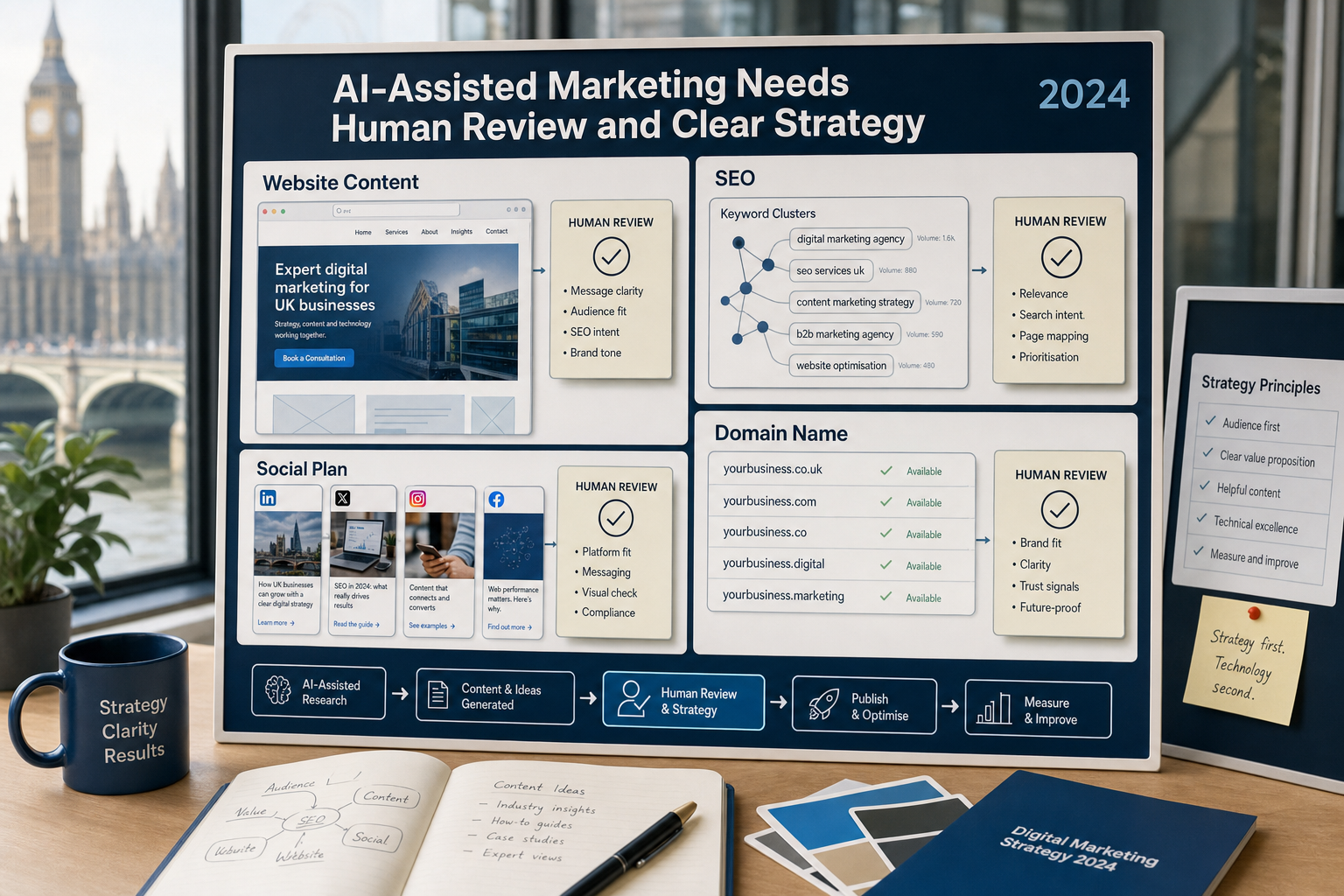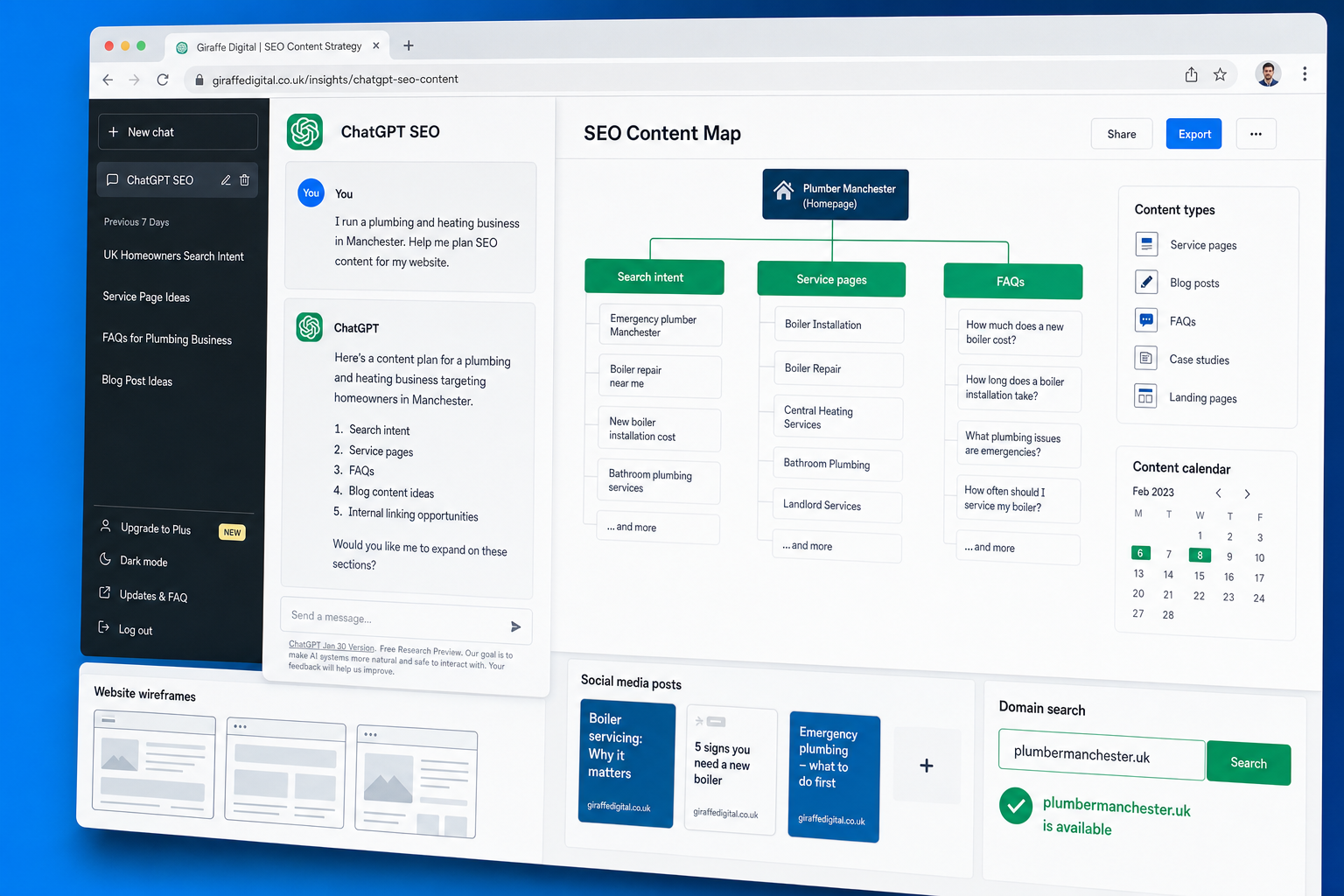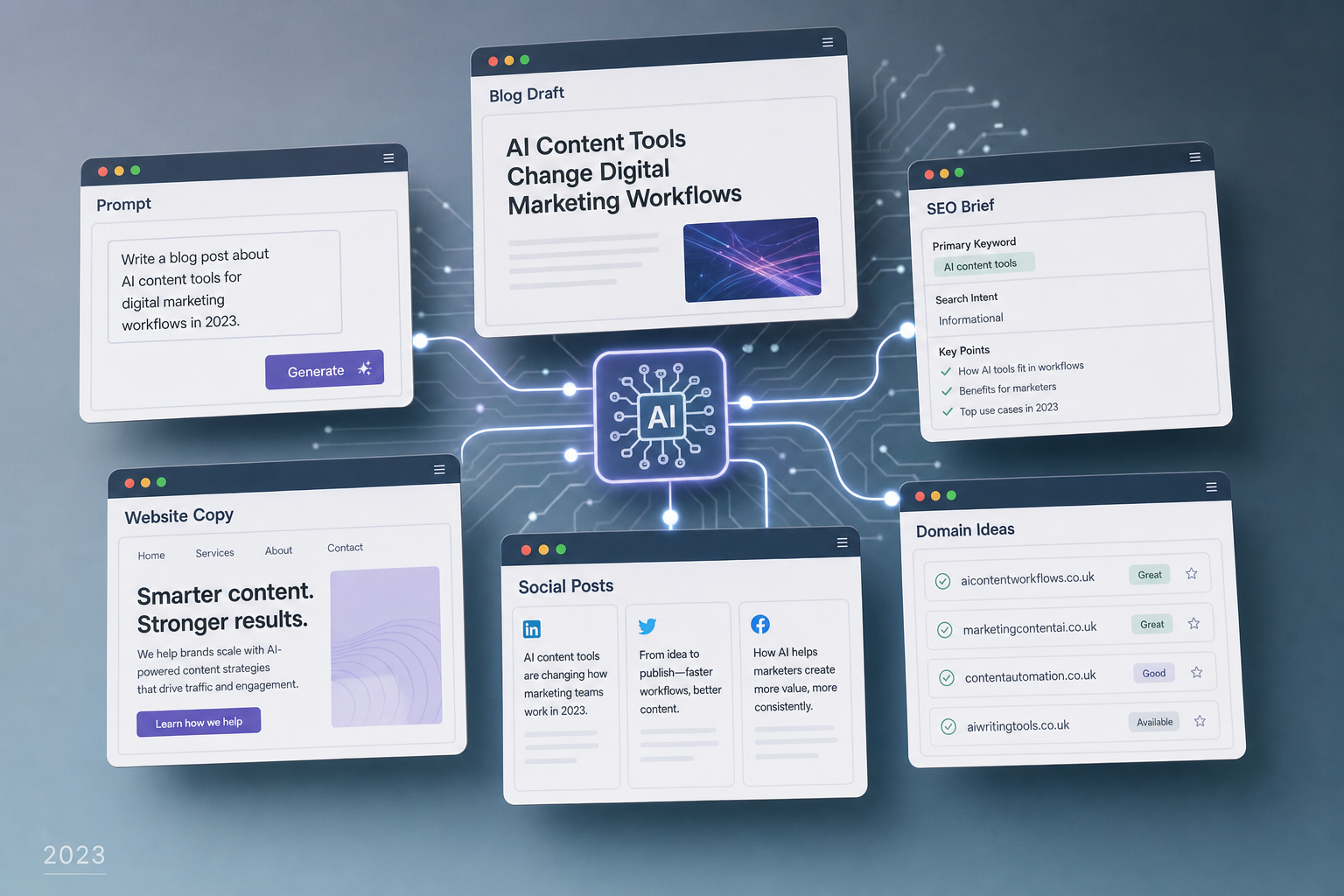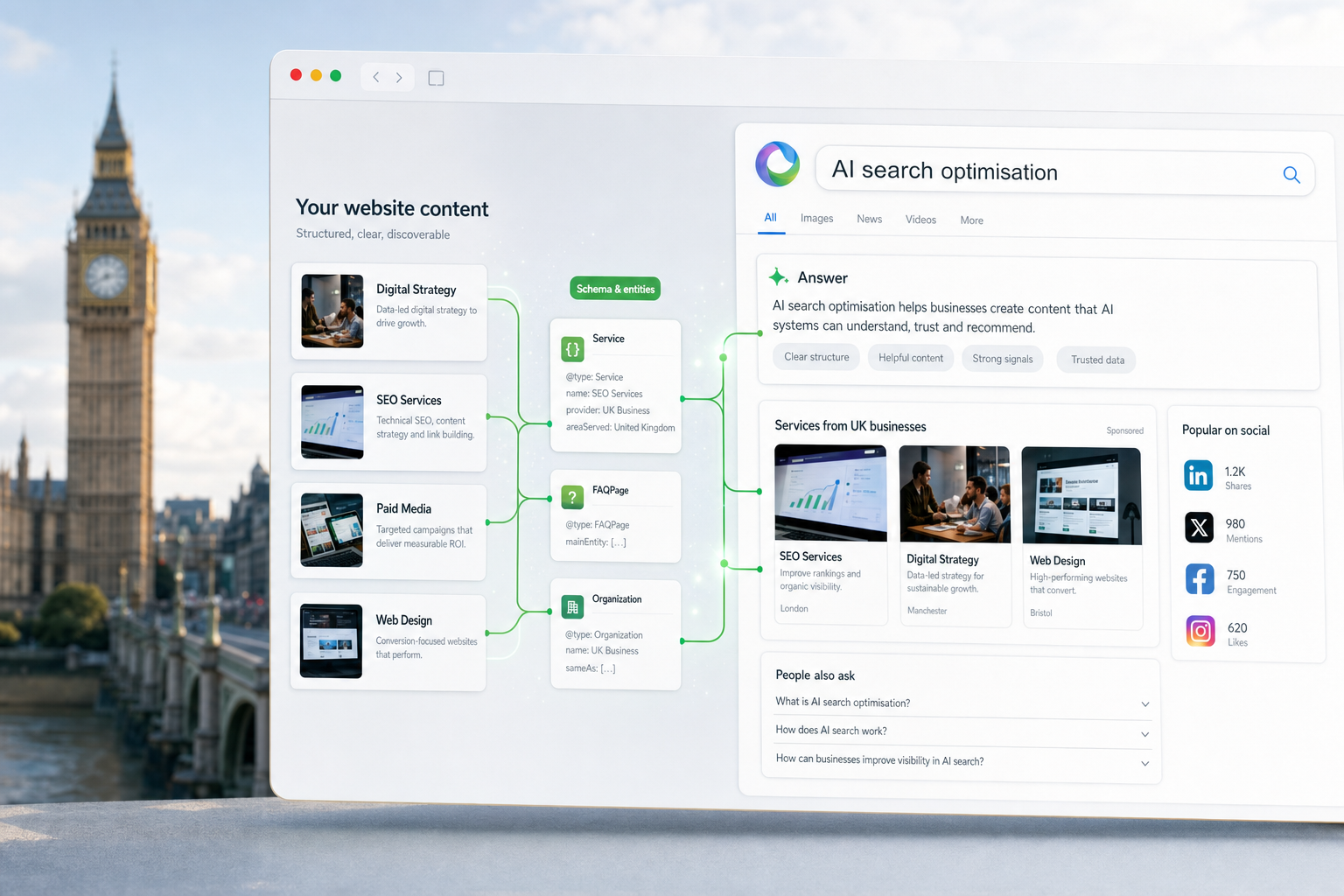
Search is becoming more conversational, more selective and more focused on giving people a useful answer before they click. For UK businesses, this changes how website content should be planned. Traditional SEO is still important, but AI search optimisation now sits alongside it, helping your website become easier for search engines, AI assistants and potential customers to understand.
People are no longer only typing short keyword phrases into a search box. They are asking detailed questions, comparing options, using voice search, testing AI-powered search features and expecting direct, trustworthy answers. A business website therefore needs to do more than include keywords. It needs to explain services clearly, prove expertise, answer real customer questions, use a logical structure and connect smoothly with social media, branding, analytics and the wider customer journey.
What AI search optimisation means in 2025
AI search optimisation is the process of making your website content easier for AI-assisted search systems to interpret, summarise and recommend. This includes search engines with generative answer features, conversational search tools, voice assistants and AI chat products that draw on web content, structured information and trusted sources.
It does not replace SEO. Strong technical SEO, fast pages, sensible site architecture, well-written copy and quality backlinks still matter. The difference is that AI search is less dependent on matching one exact phrase and more focused on understanding the meaning, context and usefulness of a page.
For example, a traditional service page might target a phrase such as website design Portsmouth. That can still be worthwhile. An AI-aware page, however, should also answer related questions, such as what the design process involves, how long a project might take, what a business needs to prepare, how e-commerce differs from a brochure website, and how ongoing support works. This gives both visitors and AI systems a clearer understanding of the business offering.
AI search also rewards clarity. If your website uses vague language such as innovative digital solutions for forward-thinking brands, it may sound polished but fail to explain what you actually do. Clear copy such as website design, SEO and social media marketing for UK businesses gives search systems and customers a much stronger signal.
Why this matters for business owners
For many business owners, the practical question is simple: will AI search help bring better enquiries? The answer depends on how well your website explains your services and supports decision-making. AI-powered search tends to favour content that is specific, organised and genuinely helpful. This can benefit businesses that invest in clear, authoritative website content rather than thin pages written only to rank.
Customers often use search when they are trying to solve a problem. They might ask how to choose a website design agency, whether their business needs local SEO, what to include on a landing page, or how social media content supports search visibility. If your website answers those questions properly, it can appear in more research-led journeys, not only in searches from people ready to buy immediately.
This is especially relevant for service businesses. A prospective customer may compare several providers before making contact. AI search can summarise strengths, pull out frequently mentioned services and highlight useful explanations. If your site lacks detail, search systems have less to work with. If your competitors publish clearer service information, stronger guides and better proof of expertise, they may be easier to recommend.
The business value is not just ranking. Better content improves conversion. When visitors arrive on a page that answers their questions, explains next steps and feels credible, they are more likely to make an enquiry. AI search optimisation therefore supports both visibility and website performance.
Plan content around questions, tasks and decisions
Keyword research still has a role, but content planning in 2025 should begin with the questions customers ask before they contact you. These questions often reveal buying intent more clearly than a single keyword.
One useful approach is to map customer questions into stages:
- Problem awareness: The visitor knows something is not working, such as poor website enquiries, weak search visibility or inconsistent branding.
- Research: They compare options, such as SEO versus paid advertising, a new website versus improving an existing one, or organic social media versus paid social campaigns.
- Evaluation: They want to know how your process works, what experience you have, which sectors you support and what makes your approach reliable.
- Action: They need a clear route to enquire, book a consultation, request a proposal or ask a specific question.
Your website should include content for each stage. A homepage alone cannot do all this work. Service pages, sector pages, case study-style project summaries, FAQs, blog posts and landing pages can each support a different part of the decision.
For example, a business offering social media marketing might create pages explaining content planning, paid social advertising, platform selection, brand tone of voice and reporting. A blog post could answer whether a small business should focus on Instagram, LinkedIn, Facebook or TikTok, depending on its audience and goals. This gives AI search systems more context and gives visitors more confidence.
Use structure that helps both humans and AI
AI systems rely heavily on structure. If a page has a clear heading hierarchy, concise paragraphs, descriptive subheadings and logically grouped information, it is easier to interpret. This also improves the reading experience for busy visitors.
Every important service page should make the basics easy to find. It should explain what the service is, who it is for, what problems it solves, what is included, how the process works and what the visitor should do next. Avoid hiding essential details in image text, sliders or vague design blocks. Search systems may not interpret those elements as reliably as well-structured HTML content.
Good website design supports AI search optimisation when it makes information accessible. Navigation should be predictable. Page titles should describe the subject. Internal links should connect related services and guides. Calls to action should be visible without being aggressive. Mobile layouts should be just as clear as desktop layouts, because many searches and social media visits happen on mobile devices.
Structured data can also help search engines understand your website. Relevant schema markup for organisations, local businesses, articles, FAQs, services and reviews can provide additional context. It should be accurate and reflect visible page content. Structured data is not a shortcut to rankings, but it can reduce ambiguity and support richer search presentation where eligible.
Write content that demonstrates expertise
AI search is designed to identify content that appears useful, trustworthy and relevant. For business websites, this means generic copy is becoming less effective. Pages should show real expertise through practical explanation, not empty claims.
Instead of saying we are experts in SEO, explain how you approach technical audits, content planning, local search visibility, reporting and ongoing optimisation. Instead of saying we build beautiful websites, describe how design choices support user experience, accessibility, conversion and content management. This gives visitors substance and helps search systems understand the depth of your service.
Useful credibility signals include:
- Clear author or business information where appropriate.
- Specific service descriptions rather than generic marketing language.
- Examples of the types of problems you solve, without inventing results.
- Frequently asked questions based on genuine customer conversations.
- Consistent contact details, location information and business details.
- Helpful internal links to related services, articles and enquiry pages.
Businesses should also review older content. Articles written several years ago may still attract traffic but contain outdated advice, old platform references or weak calls to action. Updating content for 2025 can improve accuracy and make the site more useful for both visitors and search systems.
Connect website content with social media marketing
AI search does not operate in isolation from wider digital marketing. Brand visibility across social platforms, video, reviews, business profiles and third-party mentions can influence how people search for you and how confident they feel when they find you.
Social media content can support website search performance by identifying the questions and topics your audience cares about. Comments, direct messages, poll responses and post engagement can all reveal useful content ideas. If customers repeatedly ask the same question on social media, it may deserve a permanent answer on your website.
There is also a content reuse benefit. A well-written blog post can become a LinkedIn carousel, a short video script, an email newsletter, a set of frequently asked questions or a series of social posts. This keeps messaging consistent and gives people several ways to discover your expertise.
For example, a website design article about planning a new business website could be supported by social posts covering domain names, sitemap planning, photography, copywriting, launch checklists and SEO basics. Each post can link back to the relevant website page, while the website provides the more detailed explanation.
Think carefully about domain names and brand clarity
Your domain name remains an important part of your digital identity. It should be easy to remember, easy to spell and clearly connected to your business or brand. AI search optimisation is not about stuffing keywords into a domain. A trustworthy, brandable domain supported by strong content is usually more valuable than a confusing, keyword-heavy name.
When choosing a domain for a UK business, consider whether the name works when spoken aloud, avoids awkward hyphens or ambiguous spelling, and matches your wider brand identity. If your business is mainly UK-focused, a UK-relevant domain extension may support familiarity, while a broader extension may suit organisations with wider plans. The decision should fit the business strategy, not only a search assumption.
It is also worth protecting important variations where sensible, such as common misspellings or closely related extensions, but the main domain should remain the one customers recognise. Keep ownership details, renewal settings and administrative access well managed. Losing control of a domain can create serious disruption for websites, email and marketing activity.
Domain choice will not compensate for weak content, poor website performance or unclear services. It is one part of a wider digital foundation that includes hosting, security, analytics, search visibility, design and brand consistency.
Technical foundations still matter
AI search optimisation depends on a website being accessible and technically sound. If important pages are slow, blocked from indexing, difficult to crawl or hidden behind poor navigation, search systems may struggle to understand them.
Core technical priorities in 2025 include fast loading, mobile-friendly layouts, secure connections, clean URL structures, XML sitemaps, accurate robots directives and well-managed redirects. Core Web Vitals remain useful indicators of user experience, including loading performance, visual stability and responsiveness.
Accessibility should also be part of the planning process. Clear contrast, keyboard-friendly navigation, descriptive link text, sensible heading order and alternative text for meaningful images all help real users. They also support machine understanding because the page becomes better organised and more descriptive.
Analytics and search performance data should guide ongoing improvement. Search Console data, website analytics, enquiry tracking and call tracking can help identify which pages attract visitors, which pages convert and which topics deserve more depth. The aim is not to chase every search impression, but to understand which content supports genuine business goals.
How to start improving your website for AI search
Business owners do not need to rebuild their entire website at once. The best starting point is usually a focused content and search review. Look at your key service pages first, because these are the pages most closely connected to enquiries.
Ask the following questions:
- Does each service page clearly explain what the service includes?
- Does the page answer the questions a customer would ask before making contact?
- Are headings descriptive and easy to scan?
- Is the page supported by relevant internal links?
- Is the call to action clear and appropriate?
- Does the content sound specific to your business, or could it appear on any competitor’s website?
- Are older articles accurate for 2025?
- Can visitors understand your location, service area and contact options quickly?
Once key pages are improved, create a content plan that supports customer decisions. This could include comparison articles, planning checklists, service explainers, industry-specific landing pages, FAQs and thought leadership pieces. Each item should have a purpose. Publishing more content is not automatically better; publishing clearer, more useful content is.
AI search optimisation works best when it is treated as part of a joined-up digital strategy: clear website structure, useful content, strong branding, social proof, technical reliability and consistent marketing activity.
The businesses that benefit most are likely to be those that communicate clearly. AI-assisted search is raising expectations, but the core principle remains straightforward: help people understand their problem, trust your expertise and take the next step with confidence.
For UK businesses planning a new website, refreshing an existing one or reviewing their digital marketing in 2025, now is the right time to build content around real customer needs. Search is changing, but useful, well-structured and credible information still sits at the centre of effective online growth.