PPC advertising can be a very useful way for a small business to quickly bring the right visitors to its website. While search engine optimisation is still essential for long-term visibility, paid search allows you to appear when people are actively looking for a product or service. For a UK business with a clear offer, a well-designed website, and a sensible plan, pay-per-click can support enquiries, telephone calls, brochure requests, online sales, and brand awareness.
The important word is planned. PPC advertising is not simply a matter of writing an advert and hoping for the best. It works best when it is connected to your wider digital marketing: your website design, your landing pages, your search engine optimisation, your branding, your analytics and even your social media activity. A small, carefully structured campaign can often be more useful than a large campaign that sends visitors to the wrong page or uses vague keywords.
What is PPC advertising
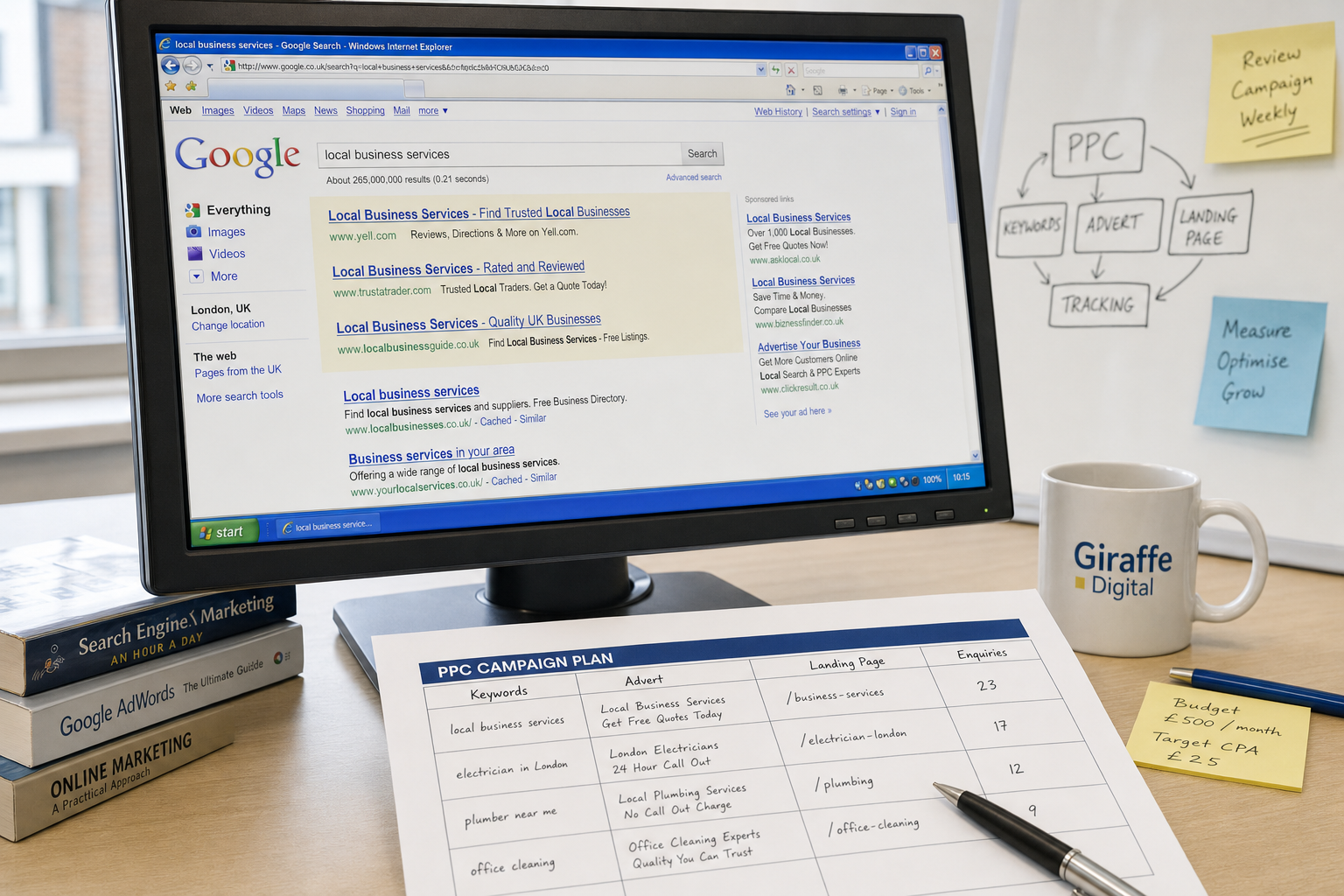
PPC stands for pay per click. In simple terms, you create an advert, choose the search terms or placements that should trigger it, and pay when someone clicks through to your website. The most familiar form is paid search advertising, where sponsored results appear above or beside the natural search results. The same principle can also apply to display advertising and certain social media advertising options, although search remains the most direct starting point for many small businesses.
For example, a local accountant in Bristol might want to appear when somebody searches for "small business accountant Bristol" or "tax return help Bristol". A wedding photographer might choose phrases such as "wedding photographer Surrey" or "bridal photography packages". These searches show a clearer intent than a very general phrase such as "accounting" or "photography", which could attract people who are not ready to enquire.
The appeal of PPC advertising is the high level of control it offers. You can decide which areas to target, when adverts should run, which terms to bid on and which page of your website people should see after clicking. You can also pause, edit and test campaigns far more quickly than you can alter most offline advertising.
Why PPC can be valuable for small businesses
Many small businesses have limited time and limited marketing resources. PPC advertising can help because it is measurable and focused. You can see which keywords brought visitors, which adverts attracted clicks and, if your tracking is set up correctly, which clicks turned into enquiries or orders. This makes it easier to learn what is working and to stop spending effort on irrelevant terms.
Paid search is also useful when a website is new. Natural search engine optimisation takes time, particularly for competitive phrases. A new website may not appear prominently in organic search results straight away, even if it is well built. PPC can help provide immediate visibility while your SEO work develops. This does not mean PPC replaces SEO. The strongest approach is often to use both: PPC for targeted, controllable traffic and SEO for steady long-term search visibility.
PPC can also support seasonal campaigns. A garden centre may want to promote patio furniture in spring, a training provider may wish to advertise new course dates, or a retailer may want to highlight a particular range for a short period. Paid search allows you to react quickly, test wording and direct visitors to the most relevant page.
Start with clear objectives
Before choosing keywords or writing adverts, decide what you want the campaign to achieve. A campaign designed to generate telephone calls may need different wording and landing pages from a campaign designed to collect brochure requests. A business selling online will need to think carefully about product pages, basket usability and conversion tracking. A service business may need a strong enquiry form, a clear telephone number, and reassurance about its experience, qualifications, or location.
Useful objectives might include:
- Increasing relevant enquiries from a specific town, county or region.
- Promoting a new service or product category.
- Testing demand for a new offer before committing to broader marketing.
- Supporting a new website launch while organic rankings develop.
- Encouraging visitors to download a brochure, request a quote or book a consultation.
Once you know the objective, you can make better decisions about keywords, ad copy, landing pages, and campaign settings. Without a clear goal, it is easy to attract clicks that look encouraging in the account but do not create real business value.
Choosing the right keywords
Keyword choice is one of the most important parts of PPC advertising. A common mistake is to choose keywords that are too broad. Broad phrases may receive more searches, but they may also bring people who are researching, comparing unrelated topics or looking for something you do not provide. For a small business, relevance is usually more valuable than volume.
Think about the words your customers actually use. A business owner may not search in the same way as someone inside your industry. Avoid jargon where possible, but include specialist terms if your buyers genuinely use them. Location phrases are particularly useful for many UK service businesses, such as "web design Hampshire", "solicitor in Leeds" or "emergency plumber Cardiff".
It is also sensible to use negative keywords. These are words that prevent your advert from appearing for unsuitable searches. For example, if you do not offer free services, you may wish to exclude searches containing "free". If you sell premium furniture, you may not want to appear for "second hand" or "cheap" searches. Negative keywords help reduce wasted clicks and keep your campaign more focused.
Writing adverts that attract the right click
A good PPC advert should not simply attract as many clicks as possible. It should attract the right clicks. Your advert needs to make clear what you offer, where relevant, and why someone should visit your site. Include the keyword theme where it reads naturally, because searchers are more likely to notice an advert that reflects their query.
Strong advert copy often includes a specific service, a benefit and a clear call to action. For example, "Local Business Accountants" is clearer than "Professional Services". "Request a Consultation" is more useful than a vague "Click Here". If you operate in a defined area, mention it. If you specialise in a particular type of customer, say so. The more accurately your advert sets expectations, the more likely the visitor is to find what they need after the click.
It is worth testing more than one advert in each campaign or ad group. Small differences in wording can affect click-through rate and enquiry quality. Over time, you can keep the stronger adverts and refine the weaker ones.
Your landing page matters as much as the advert
Sending every PPC visitor to your home page is rarely the best choice. If someone clicks an advert about commercial photography, they should land on a page about commercial photography, not a general home page that also covers wedding portraits and events. The landing page should continue the promise made in the advert.
Good landing pages are clear, focused and easy to use. They should load reliably, explain the offer, provide evidence of credibility and make the next step obvious. For service businesses, this may mean a visible telephone number, a short enquiry form and concise information about the service area. For retailers, it may mean clear product information, delivery details, returns information and a straightforward route to purchase.
Website design directly influences PPC results. A confusing layout, slow page load times, hidden contact details, or poor navigation can cause visitors to leave without enquiring. This means you may be paying for traffic that your website is not ready to convert. Before increasing your campaign activity, review whether your site supports the action you want people to take.
Tracking enquiries and measuring results
One of the main advantages of PPC advertising is measurement. At a basic level, you can see impressions, clicks, click-through rate and average position. More importantly, you should aim to measure conversions. A conversion might be an enquiry form submission, a brochure request, a sale, a newsletter sign-up or another valuable action.
Analytics and conversion tracking help you understand which keywords and adverts are producing meaningful results. Without tracking, you may judge a campaign only by the number of clicks it receives. That can be misleading. A keyword that brings fewer clicks but more enquiries may be far more valuable than a popular keyword that attracts casual visitors.
Telephone enquiries can be more difficult to measure than form submissions, but you can still improve your understanding. Ask new enquiries how they found you, use dedicated campaign landing pages where appropriate, and monitor call volume patterns when campaigns are active. The aim is not perfection; it is to make better decisions than guessing.
How PPC supports SEO, branding and social media
PPC advertising should not sit in isolation. Paid search data can inform your search engine optimisation. If a particular keyword consistently generates good enquiries through PPC, it may be worth developing stronger website content and SEO activity around that topic. Similarly, if a phrase attracts poor quality traffic, you may decide not to prioritise it for organic search.
PPC can also support branding. Even when people do not click, seeing your business name in relevant search results can help build familiarity. This is particularly useful in competitive local markets, provided your advert is professional, and your website reflects the same brand message. Consistency matters: the wording in your advert, the design of your website and the promises on your landing page should all feel connected.
Social media marketing can also play a supporting role. A small business using platforms such as Facebook, Twitter or LinkedIn can reinforce campaign messages, share useful content and maintain contact with customers who are not ready to buy immediately. Paid search often captures demand when people are actively looking; social media can help build trust and awareness between those moments.
Practical account structure for a small campaign
A simple, well-organised PPC account is easier to manage than one large group of unrelated keywords. Group similar keywords together so that each set can have relevant advert copy and a suitable landing page. For example, a web design company might separate “business website design", "ecommerce website design" and "website redesign" into different groups rather than placing all terms together.
This structure helps improve relevance. The search term, advert and landing page all work in the same direction. It also makes reporting clearer. You can see which service areas are performing well and which need adjustment.
Small businesses should review campaigns regularly. Look for irrelevant searches, underperforming adverts, poor landing pages and opportunities to refine location targeting. PPC is not a one-off task. It needs ongoing attention, even if the campaign is modest.
Do not forget your domain and website foundations
PPC visitors judge your business quickly. Your domain name, website design and general presentation all influence trust. A clear, memorable domain can help people recognise your business and return later. When registering a domain, choose something easy to spell, relevant to your business and suitable for long-term use. Avoid unnecessary hyphens or confusing wording if a simpler option is available.
It is also wise to keep domain registration details organised, renew domains promptly, and ensure domains are registered under the correct business ownership. Do not leave access details with only one member of staff or an external supplier without proper records. Losing control of a domain can disrupt email, search visibility and advertising campaigns.
Your website should also be built with search engines and visitors in mind. Clean page structure, readable content, sensible navigation and fast-loading pages all support both SEO and PPC. Flash-heavy pages, unclear calls to action and thin content can make it harder for visitors to understand what you offer. Good design is not only about appearance; it is about helping people take the next step with confidence.
Common PPC mistakes to avoid
Several PPC mistakes recur. The first is targeting too broadly. If your business only serves a particular region, make sure the campaign reflects that. The second is sending visitors to irrelevant pages. The third is failing to use negative keywords. The fourth is judging success only by clicks rather than enquiries or sales.
Another common issue is writing adverts that over-promise. It may increase short-term clicks, but it can damage trust if the landing page does not deliver. Be clear, accurate and persuasive rather than exaggerated. Your advert should qualify the visitor and attract them.
Finally, avoid setting up a campaign and leaving it untouched for months. Search behaviour changes, competitors adjust their adverts, and your own business priorities may shift. Regular review is part of effective PPC management.
Getting started sensibly
If you are new to PPC advertising, begin with a focused campaign. Choose one or two important services, define the locations you want to target and create dedicated landing pages if your existing website does not already have them. Write a few carefully matched adverts and monitor the results closely. The purpose of the first campaign is not only to generate enquiries, but also to learn which messages and search terms are most effective.
As results become clearer, you can refine the campaign, expand into additional services or improve your website content. PPC works best when it is treated as part of a wider digital strategy rather than a shortcut. When combined with good website design, thoughtful SEO, consistent branding, and practical measurement, it can become a reliable source of targeted traffic and useful insights for your business.
PPC advertising is at its most effective when every part of the journey is relevant: the keyword, the advert, the landing page and the action you want the visitor to take.
For small businesses, the basics matter. Understand your audience, choose specific keywords, write honest adverts, send visitors to the right page and measure what happens next. With that foundation in place, PPC can help you compete online in a controlled, practical and measurable way.