Privacy is no longer a side issue for online marketing. For UK businesses, the way data is collected, stored and used now has a direct impact on website performance, advertising results, customer trust and long-term growth. As browsers restrict tracking, consumers become more selective about consent, and regulations such as the UK GDPR and PECR shape everyday digital activity, first-party data is becoming one of the most useful assets a business can build.
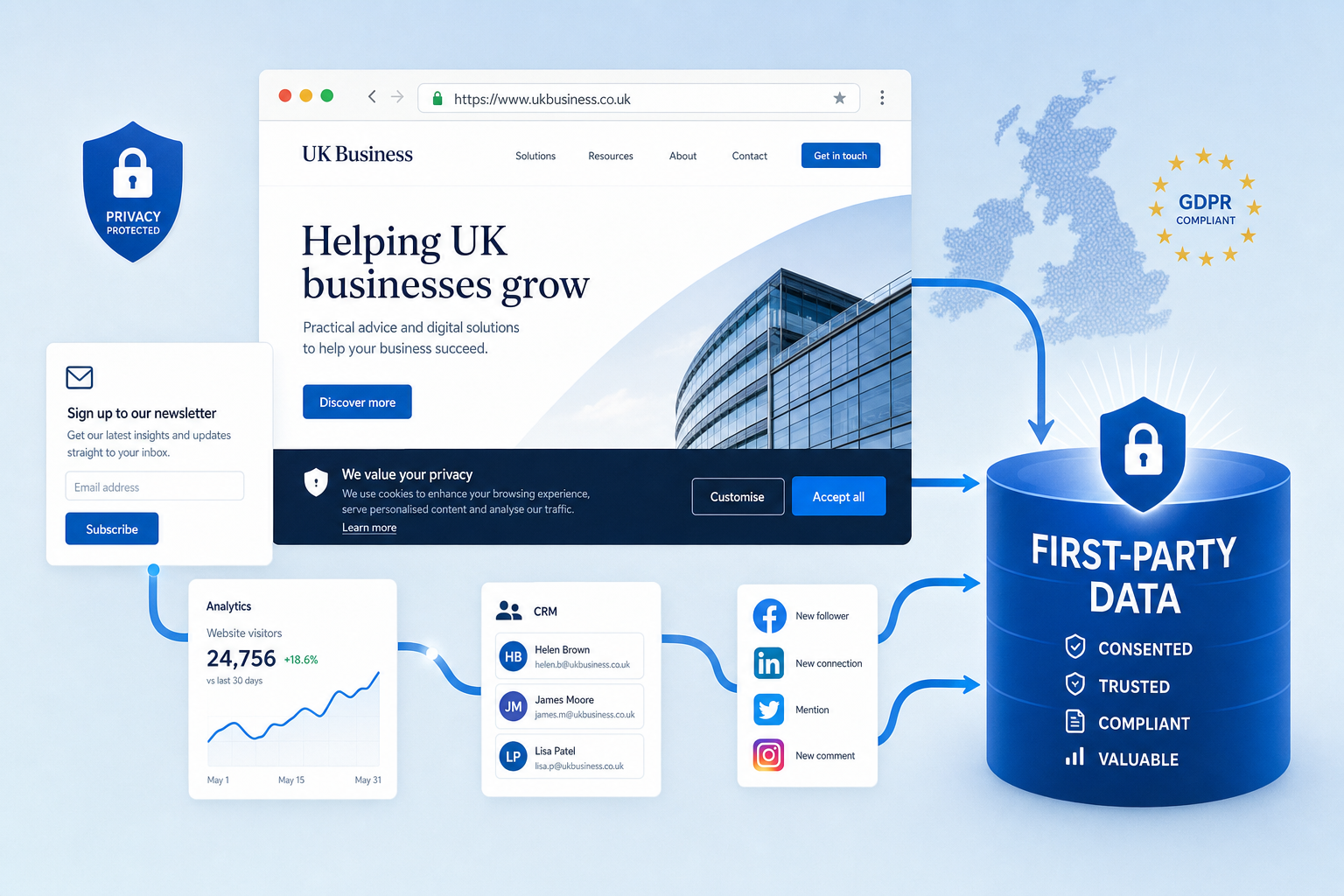
First-party data is information your organisation collects directly from people through your own channels. That might include website enquiries, email sign-ups, purchase history, account registrations, customer preferences, event bookings, survey responses or analytics collected with appropriate consent. Unlike third-party data, which is gathered and shared by external parties, first-party data is rooted in a direct relationship between your business and your audience.
For business owners planning a new website, reviewing their SEO, investing in social media or improving their digital strategy, this shift is important. Businesses that build clear, permission-based data systems now will be better placed to understand their customers, improve marketing efficiency and maintain trust as the wider digital landscape continues to change.
Why privacy changes are reshaping digital marketing
For many years, online advertising relied heavily on third-party cookies and tracking across websites. This made it possible to build audience segments, retarget visitors and measure campaigns using data gathered well beyond a company’s own website. That model is becoming less dependable.
Several major browsers already limit third-party cookies, and further restrictions are expected across the industry. Mobile privacy settings are also making it more visible when apps and platforms track users across services. At the same time, people are more aware of how their data is used and are more likely to ignore, block or decline anything that feels intrusive.
This does not mean digital marketing is becoming less valuable. It means businesses need to rely less on borrowed visibility and more on the relationships they can create directly. A well-designed website, a useful email database, clear consent processes and relevant customer records can provide a more stable foundation than data gathered indirectly through advertising networks.
Search marketing is also affected. SEO has always rewarded useful, relevant content and technically sound websites. As paid media targeting becomes more privacy-conscious, organic visibility and direct audience relationships become even more important. A strong website that answers customer questions, captures enquiries clearly and encourages repeat visits can reduce dependence on rented audiences.
What first-party data includes
First-party data can be simple or sophisticated. It does not have to mean complex systems or large databases. For many small and medium-sized businesses, it begins with the information already passing through their website and customer service processes.
Useful examples include:
- Contact form submissions from people asking for quotes, consultations, bookings or support.
- Email newsletter sign-ups where users have actively chosen to hear from your business.
- Customer purchase history from an e-commerce website or booking system.
- Account preferences such as interests, location, service needs or communication choices.
- Website analytics showing which pages people visit, which campaigns bring traffic and where visitors drop off, provided this is collected in line with consent requirements.
- Customer feedback from surveys, reviews, phone calls, email conversations and support requests.
- Event and webinar registrations showing topics that matter to your audience.
- Social media engagement from your own profiles, including comments, direct messages and responses to content.
The value is not simply in having the data. The value comes from organising it, understanding it and using it responsibly. A list of email addresses that never receives useful communication is not a strategy. A customer database with no segmentation may be underused. Website analytics that are never reviewed will not improve performance. First-party data becomes powerful when it helps your business make better decisions.
The business value of first-party data
First-party data can support almost every part of your online presence. It can help you understand who your customers are, what they need, how they find you and what encourages them to take action.
Better customer understanding
When customers engage directly with your website or marketing, they leave useful signals. A service business might notice that visitors repeatedly read comparison pages before enquiring. A local retailer might find that email subscribers respond best to new product announcements rather than general updates. A professional services firm might learn that downloadable guides attract early-stage prospects who are not ready to speak to a consultant yet.
These insights can shape your content, navigation, service pages and sales follow-up. Instead of guessing what your audience wants, you can use real behaviour and direct feedback to refine your approach.
More relevant marketing
Relevance is one of the strongest advantages of first-party data. If a customer has shown interest in a specific product category or service, you can send information that is genuinely useful. If a prospect downloaded a guide about website planning, a follow-up email about preparing a design brief may be more helpful than a generic sales message.
This does not mean overwhelming people with constant communication. In fact, first-party data should help you send fewer, better messages. Good segmentation allows you to respect customer interests, avoid irrelevant campaigns and build stronger relationships over time.
Improved advertising efficiency
Paid social and search advertising remain valuable, but privacy changes mean businesses need to be realistic about attribution and targeting. First-party data can help by improving the quality of campaign planning. For example, customer lists can help identify common traits among existing buyers, while enquiry data can show which services are most profitable or which locations produce the strongest leads.
Even when platform reporting becomes less complete, businesses with their own records can compare advertising activity against enquiries, bookings and sales. This creates a more practical view of performance than relying solely on platform dashboards.
Stronger customer retention
It is often more efficient to keep in touch with existing customers than to constantly find new ones. First-party data can support retention through service reminders, loyalty communications, product replenishment prompts, aftercare content and helpful updates.
For example, a home improvement company might send seasonal maintenance advice to previous customers. A training provider might notify past attendees when a related course becomes available. A consultancy might share regulatory updates with clients who have expressed interest in a particular subject. These communications work best when they are relevant, permission-based and genuinely useful.
Your website is the centre of your first-party data strategy
Your website is usually the most important place to collect and use first-party data. Social platforms are useful, but the audience ultimately sits within someone else’s system. Your website gives you more control over content, design, conversion paths and data capture.
A website designed with first-party data in mind should make it easy for visitors to take the next step. That may mean requesting a quote, downloading a guide, booking a call, joining a mailing list, creating an account or making a purchase. Each action should be clear, useful and supported by a visible privacy message.
Good website design also reduces friction. Forms should ask only for the information needed at that stage. A first enquiry form may not need a long list of details. A newsletter sign-up might need only an email address and a clear explanation of what the subscriber will receive. Longer forms can be appropriate for detailed quotes or applications, but they should be carefully structured and easy to complete on mobile devices.
Trust signals matter. Privacy notices, cookie information, contact details, professional design, clear navigation, fast-loading pages and secure browsing all help visitors feel comfortable sharing information. A website that looks outdated, confusing or insecure can reduce the amount and quality of data collected.
SEO and content help you earn direct relationships
Search engine optimisation is closely connected to first-party data because SEO brings people to your owned channels. When your website ranks for relevant searches, you are less dependent on paid media or third-party audiences. The key is to create content that attracts the right visitors and gives them a reason to engage further.
For a UK business, this might include service pages tailored to specific locations, practical guides that answer common customer questions, case study-style explanations without invented claims, FAQs, comparison articles, buying guides, aftercare advice or sector-specific resources. The aim is to match real search intent and build confidence.
Once visitors arrive, the page should offer a logical next step. A guide could invite readers to sign up for related advice. A service page could include a short enquiry form. A product category page could encourage account creation or wish-list saving. A blog post could link to a downloadable checklist. These steps should feel helpful rather than forced.
SEO performance should also be reviewed alongside first-party data. It is useful to know which search-led pages generate enquiries, not just which pages attract traffic. A page with modest visitor numbers but strong conversion intent may be more valuable than a high-traffic post that rarely produces leads.
Social media still matters, but ownership is important
Social media platforms remain important for visibility, brand awareness, community building and customer service. Many businesses use social channels to showcase work, share updates, answer questions and promote content. However, social media should not be the only place where your audience relationship exists.
Algorithms change, organic reach varies and access to audience data is limited. A follower is valuable, but it is not the same as a subscriber, customer account or direct enquiry. The best approach is to use social media to start conversations and then guide interested people towards your owned channels.
Examples include promoting an email sign-up, linking to helpful website guides, inviting people to register for an event, encouraging direct enquiries through a website form or offering a downloadable resource. The exchange should be clear: the user receives something useful, and your business gains permission to continue the relationship in an appropriate way.
Social insights can also inform your first-party strategy. Questions asked in comments can become blog topics. Popular posts can highlight customer interests. Direct messages can reveal common barriers to purchase. The important step is to feed those insights back into your website, content and customer communications.
Domain names, brand trust and data confidence
Your domain name plays a quiet but important role in trust. If you are asking someone to submit an enquiry, create an account or sign up for email updates, they need to feel confident they are dealing with the right organisation. A clear, brand-aligned domain supports that confidence.
When choosing or reviewing a domain, consider whether it is easy to spell, easy to say and consistent with your trading name or brand. For many UK organisations, a UK-focused domain can help signal relevance to a domestic audience, while a broader domain may suit businesses with wider ambitions. The right choice depends on your brand, sector and growth plans.
It is also sensible to protect closely related domains where appropriate, such as common spelling variations or important extensions. This can reduce confusion and help prevent customers from landing on unrelated websites. Avoid making domain decisions based only on short-term campaign ideas. Your main domain should be stable enough to support long-term SEO, email deliverability, brand recognition and customer confidence.
Technical basics matter too. Your website should use secure browsing, have reliable hosting, redirect old pages correctly when a site is redesigned and keep email authentication in good order. These details may not be glamorous, but they support trust, protect data collection and reduce avoidable disruption.
Practical steps to build a first-party data strategy
A useful first-party data strategy does not need to begin with a large project. It can start with a clear review of what you already collect and what would help the business most.
- Audit your current data. List the information collected through your website, email marketing, e-commerce system, booking tools, social media and offline enquiries.
- Check consent and transparency. Make sure people understand what they are signing up for, how their information will be used and how they can change their preferences.
- Improve website conversion points. Review forms, calls to action, landing pages and content offers. Remove unnecessary friction.
- Segment where useful. Group contacts by interest, location, customer type, purchase history or enquiry stage, but keep segmentation manageable.
- Connect marketing with sales or service records. Ensure enquiries are followed up properly and customer information is not trapped in separate inboxes or spreadsheets.
- Review analytics regularly. Look beyond traffic volume. Track which pages, channels and campaigns lead to meaningful actions.
- Create value in exchange for data. Offer helpful guides, relevant updates, account benefits, event access or personalised support rather than asking for information with no clear benefit.
- Keep data clean. Remove duplicates, honour unsubscribe requests and avoid keeping information for longer than necessary.
The goal is not to collect as much data as possible. The goal is to collect the right data, with clear permission, and use it to improve the customer experience.
Respect and relevance are the foundation
Privacy changes are often discussed as a challenge for marketers, but they can also be viewed as a useful correction. People are asking for more control, clearer choices and better experiences. Businesses that respond well can build stronger relationships than those that rely on opaque tracking or irrelevant campaigns.
First-party data works because it is based on a direct exchange. A visitor gives you their information because they want a quote, a useful guide, a product update, an account benefit or a better service. Your responsibility is to respect that choice and use the information in a way that feels appropriate.
For UK business owners, this is a good time to review the foundations: website design, SEO, content, email marketing, social media activity, domain strategy, analytics and customer records. When these elements work together, first-party data becomes more than a compliance-friendly alternative to third-party tracking. It becomes a practical asset that supports better decisions, stronger marketing and more resilient digital growth.