Many business websites have useful pages, articles and landing pages that were created with good intentions but have gradually lost relevance. Products change, search behaviour shifts, competitors improve their pages, and older advice can become less convincing. An SEO content refresh helps you make better use of what you already have by updating, improving and repositioning existing content so it can perform more effectively in search.
For UK business owners, refreshing content can be a practical route to stronger visibility without starting from scratch every time. A well-planned refresh can support website design, digital marketing, social media activity and lead generation by making sure your website reflects the services, expertise and values your organisation offers now.
What is an SEO content refresh
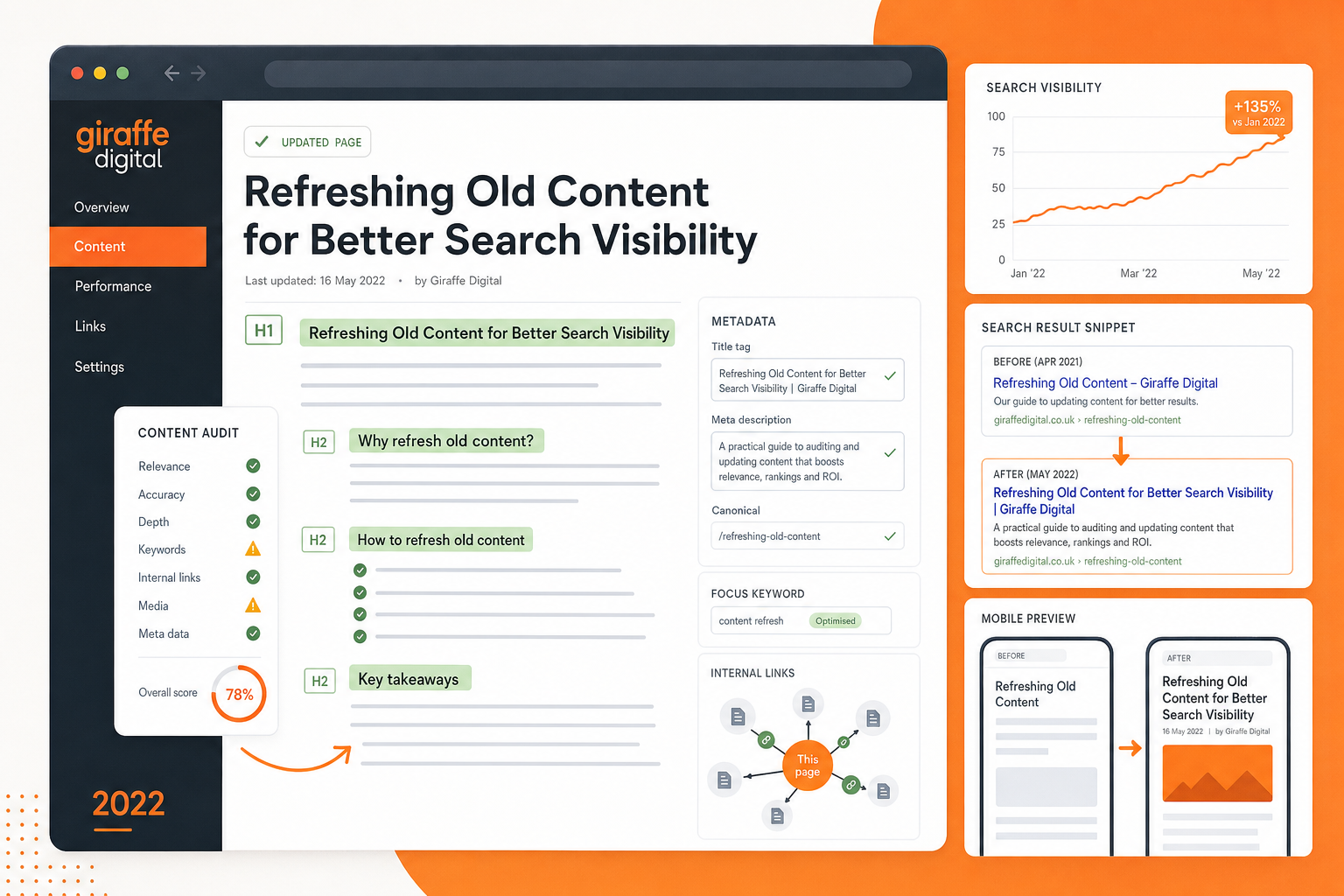
An SEO content refresh is the process of reviewing and improving existing website content so it is more accurate, useful, searchable and aligned with current business goals. It is not simply changing a few words or adding a new date. A worthwhile refresh considers whether the page still satisfies search intent, whether the information is complete, whether the user experience is strong and whether the page gives visitors a clear reason to take the next step.
This might involve updating statistics, adding missing sections, improving headings, rewriting thin copy, replacing outdated screenshots, consolidating overlapping articles or adding clearer calls to action. It may also include technical improvements such as better internal linking, improved page speed, clearer metadata and stronger image optimisation.
The aim is to make each page more useful for people and easier for search engines to understand. Search visibility is rarely won by content volume alone. Quality, relevance and consistency matter, particularly for service-led businesses competing locally, regionally or across the UK.
Why older content loses search visibility
Older content can decline for several reasons. Sometimes a page still ranks but receives fewer clicks because its title or description no longer feels current. In other cases, the content no longer answers the questions people are asking, or a competitor has published a more detailed and better structured resource.
Search behaviour also changes. The terms people use to find website design, branding, SEO or social media support are not fixed. A phrase that brought good traffic two years ago may now have different intent behind it. For example, a business searching for social media marketing support in 2022 may be looking for help with short-form video, Instagram Reels, LinkedIn content or TikTok visibility, not just a monthly posting schedule.
Design expectations change too. If a page looks dated, loads slowly on mobile or makes it hard to find the next step, visitors may leave before engaging. Search engines pay attention to how useful a result appears to be, and a poor on-page experience can make it harder for strong content to achieve its potential.
How to choose which pages to refresh first
A content refresh works best when it is prioritised. Rather than trying to update every page at once, start with the pages most likely to deliver business value.
Good candidates include pages that:
- Previously attracted search traffic but have declined over time.
- Rank on page two or three for valuable search terms and could improve with focused work.
- Receive impressions in Google Search Console but have a low click-through rate.
- Cover services, locations or topics that are commercially important.
- Contain outdated advice, old screenshots, broken links or expired offers.
- Compete with another page on your own site for the same keyword.
- Attract visitors but generate few enquiries, calls or form submissions.
For many businesses, the best starting point is not the oldest article. It is the page with a clear opportunity. A service page ranking just below the first page of Google may be a better refresh candidate than a blog post with little commercial relevance.
Use data before rewriting
Before making changes, gather evidence. Google Search Console can show which search queries are already generating impressions and clicks. Analytics data can show which pages receive traffic, how users arrive and whether they go on to complete valuable actions. If your business is preparing for Google Analytics 4, this is also a good time to review whether your events and conversions are being tracked properly.
Look for patterns. A page may receive impressions for a keyword that is not properly covered in the copy. Another page may rank for a broad topic but fail to convert because it does not explain the service clearly enough. You may find that visitors from social media behave differently from visitors arriving through search, which can help you refine both the page and the way you promote it.
It is also sensible to review competitors, but the goal is not to copy them. Look at the type of content ranking well. Are the best results detailed resources, local service pages, comparison articles, FAQs or product-led pages? The format of the search results can tell you what users expect to find.
Check search intent and update the page structure
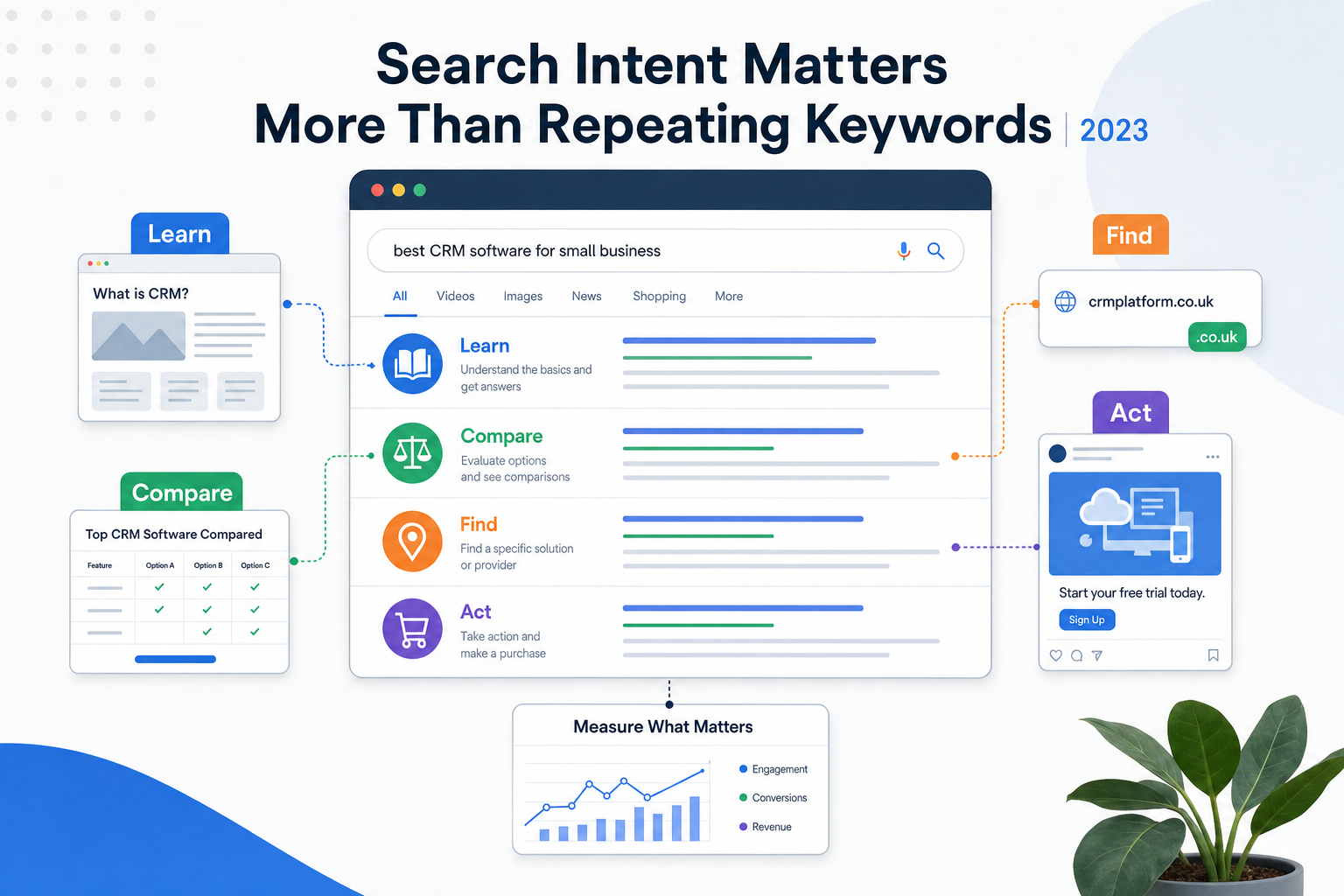
Search intent is the reason behind a search. Someone searching for how to improve website SEO may want step-by-step advice, while someone searching for SEO agency for small business is likely comparing providers. A refreshed page should match the intent behind the primary keyword and related phrases.
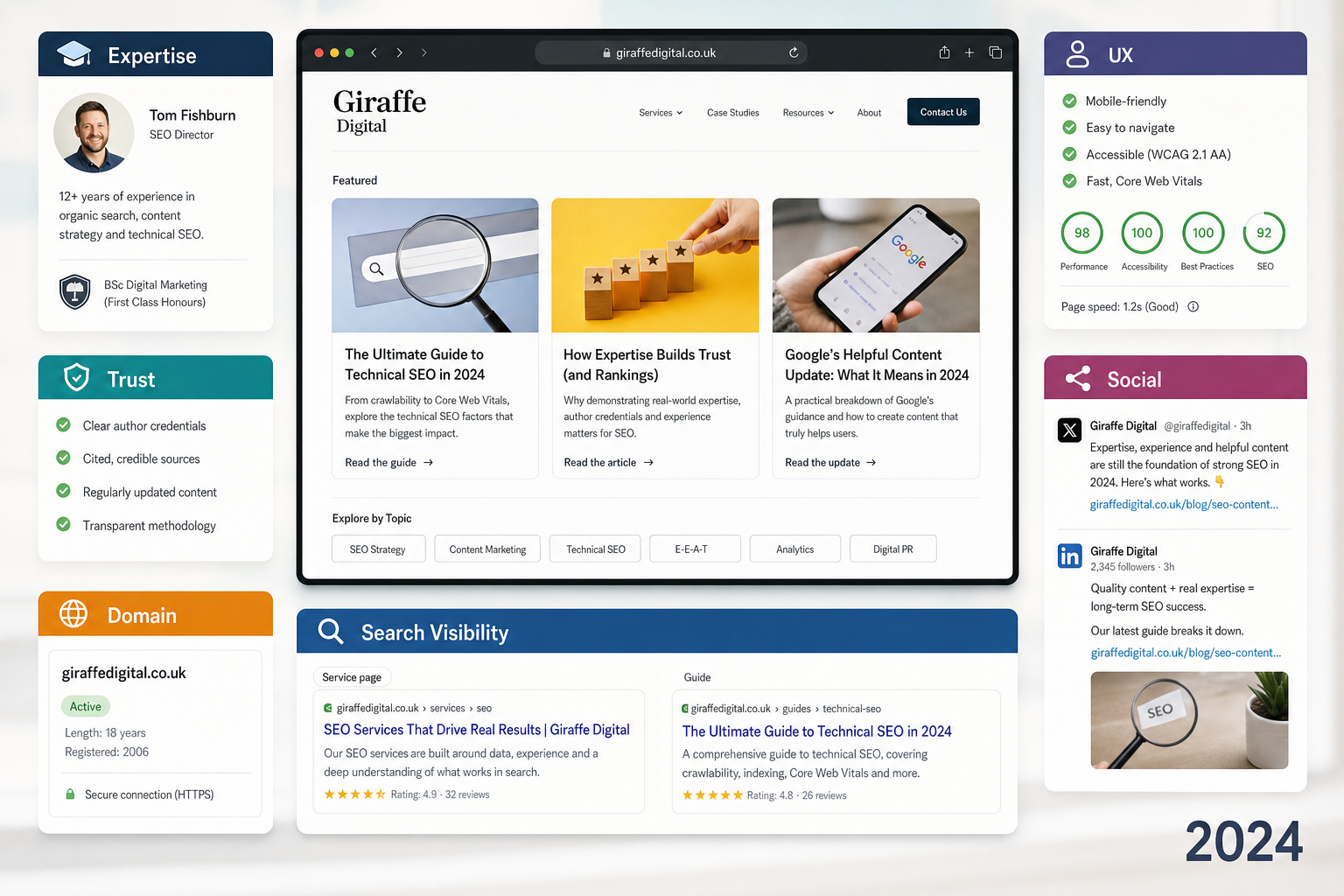
Start by reviewing the page title, introduction and headings. A strong structure helps readers scan the page quickly and helps search engines understand the subject. Use headings to answer real questions and guide visitors through the topic logically.
For example, an older article about website design might be improved by adding sections on mobile responsiveness, accessibility considerations, content management systems, Core Web Vitals and conversion-focused calls to action. A service page about social media marketing might benefit from clearer explanations of strategy, content planning, community management and reporting.
Avoid adding words purely for length. A longer page is only better if the extra content is useful. In 2022, Google continues to reward pages that serve users well, and its focus on helpful, people-first content makes thin or generic copy increasingly risky.
Improve accuracy, freshness and trust
Outdated details can quickly reduce confidence. Check every factual claim, statistic, screenshot, platform reference and process description. If your article mentions a feature on Instagram, LinkedIn, Facebook, Twitter or TikTok, make sure the wording reflects how the platform currently works. If your content explains domain registration, hosting, SSL certificates or email set-up, make sure the advice is accurate and not tied to old practices.
Trust also comes from clarity. Explain who the content is for, what problem it solves and what action the reader should take next. If you are writing for business owners, avoid jargon where plain English would be more helpful. Terms such as metadata, redirects, canonical tags and schema can be useful, but they should be explained when they affect decisions.
Strengthen E-A-T signals where appropriate. This means demonstrating expertise, authority and trustworthiness through accurate information, clear authorship where relevant, helpful references, professional presentation and honest claims. Do not invent results or use vague boasts. A credible page is specific, balanced and easy to verify.
Refresh metadata to improve clicks
Metadata is often overlooked during a content refresh. Your SEO title and meta description influence how a page appears in search results, so they should be clear, relevant and persuasive. If a page receives many impressions but few clicks, metadata may be part of the problem.
A good SEO title should include the main topic naturally and give the searcher a reason to choose your result. A good meta description should summarise the value of the page, reflect the content accurately and avoid overpromising. For a service-led business, it may also help to include the location or audience if that is important.
Do not write the same title and description for every page. Each important page should have a distinct purpose. Duplicate metadata can make your website look less considered and may reduce the relevance of individual pages.
Make the page better for mobile visitors
Most business websites now receive a significant share of visits from mobile devices. A refreshed article or landing page should therefore be reviewed on a phone, not only on a desktop screen. Check that paragraphs are easy to read, buttons are easy to tap, images fit properly and forms are not frustrating.
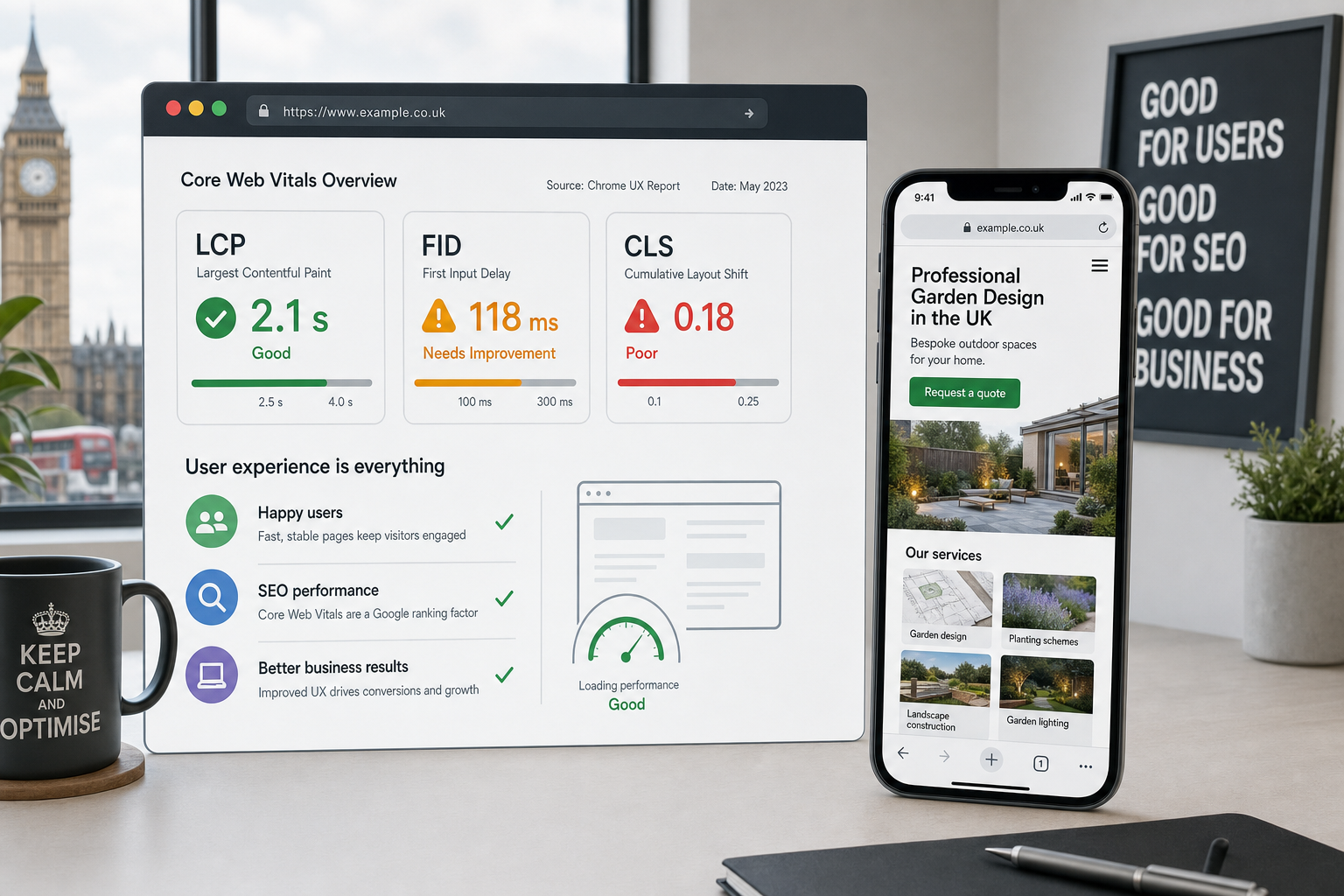
Website design and SEO are closely connected. A page may contain excellent content, but if it loads slowly, shifts around while loading or hides important information behind awkward menus, performance can suffer. Core Web Vitals provide useful indicators of loading, interactivity and visual stability, but they should be viewed alongside common sense. A fast page that fails to explain your service will not convert well, and a detailed page that feels slow or cluttered may lose visitors.
When refreshing a page, consider whether the design still supports the message. Could a comparison table, clearer section layout, better imagery or stronger call to action make the content more effective? Content updates and design improvements often work best together.
Use internal links to support important pages
Internal links help visitors move around your website and help search engines understand which pages are important. During an SEO content refresh, look for opportunities to link from relevant articles to service pages, from service pages to useful resources and from older posts to newer content.
For example, an article about choosing a domain name could link to a website design service page, a branding resource and a page about hosting or ongoing support. A blog post about social media planning could link to a wider digital marketing strategy page. These links should be useful and natural, not forced into every paragraph.
Use descriptive anchor text where possible. Read our website design advice is more helpful than click here. It tells both users and search engines what to expect.
Review domain and brand consistency
Refreshing content is also a good opportunity to check whether your digital presence feels consistent. Your domain name, website copy, page titles, social media profiles and email addresses should all support the same brand identity.
If you are registering a new domain for a campaign, rebrand or additional service, choose a name that is easy to spell, memorable and suitable for long-term use. Check that it does not conflict with existing brands, avoid unnecessary hyphens where possible and consider whether the domain extension suits your audience. For most UK businesses, a UK-focused domain can help reinforce location and trust, while other extensions may be appropriate for broader or specialist projects.
Keep control of your domain registration details, renewal dates and access credentials. Domain ownership is a business asset, so it should not sit in an unmanaged inbox or depend entirely on one individual. Clear administration helps avoid disruption later.
Promote refreshed content through social media and email
Once a page has been improved, do not leave it to search alone. A refreshed article can support your social media marketing, email newsletters and sales conversations. Pull out useful tips for LinkedIn, create a short Instagram carousel, discuss a practical point in a video or share a concise thread on Twitter. The format should suit the platform and your audience.
Social activity can help bring existing customers, prospects and partners back to useful website content. It can also provide signals about which topics resonate. If a refreshed resource receives strong engagement on LinkedIn, for example, it may be worth developing related content or turning the topic into a downloadable resource.
Make sure the page itself is ready before promotion. If a social post sends people to a page with outdated branding, broken forms or weak calls to action, the opportunity may be wasted.
Measure the impact of your refresh
After updating a page, give search engines time to recrawl and reassess it. Some changes may show movement quickly, while others take longer. Track relevant measures such as impressions, average position, click-through rate, organic sessions, enquiries, phone clicks, form submissions and assisted conversions.
Compare performance before and after the refresh, but avoid judging success by rankings alone. A page that attracts slightly less traffic but generates more qualified enquiries may be more valuable than one that brings in broad, low-intent visitors. Business outcomes matter.
Keep a simple record of what changed and when. Note updates to headings, copy, metadata, internal links, images, calls to action and technical elements. This makes it easier to understand what influenced performance and prevents the same work from being repeated unnecessarily.
How often should content be refreshed
There is no single schedule that suits every website. Fast-moving topics such as social media platforms, search marketing tactics and technology guidance may need reviewing several times a year. Core service pages, location pages and evergreen resources might be reviewed every six to twelve months, depending on their importance.
A sensible approach is to build content refresh work into your ongoing digital marketing programme. Set aside time each month to review performance, update priority pages and identify new opportunities. This is more manageable than waiting until the whole website feels out of date.
For a new website design project, content refresh work should begin before the build is complete. Migrating old, weak or duplicated pages into a new design can limit the impact of the investment. A redesign is a chance to improve structure, messaging and search relevance at the same time.
A useful checklist for your next refresh
Use this checklist when reviewing an important page:
- Confirm that the page has a clear purpose and target audience.
- Check current search queries, impressions, clicks and conversions.
- Review whether the primary keyword and related terms still match search intent.
- Update outdated facts, examples, screenshots and platform references.
- Improve headings so the page is easy to scan.
- Add genuinely useful information where the page is thin or incomplete.
- Remove duplicated, vague or off-topic copy.
- Refresh the SEO title and meta description.
- Check images, alt text, file sizes and mobile display.
- Add relevant internal links to and from the page.
- Test forms, buttons, phone links and calls to action.
- Measure results after publication and record the changes made.
Turning existing content into a stronger asset
An SEO content refresh is one of the most practical ways to improve the value of your website. It helps keep your information accurate, supports better search visibility and gives visitors a clearer reason to trust your business. It can also strengthen the wider digital marketing mix by providing better destinations for social media, email campaigns and paid activity.
For UK businesses investing in website design, branding, SEO or digital strategy, refreshing existing content should not be treated as an afterthought. Your website is often the central point of your online presence. Keeping it useful, current and commercially focused helps it work harder for your organisation and for the people searching for what you offer.