A well-designed website should do more than look professional. It should help people understand your offer, trust your business and take the next sensible step, whether that means making an enquiry, booking a consultation, buying a product or joining a mailing list. That is where conversion focused design becomes valuable. It brings together clear messaging, fast-loading pages, simple navigation, mobile-friendly layouts and well-placed calls to action so that your website supports real business goals.
For UK business owners, this matters because online visitors are often comparing several options at once. They may arrive from Google, a social media post, an email campaign or a referral. If your website is slow, cluttered or difficult to use on a phone, potential customers can leave before they have properly considered your products or services. Faster websites and cleaner design are not just technical improvements; they are practical ways to reduce friction and improve the likelihood of a conversion.
Why speed has become a conversion issue
Website speed affects how people feel about your business. A visitor who has to wait too long for a page to load may assume the rest of the experience will be equally frustrating. This is especially important on mobile, where people may be using a weaker connection, browsing between appointments or looking for quick answers while comparing local suppliers.
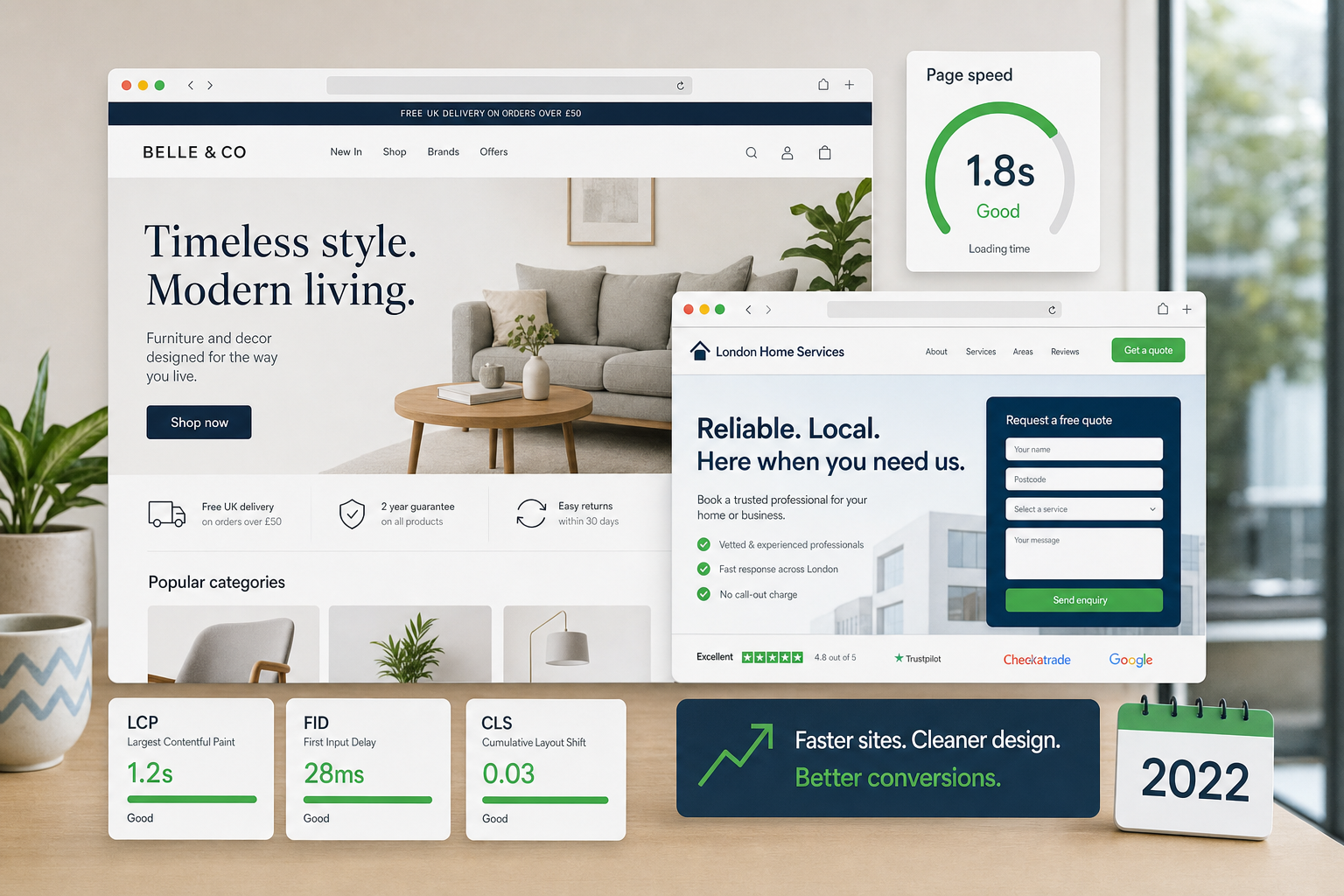
Speed also has a role in search marketing. By June 2022, Google’s Core Web Vitals were well established as part of the wider page experience signals. These include Largest Contentful Paint, which relates to loading performance; First Input Delay, which relates to interactivity; and Cumulative Layout Shift, which relates to visual stability. They are not the only factors in SEO, and strong content remains essential, but they encourage website owners to take ususer experienceeriously.
For conversion focused design, the important point is not to chase scores for their own sake. The aim is to make key pages feel quick, stable and easy to use. If your homepage, service pages, product pages or contact page are slow to respond, visitors may not get as far as the enquiry form or checkout. If buttons shift as the page loads, users can tap the wrong area and lose confidence. These small moments can have a direct effect on leads and sales.
Cleaner design helps people make decisions
Clean design does not mean plain, empty or characterless. It means making deliberate decisions about what appears on each page and why. A well-structured page guides attention. It gives visitors enough information to act without overwhelming them with unnecessary banners, competing buttons, large blocks of text or confusing navigation.
A business website should quickly answer a few important questions: what do you offer, who is it for, why should someone trust you, and what should they do next? If those answers are hidden behind vague headings or crowded layouts, the design is working against the business. Cleaner design improves clarity, which improves confidence.
For example, a professional services firm may be tempted to put every available service on the homepage. A conversion focused approach would usually lead with a clear value proposition, link to the main service areas, show credibility through testimonials or accreditations where appropriate, and provide a visible enquiry route. An e-commerce business may focus on product photography, concise benefit-led copy, clear delivery information and a straightforward checkout path.
Whitespace, contrast, readable typography and consistent button styling all help people process information. These elements may sound visual, but they have commercial value. If visitors can scan a page comfortably, understand the offer and see the next step, they are more likely to continue.
Designing around the customer journey
Good website design starts with the user’s journey rather than the organisation’s internal structure. A visitor arriving from a search result may want a detailed answer to a specific problem. A visitor arriving from social media may need more context before they trust the brand. Someone who already knows your business may simply need a quick route to contact details, booking options or a product category.
Conversion focused design maps these different journeys and removes unnecessary barriers. This may include improving navigation labels, adding clear internal links, placing calls to action after persuasive information, and making forms easier to complete. It can also mean reducing the number of choices on a page. Too many competing actions can create hesitation, especially when a visitor is using a mobile device.
Calls to action should be specific and relevant. A button that says Request a consultation, Get a quote or View the range is usually more helpful than a vague instruction. The page should also support the action with appropriate reassurance. This could include delivery details, opening hours, response expectations, professional qualifications, case study summaries or answers to common questions.
Practical ways to improve website speed in 2022
Many speed improvements are practical and achievable without changing the whole website. The right priorities depend on the platform, hosting environment and how the site has been built, but common areas are easy to identify.
- Compress and resize images: Large, unoptimised images are one of the most common causes of slow pages. Use appropriately sized images for their display area and consider modern formats where they are well supported.
- Review plugins and third-party scripts: Websites often become slower as more tracking tags, chat widgets, booking tools and plugins are added. Keep what is genuinely useful and remove what is not supporting the user or the business.
- Use reliable hosting: A well-built website can still perform poorly on weak hosting. Choose hosting that suits the size and purpose of the site, with sensible support and security measures.
- Enable caching where appropriate: Caching can help pages load faster for returning visitors and reduce server work. This is particularly useful for content-led websites and many brochure sites.
- Minimise unnecessary code: Bloated themes, unused styles and excessive JavaScript can slow down the experience. A leaner front end often supports both performance and maintainability.
- Test important pages: Tools such as PageSpeed Insights, Lighthouse and Search Console can help identify issues, but real user experience should remain the main consideration.
Speed work should be prioritised around the pages that matter most commercially. A service landing page receiving paid search traffic, a popular product category, a campaign landing page or a contact page may deserve attention before a low-traffic archive page.
How cleaner design supports SEO and social media marketing
SEO and design should not be treated as separate disciplines. Search visibility can bring visitors to a website, but design influences whether those visitors stay, engage and convert. A page that ranks well but fails to answer the visitor’s question will not deliver its full value.
For search marketing in 2022, useful content, sensible page structure, clear headings, internal linking and technical accessibility all remain important. Cleaner design helps by making content easier to read and navigate. It can improve engagement, reduce confusion and make it easier for search engines to understand the purpose of key pages.
Social media marketing also benefits from conversion focused design. A campaign on Facebook, Instagram, LinkedIn or another platform can generate interest, but the landing page must continue the same message. If an advert promotes a specific service, the landing page should not send users to a generic homepage and make them hunt for the relevant information. Match the headline, imagery and call to action so the journey feels joined up.
This is particularly important for seasonal campaigns, recruitment activity, product launches and local promotions. Social media can create attention quickly, but attention is fragile. A focused landing page with fast loading, clear benefits and a simple enquiry or purchase route gives that attention somewhere useful to go.
Domain names, trust and brand consistency
Your domain name is often one of the first brand assets a customer sees. It appears in search results, email addresses, adverts, social profiles and printed materials. A clear, memorable domain supports trust and makes it easier for people to return to your website later.
When choosing or reviewing a domain, keep it simple and relevant to the business. Avoid spellings that are difficult to explain, excessive hyphens or words that can be easily confused. If your business is UK-focused, consider whether a UK domain extension, an international extension or both fit your plans. The right choice depends on your market, brand and growth ambitions.
It is also sensible to keep domain registration details organised. Use a secure account, maintain access to the registered email address, enable renewal reminders and keep records of who manages the domain. Losing track of a domain can create avoidable disruption, particularly if it is connected to the website, email and marketing campaigns.
Domain decisions also affect brand consistency. Your website address, business email, social media handles and printed materials should feel connected. If a visitor sees one name on social media and a noticeably different website address, it can create unnecessary doubt. Consistency makes the business easier to recognise and easier to trust.
Conversion focused design for different types of business
The principles are consistent, but the execution varies by business model. A local trades business may need prominent phone numbers, service area information, trust signals, before-and-after images and a quick quote form. A consultancy may need clear service positioning, thought leadership, credibility markers and a low-pressure enquiry route. An online retailer may need strong product filtering, clear stock and delivery information, reviews and a checkout that feels secure.
A charity, membership organisation or community group may focus on donations, sign-ups, event bookings or volunteer enquiries. Here, design should explain the mission clearly and reduce hesitation around the action. The page must make the next step feel worthwhile and simple.
In each case, the website should be built around the action that matters most. Not every page needs to sell immediately, but every page should have a purpose. Some pages educate. Some build trust. Some capture demand. Some support existing customers. Conversion focused design connects these roles into a coherent journey.
Measuring what matters
Improving design and speed should be supported by measurement. Website analytics can show where traffic comes from, which pages attract attention and where users leave. Enquiry tracking, form submissions, phone call tracking and e-commerce data can help link design decisions to business outcomes.
It is worth reviewing both quantitative and qualitative evidence. Analytics may show that a page has a high exit rate, but user feedback or enquiry patterns may explain why. Perhaps the page lacks pricing guidance, delivery information, service details or proof of expertise. Perhaps the call to action appears too late, or the form asks for more information than people are ready to provide.
Testing does not always require complex experimentation. Small improvements, made carefully and reviewed over time, can be valuable. You might simplify a form, rewrite a headline, improve a page introduction, reduce image weight or make a key button more visible. The important thing is to connect changes to a clear objective rather than redesigning based only on preference.
Building a website that feels easier to use
Visitors rarely describe a good website in technical terms. They simply feel that it is easy to use. They can find what they need, pages load without fuss, the design feels credible and the next step is obvious. That feeling is the result of many considered decisions across design, content, technology and marketing.
For UK business owners planning a new website or reviewing an existing one, the priority should be practical business value. A faster site can reduce lost visits. A cleaner layout can improve understanding. Better calls to action can increase enquiries. Stronger brand consistency can build trust. Joined-up SEO and social media landing pages can make campaigns more effective.
Conversion focused design is not about forcing users into an action. It is about making the right action easier when the visitor is ready. By combining speed, clarity and purposeful design, your website can become a more reliable part of your sales and marketing activity.