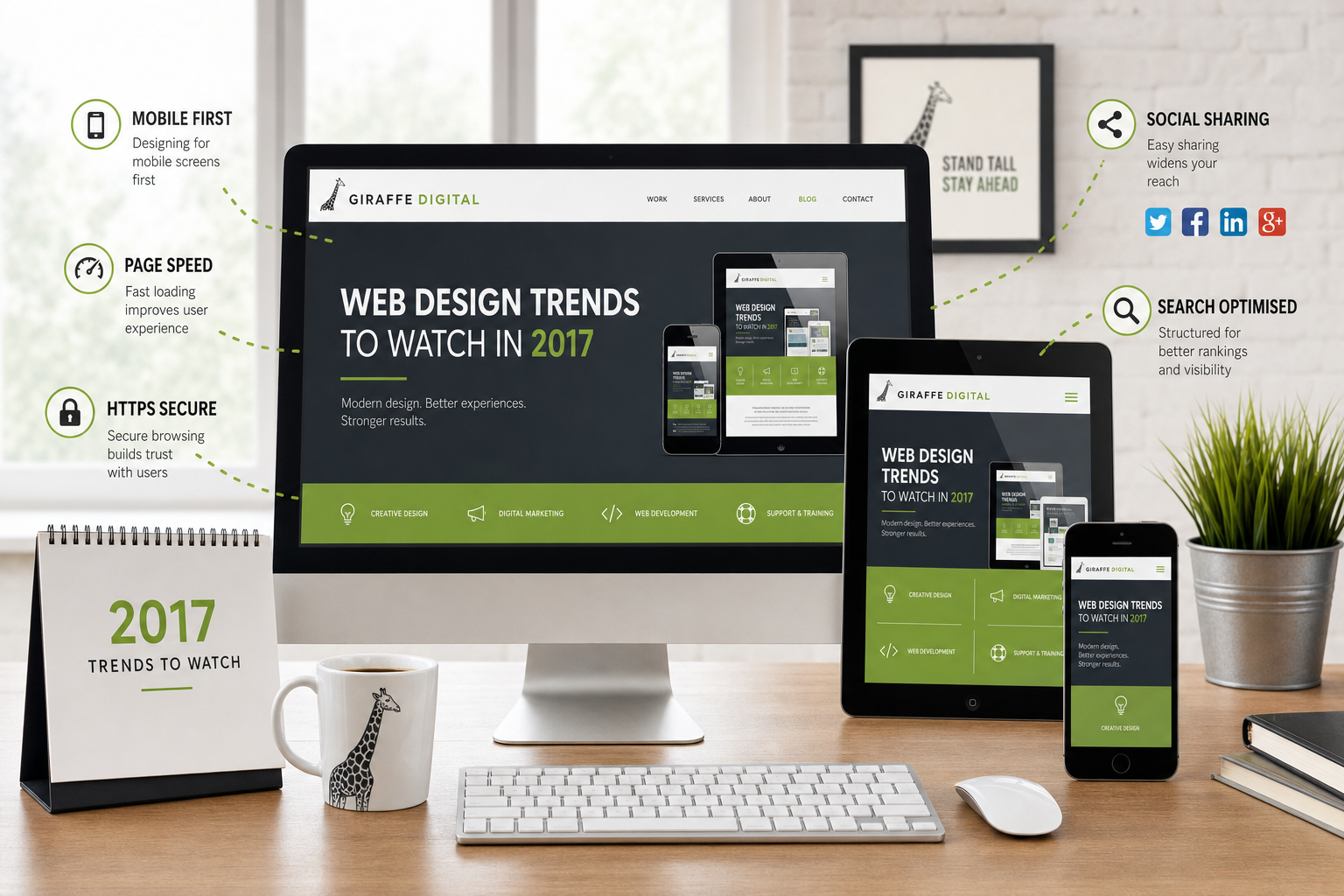
Planning a new website or refreshing an existing one in 2017 is not just a design exercise. For UK business owners, a well-planned website needs to support search visibility, brand trust, social media marketing, lead generation and the day-to-day expectations of increasingly mobile customers. The strongest web design trends to watch in 2017 are not about chasing novelty for its own sake; they are about making websites faster, clearer, more useful and easier to act upon.
Over the past few years, business websites have moved from static online brochures to central hubs for digital marketing. Customers may first discover your organisation through a search result, a shared post on Facebook, a Twitter conversation, a local listing or a recommendation viewed on a smartphone. By the time they arrive on your website, they expect answers quickly. They also expect the experience to feel professional, secure and consistent with the impression they have already formed elsewhere online.
The following trends are worth watching because they connect design decisions with commercial outcomes. Whether you are reviewing your current site, choosing a domain, planning content or preparing a wider digital strategy, these areas can help you make better decisions for the year ahead.
Mobile-first design becomes a business priority
Responsive web design has been important for some time, but in 2017 it should be treated as a foundation rather than an optional extra. More customers are browsing, researching and comparing businesses on mobile devices. This is especially important for local service providers, retailers, hospitality businesses and organisations that rely on enquiries made during commuting, lunch breaks or evenings.
A mobile-first approach means thinking about the smallest screen first. Rather than designing a large desktop site and squeezing it down, the structure begins with the essential actions a mobile visitor needs to take. Can they understand what you do within a few seconds? Can they tap to call? Can they find your opening hours, location, services or enquiry form without pinching and zooming?
For business owners, the value is straightforward. A mobile-friendly site can reduce frustration, improve engagement and make it easier for potential customers to contact you. Search engines are also placing increasing importance on mobile usability, with Google already making mobile performance a clear consideration for site owners. If your site is difficult to use on a phone, you risk losing both visitors and visibility.
Speed, simplicity and performance-led design
One of the most practical web design trends to watch in 2017 is the move towards faster, leaner websites. Large image files, unnecessary scripts, bloated templates and overcomplicated features can make a website feel slow, particularly on mobile connections. A visually impressive website is of little value if visitors abandon it before it finishes loading.
Performance-led design does not mean plain or uninspiring design. It means choosing visual elements carefully and making sure each one has a purpose. Compressed images, well-structured code, sensible hosting, browser caching and streamlined page layouts can all make a noticeable difference. For many businesses, improving speed can also help improve conversion rates because visitors are able to move from interest to action with fewer barriers.
When planning a redesign, it is worth asking what each feature contributes. A large carousel, for example, may look appealing in a design presentation, but if it slows the page and hides the most important message, it may not be the best choice. Clear service summaries, prominent calls to action and fast-loading images often create a stronger result than unnecessary visual complexity.
Clearer user journeys and stronger calls to action
Good website design in 2017 should guide visitors towards a useful next step. Many business websites still present information without making it clear what a visitor should do after reading it. A potential customer may like what they see but leave because the route to an enquiry, booking, purchase or phone call is not obvious.
User journey planning starts by understanding the different reasons people visit your website. A new prospect may need reassurance and service information. An existing customer may need support details. A local visitor may simply want your address or phone number. A journalist, supplier or potential employee may need company information. Each audience should be able to find the most relevant route quickly.
Calls to action should be specific and placed where they are naturally useful. Instead of relying on a single contact link in the main navigation, consider prompts such as Request a consultation, Ask for a quote, Book a table, Download the guide or Call our team. The wording should match the customer’s stage of decision-making. A visitor reading an introductory article may not be ready to buy, but they may be ready to download a checklist or make an initial enquiry.
Content that supports search and builds trust
Content remains central to effective digital marketing. In 2017, the best business websites will not rely on thin service pages or keyword stuffing. Search engines have become better at understanding relevance, quality and user intent. Visitors have also become more selective about which organisations they trust.
For UK businesses, this means website content should be genuinely useful, clearly structured and written in the language customers use. Service pages should explain what you offer, who it is for, where you operate and what makes your approach credible. Blog posts, guides, FAQs and case study-style content can help answer common questions while supporting long-tail search visibility.
The primary aim should be to help people make informed decisions. If you are a professional services firm, this might include guidance on choosing the right service. If you are a retailer, it might include product care advice or buying guidance. If you are a local trade business, it might include maintenance tips or explanations of common problems. Useful content can also provide material for email newsletters and social media updates, making the website a central part of your wider marketing activity.
Authentic imagery and distinctive brand presentation
Stock imagery has its place, but many business websites have become visually interchangeable. In 2017, more organisations are likely to invest in photography, illustration and design systems that better represent their actual brand. Visitors can often sense when a website is relying on generic images that say little about the company behind it.
Authentic imagery can include photographs of your premises, products, team, working process or location. For service-based businesses, it can also mean using carefully designed icons, diagrams or illustrations to explain what you do. The goal is not to fill every page with images, but to create a visual identity that feels credible and memorable.
Typography, colour and spacing also play an important role. A clean design with consistent fonts, strong contrast and generous spacing can feel more professional than a crowded layout full of competing messages. Branding should support clarity. If a visitor remembers your name, understands your offer and feels confident enough to take the next step, the design is doing its job.
Video, animation and movement with a purpose
Video continues to grow as a useful marketing format, particularly when it explains something more quickly than text alone. Short introductory videos, product demonstrations, behind-the-scenes clips and customer guidance can all support a website when used thoughtfully. Social media platforms have also made video more familiar to everyday users, which means website visitors are increasingly comfortable with it.
However, video and animation should be used with care. Autoplaying video with sound, heavy background footage and distracting movement can harm the user experience. They may also slow down pages, especially on mobile devices. A better approach is to use short, relevant video content where it supports understanding or confidence.
Subtle animation can help draw attention to important features or make an interface feel more responsive. For example, a form field might clearly show when it has been completed correctly, or a menu might open smoothly on mobile. These details should improve usability rather than simply decorate the page.
Security, trust signals and professional credibility
Trust is a design issue as well as a technical issue. Visitors need to feel safe when browsing your website, particularly if they are submitting personal details, making a booking or buying online. In 2017, more business owners should consider secure connections, clear privacy information, professional contact details and visible credibility signals as part of their web strategy.
Using HTTPS is becoming increasingly important, especially for websites that include forms, logins or e-commerce features. Security also affects perception. A site that looks outdated, lacks clear ownership information or contains broken pages can make potential customers hesitate. By contrast, a professional design with accurate contact details, testimonials where appropriate, clear policies and well-maintained content can strengthen confidence.
Trust signals should be genuine and relevant. Memberships, accreditations, awards, reviews and guarantees can all help, but only if they are presented honestly and kept up to date. Avoid cluttering pages with badges that do not matter to your audience. The best credibility features answer the visitor’s unspoken question: why should I choose this business?
Social media integration that supports the website
Social media marketing should complement your website rather than replace it. Platforms such as Facebook, Twitter, LinkedIn, Instagram and Pinterest can help businesses reach audiences, build awareness and distribute content. However, your website remains the place where you control the message, structure the customer journey and capture enquiries more reliably.
In 2017, effective social integration means more than placing a few icons in the footer. It involves making content easy to share, using campaign landing pages, matching social posts with relevant website pages and ensuring that brand presentation is consistent. If a user clicks from a Facebook post about a specific service, they should arrive on a page that continues that same message, not a generic homepage that forces them to search again.
Social proof can also help, but it should be used carefully. Testimonials, reviews and embedded social content may support credibility when they are relevant and well presented. The key is to avoid turning the website into a noisy collection of feeds. Social media should lead people towards useful action, not distract them from it.
Domain names, structure and long-term digital assets
Your domain name remains one of the most important digital assets your business owns. When choosing a domain in 2017, aim for something clear, memorable and appropriate for your audience. For many UK businesses, a domain that reflects the brand name is usually stronger than one overloaded with keywords.
Shorter names are often easier to remember, type and share verbally. Avoid unnecessary hyphens, confusing spellings and wording that may limit future growth. If your organisation operates mainly in the UK, consider whether a UK-focused domain extension supports customer trust and local relevance. If you have ambitions beyond the UK, think carefully about how your domain choice may work internationally.
It is also sensible to keep domain ownership details organised internally. Make sure renewal dates, access details and administrative contacts are properly recorded by the business. A domain should not be left under the sole control of an individual employee, freelancer or temporary supplier. Losing access to a domain can create serious disruption for email, search visibility and brand reputation.
Search marketing and design working together
Design and search marketing are sometimes treated as separate disciplines, but they are closely connected. A visually appealing website still needs crawlable pages, sensible navigation, descriptive headings, useful copy and well-structured URLs. If search engines and users cannot understand the site, the design is not working hard enough.
In 2017, business owners should pay particular attention to local search, content quality and technical foundations. Local businesses should ensure that names, addresses and phone numbers are consistent across the website and wider web. Service areas should be explained clearly, without creating low-quality duplicate pages. Blog content should answer real questions rather than exist purely to target keywords.
Recent search developments have continued to reward relevance and discourage manipulative link practices. A sustainable approach is to create a site worth recommending, publish content worth sharing and earn mentions through genuine relationships, PR, community activity and useful resources. Search visibility is rarely built by design alone, but design can make good content easier to find, read and act upon.
Practical steps for planning a 2017 website project
If you are considering a redesign, begin with business objectives rather than visual preferences. What should the website achieve over the next year? More enquiries, better quality leads, stronger recruitment, online sales, improved local visibility or clearer communication with existing customers? Each objective may require a different structure, content plan and measurement approach.
Before commissioning design work, review your current analytics, search performance, enquiry sources and customer feedback. Identify which pages already perform well and which cause confusion. Speak to staff who answer customer questions, as they often know what visitors fail to find online. This preparation can make the design process more focused and reduce the risk of rebuilding the same problems in a new format.
A useful website brief should include your audiences, services, brand positioning, competitors, content requirements, technical needs and marketing goals. It should also consider how the site will be maintained after launch. A modern website needs ongoing attention, from publishing fresh content to updating software, reviewing forms and improving pages based on performance data.
Final thoughts on web design trends to watch in 2017
The most valuable web design trends to watch in 2017 are not passing fashions. They reflect a broader shift towards websites that are mobile-friendly, fast, trustworthy, content-rich and closely connected to digital marketing activity. For UK businesses, the opportunity is to create websites that do more than look current. A strong website should support brand reputation, search visibility, social engagement and customer action.
As you plan for 2017, focus on the fundamentals first: clear messaging, responsive layouts, fast performance, useful content, secure browsing and a simple route to enquiry. Once those foundations are in place, visual creativity, video, animation and social integration can add real value. The businesses that benefit most will be those that treat their website as a long-term digital asset rather than a one-off design project.